
Introduction
This chapter will be our first in depth look at one of the numerous sub-factions of the Warhammer 40k franchise. With subfaction I am referring to a specific organization, culture or species that has a meaningful impact on the narrative, but is part of a greater faction, such as the IoM. This chapter will, as mentioned in previous chapter, be focused on the religious order/scientific institution by the name of Adeptus Mechanicus. In this, as well as similar future chapters, we will discuss the factions codex (see part 1) as well as some supplementary materials. We will do this to get a base understanding of how this faction is presented, and what part they play in the narrative as a whole. We will later contrast and complicate this image by comparing them with real life ideologies, historical events and organisations and institutions. In doing so we will be creating a more complex and intriguing view of the franchise as a whole.
First and foremost, this will not be an exhaustive explanation of all the lore surrounding each faction. as This would be too much of a time and space consuming process. I will simply present enough context to make my arguments in a precise and understandable manner, even for newcomers to the franchise. Links to further reading will be provided at the end of the text.
Aesthetics
Arguably one of the most iconic images of the Adeptus Mechanicus is that of the “tech priests” and “magus”. The hooded individuals in long red robes, enveloped in machinery and religious artefacts.

Source: http://warhammer40k.wikia.com/wiki/Tech-priest?file=Techpriest2.jpg
Here we can clearly see a mix of the technological and the arcane that we discussed last chapter. This individual is completely engulfed in machines, wires and cybernetics, yet wears a robe and incense that makes us think of a catholic monk. We can also clearly see Games Workshop’s love for including skulls in their designs This is a theme that continues in the emblems of the Adeptus Mechanicus.
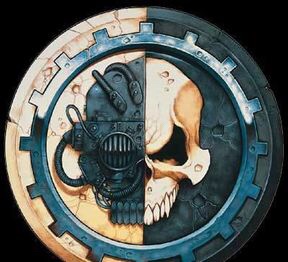
Source: http://warhammer40k.wikia.com/wiki/Adeptus_Mechanicus?file=Adeptus_mecanics.jpg
Here we see a heavily stylised human skull next to a mechanically reconstructed version of the same skull. Note that this skull is a recurring design within Games workshops visual aesthetics.
In universe history
The history of the Adeptus Mechanicus arches back to the colonisation of present day Mars. These colonies, with time, developed completely differently than the nations of Earth. Science and technology was highest regard, and with time became the basis for their art, culture and religion. Binary code and technical instructions was made in to poetry and prayers. Vital mechanical functions were fashioned to be provocative art, and simple activation routines were styled into rituals and prayers. (Sanders, R. 2016)
With time, and a series of crises, (which I will go into later) these texts and rituals eventually lose their context and meaning, but not their function. What was once written as a celebration of science, ingenuity and art becomes strict dogma and scripture, to be followed without questions. These arcane rituals are the only things that stand between humanity and complete and utter loss of their advanced technologies. (Sanders, R. 2016)
Structure and beliefs
The structure of the Adeptus Mechanicus is one of traditions and strict hierarchies. With the initiates at the bottom and the Mages at the top. The Magus have sole access to the most sacred and arcane knowledge.
The official religion of the Adeptus Mechanicus is named Cult Mechanicus. This religion is based on the previously mentioned rites and prayers, as well as a set of tenets and warnings displayed below:
The Mysteries
- 01. Life is directed motion.
- 02. The spirit is the spark of life.
- 03. Sentience is the ability to learn the value of knowledge.
- 04. Intellect is the understanding of knowledge.
- 05. Sentience is the basest form of Intellect.
- 06. Understanding is the True Path to Comprehension.
- 07. Comprehension is the key to all things.
- •08. The Omnissiah knows all, comprehends all.
The Warnings
- 09. The alien mechanism is a perversion of the True Path.
- 10. The soul is the conscience of sentience.
- 11. A soul can be bestowed only by the Omnissiah.
- 12. The Soulless sentience (i.e. the Necrons) is the enemy of all life.
- 13. The knowledge of the ancients stands beyond question.
- 14. The Machine Spirit guards the knowledge of the Ancients.
- 15. Flesh is fallible, but ritual honours the Machine Spirit.
- 16. To break with ritual is to break with faith.
Omnissiah
The being of Omnissiah, or the Machine spirit, is said by the Mechanicus to be the primary motivating force in the universe, especially within mechanical constructs. Each machine is said to have a will and spirit of its own. When a machine breaks down or fails to function it can be attributed to an angry or otherwise upset machine spirit. To appease the machine spirit, certain rites of repair, maintenance and prayer must be conducted. Rites must also be conducted to properly start, control and shut down any machine. The more ancient or complex the machine, the more complex and time consuming the rites needed to properly operate and maintain a certain machine. A simple rifle might just need a prayer of thanks and some sacred oils to function, while the great war machines called Titans, might need days or weeks to properly prepare. The supposed existence of the machine spirit is also why Artificial Intelligence (known as Abominable Intelligence by the Mechanicus), is seen as such a crime against the machine spirit, as this intelligence removes agency and freedom from said machine spirit.
At first glance it is easy to interpret these rites simply as misunderstood maintenance and repair routines, and that is defensibly a valid read. Here I will introduce one of the more interesting concepts of the 40k narrative. There exist two interlinked dimensions in the universe of Warhammer 40k. First of all there is the physical plain of the Materium, or the world of matter. Secondly is the Immaterium or the Warp, this dimension is a world of raw and pure emotions, reflecting the wishes, fears and feelings of every living creature in the Materium. If a group of individuals believes in something enough, it will manifest within the Immaterium and become real. For example, the citizens of the Imperium believe their Emperor to be a god, so he becomes one in the Immaterium. As a result it is possible to argue that even though these rites started as purely practical, the Mechanicus has enough faith to conjure their Machine god into existence. (Sanders, R. 2016)
The individual
These tenets outlines a faith of furthering the individuals personal growth of understanding, but also outlines a strict guidelines and paths to thread in order to learn this knowledge. Many avenues of research is completely outlawed, particularly alien machines, and as mentioned in earlier chapter, any form of artificial intelligent. The name Cult Mechanicus further paints the Mechanicus in the realm of mysticism. The status of cult is further cemented by the comparison to the Ecclesiarchy, that is presented as the official faith of the Imperium of mankind. The Ecclesiarchy will be the subject of a future text, but for now al we need to know that its a quite heavily exaggerated version of the catholic church.The Mysteries and the Warnings outline a doctrine designed to furthering the individual’s personal growth of understanding, but also outlines strict guidelines and paths to thread in order to learn this knowledge. Many avenues of research are completely outlawed, particularly alien machines, and as mentioned in earlier chapters, any form of artificial intelligence. The name Cult Mechanicus further paints the Mechanicus in the realm of mysticism. The status of cult is further cemented by the comparison to the Ecclesiarchy, which is presented as the official faith of the Imperium of mankind. The Ecclesiarchy will be the subject of a future text, but for now all we need to know is that it’s a quite heavily exaggerated version of the catholic church.
Progress vs history
The Mechanicus are guardians, distributors and producers of all of humanities more advanced technologies. These technological wonders are scarcely understood are exclusivity from humanities glorious past. Any and al innovation is me. The Mechanicus are guardians, distributors and producers of all of humanity’s more advanced technologies. These technological wonders are scarcely understood, and present relics from humanity’s glorious past. Any and all innovation is met with extreme suspicion, both from the Adeptus Mechanicus, and the general Imperium. To innovate is to question the masters and the Mechanicus itself, as a result any form of innovation is strictly forbidden. The goal of the Mechanicus is in other words, not to lead humanity into a new age of prosperity, but rather to fight to preserve what can be saved from humanity’s golden past. (Sanders, R. 2016)
Here it is interesting to mention two terms used universally within the 40k narrative. These terms being miasma and alchemy. Both of these terms were at one point seen as the height of science, but have later been replaced by other terms and concepts as science evolved. In the place of miasma (the theory that illness was caused by “bad air”) was replaced with germ theory, and in place of alchemy we have the study of chemistry.
As we can see from the mysteries and warnings, knowledge and understanding are set in highest regards. Yet to go against previous knowledge is the highest form of taboo. The focus lay on traditions and honouring the old ways, rituals and old truths are beyond question. (Sanders, R. 2016)
Traditions vs innovation
The Mechanicus, like any cult, follows a strict series of rules and traditions to the point that they lose their original meaning. Everything from production of new tanks to the maintenance of a simple rifle is seen as a sacred duty that must be done following proper rites and rituals. These rites have taken the place of any meaningful scientific research and discovery in the IoM.
The Mechanicus might seem extremely conservative and needlessly complicated, but as is with most things in the IThe Mechanicus might seem extremely conservative and needlessly complicated, but as is with most things in the Imperium of mankind, this is for a reason. The universe is full of old alien or human technological wonders that are unimaginably dangerous. Not to mention the numerous agents of the mirror dimension known as the warp, and the dark gods that rule there (see chapter “the Immaterium”). Many reckless adventures have been undone when they stumbled upon a secret of the universe that would have been best left undiscovered. Considering the fragmented and often contradictory knowledge the Mechanicus has about the things they study, it’s understandable that a more caucus and calculated approach was adopted.
Data vs knowledge
Other than technology, the Mechanicus collects data, about anything, big or small. Any reading is important, and they are all fed into a great central computer, that will one say reveal the Truth. Data is in other words not a means to an end, but the end itself. The members of the Mechanicus use data as a currency amongst themselves. One interesting definition of knowledge to keep in mind is the following.
Data is to be seen as raw numbers, figures, readings etc, a description of the real world but void of any context or further meaning. Information is data organized, and put in a further context to be able to constructively use said data. The last part that I will use is the term knowledge. Knowledge is the same information internalised within a person, and absorbed with other pieces of information previously internalised by the individual to make up what an individual knows. Not for the Mechanicus, who see data as the purest form of knowledge and tirelessly strive to collect as much as possible.
The Dark Mechanicus
The Dark Mechanicus is the first example of the “dark and corrupted” version of a IoM faction we encounter. This corruption occurs when the individual in question willingly or unwillingly gets in contact with the mirror world known as The Warp. In the case of the Dark Mechanicus does this corruption manifest in innovation, creativity and mixing of sciences. These heretics dares to go against many of the warnings, chiefly exploring alien technology as well as improving on or even disregarding the knowledge of the ancient masters of Mars. (Sanders, R. 2016)
Conclusion
The Adeptus Mechanicus is a good example of what happens when rituals and traditions lose context and meaning. The traditions themselves become deified and become beyond question. We can also see how these misunderstandings and dogmatism are made true, through the power and influence of the Immaterium.
Here we also see the first dynamic of loyalist vs heretics and how Warhammer 40k toys with what ideals are assigned to protagonists and antagonists. Here the loyalist and “good” Mechanicus is dedicated to dogmatically following traditions and rituals, at the expense of innovation and the self, while the corrupted renegades seek new and innovative discoveries, at the cost of morals, traditions and themselves.
References
Sanders, R. (2016). Adeptus Mechanicus. Games Workshop.
Copyright Disclaimer
Under section 107 of the Copyright Act 1976, allowance is made for “fair use” for purposes such as criticism, comment, news reporting, teaching, scholarship, education and research. I do not claim to own an of the pictures in this post. Al copyrighted materials belongs to their respective owners.
This blog post was spell checked and edited for readability at 2021-06-08

 An Unused Frequency


3 thoughts on “Warhammer 40k an in depth analysis: Part 1, IoM, part 4, in service to the machine.”