
Introduction
Last time we briefly discussed how the most numerous and expendable rank and file troopers of the Imperium of Man are presented and represented. We also previously discussed possible real life inspirations for these armies. This chapter we will take a look at the opposite, the elite and superhuman Space marine, or Adeptus Astartes. As with earlier chapters will this one serve as a simple introduction, a starting point on which we can later discuss more deep and complex subjects. This text will be focusing on describing the Space Marine, as well as their place in a long line of fictional, genetically engineered superhumans.
To begin with, we will start with some fast simple comparisons. A marine is a type of soldier, being trained to fight primarily at sea, and is in Science Fiction often a shorthand for specialist soldier. Adeptus, as we know from earlier chapters, roughly translates to servant of, or belonging to something. I have on the other hand not been able to find a direct translation to the word Astartes, though the simplest explanation would be that it is a simple pun on the term Star, so in other words, servant of the stars or belonging to the stars.
The Marine
The Space Marine is a hulking monstrosity of a human, breed from early age to fight. Later augmented with a series of artificial organs, they are turned from a normal human into a several feet tall monster of pure muscle and devotion. Clad in their signature power armour, and wielding their famed Bolter, they strike instantly recognizable image, often being used as the primary mascot of the franchise as a whole.
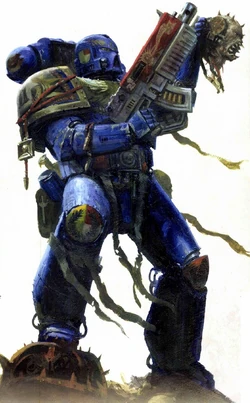
Source: http://warhammer40k.wikia.com/wiki/Ultramarines
A Space Marine is raised from the age of fourteen to become a loyal servant and instrument of the will of the Immortal Emperor of mankind. In order to reach this goal the individual is systematically broken down and built up from the ground up, both mentally and physically. This is done by inhumane mental and physical training, as well as with the implementation of powerful artificial organs. This procedure is extremely dehumanizing and dangerous, many die or get irreversibly disfigured during the process.
Standing several heads over the tallest mortal human, with the body proportions more akin to an early 90s superhero comic, then any form of real life anatomy, the Adeptus Astartes makes for an imposing figure. This grander than life size and stature is further enhanced by their armour, a fully sealed suit of armour powered by several motors and other assist systems. The Space Marine seem almost mythical, inhuman next to their unaugmented kin.
The Astartes, or Space Marine is raised by, and indoctrinated into a brotherhood of warriors, a cult of fully devoted soldiers, with a singular purpose, to serve the Emperor of mankind. The Astartes live a Spartan life, away from temptation and vice, their days being filled with prayer, drills and combat training. Everything to keep their mind and bodies occupied, and to stop them from turning against their creators. This fear is not without precedent, as their genetic ancestors rebelled against the Emperor himself at the order of Primarch Horus, a story we will cover at length in later chapters.
The Astartes has in essence, shredded himself, and become something non-human, in order to protect the very thing he has sworn off forever. For an Astartes there is no retirement, no leave of absence, no end to the struggle, for only in death does his service end. They know no other joys than battle, have no other goals than the safeguarding of all of Imperial space.
The superhuman
The myth of the superhuman is not a new one in science fiction, or in literature and storytelling in general for that matter. From the Greek myths to the modern super hero classics, can we find examples of individuals that through birth or other means become more than human.
The first allegory we will look to is that of the Jewish myth of the Golem. The Golem has become a standard stable of much of contemporary fantasy as well. The Golem being a sentient magical being, often made out of clay. This Golem is animated by holy texts and is said to follow the owners commands unquestioningly, until it is told to stop. The Marine is also a large loyal servant, created in much, with the use of holy scriptures and religious dogma.
The theme of super human soldiers is, as mentioned before, a long lasting staple of science fiction narratives. From Captain America and Bane to Solid Snake and Agent 47, only to mention a few, are contemporary fiction filled with genetically modified humans, breed to fight in humanities wars or other conflicts.
An imperfect system
As you will see in this series, the Imperium of man’s narrative is full of imperfect, broken or seemingly arbitrary laws, ideas or organisations. This imperfect state helps to further the feeling of dread, hopelessness and frustration that we have discussed earlier. Much of these emotions are created via the use of dramatic irony. Dramatic irony is a narrative tool, where the audience knows more than the actors in the story. The most well known example being, a couple sits at a restaurant, and there is a bomb under the table, the audience knows, but the couple do not. Alfred Hitchcock famously used this example to illustrate how he liked to build suspense in his stories.
Much of the drama and tension that the Astartes creates comes from a similar notion, for despite rigorous testing, and check-ups, are each Space Marine potentially flawed, unstable or disloyal. The creation of new Astartes is achieved using genetic materials of their predecessors, with the help of science beyond even the most skilled of the Imperium´s scholars. The Imperial scholars can not improve, nor reproduce the systems involved in the creation of new Astartes, only replicate it. This fact further helps create tension, and drama. To create a new Astartes, the organs and hormones needed for the process, must be extracted from an Astartes corpse. This means, if a Astartes corpse is lost, not only is he lost, but so is every possible successor that could be created using his genetic materials. These facts are well known to the readers, but not to the majority of the actors within the various narratives where the Astartis appears.
The inherent flaws of the Space Marine, and the Primarches, is the basis for one of the more popular and elaborate narratives within the Warhammer 40,00 franchise, the Horus heresy. We will tackle the setting, narratives and overall presentation of the Horus heresy in a later series.
The warrior cult
The last thing I like to discuss is how the Marine relates to the overall faith of the Imperium, more specifically The Imperial Creed, a subject which we will also discuss in a later chapter.
The Adeptus Astartes do not follow this general faith of the Imperial Creed, but rather have their own, unique cultures of devotion. The Astartis follow their own form of worship and traditions. All loyal Astartes, just like the rest of the Imperium, worship the God Emperor in one form or another. These traditions may vary from solemn prayer and contemplation, to worship through creation of art and weapons, or even severe self flagellation. These religions and cultures are a tightly guarded secret by the chapter, and are all but unknown to outsiders, something that further spreads paranoia and fear through the Imperium regarding the super human Astartis.
This dedication and secrecy further cements the Space Marines as more than just a fighting force, they are a devoted warrior cult, full of secrets and mysterious practises.
Conclusion
This chapter has been a short introduction to one of the major elements of the Warhammer narratives, the Space Marine. We will return to this topic many times in the future, but for now, this will be enough for us to be able to continue and explore the more complex parts of the Warhammer 40k narrative. Next time we will take a look at the Ecclesiarchy, the Imperiums official religious organisation, as well as the secretive polishing organ known as the Inquisition.
Source
Games Workshop (2017). Codex Space Marines . Games Workshop.
Copyright Disclaimer
Under section 107 of the Copyright Act 1976, allowance is made for “fair use” for purposes such as criticism, comment, news reporting, teaching, scholarship, education and research. I do not claim to own an of the pictures in this post. Al copyrighted materials belongs to their respective owners.
This blog post was spell checked and edited for readability at 2021-06-14

 An Unused Frequency
2 thoughts on “Warhammer 40k an in depth analysis: Part 1, IoM, part 6, The Emperors chosen.”