
The Emperor of Mankind is a symbol of many things, some which are direct contradictions of each other. In this chapter we will try to explore the major themes, as well as relate them to the rest of the Imperium of man as a whole. By understanding the Emperor of mankind can we get a more clear picture of the rest of the faction, as well as the narrative of Warhammer 40k as a whole.
The hidden saviour
The Emperor is described as being an ageless stoic giant, silently leading humanity from the shadows. It was only at the 30th Millennium, during humanity’s greatest struggle that he first chose to reveal himself. He arrived at the head of a group of genetically engineered soldiers known as Thunder Warriors, the precursor to the Space Marine. They rapidly unified the Earth under one banner, his banner. With his home now united once more, with his genetically engineered sons at his side, he set his gaze on the winder galaxy.
The image of a lone saviour can be found in many faiths and mythological stories. To keep the catholic allegory, the easiest connection would be to Jesus, the saviour of the catholic faith. This is, though far from the only example we find of this character trope.
Due to the fact that the material we have discussed so far does not deliver very far into the past of the Emperor, then neither will we do so here.
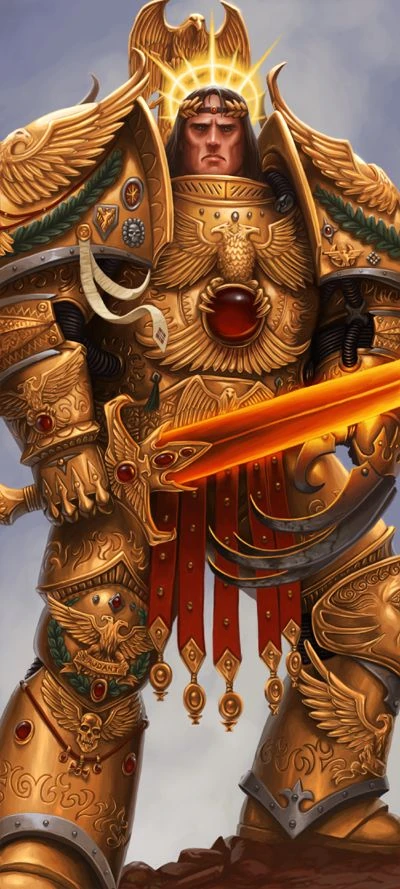
Above we see an image of the Emperor of Mankind leading the Imperium across the stars. Some of the common imagery, such as the seal and the skull are here overshadowed by another icon, one we have yet to discuss. This icon is the two headed eagle, a common symbol for Empires and Imperiums through history. (Chariton 2011)
In the context of Warhammer 40k does the two headed eagle represent the two leading powers of the IoM, the Lords of Terra, and the Tech Mages of Mars. While this icon is widely used within the imperium of Mankind, especially within the imperial guard (hill 2016), this icon has been joined by the symbol of the Ecclesiarchy and the Inquisition, amongst others to show the might of the Emperor and his might Imperium. (Games Workshop 2013)
The great crusade
The great crusade here refers to the time where the Emperor set out from earth to conquer the stars in the name of humanity. The term crusade once again makes connections to the Christian faith, via the Catholic crusades. The term Great crusade refers in the context of Warhammer 40k, to the time where the Emperor set out from Earth to conquer the stars in the name of humanity. The term crusade once again makes connections to the Christian faith, in particular to the Catholic crusades against the people they saw as infidels and heretics.
The imperialistic themes and undertones of the Great Crusade are hard to ignore, tying it closer to the themes of colonialism discussed in earlier chapters. The biggest difference being that the Emperor’s great crusades, and those carried out by the catholic faithful, was not made in the name of any god. The Emperor in fact, banned all forms of magic, mysticism and occultism. These crusades were, much like the British colonization, made under the mantra of reason, logic and civilisation (see Manifest destiny). One can argue, that due to the fact that the Emperor, were in several ways a god, even before he became the centre of a monotheistic religion, was the Crusades a perfect example of the will of god.(Games Workshop 2017)
The father and his sons
During the time of the great crusades the Emperor of mankind perfected his thunder warriors. The Thunder Warriors had proven themselves to be violently unstable and prone to going into psychotic murderous rages from where there was no stopping them. The Emperor eventually managed to create the Primarch Space marines from his DNA, and from these templates he created the space marines. The grand forces of Chaos, the big evil of the 40k narratives conspired and managed to kidnap the primarches as children, and spread them across the universe. All of them seemed to land on planets that reflected their specific sentiments, talents and personalities, for better or worse.
After being separated from his sons by the forces of chaos (explained further in a future chapter) he slowly reunited with them as his great crusade progressed, giving them commands of legions of their own lesser clones, or sons. These Primarches have been moulded by the life they have lived away from their gene father, as well as by the various genetic mutations they had endured. These changes ranged from differences in eye and hair colour, to having fangs or even wings in the case of Sanguinius. These genetic differences later showed up in their clones to a greater or lesser degree.lones to a greater or lesser degree. The Space Marines of a certain chapter seemed to also take on the mentalites and quirks of their gene fathers, be it as mild as the Salamanders sharing their Genefathers humbleness and love for craftmanship, to the more sever anger of the Blood Angles, or the almost obsessive cybernetic enchantments of the Iron Hands.
The Emperor, the Primarchs and the Space Marines, all use terms like father, son and brother when referring to the relationship to each other. The Emperor created the Primarchs from his own genetic makeup, though despite this, it would be more accurate to call them his creations rather than his children. Note that this repudiation of heritage was made without sexual repudiation, a theme common in both post-humanist and futurist works.
The Space Marines see their Primarchs, as well as the Emperor both as deities and as their parental figures. It is true that the Space Marines share some genetic materials via their implants (see Space Marines),but other than that they do not necessarily share family bloodlines. Note that the term brother is also a reference to battle brothers, as well as brothers of the same convent, much like a priest or monk would speak about his equal. The term Father, may also be used in the same way as the elder or superior member of the same religious order would be addressed. The term Son would be similarly be applied by this superior member while addressing his lesser. (Games Workshop 2017)
Conflict, betrayal and defeat
During the great crusade, the Emperor was forced to rely more and more on his Primarchs. This left them alone and leaderless for long periods of time, and some started to resent their gene father. Some felt used, treated like nothing more than a tool by their creator, Magnus the Red felt scorned by the ban on Psychic powers, that greatly limited his and his sons research. But none were as resentful as Logar.
Logar had, despite his father’s wishes, started a religion venerating his immortal creator. On each planet he and his sons would conquer, they would erect huge temples, and form cults in his father’s honour. This, of course, went against the Imperial Truth, and the wishes of the Emperor himself. Logar was forced to kneel and watch, as his most prized achievement, a city sized monastery and temple was burned to the ground. He was also forced to swear off worship of the Emperor, as well as any other form of deity or god.
Instead of following his gene fathers wishes, Logar instead, simply found other gods, darker more sinister gods. These gods, the Ruinous Powers, will be discussed in a later chapter. He proceeded to try and convince his fellow Primarchs to join him, and his new gods.
This rebellion would be known as the Horus Heresy, so named after the general, Horus, chosen to lead the rebellion. TThis rebellion would be known as the Horus Heresy, so named after the general, Horus, chosen to lead the Emperor’s armies in his fathers absence. This rebellion saw half of the Space Marine legions join the rebellion, as well as leave much of what the Emperor had built in ruins. This rebellion was eventually stopped, at holy Terra itself, this victory was not without great cost though. Chief amongst them, being the Emperor being left mortally wounded by his son Horus. (Games Workshop 2017)
The absent leader
After defeating, and being mortally wounded by War-master Horus, the Emperor was entombed in an archaic machine known as the Golden throne. This golden throne keeps the Emperor clinging to life, using poorly understood science, and the sacrifice of a thousand souls each day. This throne keeps the Imperium’s beloved god Emperor alive, but also works as a beacon for interplanetary space travel for the Imperium.
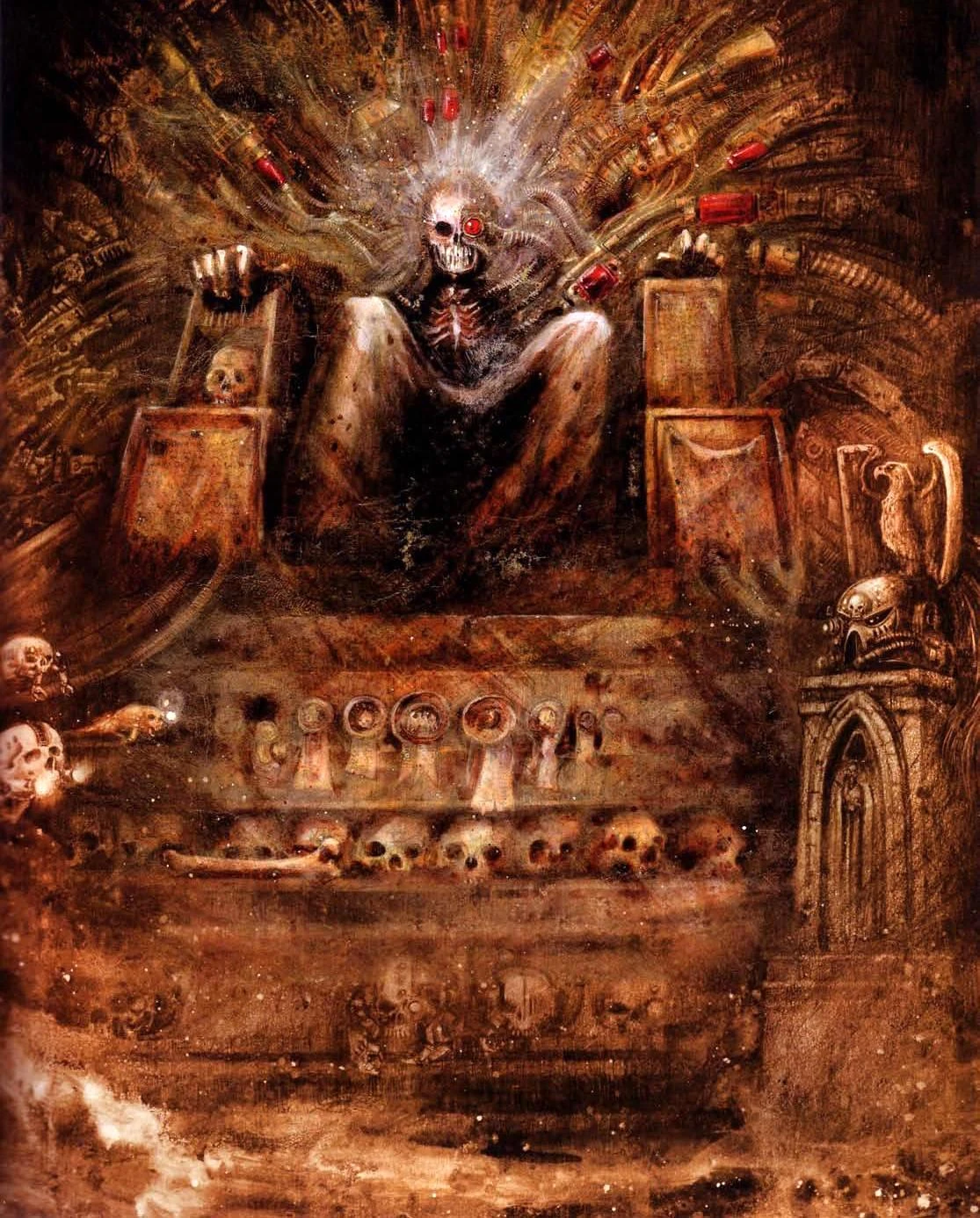
Many of the same visual themes are present here, as in much of the other artwork we have seen representing the IoM. The Emperor is an amalgamation of machine and man, there are sigils as well as themes of Gothic and catholic Much of the same themes we have found in earlier visual designs is present in the representation of the Emperor in his Golden throne. The Emperor is an amalgamation of machine and man, there are sigils as well as themes of Gothic and catholic architecture in the form of the dust, holy statues and arches covering the throne. Skulls are once again prevalent, both in the form of the Emperor himself being a literal skeleton, but also in the iconography and decoration of the Golden throne itself. The dust driving home the point of how ancient and poorly kept this machine truly is, and the row of skulls is an apt metaphor for the millions of lives lost every day to keep the machinery running. This allegory works both for the Golden Throne, but also for the Imperium itself. (Games Workshop 2017)
Conclusion
As we can see from this quick breakdown is many of the themes we have discussed earlier present here as well, with that said are they for the most part subtly, or not to subtly altered. This further drives home the scale and timespan of the narrative within the 40k universe. The most striking of these differences, would be the Emperor’s “ascension” from leader, to godhood in the eyes of his followers, a move he himself adamantly opposed. This ascension is common in man
We can once again see several different themes return in the design of the Emperor himself. The mystical blend of magic and science return both in the Golden Throne as well as the Primarches. The focus on gothic architecture and death is present in the throne itself. The fact that the Emperor himself is, literally in life support, drives home a certain inevitable horror of a grand collapse and slow painful death. The Imperium as a whole holds a similar fate in the not too distant future.
Time once again placid a major part in the narrative. One of the major examples would be the Emperor’s ascension from leader, to godhood in the eyes of his followers, a move he himself adamantly opposed. The change of Emperor from secular leader to mythical deity closely mirrors that of the Imperium´s change from a secular society honouring technology and research, to a conservative theocracy.
We now have all the pieces we need to more fully understand one of the major parts of the Warhammer 40k narrative, the Imperium of Mankind. Next chapter will be focused on combining all these pieces to form a coherent picture of the faction. Next series will focus on the mystical dimension of the Warp and the gods of the Warhammer 40k universe that reside within it.
References
Games Workshop (2013). Codex: Inquisition. Games Workshop. Lenton, Nottingham.
Chariton. J (2011) The Mesopotamian Origins of the Hittite Double-Headed Eagle
Hill, J.D. (2016). Astra militarum. Games Workshop. Lenton, Nothingham.
Games Workshop (2017). Codex Space Marines . Games Workshop.
Copyright Disclaimer
Under section 107 of the Copyright Act 1976, allowance is made for “fair use” for purposes such as criticism, comment, news reporting, teaching, scholarship, education and research. I do not claim to own an of the pictures in this post. Al copyrighted materials belongs to their respective owners.
This blog post was spell checked and edited for readability at 2021-07-03

 An Unused Frequency