
Introduction
This chapter will tackle one of the more iconic classes of Dungeons and Dragons- the Cleric. In this chapter, we will discuss the more common tropes of the cleric, how it ties to the Catholic faith, as well as other fictional representations of the same archetype. In part 2, we will explore some of the sub-classes of the Cleric and try to find a real life connections of these varied archetypes.
The Cleric in Dungeons and Dragons
The Cleric is a magic user, healer and warrior. The power of the Cleric comes from their gods rather than inert magical abilities like that of the Sorcerer, or from intense studies of the arcane arts of the Wizard. This difference gives these magical classes considerably different approaches to what magic is and how it is used. (Wizards of the Coast 2019)
The Cleric is described as more than a mere priest or devout follower. These clerics are mortals that are chosen by their deity to receive some of their divine power. The interesting aspect of this is that the Cleric can as a result lose his power if they anger their patron god, or lose their good graces. (Wizards of the Coast 2019)
The Cleric of D&D is not, as we will see, tied to any one particular faith or creed. The Cleric is very much the catch-all term for individuals that have in one way or another, gained divine powers from a greater godly power 1. These would, in terms of Medieval Europe, might be a parallel to a prophet, soothsayer or other even a saint2.
The Medieval Catholic Clerics and Monks3
The Catholic church is what comes to mind when Clerics are discussed within a western context4. The Cleric, in the context of the Catholic church, usually refers to the priestly office in some capacity. These clerics had a large authority over medieval society, both within and outside of theological matters. These powers came partly from their monopoly of the language of the Holy book5, which was Latin. (Wilson 2018)
When discussing this instance of the Clerical archetype, I will refer to the medieval Catholic Cleric, and his office. It is hard to overstate the importance of these men within the social order of Medieval Europe, for good and for ill. Faith, as in many different places around the world, was both uniting and dividing force. An important factor to keep in mind is that the Medieval Catholic clergy, as well as the clergy of most major religions were part of the privileged part of society. (Wilson 2018)
Prayers and Miracles
In his book A magical world: superstition and science from the Renaissance to the Enlightenment does Wilson (2018) describe the Miracle as the “bread and butter” of the Catholic church. The saints and the miracles they produce are meant to lend legitimacy to the church, as well as be the basis for the divine powers of the prayer. By praying at certain places, in certain ways, a devoted follower would be able to gain certain blessings. (Wilson 2018)
Miracles are of course a major part of other religions, as are prayers, but I believe that the original inspiration from Wizards of the Coast primarily came from Catholic Christianity6. With that said, D&D as time went on, has added more and more influences as the franchises. As a result, their player base grew. We will take a look at this wider source of inspiration and world-views.
The prayer in Dungeons and Dragons, when performed by a Cleric, follows the same general theory. The Clerics prayer is most often directly answered in some way by their deity, in form of a spell, blessing or curse. Purely mechanically speaking, this is similar to a Wizard casting a spell. (Wizards of the Coast 2019)
The tools of the office
The most striking image of the Medieval Catholic priest is that of a stoic man in long flowing robes, carrying books, scrolls or incense. These articles are vital to the performance of the office of the Cleric or priests. These objects are often referred to as symbols of office and serve as a unifying force for the faith in question. The symbols of office also allows the priests to give their prayers a lot more weight and importance than they would have if anyone else performed them. (Bourdieu 1991)

This image of the robed holy figure is one that we can easily find in Dungeons and Dragons, as well as other contemporary fantasy works that take place in a similar time period. Below we have two images, a Cleric from the 5th edition Dungeons and Dragons and a Priest from the MMORPG7 World of Warcraft. Here we can see clear connections between the visual aesthetics of the Medieval Catholic church and these two gaming narratives.
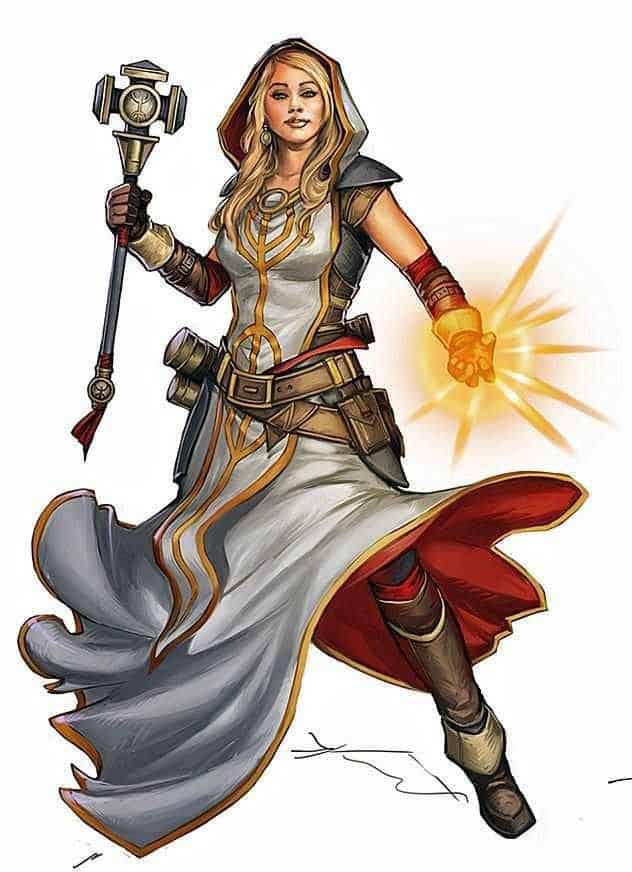

The office of the Cleric, is in gameplay, the focus of their divine power and the centre point for their magical powers. This is in contrast to the Wizard, who needs to use components, or an arcane focus to cast spells. This magical force, like much in Dungeons and Dragons, is partly left to the discretion of the DM. A number of smaller details are in fact, left rather vague, for the possibility for the DM to modify and better fit their players. The symbol of office, in the case of the Cleric in D&D, is their focus of their power and the tools they use to cast their spells. In other words, the symbolic power of the Catholic cleric becomes a physical tangible power in the case of the D&D Cleric. The symbols of office, or the holy symbol as it is called in game, is vital for the Cleric to perform their magic. These symbols can take many forms- from books, to talismans to swords, but they all have the same function, to let a chosen wielder to be heard by their chosen deity. (Wizards of the coast 2019).
Divinity in the world of Dungeons and Dragons
The pantheon of the D&D world is vast and complex, We are going to give a very brief overview here of the various pantheons. The gods for good or ill have a large presence in the world of Dungeons and Dragons. Deities can be contacted both directly by individuals such as clerics, or by prophets via prayers or indirectly through prophecies and signs. The pantheons and gods that are presented in the official D&D materials are way too numerous to go into detail here. We will go through the general outline of how the pantheons work, and how they are organized. (Wizards of the coast. 2019)
The Pantheons of gods we will discuss today are roughly sorted into two categories. The first category goes by the name of Deities of the Forgotten Realms, or the gods created specifically for Dungeons and Dragons. The second category is the so called Fantasy-Historical Pantheons. The Fantasy-Historical Pantheons are all based on real life gods from the Greek, Egyptian, Celtic and Norse faiths. These gods have a clear grounding in real life faiths, and we will go into more detail with them in the next chapter. (Wizards of the coast. 2019)
The gods are further sorted into categories based on their domain of influence as well as their alignment. These alignments inform a lot of how the character in question are predisposed to act. These guidelines help role-play, as well as keeping the characters consistent, between sessions and campaigns. (Wizards of the coast. 2019)
These different gods all have a realm of power or responsibility. Note that these areas often overlap. This makes sense, since not every culture in D&D worship every deity. As with real life pantheons, several gods of life for example exist within the same geographical area. In terms of D&D, we have for example we have the god Ilmater, god of endurance, who is a lawfully good god, with reign over life Life and his symbol is a pair of hands bound at the wrist with red cord. Another god with reign over Life is Chauntea, goddess of agriculture, a neutral good goddess of Life with her symbol being a sheaf of grain or a blooming rose over grain. It is up to the DM to use these gods how they see fit, as well as in which configurations they are used. As I mentioned before, much of D&D meant to be modified and transformed to fit the players and DM the best. (Wizards of the coast. 2019)
Conclusions
We had as a goal in this essay to analyse the connections between the D&D Cleric and their real life counterparts. I believe we have managed to point towards a series of interesting connections between Dungeons and Dragons and real life religious practices, in this case, the Catholic church. Much of the visuals, such as the symbols of office, the clothing, as well as the general mythos of the role is shared by both incarnations. The focus on prayers, as well as miracles and the performance of miraculous things are present in both roles. Lastly, the symbols of office or the holy symbols do carry great weight when it comes to performing these wonders and miracles.
Next chapter will be dedicated to another spellcaster that uses divine or otherworldly powers, the Warlock.
Footnotes
1Note that Clerics are not the only classes that get their powers from a divine source. Some other notable examples are Paladins and Warlocks, which we will discuss in later chapters.
2 All individuals that were believed to be able to perform miracles in one form or another.
3 Not to be confused with the D&D class, the Monk.
4 A context of which Dungeons and Dragons were created (Wizards of the coast).
5 See, The Bible.
6 I base this assumption on the fact that Wizards of the Coast is a primarily American company, that at its conception primarily sold to an American public. As a result, would it make sense to tie the Cleric to a religious context this public would be the most familiar with. (Wizards of the coast)
7 Massive multiplayer online role playing game
References:
Wizards of the coast. (2019). Pantheons. Retrieved 2019.09.25 from https://www.dndbeyond.com/sources/basic-rules/appendix-b-gods-of-the-multiverse
Wizards of the coast. (2019). Cleric. Retrieved 2019.09.25 from https://www.dndbeyond.com/classes/cleric
Wilson, D.K. (2018). A magical world: superstition and science from the Renaissance to the Enlightenment. (First Pegasus books hardcover edition.) New York, NY: Pegasus Books, Ltd.
Bourdieu, P. & Thompson, J.B. (1991). Language and symbolic power. Cambridge, Mass.: Harvard University Press.
Further reading
General texts on the chatolic faith or mission
http://www.newadvent.org/cathen/04049b.htm
https://www.gutenberg.org/files/25133/25133-h/25133-h.htm
https://www.gutenberg.org/files/52040/52040-h/52040-h.htm
https://www.gutenberg.org/files/11553/11553-h/11553-h.htm
http://www.gutenberg.org/cache/epub/18039/pg18039-images.html
Further reading on symbols of office
https://www.dio.org/bishop/symbols-of-the-bishop.html

 An Unused Frequency