
Every advanced emotion felt by enough sentient species is reflected within the warp. No feeling is so universal, and so often felt then the fear and relief related to the trails and tribulations of death and disease. It is these emotions, these fears, hopes and dreams that fuels Nurgle, the god of death and suffering, but also the god of hope, life and rebirth.
Introduction
We will begin our series of the Deities of the 40k narrative, by looking at the most contradictory, and ambiguous of al the strange inhabitants of the Warp. Nurgle is said to have been a part of the fate of humanity since the very start, or maybe, even before that. The fear of rot, decay and death has always been prevalent in the human psyche, tough revered by some, most try their best to repress and ignore the sinking feelings of the inevitable, it is in these notions that Nurgle truly thrives. (Games Workshop 2016)
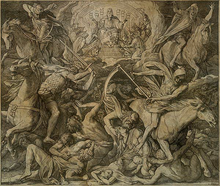
The gods of death and plague is one that can be found in most if not al major human faiths, as it has been a large part of human history, al from the start. Just like decease rot and death has been with humanity from the start, so has Nurgle been there, walking besides us. Few things has caused as much fear and dread in human society as the slow extinction at the hands of a malignant disease or plague. One of the more common faces of disease in the west is that of pestilence, one of the possible identifies of the four horsemen of the apocalypse.
Nurgle is not, as one might think, a sombre spirit, or even one of malice or contempt, he is rather a figure full of life and lustre, full of the wishes to organize, create and educate. To understand Nurgle, one must understand the constant contradictions that he, even more then the other chaos gods represent. (Games Workshop 2016)
Nurgle is a grand example on how the Warhammer 40k narrative uses dramatic irony to create a sense of dread and hopelessness. Dramatic irony, as we have discussed earlier, is the practice of making the audience preview to more information the the characters in the text has. In this case are the readers fully aware of the immense pain and suffering that Nurgles “gifts” wreck on the sentient life of the galaxy, as well as the seemingly loving and well-meaning spirit of Nurgle himself.
A creed of duality
The domains of Nurgle are the duel domains of life and death, decay and rebirth. For every spore, every cell of a disease is new life and from every corpse grows new and fascination life forms. Life leads to death, which leads to new life. It is this cyclical nature that Nurgle represents. His fascination has always been chiefly with life, and its many struggles. (Games Workshop 2016)
Nurgle shares his plagues and diseases as gifts and blessings to a seemingly uncaring universe. He watches with fatherly pride as his minions spreads his foul contingents, and the deaths and pains that they spread throughout the galaxy. (Games Workshop 2016)
To ally once self with Nurgle is to accept this endless cycle and embrace the gradual decay of al things. In return will Nurgle give you immunity from the pains and discomfort related to eutrophy, and can as result conformably enjoy Nurgles great work. (Games Workshop 2016)
The garden of rot
Nurgles lands within the Warp manifests as an enormous bloated swampy garden, beautiful and terrifying in equal measure. Great vine trees reach to the sky, and colourful toxic mushrooms, some the size of humans or taller, fill the ground, spreading colourful spores across the lands. (Games Workshop 2016)
One can not survive Nurgles lands uninvited, for only he can protect you from the various illnesses and parasites that inhabits Nurgles forests. Many invaders and unwelcome visitors has learned this the hard way, as they have become a permanent resident in one form or another, to the gardens of Nurgle. (Games Workshop 2016)
Within this garden lays Nurgles Manor, it is described as rotten overgrown and creaking, yes fundamentally strong and immovable at its base. Driving home the theme of gaining strength from weakness and life from death.
The daemons of Nurgle
The daemons of Nurgle can roughly be categorised in one of two categories, the sombre and serous and the playful and mischievous. This further drives home the idea of the duality that exits within Nurgle himself. (Games Workshop 2016)
The playful beasts
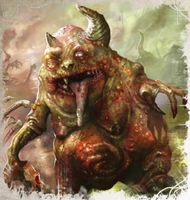
Amongst the many beasts and creatures that serve Nurgle, is few as obvious and the duality of Nurgle as the Plauge beasts, large slug like creatures that are abhorrent to visit, and is highly toxic to touch. They pair this abhorrent physical appearance with the temperament, energy and personality of an attention star puppy. They do not see the enemy combatants as foes to slay, but rather new friends to play. The beasts are blissfully unaware of the fact that their touch are fatal to every living creature, and gets genuinely upset when their latest victim don’t want to play along. This is until another hapless mortal catches their eye at least. This is another clear example of the dramatic irony coming in to play. Both the attacker and the attacked misses vital pieces of information, only at the preview of the reader. The attacked is not aware of the beasts intention to simply play, and the attacker is not aware of the fatal outcome for their new playthings. (Games Workshop 2016)
The Nurglings, small creatures, looking like miniature version of the grand god of rot himself. These small creatures are born from the Great unclean once, and spend most of their time fighting for attention from either the larger daemons, or Nurgles faithful follower. (Games Workshop 2016)
The legion of research
The second category of daemons are in one way or another representation of Nurgles wish to educate and research. Chief amongst these are the Plague bearers, mortals that has consumed to the plague known as Nurgle rot, and reborn in the Garden of Nurgle as one eyed, bloated version of themselves.
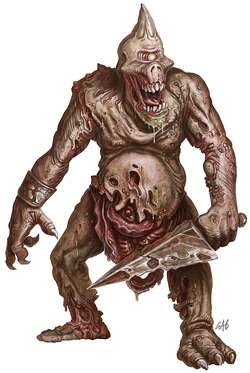
These creatures are now tasked with cataloguing, spreading and researching the effects of Nurgles so called gifts. They are also tasked with carrying out Nurgles will, and making sure his feat work do unchallenged. The tasks of these tally-men are an endless one, for Nurgles creations are always changing morphing and transforming, even as they take its course on the helpless victims. This bothers the plague bringers little, as they find great enjoyment in this seemingly monotonous and endless task. (Games Workshop 2016)
These two subsets of daemons are seemingly always at odds with each others, and the Plaguebringers see the Nurglings as nothing else but painful distractions from the endless work of helping their master achieve his goal of creating the ultimate illness.
Followers of ruin
The followers of Nurgle are legion, for the church of the fly is open to everyone, and turns no one away, for after al, Nurgle will embrace al in the end. Amongst the more eye catching are the members of the Adeptus Astarties that at one point or another abandoned the Imperium of man and embraced the Plague father. Chief amongst the many children of Nurgle is the Death Guard. hailing from a planet of plague and disease, did the death guard see themselves as immune to such maladies, and were often sent in to the most toxic environments, that was until one day they were stricken down with one of Nurgles finer creations, and left stranded in the warp, they turned to the only thing that could save them, the Plague father himself. The Death Guard of the modern imperium are great rotting monstrosities, a fusion of armour and rotten flesh, blessed with the absence of any pain and discomfort from their dread father. Stricken down by the very thing they saw themselves the masters of, they now server the very being that brought forth their downfall. (Games Workshop 2012)
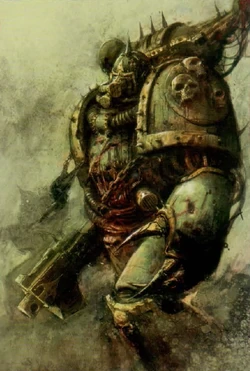
Beyond spreading death and disease wherever they travel, do these fallen Astartes also take pride and joy in the Masters great work, either indirectly by cataloguing and tallying the victims of his many plagues, or directly in one of many laboratories and research station located on the Death Guards home planet. (Games Workshop 2012)
Origins of the plagues
I will here raise an inportant question, one that will follow the rest of our investigations in to the deities of the warp. Did the existence of Nurgle, create the first plague, or did humanities fear for dying this way, lead to the birth of Nurgle? The evidence I would say supports the second interpretation, but this raises another question. How did Nurgle go from a representation of the fear of death and disease, to an actual creator of these things? This is a question we will come back to in a later chapter, and one I am note sure I have an answer to myself.
Conclusions
Nurgle is an interesting and complex character within the 40k narrative, and a good example to the inherent paradoxical nature of the warp and the creatures that lives within. The fear and dread that Nurgle creates in his followers are in a stark opposition to the demeanour and mannerisms of the god himself. he calls his followers his children, and see his creations not at curses, but rather blessings and gifts that he sends out on the material plain.
Lastly, to follow and embrace Nurgle is to embrace the inevitable, to accept the death of al things, and in the process be freed from the more physical distresses that comes with such entropy. It is also to internalize the dual nature of Nurgle, to grow strong as the rest of the world grow weak. To take suffering and rot, and make it your power and life. This is a trait that we will find with the followers of al the chaos gods, and one that further drives home the horror of these creatures. In order to become free, you must embrace that you fear the most.
References
Codex: Chaos daemons (7th Edition), Games Workshop, 2016
Codex: Chaos Space marines(7th Edition), Games Workshop, 2012

 An Unused Frequency
One thought on “Warhammer 40k an in depth analysis: Part 2, The Warp: part 3, Chaos: Nurgle, the god of death and rebirth”