

Introduction
Skyrim is the latest installment in the Elder scrolls series. The game series is an open world rpgs filled with magic, monsters and intrigue. Skyrim is set in the fringed northern land of the same name. This land is deeply inspired by a romanticized version of Viking and Nordic culture. The land is rugged and mostly barren, with a few scattered cities hidden behind grand walls. There are small farms scattered amongst the landscape, so are strange stone formations, caves, old temples and many many burial mounds. Skyrim is a mountainous land, and very few areas are completely flat.
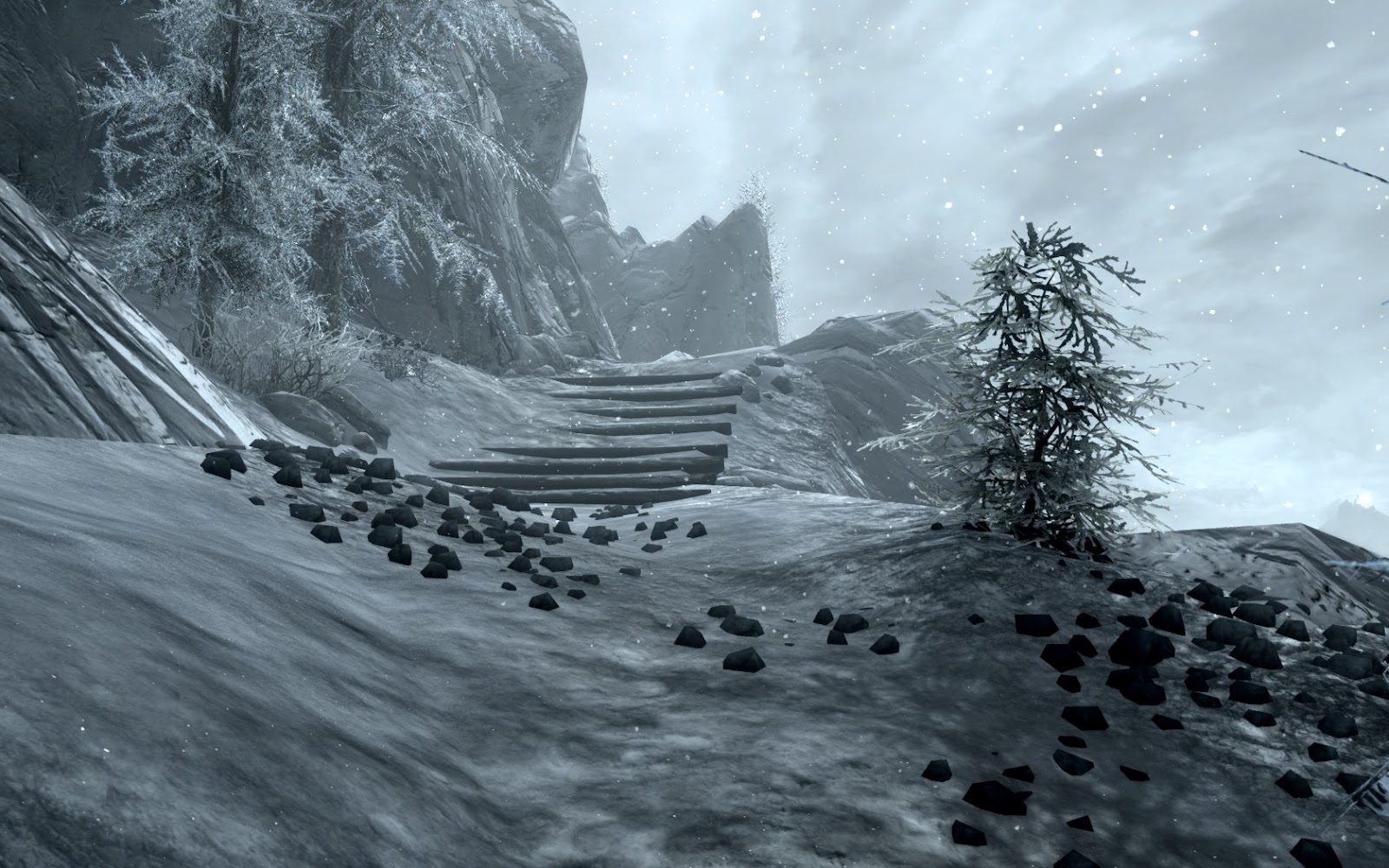
This makes the inclusion of stairs feel like a very natural part of the environment. One of the problems with open world games, especially those that are as large as Skyrim is the risk of players getting lost. Skyrim has many clever way of leading the player towards points of interests, from stone canines, small rocks statues, and dirt paths. One of the greatest way that the game leads the players is with stairs, low stone stairs that do not impede the players walking speed, but that subtly show that there is something important nearby.
Height has also been used with great effect in Skyrims two latest predecessors. Cyrodiil in Oblivion is markedly bowl shaped, with the imperial city in the centre of the bowl. The effect is that if the player goes downhill they will eventually end up in the Imperial city. A logical design considering how vital the city is for the game both narrative and gameplay wise.
Vvardenfell in Morrowind is likewise built around a specific geographical feature, namely the red mountain. The cause of the red fever and home of Dagoth Ur. The presence of the red mountain in the centre of the map, in combination with the constant belching of smoke gives the game a constant sense of dread and urgency.
The player often simply needs to look up for a reminder of what they are fighting for, and trying to destroy.
Mountains and cliffs
The decision to make Skyrim a very mountainous area further helps to funnel the player in to areas of interest. Roads snaking along valleys and across vaistas is an easy way to lead the player towards points of interest. This strategy is very much enhanced by the combination of stairs leading up otherwise unscalable hills and cliffs. The world design takes great advantage of its mountainous areas to create breathtaking vistas from many of the games key locations.

The dragon priest ruins having several high points from where they practiced their Thu’um also makes for great vantage points to the players. Mountains also make for natural barriers, and while they do not often work like that in practice, mountains are great theoretical barriers to keep the players away from certain areas, or from taking unintended routes.
The introductory road to Riverwood being a great example of this, as the players snake along the road down the cliff they are faced with the vastness and emptiness of Skyrim’s wilderness.
Miraaks temple is placed on a hill, at one of the highest points of the island. The castles of the vampires and the Dawnstar are both located on an elevation, letting them loom over the players as they approach.
Cities and stairs
The main cities of Skyrim all use elevation in interesting, and often historically accurate ways. Windhelm is very clearly stratified around elevation, with the jarls kept at the top, leading down to great families, then the traders and last the common citizen. Morthal has a similar design with the temple of Diala and the jarls keep rather literally lording above the lower levels of the city. The poor are literally forced underground, while the rich live in cliffside residents.

Winterhold is rather flat, with two exceptions, the docks and the grey quarters are both located at the bottom of steep stairs, putting them at a both spiritual and visual lower level then the ruling nord classes. It also increases the sense of isolation and destitution of these areas
Solitude has an interesting dip in the middle of the city, as well as a hill approaching it. This detail means that both the blue palace and the imperial fort are located uphill. The player will always approach these structures from below. Riften has the most obvious height dichotomy, with its most poor literally living underground, while the Jarl fort is also located at the top of a small hill.
The college of winterhold also is kept at a distinct elevation from the ruins of its former patron city. Finally at the greybeards located at the highterst top of the world, both in literal and spiritual sense.
Conclusions
Height and the traversal of height is a vital part of Skyrim, both from a narrative and gameplay point of view. The ways that Skyrim uses height can be mirrored in the way that Oblivion and Morrowind uses height. The concept of elevation can be used both as a gameplay tool, and as a narrative tool.

The volcano of the Red Mountain in Morrowind both works as a goal, but as a deterrent to the player. Doubly so with the addition of the ghost fence cutting the player off from the peak for most of the gameplay. It is a deterrent, but also a sign of the ultimate goal for the player.
Oblivion uses its bowl shape to give the player a constant reminder of the Imperial city, the seat of power for the empire, and the very thing that the player is working to save. From a gameplay perspective does Oblivion use the high tower of the Imperial city as well as its central location as a tool for the player to navigate, and find their way back to the central hub of the game.
Skyrim likewise uses elevation, and stairs both for narrative and gameplay use. The narrow valleys help guide the players towards points of interest, and the elevation of certain buildings relative to its surrounding can tell the player a lot about a place without saying it expressly.

 An Unused Frequency