
Warhammer 40k an in depth analysis: Part 1, IoM, part 2, A Gothic future

To be able to talk about the aesthetics of the Imperium of Mankind, we must first discuss how the narrative of the Warhammer 40.000 franchise is presented. We will divide the various narrative parts in to different levels. I will break down these narratives in the following structure:

1, rulebooks and expansions

2 Codexes

3 Novels

4 “Out of house” productions such as movies, card games, promotional materials etc.

The largest reason for this division is that it gives a much more flexible approach to analysing the different texts, as well as helping with the problem that some layers are considered more canonical than others.  Canonical is here used to mean “what is real or true within the limitations of a fictional universe”.

In this part we will focus on the second level of the narrative structure. More specifically the way that the Imperium of mankind is presented visually both in writing and illustrations within their Codexes.

The decision to base this analysis solely on only the second level is partly because  because I believe most readers comes in comes in contact with the Codexes first, as well as being the most consistent when it comes to tone and theme. This level is also under the tightest control of Games Workshop.

As the title suggests, I will in this text compare the visual aspects of the Imperium of Mankind to that of the Gothic aesthetic movement. Now, a disclaimer before continuing, my knowledge in this field is limited, so I apologize in advance for any errors that may occur.

In this chapter we will primary discuss the architecture of buildings, starships as well as war machines, and how they help to set a certain tone within the narrative, but first of all I would like to draw a parallel between the term Gothic, and the term for the two common human languages of the IoM, this being high and low Gothic. High Gothic being represented by a tongue and cheek take on Latin is presented as the language of the rich and learned. Low Gothic on the other hand is represented as English, and is the tongue of the commoner and uneducated (Hill, J.D 2016). Here we can see a clear nod to the Gothic movement.

Before we begin to discuss the visual aspect of the IoM, I will define what I mean with the term Gothic architecture. I will base my definition of the book Gothic architecture  (Banner, R. 1961) In this text he outlines the history of the style, as well as a series of defining features. These features include spires, prominent buttresses and a focus on verticality and scale in the design. The architecture in many parts mimics that of medieval fortresses. High Gothic architecture in particular was meant to make the onlooker feel small and insignificant. Branner ends his book by describing the Gothic architectural movement in the following manner:

“Gothic was the final expression of the medieval world, of the concepts of a mystical cosmos and a transcendental universal religion” (Banner 1961)

Keep this description in mind as you continue to read this series. This definition will become quite striking when we have a more complete picture of how the Imperium of Man is being described. First we will take a quick look at some buildings of the Imperium of man.
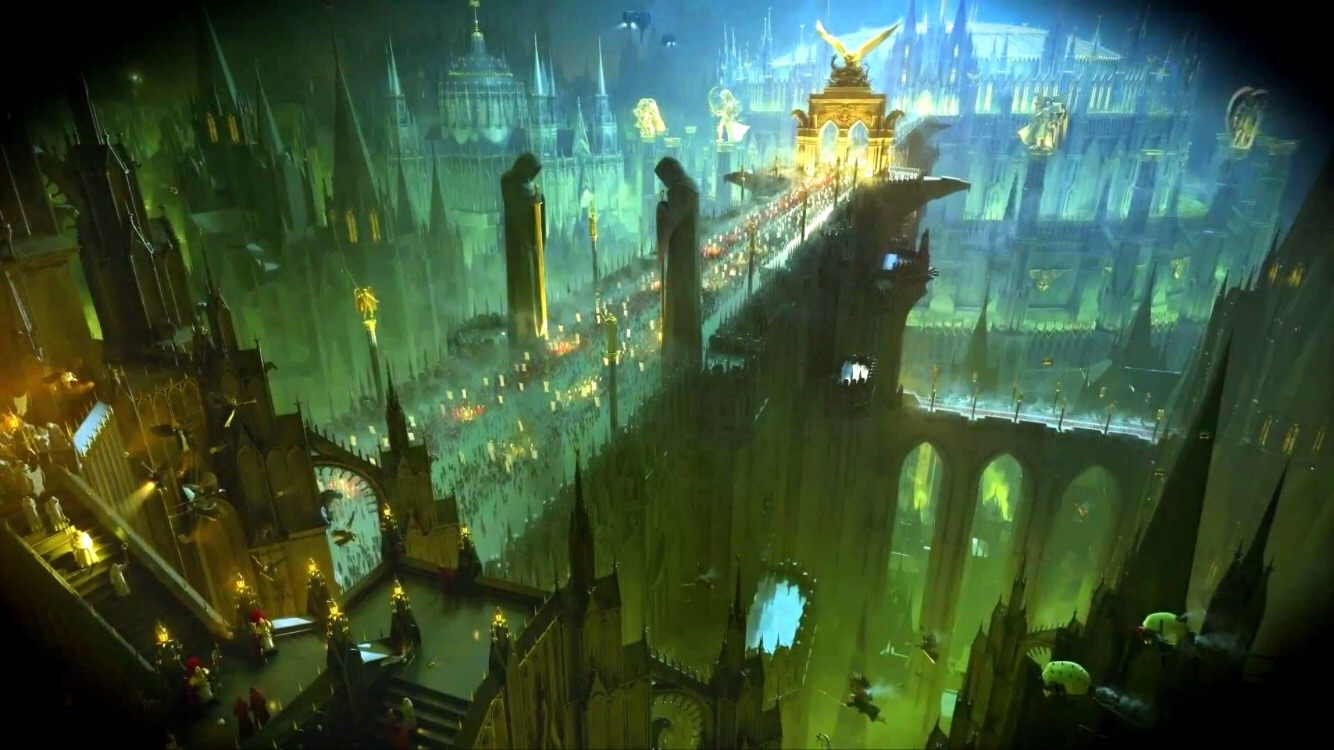
Source: http://warhammer40k.wikia.com/wiki/Imperial_Palace?file=Imperial_Palace_Terra2.jpg

As you can see from the picture above, there are many of the aforementioned details such as large spires,  prominent buttresses as well as an overall fortress-like design. Furthermore does the sensation of size and impression of grandeur permeate the works, making the humans next to buildings look miniscule and insignificant.

Imperial_vs._Chaos_duel.jpg

Source: warhammer40k.wikia.com/wiki/Battlefleet_Scarus

These design elements can also be seen on many of the Imperium s larger space ships. These designs can also be seen on many of the Imperiums larger space ships. These ships do not only include spires and buttresses, but also a notion of scale and a sense of a “larger than life” impression. These aesthetic elements can also be seen on many of the Imperium`s war machines such as the Imperial Titan, (a terrifyingly large walking gun platform used by some powerful Imperial officials), as well as the Imperiums more extravagant tanks.
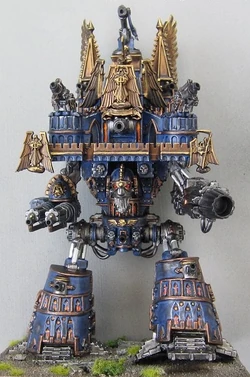
Imperial Imperator Titan

Source: http://warhammer40k.wikia.com/wiki/Titan

http://wh40k.lexicanum.com/wiki/Fortress_of_Arrogance

At this point most readers will have noticed the prevalent use of religious iconography, more specifically to the Christian catholic faith. The connection between Warhammer 40k and the catholic faith, can partly be explained by the fact that the company responsible for it series is based in Great Britain, a land with a history of Catholic faith, as well as grand Gothic architecture. I will discuss faith and religion in the Warhammer 40k franchise in a later chapter. Lastly I would like to draw the attention to how dark and imposing this architecture appears, with dark colours and imposing size. I believe that the use of Gothic architecture is meant to enhance the tone of oppression and horror in the narrative.

Next chapter we will continue to discuss this topic by taking a  look at the Imperium use of technology.

References:

Branner, R. (1961). Gothic architecture. New York: George Braziller.

Hill, J.D. (2016). Astra militarum. Games Workshop. Lenton, Nottingham.

Copyright Disclaimer

Under section 107 of the Copyright Act 1976, allowance is made for “fair use” for purposes such as criticism, comment, news reporting, teaching, scholarship, education and research. I do not claim to own an of the pictures in this post. Al copyrighted materials belongs to their respective owners.

This blog post was spell checked and edited for readability at 2021-06-08

Warhammer 40k an in depth analysis: Part 1, Imperium of Mankind: part 1, Manifest destiny.

This begins a series of looks into the large and complex narrative of the Warhammer 40k franchise. We will begin this series by taking a look at the Imperium of mankind (IoM). We start with the IoM for a number of reasons, firstly does the IoM represent humanity within the narrative, and is as a result easiest to explain without further context. Secondly do IoM take part in, or work as a point of reference in the other factions narratives. Lastly, does IoM by far have the most material written about it. In the first part of this series we will discuss how one can find similarities between the IoM and Colonial Great Britain, more specifically how both cultures exhibit traits of colonialism and nationalism. The Imperium of Mankind can be seen as a glorification as well as a stark criticism of these concepts (1).

The Imperium describes itself as the “universe’s sole and rightful ruler” (.J.D. 2016) The Imperium is ruled in theory by The Emperor, a glorified corpse of a man, kept in semi-life by the sacrifice of millions of human lives. In reality an unimaginable large governmental body of scribes, bureaucrats, rule makers and statesmen rules in his stead. This organisation, just like Colonial Britain, is centrally controlled. In the case of the IoM this central entity is known as the High Lords of Terra (Hill 2016). The rule of both Empires was in fact quite decentralized due to the distance between the seat of power and her colonies. Greater decisions, and of course the collection of taxes is left to the central rulers. The biggest difference between the two empires being the mind bogglingly large scale of the IoM. Despite these long distances and independent rule, do the planets and space stations under mankind’s Control have an obligation to pay large amounts of taxes to Terra. These civilisations and communities are also expected to stay true to the “true Imperial values and customs”. This again, can be linked to how Great Britain ruled their colonies (Pennycook 1998). It is said that amongst all of the colonial powers, Britain was most eager to spread their culture to their colonies (Pennycook 1998). For example, did the British start cricket leagues in several of their colonies for this purpose, and it’s said that while Germans built railroads, Brits made horse racing tracks. Likewise does the IoM bring their creed, customs and religion to each planet they colonize or recapture. Like with the real life colonial counterparts, some cultures and people encountered became what was called “sanctioned aliens”, many others were destroyed (Hill 2016). To further cement the allegory to the British colonies are the rulers of Imperial planets named “planetary governors”, not unlike the title colonial governor given to the rulers of British colonies.

Next we will get into the most controversial and difficult topic of this comparison, how the IoM see “the other” and how this compares to their real life contemporaries.

The British Empire as well as the other contemporary colonial powers has a well documented and bloody history with what they saw as “the local savages”.These natives were never met on equal terms, always seen as the “lesser”. To further understand how the British colonial power saw the other, we must first discuss how it saw itself. The British empire is always described as cultivated, intelligent, mature and masculine. In comparison the “other” is seen as lesser, savage, childish and feminine (Pennycook, A. 1998). As you can see, does the British empire need others to define itself as superior.

The Imperium of Mankind follows a similar ideology, only expanded on a galactic scale, and against not just humans, but different sentient species as well. The IoM has several “others” to prove itself more superior than, alien species, heretical human societies and mutants can always be used to prove its superiority against. The virtuous do differ slightly between the two empires, but some, such as strength, civilisation, and purity, seems to exist within both cultures. (Hill 2016. Pennycook 1998).

Lastly will I discuss how these two colonial powers justify their conquests and exterminations. Part of the strategy of colonial Britain was to paint the colonization effort as a great adventure, where great men went on journeys of grand discoveries, slaying monsters, and (hopefully for the rulers), die som heroic death somewhere in the great wilderness. The actual reasons can more concisely be narrowed down to economical and political reasons, as well as a need to “educate and help” the local population (Pennycook, A. 1998). In the Warhammer universe there is a similar comparison to the wanderlust in the Rogue Traders faction, which will be explored in a later chapter. The Imperium of Mankind is on the other hand described as to follow a sort of Divine plan. It was their will of their Immortal God Emperor that humanity would rule the stars. And as their god commands, so shall it be. In other words, a literal form of divine destiny (Hill. 2016 Pennycook 1998).

In conclusion, we can see several ties between the fictional Imperium of Mankind and the real colonial powers, and colonial Britain in particular. This chapter has been but a small taste of our further discussion in order to familiarize the reader with my arguments and the topics we will discuss. Next chapter will dive into how the Imperiums aesthetics is presented and what that can say about the faction and the narrative at large.

(1) My choice to compare the IoM with just the great Britain is because the franchise creators Games Workshop is based in Great Britain, they use a lot of inspiration from their homeland in their work. Something that will only become more apparent as we move forward.

Referensers:

Hill, J.D. (2016). Astra militarum. Games Workshop. Lenton, Nottingham.

Pennycook, A. (1998) English and the Discourses of Colonialism. London: Routledge, 133-144.

Copyright Disclaimer

Under section 107 of the Copyright Act 1976, allowance is made for “fair use” for purposes such as criticism, comment, news reporting, teaching, scholarship, education and research. Al copyrighted materials belongs to their respective owners.

This blog post was spell checked and edited for readability at 2021-06-08

Warhammer 40k an in depth analysis: Introduction

This series will consist of an in-depth analysis of the major concepts, factions and themes that can be found within the Warhammer 40k franchise, created by Games Workshop UK. We will start with analysing each faction, theme and narrative individually. Later we will compare and contrast these different parts against each other, as well as contrasting them against some real world concepts.
The goal of this series of texts is to try and legitimize the analysis and discussion of this series of texts, as well as similar pop culture series. I also wish to help to spread a deeper intellectual discussion about the media you are passionate about.
Next time we will start our deep dive into The Imperium of Mankind, the totalitarian and Gothic description of humanity within the Warhammer 40k franchise.

This blog post was spell checked and edited for readability at 2021-06-07

Canon: an introduction

This article will serve as an introductory look into the term canon, and how we will use it in the rest of this blog. The term canon is most commonly used to group a series of works together. Usually you discuss  one or two connections. The first is a real world, or para-textual connection such as the canon of an author (Culler, 2011). The second is a fictional, or intertextual connection, like the Star Wars canon, or canon or non canon episodes of Fresh prince of Bel Air.

In this series we will mostly focus on the second definition. This is not to say that the other definition is any way less of a form of analysis, but this will be what we mostly focus on. More specifically, we will focus on what is considered “true” within the framework of certain pieces of media. It’s equally important for any canonical study to look at what isn’t included in a collection, as what is.

Culler, Jonathan D., Literary theory: a very short introduction, 2. ed., Oxford University Press, Oxford, 2011

This blog post was spell checked and edited for readability at 2021-06-07

The game: a definition

Several definitions of games exist within and without the academic world. With this text I will make the case for one of them. This definition goes as follows, “each game must have an implicit or explicit player” Furthermore we will define the player as “Someone with implicit or explicit control over the actions in a game”.

An observant reader might have noticed that the two definitions are intertwined, there is a point that we will come to later. But first let’s break down these two definitions into smaller parts. Let’s begin with the definition of a game, this is a modification of a literary definition. “A text is a text if it has an explicit or implicit reader”. The distinction between explicit and implicit reader is important. This way a text is not only a text if it would be to read, but also if it had the potential to be read. The same logic applies to or definition of a game. A game is still a game, even if no one ever plays it, as long as there is a possibility that someone could play it.

The next step is to define the player that is mentioned in our games definition. It’s important to define the term player for two reasons. First of all, the term is not as directly obvious as that of a reader. Secondly, the term player is used in several different scenarios, which leads to a need for further clarity to avoid confusion.

These definitions clear up two things, a game must not have been played, in order to be discussed or analysed as a game. Finally these definitions together means one very important thing. In order for a game to be considered a game in our discussion, it must have one thing. It must be possible for a player to take control over, in other words change something in the game. Note that this control does not need to have any meaningful result on the game itself. There must exist a deliberate interaction between the game and the player.

When we in the future discuss games of any kind, from board games to video games to slot machines, this is the definition I will use.

This blog post was spell checked and edited for readability at 2021-06-07

Pop culture analysis: an introduction

This series will be dedicated to a critical discussion about popular culture. This is made in a hope of deepening the discussion about pop culture and hopefully putting these texts in a broader context. I believe that we can learn much about culture and history from the types of media we consume.

In this introduction I will describe my definition of pop culture, and why I believe it’s worth studying.

The term Pop culture or popular culture is in broad terms “low culture’”. More specifically, everything that isn’t considered “art” or “high culture”. Part of the mission with these texts is to disprove some of these myths about pop culture.

This segment will contain everything from discussion about theme, writing styles to analysation and discussion about specific works.

This blog post was spell checked and edited for readability at 2021-06-07

Consider a state

Today we will follow up on our earlier discussion about the state as a concept. Historicity has states, as defined by Hobbes, exist as long as humans have lived in any form of organized tribe.

Today we will focus on defining the “modern nation state”. With this term I refer in this text, specifically to the unified nations that formed as a result of, and with the explicit help of the rise of European nationalism.

This nationalism can in part be attributed to the rise of unified nation states in the west. Germany, the UK, France and many more nations went from decentralized governance to a more centralized form. With this centralization came the need for a notion of a complete and uniform national identity. This identity would unify the nation’s citizens under one banner. This national identity would also legitimize the state’s rule. This act also helped legitimize the state’s interaction with other states. These interactions include everything from trade negotiations, to war and colonization.

This nation state is as much defined as what it is, as what it is not. What I mean by this statement is the following. When defining who are the citizens of a state (us), one must simultaneously define why is not (them). At the rise of European nationalism this often meant exaggerating some perceived virtue of the nation’s citizens while exaggerating negative traits of the “others”.

It is true that nationalism has similar themes, discussions and problems etc has evolved in several areas and time frames around the world. The somewhat unfortunate Eurocentric standpoint of the environment this blog is created in, makes me think that Europe is where our discussion starts. With this said, I believe there are some simulates that can be found in most if not all of these events.

The common element that we are going to focus on here is the following: all national identities are by their design, fabricated. What I mean by this is the following:

All national identities are created by its parent nation, state and most importantly, the people that embody it. Next time we will look closer at what makes up a national identity.

This blog post was spell checked and edited for readability at 2021-06-07

Conider a country part 1

Consider a country, consider it bearing in mind all we have considered before in these texts considering roads, towns, cities, cars and people. From above imagine the network of roads, towns, houses and businesses and lives. These collections are both independent, and completely dependent on each other.  Note that these dependencies do not end at an arbitrary land border, but spread freely, along the globe. But for this experiment, we will contain it within one nation’s imaginary borders. But a country constitutes more than that, more than the land it entitles, more than the people in it. These are in a way, arbitrary and incidental, simply existing in one time and space.

More than that a country also signifies a contract, for better or worse. A contract between the individual and a collective. This contract can be given the label of “citizenship”. These citizens collectively, and often forcibly build clumped together to create the populace of the “state”.

The state is a catch-all term for a ruling organ of some form, for where citizens get the rules of said citizenship contract. It is through these limitations, as well as the imagined borders of said country that the citizens get their shared history. This history, together with culture, traditions, customs and products created within these borders helps to form a citizens “national identity”. In doing this, these identity collectivity and simultaneously creates a country “identity”. Both affecting each other simultaneously.

This identity helps legitimize the state, and with it, its right to rule. The state rules with contracts between citizen and state and as Thomas Hobbes (1651) states “A monopoly of the legitimate use of physical force”. These nations also identify themselves in relation to other nations. Creating groupings of shared history, culture and other bonds, or forced together by one reason or another. A nation’s identity grows when it relates to others, for better or worse.

In this way a nation becomes more than itself, more than its borders, citizens and its culture. It becomes a collection of all these incidental parts, brought forth by time and space and becomes something else. Both as a physical force and as an illusion it becomes a nation, a country.

Thomas Hobbes, Leviathan 1651

This blog post was spell checked and edited for readability at 2021-06-07

Consider a city, part 2

We continue by examining other buildings of our city. The buildings in which we do not live, but yet spend much of our time. These would be the buildings of professions, either of ours, or of those needed for our lives and well being.

Let us begin with the prior category. This is your location of business, note that for some this is also our home, tough for most it is not. Here we perform a service, or produce a product for consumption. Services can range from selling to repairing, and selling can range from physical items such as food and toys to abstract concepts such as stocks and insurance.

You may or may not enjoy this work. Though for the process of these texts, all these facts are secondary. The main point is that you have an occupation, in which you spend a set amount of time. For the time and effort you are compensated a monetary sum, which you can buy goods and services from the second category of buildings.

These transactions will inevitably be handled by another individual, currently at their job. For the time and effort of handling your monetary transaction, they too will be compensated.

After a set number of transactions this individual will be able to make a purchase of their own, and the monetary flow stretches out, flown and intertwined throughout our city. This transactional chain does not stop in our town of course, but rather sprawls out in the world, as said worlds transactions sprawl back in.

In this way our imagination is not only interconnected through the physical lines of traffic, but through the metaphysical means of the exchange of goods and services.

Lastly there is one more group of buildings I would like to take up. These are the buildings of government and services. In some cases funded by public means, in other words the citizens of said city, or  in other cases they are funded privately privately. In this category do I put everything from police, to libraries and garbage collection. These are here due to, the are in their very core to more or less mean to serve the public.

Note that these buildings are also where individuals work, and are part of the previously mentioned monetary web. Even though some of these buildings (in some areas) have a need to stay profitable, this is not their main goal. Their goal is to provide the services needed for others to make a profit. See them as a foundation support for your city, which the rest of the city is built around.

Here is where I will conclude my contemplations of a city for now. My hope is that you will not see your city or town as a collection of blocks and stretches of land. But rather a collection of homes. That you will see the workspaces, where people like yourself work to meet similar ends. Roads full of individuals, as well as people and work of numerous services, making it all possible.

My hope is that you will look out upon your city or town and see, something more.

This blog post was spell checked and edited for readability at 2021-06-07

Consider a city part 1

Today we are going to continue where we left off, with a city or town. Full of rooms which, through complex norms, rules and social contracts, are considered homes. Homes that may be more or less yours.

Though these buildings make up so much of the actual city, their use and significance are rarely considered. Even less the apartments and lives within.

But leaving the apartment buildings behind, what else do we see? Homes yes, several, besides homes there are offices, stores, public buildings of different kinds, as well as industries and industrial complexes, we will return to these later.

For now, let us examine what lies in between these houses. Roads, paths and pavements. The grow, they shrink, they collide and they split up. They lead us towards our destinations, or away from them. At night, from above they spread out like glowing spider webs, like blood vessels they pump the traffic through the organism that is a city. Like so many things we will discuss in this series, they are simple, accepted, and almost invisible to us.

But what is a street? An area, or several, designated for transportation by car, bike, foot traffic etc. The speed, direction and phase, all dictated by abstract symbols and lights. These lines, and dots and arrows are each a message a symbol of a shared contract.

On these roads, our directions are predesignated by social and juridical norms and laws. We might walk on these roads, we might travel by bike or moped, we might travel by car. This journey might be spatially shared in a bus, in a car, or by foot traffic. Going towards something, going from something. But always with a goal, regardless if this goal is planned or not. But on all these occasions we are separate, in our own world, only these two places matter, and in a way only them exist. On our way there other travellers can seem like mere objects.

For example, you are in a car. You are travelling from your home to your job. It is rainy and cold outside, so you have your AC on. The radio plays the morning news. The car smells of home, and of you. This is your car, a several ton heavy machine, speeding along towards some-place else. But it’s not just a car, it’s your car, and it’s not just any destination, it’s yours.

Now consider the cars around you, imagine them with the same familiarity, as well as their goals, and a similar starting point. Continue with everyone on the same street, the same road, everyone from walking, to sitting half asleep on a bus. Continue to spread out through your city or town, the road full of, no longer traffic, but individuals, all from a starting point, to a goal, though not all of them planned.

Consider a city, as we consider the roads of said city.

This blog post was spell checked and edited for readability at 2021-06-07