
A short story devling in to the passage history, and the artifacts that it leaves in its wake, as well as the mysterious figure behind the collection of these forgotten, or lost objects,
Author: SamRandom
But a figment of the internet.
Short story: Transmutations: part 1: Notes
This is part one of a short suspense horror novel. Each part will be presented in a different form of medium, from notes to emails and newspaper clippings. These texts are meant to be read as pieces of a large puzzle. And only when you have the entire set will everything make sense. Note that this is also a quite big experiment for me as a writer, so it will be a bit rougher around the edges than my other writings. Comments, tips, and sharing my work around is as always, highly appreciated!
Warcraft 3 and the otherness of the Horde: Orcs
The archetype of the Orc is perhaps most well known today as the primary foil for the heroes of the series Lord of the Rings as well as many Dungeon and Dragons campaigns. The Orcs, just as the other factions discussed in this series have had a history of being portrayed as villains and monsters, obstacles to be dispatched by various heroes and forces of good.
Introduction
The Orcs of the Warcraft world is described as warlike and proud, living a life of conflict and warfare. The Orcs of the warcraft world live for the honor of their clan and their name, and will rather die than to lose either. The influences of war and combat can be seen in most depictions of their culture and traditions, from the titles of their leaders, to the layout and construction of their buildings (Blizzard 2012).
The comparison between Orcs in warcraft and certain stereotypes relating to African natives is a topic that is very well handled in the text by Spiecker (2011). I will in this text primarily focus on the Orc as an expression of the other. Here the Orc will be positioned against the more westernized human. This dichotomy is something that has existed since the series inception. The humans always presented as logical, civilized and faithful. The Orcs, and later the hoard being their opposite of vilient, illogical and savage.
The other
The Other is one way of describing the object of the self, is to relate it to, or contrast it with something outside of the self. This outside force or individual is known as the other, and by defining the other, the individual can use said outer to describe what they are not. This sense of otherness can be used to draw lines between, secualities, nationalities religions and cultures. Otherness can furthermore be related to individuals, as well as to groups of people, be them companies, religions or nation states.
I will primarily use the other to discuss race, and nationality, but also religion and politics to some extent. The other has been used to describe the underlying motivational forces, and justifications for western colonialism, where the western white and supposedly enlightened race was set against the so called savage and wild African and later Native American nations. By describing what the European explorers saw as wild, savage and uneducated, they could place themselves as cultured, logical and educated. The Others were creatures of wars, cannibalism and brutality while the Europeans represented peace, enlightenment and prosperity. The process of describing the west by a perceived other is what is in academic circles often described as Orientalism. (Mountz 2016)
The otherness of the Horde
I have described in earlier chapters how culture and religion has been used to present some of the members of the hordes as stereotypically “non European”, starkly contrasted to the eurocentric Alliance. The same sort of tropes that were used by Europeans to describe the other is present within the Horde, and within the Orcs in particular. Characteristics such as violence, superstition and “primitive” craftsmanship are all things that make out the visual language of the Orcs and the Horde as a whole.
Due to the Orcs and the Humans being the most fleshed out factions, being the only ones playable in all three original games, it does make sense that these factions, more than the rest, color the visual language of the games. It is not a far stretch to imagine that the human is meant to be considered the protagonist of the series, seeing that the writers, as well as the players are indeed human. As mentioned before, human architecture and cultures borrow heavily from western medieval costumes and architecture, something that’s made even more apparent when taken in account the witness of all of the major human characters’ skin.
One source of the creative decision of the Warcraft series comes from its original inspiration, Warhammer Fantasy. A series that is set in a fantasy version of Europe during the late medieval period,, Indeed most continents are present in the Warhammer Fantasy world, but with a large focus on Europe or “the old world”. Warhammer fantasy is a series I will return to later on.
Orcs are, as discussed earlier, often used as the typical antagonist in modern fantasy, a brutal warlike evil that can be set against the heroes and can be dispatched with impunity. While Warcraft, especially Warcraft 3 goes out of its way to humanize the Orcs and give them more redeeming qualities throughout the campaign, they still represent a society of war and strict hiercies. Where the humans have kings and ministers, the Orcs have warchiefs and warlords. Instead of building citides, they create war camps and forts. Each thing the Orcs create seems to be geared towards violence and aggression.
While the human faction also has soldiers, and fought in wars, it is not described to be so integral and tied to their culture and way of life. While not necessarily the intentions of the creators, this distinction nonetheless points towards a trend in western fantasy of the era. By tying certain cultural traits and tropes to the human factions, the text creates a link between certain culture, and humanity.


The image of the Orcs supposed savage nature is driven home by their architecture. Their buildings use bones and leather, giving them a more “primitive” look, when placed next to the human versions of the same buildings. The human buildings are mundane town houses and straw roofed hamplets. The orc houses are in comparison made out of stone and spiked poles, clearly made to be defensive structures. Even the seemingly civilian wood cutting structure of the Orcs is known as a War mill, further defining the Orc culture as one with a focus on martial traditions.


This dichotomy can most clearly be seen in buildings that create spellcasters. The Horde has a tent that brings to the imagination northern native american tribes. The human arcane sanctum that draws the imagination to alchemists and astronomers, with astrological devices and strange glowing runes. This distinction can be found in the units these buildings create as well. Where the humans have sorceresses and priests, the Orcs have shamans and witch doctors. Terms that I have discussed earlier in this series, but that rings of a clear Western and Non-western theme.


Conclusions
Throughout this series, I have used the trilogy of Warcraft to discuss the concepts of otherness when it pertains to race, faith and culture. In this final chapter I have discussed how the use of war and warlike traditions is used to differentiate between the more civilized Humans, and the savage Orcs. This destinction is one that has been used several time in human history to justify slavery and conquests. The example I have chosen in this chapter is the European colonisations of so-called “less civilized people and nations”. I hope to show with this comparison that no piece of media is made in a vacuum, and we are always colored by what came before us. But by becoming aware of this history, can we make more active and informed decisions of what kind of stories we wish to tell, and listen to in the future.
This series was made primarily to show that pop culture can be a great way to explore the people, societies and cultures that created it. It can help us understand ourselves and others, and our place in the bigger context of the societies we find ourselves living within.
Media literacy 101, part 2, The author
In this chapter I will present the reader with a number of ways we can approach the concept of the author, and how to critically deconstruct and analyze it. All the methods I mention here are viable and used in media and art analysis. I will present the various methods in a rough historical order.
Note that, just as my other texts in this series, this chapter is simply meant as an introduction to the topic, and a way to start learning more about the media we all love to enjoy.
The scribe and the codex
Without going too far back, but still getting some context to the rest of the text, I will start by quickly describing how scribes worked in medieval Europe and how these scribes created their codexes, texts created to be specifically made for a single customer’s needs. A scribe was foten, but not always employed by a monestary, and were tasked to copy texts for reditrtbuition and selling. Some texts were copied as is, but many texts were made out of materials from various diferent texts, to create compilations of certain topics.
These compilations of knowledge could contain anything from poetry, to history and philosophy and alchemy. It was not uncommon for historical or mythical events to be subtly changed to give the contractor’s family a bigger role in the commissioned version.(Woodmansee, 1994). More importantly were these books seen as objects in and of themselves Many of these texts that were sold, were carefully and lovingly edited and decorated by the scribe or one of the scribes colleagues. These codexes as a result were created as unique one of a kind items. These items were created in a communal setting, with a clear tradition and history behind their creation (Barthes, 1968).
There were of course well known named authors and scholars in medieval and renaissance Europe, though much less before the introduction to the printed word. These writers would publish under their own name, and have their works copied and circulated by the above mentioned scribes. Attributing one’s findings and research to a more well known, or even mythical figure was also far from unheard of either
I bring this up primarily as a background for what we will discuss later on in the chapter, that what we imagine as the writer and the artist is a relatively new invention all things considered. What is of most import to this discussion is the fact that the author, creator of the text, and the text itself was not nearly as closely entwined as they are today.
The genius and the craftsperson
During the late medieval and renaissance period, a new image of the creator and artist started to arise. The individual changed from a craftsperson that has worked within a tradition of art and craftsmanship to create singulair items, into a genius creaing series of texts or works. This new creative figure worked in isolation, and whatever they created, was from their own mind, or divine inspiration. This is in stark contrast to the more collectively driven bardic and craftsman traditions of past artistic endeavors (Barthes, 1968).
Ownership of the art also moved from the owner of the piece, to the originator of said piece. This has a number of reasons, as well as ramifications, but we are interested in two of these today, intellectual property rights, and canon forming (Barthes, 1968).
By strengthening the image of the writer as a genius, of one with almost divine inspiration, could works be more tightly tied to them. This meant that a specific work of art was seen as the unique and singulair creation of the genius artist, rather then the continuation of a comunal tradition. By tying the work to a singular person, can more strict control over production and distribution be justified (Barthes, 1968, Woodmansee, 1994). The elevation of the creator of art, from a mere craftsperson to one of an artist and genius also helped funding in a landscape where patronage from wealthy nobles and business men became less and less available.
The author and their environment
We would today argue that no creator exists in a vacuum, and this approach aims at understanding the text and the creator from their contemporary history. Every written word can, acording to this methond be placed within a certain context, that can, at least partly explain why the work turned out the way it did. J.R.R Tolkien’s works can for example be contextualized by his dramatic experiences fighting in world war 1, where he got a first hand experience of the brutal war machine.
We must always be weary in that when making these sorts of analyses we can not fully escape our own biases. Our knowledge and lived experiences will inevitably lead us to focus on certain aspects of the author’s experiences over others. With that said, a thorough investigation, and immersion into the context of a work’s creation, can open up a more rich and detailed understanding of the text you are taking in.
“Death of the author”
The phrase “Death of the author” refers to an essay by French literary scientist Roland Barthes (1915 – 1980) by the same name . This essay formed the basis of a new form of analysis that discards the agency and creative power of the writer, in order to move the text to the forefront of the analysis. The arguments layed forward, and that are often used in modern literary criticism can be laid out like this. The authorial intent of a text can take two forms. They can either:
a) Be apparent in the text, and as a result, it would be pointless to ask the author, since the reader can discern it themselves.
b) Not apparent in the text, and as a result, was the author unable to bring forth their intention, and as a result, it is not relevant to the text.
This removes the focus of analysation and interpretation from the author, and moves it to the reader themselves. No longer would the writer have the utmost say in what and how their works conveyed (Barthes, 1968. Woodmansee, 1994). These ideas tie closely into the idea of sender-message-receiver I discussed in the previous chapter.
To give a practical example. Will Wright, the creator of the series of video games, the Sims has argued that he did not create the game The Sims 1 in order to parody the modern American dream. I would argue, and many others have, that this is just what Will Wright did. I would argue that the focus on the acquisition of material things, chasing careers, and eventually owning the biggest house on the block, neatly transfers into a cynical, if lighthearted take on the capitalist American dream.
This method does have several advantages, primarily by removing anything between you as a reader, and the text itself, at least for as far as that is possible. I want to once again reiterate that allowing yourself to take the author, and their lived experiences into account, will also equally lead to interesting discoveries about the text in question.
Final thoughts
I have with this chapter presented a few ways one may look at the concept of the author and how we might understand them in relation to their work. The author has in this text gone from being a craftsperson or the creation of a text, to isolated genius, to being a genius that wads non the less influenced to their environment, to once again stepping down and giving the text the ultimate center stage.
All these methods do have their uses, and I wish that my readers will see these, not as competing theories, but rather as tools that can be applied to different problems when it comes to thinking about art and media. In the next chapter we will add even more tools to this theoretical toolbox.
Sources and further reading
Barthes, R. The Death of the Author 1968 – University Handout
Woodmansee, M. (1994). The author, Art, and the market: Rereading the history of aesthetics. Columbia University Press.
Short story: Harbor
The third short story focuses on a navigator of a civilian ship in wartime, and the costs of duty and empathy. Like my other short stories, this one follows a nameless protagonist, and explores their inner struggles.
Al images are used under the fair use, and taken from https://pixabay.com/ with the users permition.
Essay: Abandoned digital spaces; part 2, Second life, Life amongst the relics
Introduction
Second Life was a popular three dimensional chat room in the early 2000s, following in the footsteps of several programs and applications. What sets these chatrooms apart is the fact that they are fully modeled 3 dimensional spaces you can explore and interact with, much like in a first or third person video game. These environments are more often than not the creations of the users of the program themselves, often aided by tools created by the developers of the platform. Many of these areas, due to their technical limitations, as well as the varying artist skills of their users, often exhibit an alien, or surreal quality to them.
The creators of Second Life, Linden Labs envisioned, as the title of the program entails, that people would live two lives, one in real life, and one in Second Life. Businesses, relationships and educational endeavors were all things that were envisioned to, and still do to this day. Second life does indeed still have a very vibrant and colorful population, and the platform is far from abandoned. It is on the other hand not these areas that we are going to explore in this text, but rather we are going to use second life as a vehicle to explain creation, entropy and decay in the digital spaces.
Creation and destruction in digital spaces
The act of creation in a digital space as Second Life must by its very nature be an active act. Even if this creation is made by a program, or random algorithm is it something that needs to be started. What this means is that every single surface, regardless of how naturally created it seemed, is always willed into existence in one way or another. When it comes to the lands, the sea and the sky of Second Life is this created by Linden Labs, the self professed gods of the world. A topic worthy of its own essay, as well as the supposed roles of these gods.
Destruction is a more complicated topic to discuss. I will label destruction in two ways, intended and unintended. This distinction related to whether or not the program in question, here being Second Life, accommodated for this destruction to happen or not. In other words is intended destruction any form of deletion that happened in the similar way that creation happens, ultimately intentional and user created. Unintended destruction pertains to things not planned for by the program or its creator, such as glitches, power outages or hardware and software malfunctions. I would argue that the first category can be said to exist within the context of the digital world, while the second form pertains to destruction of the very world itself.
Degradation and entropy
The concept of degradation will here be defined as the slow and natural degradation of al mater and energy into its base components. everything breaks down, melts and crumbles, before it can be reformed into something else.
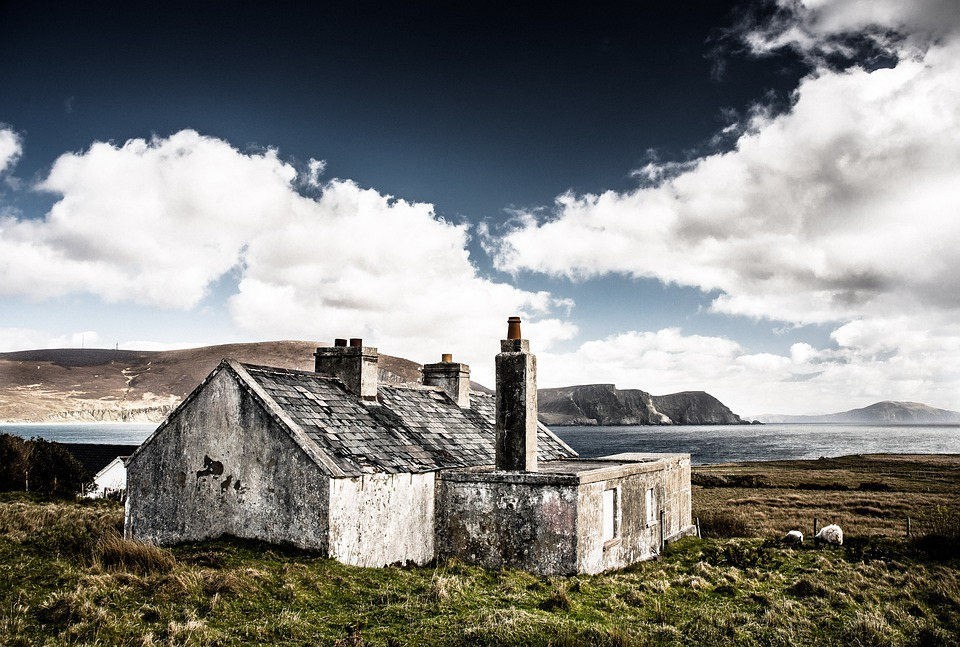
How can we tackle and quantify entropy and degradation in a world that, ideally never rots, breaks down or slows down. These examples would all fall under what I earlier described as external destruction. As we discussed before can these forces only enter the world of second life via external forces outside of the program itself. Outdated drives, invalid i.p addresses and the inevitable shutdown of a server. I would not argue that this is not to be seen as entropy in the world itself as the change of organic matter within an ecosystem or the reshaping of the planet itself. This would rather be a slow and inevitable degradation of the very framework of the world itself, the slow heat death of the universe.
Intentional destruction, as discussed before, pertains to the deletion or alteration of certain aspects of the worlds, either by the creators themselves, the creators of the program, or in some cases, by mellitus third parties such as hackers. These acts, are as the title implies, direct and intended acts of destruction, and can as a result not fall under our standard definition of entropy.
Abandoned lands
For a space to be considered abandoned in this text, must it still be available in the game world itself, but no longer in use by any of the original inhabitants or creators of the space. The space must also have fallen out of regular use and awareness of the population of Second Life in general. As long as these spaces are not actively removed, they will continue to exist in this state, in theory forever.
An area that has not been used, but not been deleted, will still exist within the world, unchanged, in status, until the server one day fails. While abandoned and left to their own devices, will their digital nature keep them from ever degrading or changing in any way, not unless any form of external or internal destruction occurs.

I have spent much time in these abandoned areas of second life in my travels of the program. It is an utterly serene, and horrifying notion to go through these still intact ruins, many of which will not be visited again for years, and will most likely never see use again. This state of affairs will however not last forever. As technology changes, code is rewritten, and new hardware is invented, these will become more and more out of sync with the rest of its reality. Visual objects will fail to load, links will break and, if care is not taken to renew these areas, will users eventually be unable to visit these areas altogether. And so, death comes to a digital land.
Reappropriation and renewal
Just as with the degradation and abandonment of an area, the appropriation and renewal of an area be made with even more of a direkt and active effort then any sort of real life area would need. Linden Labs as discussed earlier have the power to change, remove or regain control of any area or item in the game at any moment. This fact is not unique to Second life, and is indeed a basis to any website or internet product controlled by a single company. What sets Second life, and similar three dimensional chat rooms apart, is the visual aspects. Being able to control your character moving around a statue, and interact with it in real life, makes its disappearance, or replacement different, more tactile then if the same thing happened to say an image on a message board.
The size and scope of the current Second life servers makes it unlikely that many areas need to be removed, though lands on what is known as the mainland is regularly bought, sold and confiscated as it is, as Linden Labs put it “under their direct control”. Other lands are known as Estates, and are, in theory, under the direct control of whoever leases the land, though they are as well, truly under the control of Linden Labs, if they would choose to enact their powers. These estates will, just as land on the mainland, assuredly be taken back by Linden Labs if the users are found to be in breach of the companies terms of service. It is very likely that, due to the economic and popular demand of Second Life, that no region or item in under Linden Labs care will ever become so obsolete that it will become inaccessible, but this too, is also temporary in the grand scale of time.
Conclusions
It is very likely that, due to the economic and popular demand of Second Life, that no region or item in Linden Labs care will ever become so obsolete that it will become inaccessible, but even I have, in my short travels through the lands, found a fair share of unavailable modules, addresses that no longer exist, and textures replaced with error messages.
Second Life has reached its peak, and though their number of users seem stable, it is unlikely that it will make much of a resurgence in the future. So far the denizens of Second Life, and their worlds are safe from the slow breaking of their world, and if you stay within the populated areas, you would most likely not even notice it was happening.
But I implore you, if you ever visit Second Life, veer off the beaten paths, wander off into the never changing wilds, and behold the slow heat death of a universe with your own eyes.
Pictures taken from https://pixabay.com and used with their promition,
Short story: Sanctuary
A short tale of a scribe, and her battle with the inevitability of the future, and the struggle to keep the past alive. This is the second short story following an unnamed person, struggling with dangers and problems, much bigger then themselves.
Al images are used under the fair use, and taken from https://pixabay.com/ with the users permition.
Short story: the temple
A tale of a scholarly priestess, grappling with the questions of legacy and time. This is the first short story I am publishing online.
Pictures and background provided by Pixabay, under their free use license agreement. https://pixabay.com/
Media literacy 101: part 1, introduction
This series will be a quick introduction to the concepts and goals of media literacy, as well as why it is important to everyday life. This series will aim to answer three questions, as well as to arm the reader with a powerful set of tools to use in their everyday contact with a wide variety of media formas.
What is media literacy and why does it matter?
The skill of media literacy enables someone to critically evaluate, take in and create different forms of media. This skill allows the individual to detect biases, goals and intentions of the piece of media in front of them. The most prominent goal of media literacy education is to help the student to acquire knowledge of, and the ability to detect propaganda, as well as ideologically and emotionally changed material. This will allow the consumer to make active choices in their interaction with the media in questions.
Being fluent in media literacy also allows an individual to get more out of the media they consume. By becoming aware of trends and tropes, as well as thinking critically about the media we consume, will we be able to detect biases in our society, as well as within ourselves. By becoming aware of these biases can we make more informed choices on what we as individuals wish to support, or work against. In this way is media literacy a powerful tool in citizen awareness and the spread and protection of human rights and democracy.
Even though you have no interest in critically analysing texts professionally, you can still gain great advantages from being able to watch media with a more critical viewpoint. As mentioned before can these tools also be used on news, political debates or any other form of discourse that contains a form of message. Because of my educational background in literary studies, I have chosen to give these lessons and examples using pop culture, but these skills can be deployed in any of the above areas as well.
The Sender, the message and the receiver
We will focus on the dichotomy of the sender, or creator of the message, the message itself, the recipient, as well as how this relationship changes in various media forms. The sender in this equation is the creator of the message. This sender can be explicitly named and stated, or they can be implicit or implied. What is important is that there will always be a sender for a message to come into being, even if they are obscure or abstracted away.
The message in this context, is the very media itself, as well as the content that this piece of media is communication (more about this distinction later). Without this message, as well as the media that transports it, would communication not be possible. I am going to use the term Text in this series to describe a form of media that explicitly carries a message. In other words any form of media, like a book or a video game that sets out to communicate a set idea or message.
Finally we have the receiver or reader, the target for the message. A receiver is always implied, as even a message sent to no one in particular will have an intended recipient in order to be complete. Traditional communications theory presented the receiver as a passive and solely receptive part of this equation. Later studies centred the receiver or reader as an active participant in not only decoding the meaning of the message, but also as an active creator of meaning.
One theory holds that a message only gets a meaning once it is interpreted by a receiver. With the advent of social media and the web 2.0 has the lines between sender message and receiver, as the receiver is now able to directly interact with the message and the sender in the form of chat messages and comment fields and ratings. The one way communication has instead become a two way communication. A later chapter will deal exclusively with how these forms of participatory forms of communication have changed how we think about media literacy and communication in general.
Sender and intention
While consuming media is it fruitful to be aware of the fact that there is always a sender at the other end of the line, be that implicit or explicit. An explicit sender in this context would be a named author, creator or brand that is presented in the media itself. An implicit sender will be harder to detect, but is no longer present in order for the message to be sent, as discussed above.
It is a fruitful practice to analyse and try and discern the intended message of the sender. Furthermore can it be a good exercise to consider if the intended message is:
a) The sender being presented directly.
b) The sender that ends up coming across to the reviver.
c) The sender that is indirectly being presented.
By thinking critically about the sender and the intention of sending it, can we grasp a deeper understanding of the text itself. It is important that every intentional message has some form of sender. The goals, abilities and biases of this sender are all important parts of deconstruction and analysing a text.
When analysing a text, is it important to keep in mind that we are very rarely, if ever able to get to the actual intention of the sender, and often have to make due with deconstructing the meanings that can be found within the text itself. With this said, can it be a reading and informative exercise to, if the sender is known to you, investigate the context and social norms in which the sender worked. Understanding the context in which a person or team of people worked, might help us understand the messages they send out in the world.
The media and its content
I will give much time in this series to discuss various forms of texts, and how the makeup of these texts changes how they function, and how we interact with them. Our approach, even if its subconscious will naturally be different between a TV show, a film and a newspaper or a song. By understanding the forms and rules that each media form follows, can we gain a deeper appreciation for the text in front of us, as well as to start. To begin with we will focus on how these texts are traditionally understood, and we will later move on to more post structuralism approaches to creating and understanding texts.
Just as when discussing the sender, much each piece of media can be understood with its one frame of references and context. Nothing is after all, created in a bubble, and it’s important to try and understand where, when and how a text was created. It is equally important to be aware of our own biases, frames of references and prior experiences. Our world-views, opinions and experiences are very much going to colour our perception of a text. This is in and of itself not a bad thing, as long as we are aware that we are indeed colouring our perceptions of the thing we are examining.
Conclusions
These are a few of the topics that this series will include, and I will expand it as times goes on. For now this series is simply meant to be an introduction, and to aid in further reading and research in the subject of media literacy. The primary goal of this series is to make my readers more media savvy, as well as allow them to get more out of the media we all love to consume. This knowledge will also be useful to you in contexts out of pop culture and other entertainment.
This introductory chapter is a simple and quick start, as a way of dipping our toes into a rather large and complex topic that I will discuss over the coming months. I hope you are excited to go on this adventure with me!
Warcraft 3 and the otherness of the Horde: Trolls
Introduction
In the previous chapter of this series, did we get a glimpse on what in Anthropology for many years has been known as the “noble savage”. The so-called others that the European explorers encountered, individuals and communities though seen as other, and in many cases lesser, they were still seen as “good”, and in some cases even better then the corrupt western mind, due to their supposed simplicity and purity. In this chapter we will take a look at the other side of the image of the supposed savage, the one that did not get the western approval, and we will do this via the lenses of the modern troll in contemporary fantasy literature.
Voodoo, Vodou and the western narrative
The concept of Voodoo as it most commonly known in western popular culture is more often than not framed as something evil and or foreboding, strange and othering. Famous examples are the evil powers used by James Bond villains in Live and Let Die (1973) as well as the villains of Indiana Jones and the Temple of doom (1984). Similar negative and villainous portrayals can be found in many contemporary and later mainstream and pulp representations of Voodoo in western media. Common tropes of these representations are its focus on the otherness, exoticism and danger of the practice, as well as the fact that the practice is rarely, if ever described at its own terms. The first known example of horror films is the first Zombie movie, White zombie. Many examples of the negative stereotypes of Voodoo can be found in this movie, from exostisism, human sacrifice as well as snakes and skulls.
Just like with the chapter on the Tauren must I here reiterate that I am far from knowledgeable about the actual Just like with the chapter on the Tauren must I here reiterate that I am far from knowledgeable about the actual practices of Voodoo, or more specifically Vodou, or any adjacent faith structures, and I in no way claim to be. Keep this in mind however I discuss these practices in this and following texts. As a result will I in this text purely focus on how the depiction of the Trolls can be tied to tropes and stereotypes found in other western media regarding the views and stereotypes about Voodoo amongst its creators and audience.
Voodoo dolls, spirits and witch doctors are all terms that are common in the descriptions of Voodoo in popular western fiction, though rarely, if ever are they used in their indented contexts or meaning. Note that there are indeed exceptions to this rule, particularly in later years, but at the time of the release of warcraft 3 was Voodoo firmly in the realm of “strange otherness” for the vast majority of western audiences. Commuting with spirits, and the use of dolls to hurt and control victims are similarly very popular themes that seem to return several times in western media depicting the practice of Voodoo.
The savage, cannibal and the rebel
In the last chapter did we use the text of Ellingson (2001) to describe the more “benign” aspect of what has come to be known as the noble savage. This chapter will discuss the other side of that trope. Namely the people that the travailing anthropologists did not look at as favourably. Chief amongst these persevere traits were the concept of cannibalism, be it real or imagined by the western observer.
What is important for this chapter is that Haitian cultures and societies, during various points in history, have been tied, by western observers, to the practice of cannibalism as a way of lessening their worth as human beings. Ellingson (2001) further explains that in areas where cannibalism seems to be lacking, other atrocities such as mutilation or sacrifice of war prisoners could be used in its place, that way practically any “savage” could be tied to cannibalism by proxy.
The concept of alienation and savagery can easily be found in the direct connection to Voodoo, or Vodou as it is officially recognized, both in the Haitian and New Orleans incarnations. To truly understand the depth and importance of Voodoo for these areas, we must first discuss the Haitian revolution, and so many in the white western world (including me), have not thought about it. (Reinhardt, 2020)
Between the years of 1791 and 1804 did the former colony known today Haiti, carried out a successful revolt against their French colonial rulers, though many readers, just as myself, were probably not aware of this fact until now. The historian Reinhardt argues in his text, that the concept of a black revolt would be unthinkable for the contemporary white mind, slaves could run away, yes, they could kill their masters surely, but the concept of a black lead revolt was impossible to imagine, even less so a successful one. (Reinhardt, 2020)
This revolution is tightly linked to the Haitian Vodou faith and practices. A Vodou ceremony was in fact the place of the beginning of this rebellion. Furthermore is the practice of Voodoo, both in Haiti, and later the New Orleans branch, both clear examples of rebellion against colonial and racist powers imposed on their predominantly black practitioners. (Tussaint-strauss, 2020, Fandrich 2007)
Trolls in modern fantasy
The troll in modern fantasy, has as many other concepts, much of its roots to be found in J.R.R Tolkien’s massive works, as well as Germanic myths and legends. The modern troll is often described as strong, dumb, cruel and with a love for eating other sentient creatures, mainly human beings. A popular trope is furthermore that trolls are infamously difficult to damage with anything other then fire, due to their abnormal power of healing.
The modern Trolls serve descriptions and narrative uses within the fictions that they are depicted in. What matters for this text is that the troll, just as Orcs, Goblins and other monstrous creatures is almost always, if not exclusively presented as the other, the evil and the monstrous. Rarely, if ever, are these creatures pictured in a sympathetic or positive light.
Note that these creatures are physically humanoid, though always different, in often strange and grotesque ways. The most common version of the troll that we find in modern fantasy mirrors the versions found in Scandinavian folklore, as well as their reimagining in Tolkien’s mythos.
Trolls in warcraft 3
The version of the trolls we find in warcraft 3 follows many of the popular tropes discussed above. They are often the version of the trolls we find in warcraft 3 follows many of the popular tropes discussed above. They are often described as a cruel and sadistic race, taking pleasure in the pain they cause, they are furthermore very dangerous to kill off due to their ability to regenerate from what should be mortal wounds. Lastly have they been shown to have no problem in consuming other sentient races, as well as other trolls, this feature is so integral that they were given an ability to do so in the MMORPG World of warcraft, enabling the player to eat the corpses of defeated foes.
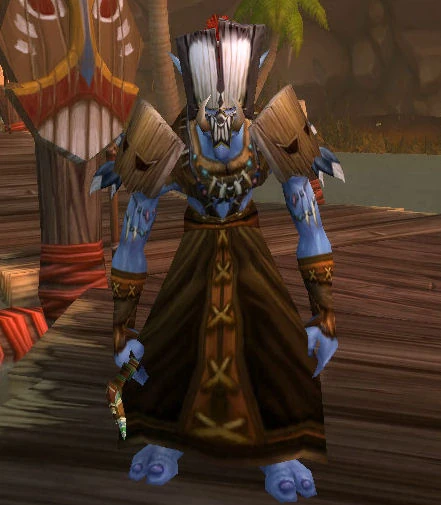
Many of the same terms and concepts that permeate contemporary western pop culture regarding Vodou can be found amongst the descriptions of the Warcraft 3 trolls. The most prominent and easily recognisable features being that one of their main military units, pictured above is known as the Witch Doctor. Furthermore are upgrades for Troll units found in a building known as the Voodoo lounge.
Many of the voice-lines of the troll characters make further references to stereotypical Voodoo related practices such as communing with spirits as well as mentioning good and bad mojo. Furthermore, do the two primary Troll units within the game, the witch doctor and the headhunter both use abilities that refer to the practices described above. The term headhunter hints at the soteriological Voodoo practice of gathering and shrinking enemies heads, while the term witch doctor is tightly tied to Voodoo and Vodou in the western imagination.

Like many other versions of the Troll in fantasy, are they depicted as more monstrous versions of the humanoid form, being tall, with enormous ears and noses. The troll is furthermore given a more bestial visage with the addition of two large tusks protruding from their face. Their alienation is made further with their blue skin tones, a trend that will continue with the Orcs. This visual can once again be prepared to the much more traditionally attractive human forms in the shapes of Humans, Elves and Dwarves respectively.
Conclusions
Once again have we seen that the creative design of Warcraft 3 shows their inspirations on its sleeves, for better or worse. the use of Vodou practices is in and of itself not the problem, but the combination of Vodou, and other Once again have we seen that the creative design of Warcraft 3 shows their inspirations on its sleeves, for better or worse. the use of Vodou practices is in and of itself not the problem, but the combination of Vodou, and other stereotypically negative “savage” tropes such as cannibalism does point at negative underlying stereotypes. This image of otherness amongst the trolls, is furthered the tropes of Vodou as well as negative “savage” tropes is given to a stereotypically monstrous race, the troll. The sensation of otherness is made quite clear when put in contrast with the human faction, that is not only predominantly shown to be white, but is also heavily coded as western and Christian in their presentation.
Just as the Tauren depiction seen in the last chapter, is the Trolls part of a wider system of tying Vodou and similar non white practices to cannibalism and other forms of brutal and savage traditions. As I have shown in this chapter is it not uncommon a trend can be found in the depictions of Vodou as evil or savage magic. The practice of condemning a foreign practice of religious philosophy, is one way of legitimizing your own as True faith. A practice that is, even though made subconsciously, continued in the text of Warcraft 3.
The choice to give the traits of traditionally coded Haitian Vodou practices to a monstrous races can not be understated, as well as the depiction of the Horde in general as a more bestial and primitive race, something that we will discuss further in the upcoming chapter on orcs can not be understated. Regardless of what the intention of this division was at the creation of the text, is it not possible to ignore the fact that it exists a stark contrast between the two major forces of the Horde and the Alliance, one having a distinctly western and “progressive” coding, while the other having a similarly distinct foreign and “savage coding. Note that foreign is here used to denote otherness, in this case, individuals other than the western culture and traditions.
The goal of this series is not to try and condemn and shame. My goal is to show how unchallenged tropes and subconscious biases can help produce hateful and derogatory depictions in the media we create. It is difficult to become aware of once biases and underlying narrative tropes without having them pointed out to you. It is my goal in this series to provide some examples of such biases and tropes to the reader, in the hopes of helping them discover their own biases, and if they choose, overcome them. While becoming aware of, and being able to reflect critically about these biases, will we be able to more inclusive, imaginative and engaging narratives in the future.
Sources
llingson, T. (2001). The myth of the noble savage. Berkeley, Calif.: University of California Press.
Reinhardt, T. (2005). 200 Years of Forgetting: Hushing up the Haitian Revolution. Journal of Black Studies, 35(4), 246-261. Retrieved September 13, 2021, from http://www.jstor.org/stable/40027220
Toussaint-strauss, Josh (2020) How ‘voodoo’ became a metaphor for evil, YouTube series
Zarka, E. (2020) The Origins of the Zombie, from Haiti to the U.S. | Monstrum YouTube series
Ramsey, K. (2012). From ‘Voodooism’ to ‘Vodou’: Changing a US Library of Congress Subject Heading. Journal of Haitian Studies, 18(2), 14-25. Retrieved September 13, 2021, from http://www.jstor.org/stable/41949200
Fandrich, I. (2007). Yorùbá Influences on Haitian Vodou and New Orleans Voodoo. Journal of Black Studies, 37(5), 775-791. Retrieved September 13, 2021, from http://www.jstor.org/stable/40034365
 An Unused Frequency