Media literacy 101: part 1, introduction

This series will be a quick introduction to the concepts and goals of media literacy, as well as why it is important to everyday life. This series will aim to answer three questions, as well as to arm the reader with a powerful set of tools to use in their everyday contact with a wide variety of media formas.

What is media literacy and why does it matter?

The skill of media literacy enables someone to critically evaluate, take in and create different forms of media. This skill allows the individual to detect biases, goals and intentions of the piece of media in front of them. The most prominent goal of media literacy education is to help the student to acquire knowledge of, and the ability to detect propaganda, as well as ideologically and emotionally changed material. This will allow the consumer to make active choices in their interaction with the media in questions.

Being fluent in media literacy also allows an individual to get more out of the media they consume. By becoming aware of trends and tropes, as well as thinking critically about the media we consume, will we be able to detect biases in our society, as well as within ourselves. By becoming aware of these biases can we make more informed choices on what we as individuals wish to support, or work against. In this way is media literacy a powerful tool in citizen awareness and the spread and protection of human rights and democracy.

Even though you have no interest in critically analysing texts professionally, you  can still gain great advantages from being able to watch media with a more critical viewpoint. As mentioned before can these tools also be used on news, political debates or any other form of discourse that contains a form of message. Because of my educational background in literary studies, I have chosen to give these lessons and examples using pop culture, but these skills can be deployed in any of the above areas as well.

The Sender, the message and the receiver

We will focus on the dichotomy of the sender, or creator of the message, the message itself, the recipient, as well as how this relationship changes in various media forms. The sender in this equation is the creator of the message. This sender can be explicitly named and stated, or they can be implicit or implied. What is important is that there will always be a sender for a message to come into being, even if they are obscure or abstracted away.

The message in this context, is the very media itself, as well as the content that this piece of media is communication (more about this distinction later). Without this message, as well as the media that transports it, would communication not be possible. I am going to use the term Text in this series to describe a form of media that explicitly carries a message. In other words any form of media, like a book or a video game that sets out to communicate a set idea or message.

Finally we have the receiver or reader, the target for the message. A receiver is always implied, as even a message sent to no one in particular will have an intended recipient in order to be complete. Traditional communications theory presented the receiver as a passive and solely receptive part of this equation. Later studies centred the receiver or reader as an active participant in not only decoding the meaning of the message, but also as an active creator of meaning.

One theory holds that a message only gets a meaning once it is interpreted by a receiver. With the advent of social media and the web 2.0 has the lines between sender message and receiver, as the receiver is now able to directly interact with the message and the sender in the form of chat messages and comment fields and ratings. The one way communication has instead become a two way communication. A later chapter will deal exclusively with how these forms of participatory forms of communication have changed how we think about media literacy and communication in general.

Sender and intention

While consuming media is it fruitful to be aware of the fact that there is always a sender at the other end of the line, be that implicit or explicit. An explicit sender in this context would be a named author, creator or brand that is presented in the media itself. An implicit sender will be harder to detect, but is no longer present in order for the message to be sent, as discussed above.

It is a fruitful practice to analyse and try and discern the intended message of the sender. Furthermore can it be a good exercise to consider if the intended message is:
a) The sender being presented directly.
b) The sender that ends up coming across to the reviver.
c) The sender that is indirectly being presented.

By thinking critically about the sender and the intention of sending it, can we grasp a deeper understanding of the text itself. It is important that every intentional message has some form of sender. The goals, abilities and biases of this sender are all important parts of deconstruction and analysing a text.

When analysing a text, is it important to keep in mind that we are very rarely, if ever able to get to the actual intention of the sender, and often have to make due with deconstructing the meanings that can be found within the text itself. With this said, can it be a reading and informative exercise to, if the sender is known to you, investigate the context and social norms in which the sender worked. Understanding the context in which a person or team of people worked, might help us understand the messages they send out in the world.

The media and its content

I will give much time in this series to discuss various forms of texts, and how the makeup of these texts changes how they function, and how we interact with them. Our approach, even if its subconscious will naturally be different between a TV show, a film and a newspaper or a song. By understanding the forms and rules that each media form follows, can we gain a deeper appreciation for the text in front of us, as well as to start. To begin with we will focus on how these texts are traditionally understood, and we will later move on to more post structuralism approaches to creating and understanding texts.

Just as when discussing the sender, much each piece of media can be understood with its one frame of references and context. Nothing is after all, created in a bubble, and it’s important to try and understand where, when and how a text was created. It is equally important to be aware of our own biases, frames of references and prior experiences. Our world-views, opinions and experiences are very much going to colour our perception of a text. This is in and of itself not a bad thing, as long as we are aware that we are indeed colouring our perceptions of the thing we are examining.

Conclusions

These are a few of the topics that this series will include, and I will expand it as times goes on. For now this series is simply meant to be an introduction, and to aid in further reading and research in the subject of media literacy. The primary goal of this series is to make my readers more media savvy, as well as allow them to get more out of the media we all love to consume. This knowledge will also be useful to you in contexts out of pop culture and other entertainment.

This introductory chapter is a simple and quick start, as a way of dipping our toes into a rather large and complex topic that I will discuss over the coming months. I hope you are excited to go on this adventure with me!
Warcraft 3 and the otherness of the Horde: Trolls

Introduction

In the previous chapter of this series, did we get a glimpse on what in Anthropology for many years has been known as the “noble savage”. The so-called others that the European explorers encountered, individuals and communities though seen as other, and in many cases lesser, they were still seen as “good”, and in some cases even better then the corrupt western mind, due to their supposed simplicity and purity. In this chapter we will take a look at the other side of the image of the supposed savage, the one that did not get the western approval, and we will do this via the lenses of the modern troll in contemporary fantasy literature.

Voodoo, Vodou and the western narrative

The concept of Voodoo as it most commonly known in western popular culture is more often than not framed as something evil and or foreboding, strange and othering. Famous examples are the evil powers used by James Bond villains in Live and Let Die (1973) as well as the villains of Indiana Jones and the Temple of doom (1984). Similar negative and villainous portrayals can be found in many contemporary and later mainstream and pulp representations of Voodoo in western media. Common tropes of these representations are its focus on the otherness, exoticism and danger of the practice, as well as the fact that the practice is rarely, if ever described at its own terms. The first known example of horror films is the first Zombie movie, White zombie. Many examples of the negative stereotypes of Voodoo can be found in this movie, from exostisism, human sacrifice as well as snakes and skulls.

Just like with the chapter on the Tauren must I here reiterate that I am far from knowledgeable about the actual Just like with the chapter on the Tauren must I here reiterate that I am far from knowledgeable about the actual practices of Voodoo, or more specifically Vodou, or any adjacent faith structures, and I in no way claim to be. Keep this in mind however I discuss these practices in this and following texts. As a result will I in this text purely focus on how the depiction of the Trolls can be tied to tropes and stereotypes found in other western media regarding the views and stereotypes about Voodoo amongst its creators and audience.

Voodoo dolls, spirits and witch doctors are all terms that are common in the descriptions of Voodoo in popular western fiction, though rarely, if ever are they used in their indented contexts or meaning. Note that there are indeed exceptions to this rule, particularly in later years, but at the time of the release of warcraft 3 was Voodoo firmly in the realm of “strange otherness” for the vast majority of western audiences. Commuting with spirits, and the use of dolls to hurt and control victims are similarly very popular themes that seem to return several times in western media depicting the practice of Voodoo.

The savage, cannibal and the rebel

In the last chapter did we use the text of Ellingson (2001) to describe the more “benign” aspect of what has come to be known as the noble savage. This chapter will discuss the other side of that trope. Namely the people that the travailing anthropologists did not look at as favourably. Chief amongst these persevere traits were the concept of cannibalism, be it real or imagined by the western observer.

What is important for this chapter is that Haitian cultures and societies, during various points in history, have been tied, by western observers, to the practice of cannibalism as a way of lessening their worth as human beings. Ellingson (2001) further explains that in areas where cannibalism seems to be lacking, other atrocities such as mutilation or sacrifice of war prisoners could be used in its place, that way practically any “savage” could be tied to cannibalism by proxy.

The concept of alienation and savagery can easily be found in the direct connection to Voodoo, or Vodou as it is officially recognized, both in the Haitian and New Orleans incarnations. To truly understand the depth and importance of Voodoo for these areas, we must first discuss the Haitian revolution, and so many in the white western world (including me), have not thought about it. (Reinhardt, 2020)

Between the years of 1791 and 1804 did the former colony known today Haiti, carried out a successful revolt against their French colonial rulers, though many readers, just as myself, were probably not aware of this fact until now. The historian Reinhardt argues in his text, that the concept of a black revolt would be unthinkable for the contemporary white mind, slaves could run away, yes, they could kill their masters surely, but the concept of a black lead revolt was impossible to imagine, even less so a successful one. (Reinhardt, 2020)

This revolution is tightly linked to the Haitian Vodou faith and practices. A Vodou ceremony was in fact the place of the beginning of this rebellion. Furthermore is the practice of Voodoo, both in Haiti, and later the New Orleans branch, both clear examples of rebellion against colonial and racist powers imposed on their predominantly black practitioners. (Tussaint-strauss, 2020, Fandrich 2007)

Trolls in modern fantasy

The troll in modern fantasy, has as many other concepts, much of its roots to be found in J.R.R Tolkien’s massive works, as well as Germanic myths and legends. The modern troll is often described as strong, dumb, cruel and with a love for eating other sentient creatures, mainly human beings. A popular trope is furthermore that trolls are infamously difficult to damage with anything other then fire, due to their abnormal power of healing.

The modern Trolls serve descriptions and narrative uses within the fictions that they are depicted in. What matters for this text is that the troll, just as Orcs, Goblins and other monstrous creatures is almost always, if not exclusively presented as the other, the evil and the monstrous. Rarely, if ever, are these creatures pictured in a sympathetic or positive light.

Note that these creatures are physically humanoid, though always different, in often strange and grotesque ways. The most common version of the troll that we find in modern fantasy mirrors the versions found in Scandinavian folklore, as well as their reimagining in Tolkien’s mythos.

Trolls in warcraft 3

The version of the trolls we find in warcraft 3 follows many of the popular tropes discussed above. They are often the version of the trolls we find in warcraft 3 follows many of the popular tropes discussed above. They are often described as a cruel and sadistic race, taking pleasure in the pain they cause, they are furthermore very dangerous to kill off due to their ability to regenerate from what should be mortal wounds. Lastly have they been shown to have no problem in consuming other sentient races, as well as other trolls, this feature is so integral that they were given an ability to do so in the MMORPG World of warcraft, enabling the player to eat the corpses of defeated foes.

Voodoo | WoWWiki | Fandom
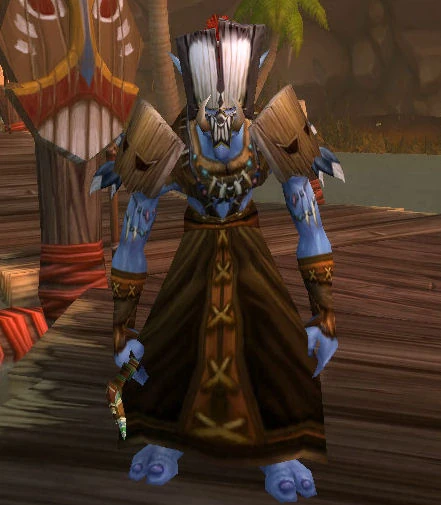
Troll witch doctor.

Many of the same terms and concepts that permeate contemporary western pop culture regarding Vodou can be found amongst the descriptions of the Warcraft 3 trolls. The most prominent and easily recognisable features being that one of their main military units, pictured above is known as the Witch Doctor. Furthermore are upgrades for Troll units found in a building known as the Voodoo lounge.

Many of the voice-lines of the troll characters make further references to stereotypical Voodoo related practices such as communing with spirits as well as mentioning good and bad mojo. Furthermore, do the two primary Troll units within the game, the witch doctor and the headhunter both use abilities that refer to the practices described above. The term headhunter hints at the soteriological Voodoo practice of gathering and shrinking enemies heads, while the term witch doctor is tightly tied to Voodoo and Vodou in the western imagination.

World of Warcraft: Cataclysm Vol'jin Sylvanas Windrunner Troll, world of  warcraft, fictional Character, mythology, warlord png | PNGWing
Source: https://www.pngwing.com/en/free-png-zordk

Like many other versions of the Troll in fantasy, are they depicted as more monstrous versions of the humanoid form, being tall, with enormous ears and noses. The troll is furthermore given a more bestial visage with the addition of two large tusks protruding from their face. Their alienation is made further with their blue skin tones, a trend that will continue with the Orcs. This visual can once again be prepared to the much more traditionally attractive human forms in the shapes of Humans, Elves and Dwarves respectively.

Conclusions

Once again have we seen that the creative design of Warcraft 3 shows their inspirations on its sleeves, for better or worse. the use of Vodou practices is in and of itself not the problem, but the combination of Vodou, and other Once again have we seen that the creative design of Warcraft 3 shows their inspirations on its sleeves, for better or worse. the use of Vodou practices is in and of itself not the problem, but the combination of Vodou, and other stereotypically negative “savage” tropes such as cannibalism does point at negative underlying stereotypes. This image of otherness amongst the trolls, is furthered the tropes of Vodou as well as negative “savage” tropes is given to a stereotypically monstrous race, the troll. The sensation of otherness is made quite clear when put in contrast with the human faction, that is not only predominantly shown to be white, but is also heavily coded as western and Christian in their presentation.

Just as the Tauren depiction seen in the last chapter, is the Trolls part of a wider system of tying Vodou and similar non white practices to cannibalism and other forms of brutal and savage traditions. As I have shown in this chapter is it not uncommon a trend can be found in the depictions of Vodou as evil or savage magic. The practice of condemning a foreign practice of religious philosophy, is one way of legitimizing your own as True faith. A practice that is, even though made subconsciously, continued in the text of Warcraft 3.

The choice to give the traits of traditionally coded Haitian Vodou practices to a monstrous races can not be understated, as well as the depiction of the Horde in general as a more bestial and primitive race, something that we will discuss further in the upcoming chapter on orcs can not be understated. Regardless of what the intention of this division was at the creation of the text, is it not possible to ignore the fact that it exists a stark contrast between the two major forces of the Horde and the Alliance, one having a distinctly western and “progressive” coding, while the other having a similarly distinct foreign and “savage coding. Note that foreign is here used to denote otherness, in this case, individuals other than the western culture and traditions.

The goal of this series is not to try and condemn and shame. My goal is to show how unchallenged tropes and subconscious biases can help produce hateful and derogatory depictions in the media we create. It is difficult to become aware of once biases and underlying narrative tropes without having them pointed out to you. It is my goal in this series to provide some examples of such biases and tropes to the reader, in the hopes of helping them discover their own biases, and if they choose, overcome them. While becoming aware of, and being able to reflect critically about these biases, will we be able to more inclusive, imaginative and engaging narratives in the future.

Sources

llingson, T. (2001). The myth of the noble savage. Berkeley, Calif.: University of California Press.

Reinhardt, T. (2005). 200 Years of Forgetting: Hushing up the Haitian Revolution. Journal of Black Studies, 35(4), 246-261. Retrieved September 13, 2021, from http://www.jstor.org/stable/40027220

Toussaint-strauss, Josh (2020) How ‘voodoo’ became a metaphor for evil, YouTube series

Zarka, E. (2020) The Origins of the Zombie, from Haiti to the U.S. | Monstrum YouTube series

Ramsey, K. (2012). From ‘Voodooism’ to ‘Vodou’: Changing a US Library of Congress Subject Heading. Journal of Haitian Studies, 18(2), 14-25. Retrieved September 13, 2021, from http://www.jstor.org/stable/41949200

Fandrich, I. (2007). Yorùbá Influences on Haitian Vodou and New Orleans Voodoo. Journal of Black Studies, 37(5), 775-791. Retrieved September 13, 2021, from http://www.jstor.org/stable/40034365

Warhammer 40k an in depth analysis: Part 4, The Necrons: part 2, The ancient terrors

Ancient Egypt has for decades inspired modern man with their mystery, and seeming fixation with death and reincarnation. The mystery hieroglyphs and monuments of this long lost civilisation has inspired fantasy, horror sand sciense fiction writer since the early 1800s. In this chapter will we delve in to the origins of these tropes, as well as some examples of the tropes that eventually led up tot he modern interpretation of the Necrons in the 7th edition of Warhammer 40k.

Ancient Egypt

until the discovery of the Rosetta stone was the texts of the ancient Egyptians a total mystery to the western researchers and archaeologists, as well as the general public. The strange animal headed gods, the mummified remains and the ominous structures and tombs awoken something in the public consciousness of the general public of the time. The text The tomb by Edgar Allan Poe, as well as numerous texts by HP Lovecraft al played on these new fears and fascinators.

The pop cultural fascination with ancient Egypt have not waned since then, and lived on trough several movies, comic books and physical and electronic games. Most relevant to this text is the faction the Tomb Kings, found in the Warhammer Fantasy franchises, also published and produced by Games Workshop, the creators of Warhammer 40k. This faction draws some clear and obvious inspirations to real life Egypt, as well as many of the theories of earlier theories of Egypt. Much of the faction, as the title suggests is based on the Egyptians connection with death and mummifications, as they are a faction made fully out of undead retextures, and hailing form a civilisation that is described as being obsessed with the quest of overcoming death. Note that these are themes that can be found in the Necrons as well. The Tomb kings are worthy of their own text eventually, as they share some interesting ties to real life events, as well as old cultural fears of orientalism and the great Crusades. The Tomb Kings, as well as the Necrons both play with the idea that some secrets are best left in the earth, undisturbed.

Let the dead rest where they lie

The idea of forbidden or dangerous secrets being buried by ancient lost civilisations is far form a new idea. From aliens and interdimensional creatures, to mycological monsters and fey, it seems that the idea of predecessor civilisations and deities have seemingly haunted the human imaginations for as long as ruins could be found. A well known myth is the idea of the pharaohs curse, once again originating in Egypt, where the texts found inside tombs of pharaohs believed to be wards designed to cure intruders. These texts were later translated and found to be used to primarily ward off evil spirits, and not mortal invaders.

Arriving on an alien seminally deserted planet, only to later find out that it is indeed filled with ruins, and possible remnants of a possibly malicious alien race is a common sciences fiction trope. The Necrons follows in this reach cultural tradition by presenting them as a poorly understood, and previously overlooked danger from the past. As discussed in the Adeptus Mechanicus chapter, the world of Warhammer 40k is one full of buried dangers and secrets bet lost in the past. The Necrons furhter cements the universe as a cold, pitiless and dangerous place for humanity to explore.

Necrons and the other races

The the human factions the Necrons has, at least until the ninth edition (a topic for a later time), been seen exclusivity as an unknowable foe. This role is not their only one tough, and I will here present the main uses that the Necrons fall in to in the wider narrative of the Warhammer 4k universe.

The old foes of the Necrons still live across the stars, most predominately the Orcs and the Eldar. Both of these factions are seemingly created by the Old once with the direct purpose of stopping the Necrons, something they were inevitably unable to do, but of vastly different reasons. The Eldar of the 41th millennium is constantly vigilant against the arrival of their old foes, and will sacrifice much to make sure that their burgeoning empire is safe from these terrors. The Orks on he other hand see them as just another foe to fight, tough just as with the Eldar, they find their technology to digest and complicated to properly loot and incorporate in to their own designs.

From the Necron point of view, these are just another hurdle to overcome, another plague of life that needs to be eradicated form the face of the universe. Many Eldar tales and myths tells about the return of the Necrons as the ancient foes. Many stories centring on the Eldar is indeed focused on fighting the deathless once.

For the races of humanity and Tau, the Necrons are an unknowable nightmare of death and destruction. Humanity in particular, as a result of being the galaxies most prominent inhabitant has met most of the Necrons ire. Humanity has had several traumatic experiences with the Necrons, often leading to the utter destruction of the hapless human populations involved. When victory is achieved it is always at a great cost for the humans involved (Games Workshop 2015). It is easy yo draw parallelises between the use of the Necrons in the Warhammer 40k franchise, and a similar faction from the Start Trek franchise, namely the Borg. Both are positioned as unimaginably advanced mindless creatures with no other interest then to subjugate and destroy their human adversaries. (Paramount Pictures 2002)

One of the more interesting facets of the 40k universe is indeed the sense of intermitted destruction, only held at bay by other, equally catastrophic forces of destruction. The rise of chaos is for example directly at odds with the goals of the Deathless Necrons and the every consuming Tyranids. (Games Workshop 2015)

Conclusions

In this chapter I have presented you to a small number of inspiration and tropes from real life as well as previous fictional works. We have also discussed how their role as an ever present unknowable evil can be understood in relationship to the rest of the narrative. We can see how the mysteries of ancient Egypt, as well as tales of death and resurrection has been an inspiration for fantasy and existential horror, and how these themes eventually found their way in to the Necrons of the 7th edition of the Warhammer 40k franchise. Next chapter of this series will conclude our discussions on the Necrons for now, before moving on to the other existentialist horror of the franchise, the Tyranids!

References

Games Workshop (2015) Codex: Necrons. Games Workshop

Cavendish, R. (1983). The Black Arts: A Concise History of Witchcraft, Demonology, Astrology, and Other Mystical Practices Throughout the Ages. TarcherPerigee

Paramount Pictures. (2002). Star trek, the next generation.

Warhammer 40k an in depth analysis: Part 4, The Necrons: part 1, The deathless once

The ancient enemy of the Eldar, and the Old once, they gave their souls in return for endless life. The Necrons represents an ageless, unknowable evil in the Warhammer 40k setting, their technology so advanced, they seem to have magical powers.

Introduction

As always will I begin my series with a quick rundown on the major topics series, as well as giving a general overview of what the faction is about. I want to in this series use the Necrons to discuss a few topics, chief amongst them being, the individual and the collective, death and rebirth, the Necrons complicated relationships to their gods.

https://i.pinimg.com/originals/ec/87/06/ec8706b50395fbcd8fb6482e6cc8950b.jpg
Source: Necrons codex 7th edition, Games workshop 2015

War and sickness

The story of the Necrons is one of suffering and strife, like many narratives in the 40 universe. Plague and war are themes that runs trough the factions narratives, I will begin this text by giving a short summery of the Necrons in universe history.

The age of the Necrontyr

The Necrons was once a mortal race, made out of flesh and bones, known as the Necrontyr The race of the Necrontyr is described as a warlike race which short life spans full of suffering and illness. This fate has lead them to developed a burning obsession with death and immortality. They searched outwards towards the starts to find the secrets to life and death. As their armies expanding ever outwards, their kings and priests devoted their times to gain mortality via rituals, research and the great acts of fame and infamy. As their empire grew, the Necrontyr eventually fell to infighting, and it was this division that eventually forced the Necrontyr rulers to find an external enemy to fight. They chose for their foes was the immortal Old Once, the future creators of the Eldar race. The Necrontyr despised that the long-lived and tranquil Old Once refused to share the secret of immortality with the long suffering Necrontyr. (Games workshop 2015)

War of the heavens

The Necrontyr greatly underestimated the power of their foes. In an hour of desperation their ruler, known as the Silent king made a deal with ancient and all-powerful gods, known as the C’tan . He offered the the servitude of his entire races, for the gift of immortality, as well as the power to smite their foes. The C’tan offerd the Necrons the secrets of a process known as the biotransferences. This arcane procedure transformed the Silent kings subjects from the mortal Necrontyr of flesh and blood, to immortal Necrons of steel and plasma. This king, known as Szarekh, later realized what he had done to his races, and lead the Necrons against their former masters, managing to break doen the seemingly immortal C’tan and enslave the remaining shadowy forms of their former gods.

In the end, both the C’tan, and the Old Once lay defeated, but the Necrons were to wounded and scattered to continue properly rule their new empire. The silent king Szarekh ordered al his subjects to go in to hibernation, and return only once the galaxy was once again ripe for conquest. (Games workshop, 2015)

The awakening

the Nercons awaken decades later to find a galaxy infested with new adversaries, as well as old foes. The Necrons awoke scattered, disorganized, and in some cases, quite mad. One of the more intriguing facets of the Necron narrative, is what the passage of time has done to them during their cryosleep, as endless aeons have not left them without wounds. Despite these early setbacks, the Necrons have managed to slowly retake more and more of their former empires Their technology vastly outshining anything that the other races have to their disposal. Here is where the cosmic horror of the Necrons comes from. they are portrayed as an ancient, sleepless race of death machines who have managed killed their own gods. It is not a question of if the Necrons will return, it is a question of when. (Games workshop, 2015)

Death, reincarnation, and the individual

The Necron society is represented to be built on honour, war and a strict cohesion to hierarchy. The overlords and kings at the top being able to freely pursue any agenda they see fit, while the lowly Warrior and scarabs are little more then an automata, with only middling consciousness remaining.

Gods and masters

The C’tan, being the architects of the Necrontyrs transformation in to the Necrons was first lorded as gods by their followers, the Necrons. In return for immortality and power, the Necron would swear endless servitude to their new gods.

The highest members of the Necron society, the priests, researchers and rulers are the only individuals that were allowed to keep their personality, autonomy and memories intact when the when trough the biotransference. In fact, the codex descries how, not only these individuals persevered by their new bodies, and their ambitiousness now freed from mortal fears and desires greatly enhanced their powers.

Many of the Necron worlds are described to have been lost during the season of cryosleep, and even those who have remained intact, have come out changed. Their vital programming irreversibly damaged, and the inhabitants have often awoken with a strained grasp on reality, at best. The dichotomy of madness, and soulless logic is one of many opposing themes that can be found within the Necron narrative. (Games workshop, 2015)

Slaves and servants

The lesser casts of the Necrontyr were not deemed worthy of being fully transformed, in the same manner as their masters were. Instead only the tiniest bit of each individual was preserved within each Necron Warrior. These Warriors are now traded, stolen, and discarded much like any other commodity would, and the Necron lords regard them with as little empathy as the weapons they carry.

Following betrayal of the C’tan, these once world ending deities split up were, enslaved turned in to mere tools to the pragmatic and power hungry Necrons.The masters had effectively become the slaves. The C’tan of the 41th millennium is used as glorified energy sources for al manner of twisted and horrendous war machines, much to the joy of their Necron captors. (Games workshop 2015)

Science and magic

We once again return to the topic of sciense and magic within the world of Warhammer 40k. We find the same common trend of mixing the terminology of magic, with that of the scientific. Note that much of these descriptions comes from the viewpoint of the enemies of the Necrons, who see their advanced technology akin to mysticism and arcane wonders. (Games workshop 2015)

Techno-sorcery

The levels of technological mastery of the Neconrs is has allowed them to bend the very laws of physics to their whims. They are able to slow down down time, travel to time and space in an instant, or to service possible futures. This power is at once decried as mystical and purely scientific. Nowhere else is this duality made more clear as in the term for the arts of the Necron Scientist use, “techno sorcery”.

Cryptek - Warhammer 40k - Lexicanum
Source: https://wh40k.lexicanum.com/wiki/Cryptek

Just like with the Humans and Dark Eldar of the Warhammer 40k universe, is technological and scientific know-how bound to a specific, often secretive group of individuals, in the case of the Necrons, the Cryptek. The names of the individuals can either derive from the word crypt, as in the funeral complex, or the term cryptic, as well as the term technology or technician. Furthermore, the rest of the (sentient part) of the Necron society seems to be fully or partially apathetic to how these scientific marvels function, only that they do so. (Games workshop 2015)

The blending of science and magic, as well as limiting knowledge and wisdom of al things scientific and mechanical to a certain small group, often referred to in some form of arcane society, are themes that will return over and over again trough out the Warhammer 40k series. The apparent apathy of the wider societies of Necrons, Eldar and Humans alike, is also a theme that will continue to return again and again. We have already seen the same pattern a few times with the human Tech priests, and the Dark Eldar Homunculi.

Prophesies and magic

The most apparent trend of mixing magic and sciense, when it comes to the Necrons comes in their use of astrology to try and perceive future events, and if possible change them to their liking. The use of astrology is another theme that we have seen both in the Eldar properties, as well as in the Emperors tarot used by human scholars. Despite the Necrons being described as a fully scientific and logically based society, they still follow the arcane rules of astrology. In most occult traditions is this rule known by the phrase “as above, so believe”, referring to the idea that the starts, and the lives of mortals are inexplicitly linked. The happenstance of one will directly relate to the other. The starts guides the life of mortals, just as much as the mortals guide the paths of the stars (Cavendish 1983).

Conclusions

In this chapter have I presented some base concepts relating to the Necrons, as well as some of the thematic Thematic elements they share with the rest of the 40k universe universe. I have presented the themes of strict hierarchies that can be found within the Necron narratives, as well as an ever present focus on life, death and immorality. Like many other factions is the Necrons also a faction of endless war and strife, a fact we will discuss further at a later date. Lastly have I here tied the Necrons to a tradition of deliberately mixing and mystifying technology and sciense, by blending it with images of the occult and mystical.

The Necrons themselves presents an unknowable threat to all life in the universe. An unfathomable ancient spectre that has returned to exterminate all life, and reinstate their proper rule over all. I will in the next Necron chapter discuss some of the Necrons real life inspirations, as well as how they fit in to the wider narrative traditions of sciense fiction.

References

Games Workshop (2015) Codex: Necrons. Games Workshop

Cavendish, R. (1983). The Black Arts: A Concise History of Witchcraft, Demonology, Astrology, and Other Mystical Practices Throughout the Ages. TarcherPerigee

Warcraft 3 and the otherness of the Horde: The Tauren

Introduction

The image of the Native American “noble savage” has persisted for decades in the public continuousness of the Western world. The image that mostly comes to mind seems to be the red skinned man, dressed in a large feather headdress and speaking “old truths of nature and the spirits”. In this text I aim to compare this stereotypical presentation of a northern Native American, to a faction of warcraft 3 known the Tauren.

The noble savage

The concept of the noble savage is often used in Western enlightenment philosophy as a tool to distance the so called logical westerner from the native, so called savages of the other nations of the world. Mostly this tactic us used as a way to justify the colonisation and exploitation of what the Europeans saw as lesser nations. It was the duty of the so called educated man to spread logic, enlightenment and Christian values to these people. (Ellingson, T. 2001).

This image is also used as a way to show that the supposed simple and pure lives of what the European settlers and travellers saw as as the savage cultures and people. The idea of the noble savage in this sense, is used as a way to argue against cultural and political movements that the author saw as corrupting and damning for humanity. Industrialization, high art and libertarianism was a common target for these critiques. (Ellingson, T. 2001).

The idea of the noble savage was also often used in early anthropology. Mostly it was used to describe a culture that they saw as free from the corrupting influences of civilization. The myth of the noble savage dictates that every human culture originated in a state of instinctual coexistence with nature. (Ellingson, T. 2001).

A critical definition between a savage and a noble savage, presented by some authors stem mainly from perceived moral and ethical characteristics, one of these characteristics being the consumption of human flesh. Note that this definition is solely the construction of the European observer, and observers drive to categorize and put individuals in to easily understood terms. The native North American of northern America and Canada, happening to have certain characteristics that the European observer valued, such as hunting abilities, caring for the commune and humility elevated them from mere savage to the title of the noble savage. (Ellingson, T. 2001).

Depiction in popular culture

The stereotyping of Washington Redskins marketing, naming and icons is a common example of exotification of the native American culture and traditions is one of the more famous example, both nationally and internationally.

Ponca Tribe reacts to Washington Redskins' name change | KPTM
Source: https://fox42kptm.com/news/local/uno-intnl-students

The American football team has only recently, (mid 2020), changed their names, after facing decades of ire and anger. The image of the feather head dress wearing chieftain who resides in tikis and builds colourful totems is one that can be found in everything form children’s cartoons, to the aforementioned national sports teams.

The history of exotification of the the Native American individual is not a tradition that is exclusive to American, as evident but the Swedish hockey team called the “Förlunda Vikings”, that uses a very stereotypical image of a native American mas as a mascot.

Frölunda HC - Wikipedia
Source: https://en.wikipedia.org/wiki/Fr%C3%B6lunda_HC

Note the mere act of using this iconography is not in itself an act of using topes, but tying it directly to the specific group of native American, or” Indian”, is. The instance of the feather head-dress and facial painting being one telling serotype of the native American depicted in popular culture.

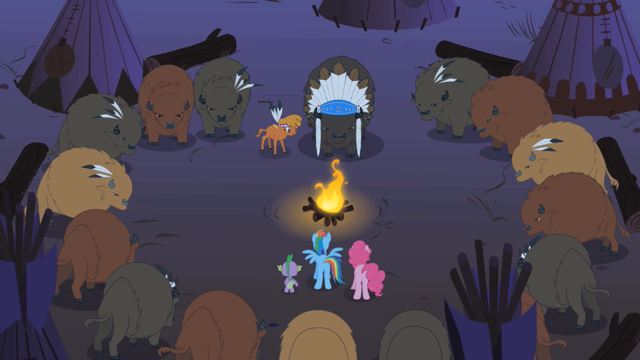
https://buffy.mlpforums.com/monthly_08_2014/post-26550-0-91715500-1409177145.png
Source: Mlp fim season 1 episode 21 Over a Barrel

Besides a focus on the visual similarities depicted in many types of western media, does the idea of the noble savage seem to persist throughout much of them. Depicting the native Americans as sensitive, but uneducated individual living with and off the land, and deeply in tune with nature. This is often set in contrast to the more “civilized” western coded society, that is often depicted as more cultured, but at the same time more corrupt and decadent. Above is an example where the buffalo is used as a more naturalist Other, to the more industrialist and “western” pony settlers.

This is far from even beginning to be able to list al the instances of Northern native American culture being using in this way, but simply meant to give a simple overview of some varying depiction trough different media forms.

The Tauren

The noble and peaceful Tauren lives in great tents in the wild open plains. By praying to large totem poles they pay their respects to the spirits of nature and the wild. It is not difficult to find connections between the depiction of the Tauren of Warcraft and stereotypes associated with the northern Native American. More specifically the the stereotype regarding idea that, the Native American is a wild savage that lives at one with the nature. The Tauren fits well in to in the same narrative as the Native American has often been used in, as an exoitified other to the industrial and scientistic minded West, or in the case of Warcraft the human lead factions of the Alliance. (Blizzard 2012)

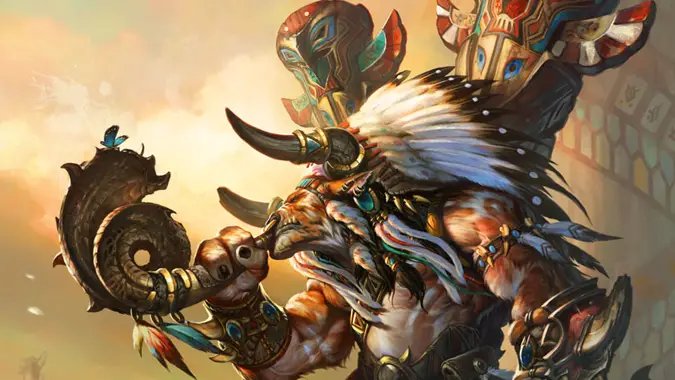
Source: https://blizzardwatch.com/wp-content/uploads/2016/01/baine_bloodhoof_glowei_header.jpg

Visually the Tauren has the closest ties to the mythical figure of the Minotaur, the half man half bull creature of great strength and anger. It is interesting to note that the depiction of the Tauren in Warcraft differ greatly from the normal tropes that are usually associated with the creature. Taking it origins as one of the most aggressive monsters of Greek myth, it is interesting that this creature of al available visual designs was chosen to represent the noble and peace loving Taurean.

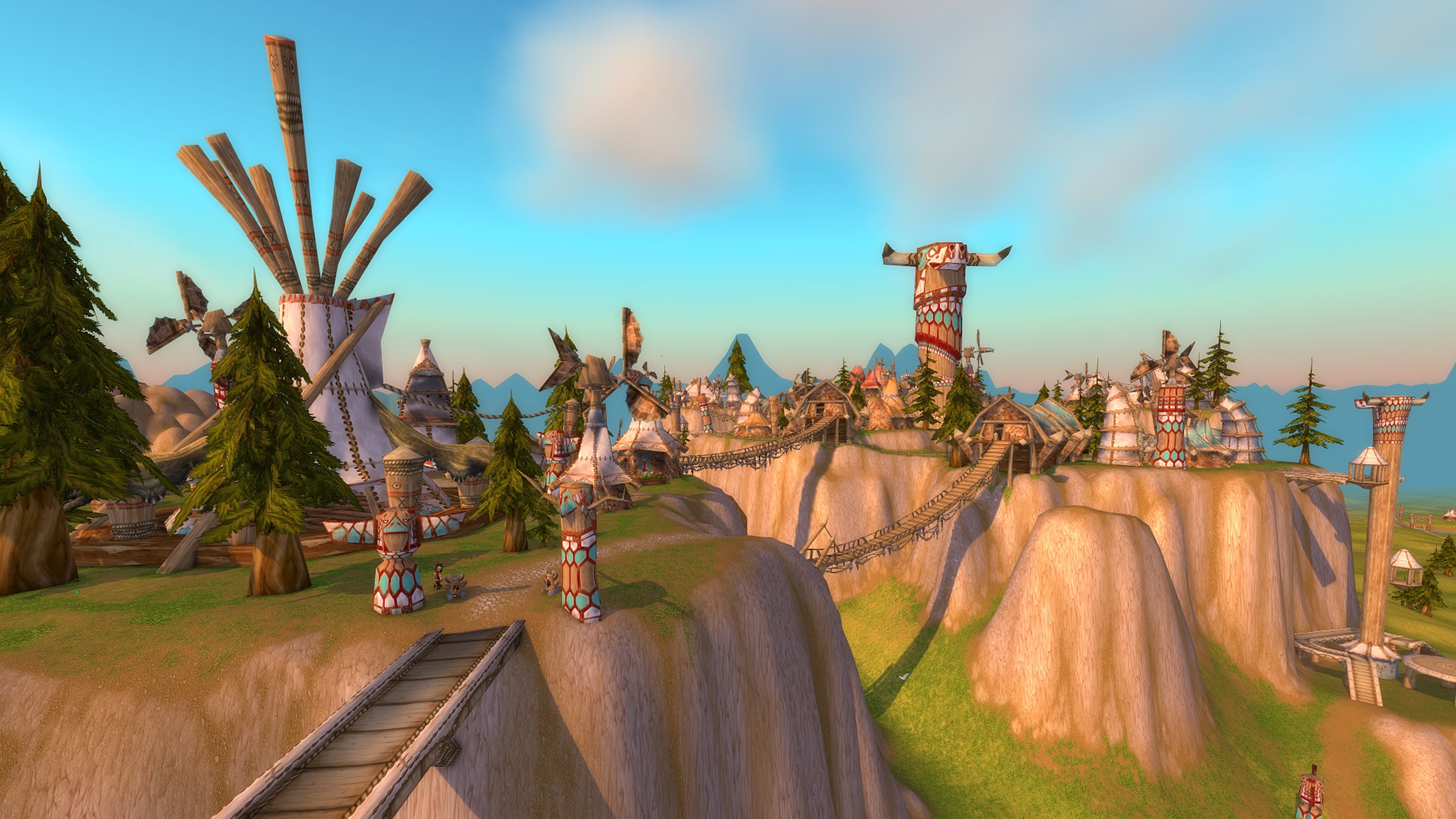
The lands of the Tauren, and later the rest of the Horde, consists of large savannas and deep red deserts, bringing to mind the iconography of an African savanna, as well as the American west respectively. The lands of the Horde is set in stark contrast to the lush fields and deep woods of the Alliance lands.

The naturalist faith of the Tauren is shown by their prayers and ceremonies to the Earth mother. Their in-game building is represented by a grand totem pole, from which they are created. The Tauren is in the Horde campaign represented primarily by a wise old Tauren, a shaman who lives close to the forces of nature. He knows where spirits for healing, as well as harming can be found. The Taurens weapon of choose is a totem pole, further driving home the theme of tying them to stereotypical native Americans.

Source: https://worldofwarcraft.fandom.com/et/wiki/Kalimdor

The visual iconography of the Tauren as a facility for the northern native American stereotype is greatly expanded upon in the massive multiplayer online game, World of warcraft. The player characters in World of Warcraft get further ties to their “living with nature” themes, by making them more capable herbalists, and gathering ingredients much faster then most other races.

Real life comparisons

The varied, complex and vivid cultures of the numerous tribes living in and around the Northern Americas and Canada, is far to complex and nuanced for me to even begin to analyse and discuss here, even if I felt even remotely confident in my ability to do so. I will as a result keep my discussion to a few topics relating to the depiction of the Tauren in warcraft 3, the totem pole, the teepee, and the feathers and paints.

Please note that I only have cursory knowlage of these very complex and nuanced themes and topics, and will as a result only cover them in my limited understanding, as a way of tying them to the stereotypical depictions of the Tauren.

Totem Pole

The totem pole has come to represent much of northern native America cultures, mainly due to their prominence in pop culture and various tourism advertisements and souvenirs. The totem pole we know is indeed only originally, historicity linked to certain tribes originating in the south of Canada´s cost. (Wright)

The creation and use of these, often mislabelled totem poles were not used for religious purposes, but was rather used as narrative devices, to tell anything from historically inportant events, to grudges and trade deals. As more white settlers colonized Canada, more and more native villages disappeared, and with it their cultures were slowly lost with them. Many totem poles were later “found” or “salvaged” from supposedly abandoned native villages. These totem poles, and poles created in their image was later made in to large tourist attraction for towns like Seattle or various museums and private collections. (King 2017)

War bonnet

To begin this discussion I would like to reiterate that I am approaching this topic from a layperson, and has as result only limited knowlage, as well as the few documentarians I was able to find to build my arguments upon.

The appearance of the feather headdress, or the war bonnet is one of the more recognizable visuals that have been capitalized upon by much of western cultures to represent the stereotypical Native American. The most common used image is of the so called plains feather headdress, worn by the numerous plains nations. These feather headdresses sometimes called war bonnets, were rarely used by the chosen few that had shown themselves worthy in the fields of war (Waldman, C 2014). These types of headdresses are far from the only kinds that can be found within the rich history of the native nations of America and Canada. The styling, aesthetics and use of the various headdresses used amongst the many tribes of the First nation and beyond. is way to complex and numerous for me to begin to try and note down in such a small text. (Guardian 2014, Monkman 2016)

A War bonnet headdress is still to this day an inportant symbol of office and responsibility, one that should not be taken lightly. It is often used as a symbol of office, and is gifted as a sign of responsibility an duty. (Monkman 2016)

Conclusions

In this chapter I have attempted to show how the Tauren represents a stereotypical image of the Northern native American tribe. The Taurens description and representation, is a part of a long tradition of exotifying and othering the Native American, but western society. The lands of the Tauren, as well as their culture is inescapably tied to a specific stereotype of the North American native. I have attempted to show that this sort of storytelling and use of Native American iconography to show otherness is a part of a long tradition of, mainly western media. Furthermore have this depiction of the Tauren, as well as similar depictions like them further the unjust and harmful trend of lumping large numbers of nations and tropes with diverse histories and traditions under the term of “native savage”.

The chose to present the Tauren in this light, a part of a wider trend of depicting the horde as non western”and none white others. This is a strategy that will become more apparent once we carry on to discuss the supposedly warlike and savage Orcs or flesh eating spirit worshipping Trolls.

I would lastly once again admit that I have learned a great deal of things during the creation of this text, and I humbly apologize if I got anything wrong in my descriptions of this complex and sensitive topic. This blog is a way for me to educate myself, as much as the readers. I encourage and welcome indigenous American and Canadian voices to share their thoughts and discussions on this topic.

References

Ellingson, T. (2001). The myth of the noble savage. Berkeley, Calif.: University of California Press.

Robin K. Wright Totem Poles: Heraldic Columns of the Northwest Coast,
https://content.lib.washington.edu/aipnw/wright.html

V. T. King (2017) Identity, material culture and tourism: Of ritual cloths and totem poles
South East Asia Research

Monkman, L (2016) Behind First Nations headdresses: What you should know
https://www.cbc.ca/news/aboriginal/behind-first-nations-headdresses-1.3506224

“This means war: why the fashion headdress must be stopped”. The Guardian. July 30, 2014.

Waldman, C (2014). Encyclopedia of Native American Tribes. Infobase Publishing. ISBN9781438110103.

Essay: The immersive world of Morrowind

This text will be my first in a series of essays, more informal texts that are more opinion oriented then my normal research oriented texts. The topic of today’s text is brought to you by Daipanda, a loyal viewer of my twitch stream. If you like to have your own topic suggestion featured on the blog, please visit Twitch.tv/samrandom13 for more information.

Introduction

This text will discuss the many aspects of world-building found in the video game Elder Scrolls: Morrowind, and how they in tern leads to a number of role-playing possibilities for the players. I have recently been playing trough the game at my twitch channel, and have as a result spent a lot of time analysing its story and world building aspects. I will today discuss three aspects that I have found of special note, the faction system, the in game dialogue, as well as the in game books and other texts of Morrowind.

Factions

Elder Scrolls: Morrowind uses a series of reputation systems, one being a personal disposition system for non playable character, that ranges between zero and hundred, that gauges how friendly each character is towards the player character. A second system, and the one I am the most interested in today is the faction reputation system. This system similarly scales between zero and a hundred, and dictates the player characters options while dealing with said faction, as well as dictating the base level for NPCs personal base disposition with the players. Bring in good standing with a faction will allow the player to use certain traders, get better prices, as well as to get specific quests from them. Being in bad standing will lock the players out of many of these features, and in some cases, will turn the entire faction hostile towards the player. Al factions starts with varying degrees of like or dislike toward the player, and some will always despise the player cahracter, regardless of what they do.

The most interesting aspect of this faction disposition system is that, besides affection the relationships between the player character and the faction, do also play a role between the factions themselves. Each faction has a set disposition ration to every other faction. For example will the two major magical factions, the mages guild, and House Telvanni, have a negative disposition towards the others members, due to them competing for the same markets, namely magical services.

When a player joins a faction, these negative modifies will be calculated in to the disposition of every other faction. <in some cases, like with the great houses, it is impossible to join more then one, and joining one of them will permanently stop the players from joining the others with said player character. Due to the immense powers struggles being a major theme of the setting of Morrowind, will it be made clear to the player right a way that joining one of these great houses will swear them in to said house, and bar them from joining any other. The actions of the player will, as they progress trough their chosen house storyline put them in direct conflict with the other houses, and as a result will their personal and faction wide disposition go down with each of the NPCs pertain to said faction.

Other factions conflicts are more obscure and easy to miss, and several are deliberately obtuse, one well known example comes to mind early in he game, where he player is first introduced to the staple factions of the Elder scrolls series, the mages, thieves and fighters guilds respectively. The players are initially able to join both the thieves and fighters guild at their leisure, but are at one point tasked with retrieving a certain item, a book containing sensitive information, for both factions. both factions will have vested interest in this book, and the players will be forced to chose a side, with some outcomes leading to the players being unable to join one of the factions in the future.

By forcing the players to take sides in these and many other conflicts does the game enforces the idea that the character the players is in fact, part of is a part of a greater narrative and world, and by forcing the player to make these decision is the player incentivised to crystallize an identity with said world. The player is not a omnipresent being that exits outside the narrative, or indeed the ultimate hero for al inhabitants of the world. They are a part of a wilder narrative, if a very crucial part of it.

Dialogue

As is the case with many role-playing games, is the interactions with player cahracter one of the bigger parts of Elder scrolls Morrowind. This is primarily doe by approaching an npc and engaging in a dialogue, here the players will be presented with a series of topics that they can ask this specific npc about. These topics vary greatly from npc to npc. The players are normally allowed to ask about as many of these topics as they like, and as many times as they like.

In some rare cases are the players forced in to a decision, here the dialogue box is frozen, and the player is presented with to or more red dialogue options, that they must pick one off, before they can continue. With this mechanic will the player be forced to conciser the context in where they ask certain questions, and take up specific topics.

One last note on the dialogue options of Morrowind, is that many of the characters will give fully, or partially incorrect information to the players, rather due to ignorance, or wilful malice. In no area is this as obvious as with the case of directions, that is often obtuse by the original quest givers, forcing the player to wander around the countryside, or look for alternate directions form other npc`s in the area.

Books

The last facet I want to touch on is the large number of books, scrolls and booklets that the player can find and read trough the game. These range from travel guides, and instructional manuals on proper trade conduct, to theological discussions and series spanning high fantasy novel series.

These books gives an incredible depth and nuance to the setting as as a whole, by giving examples of fiction and no fiction alike. Books like “The true nature of the Orks” and “The wild Elves” presents thoughts and biases of the various nations of the world, and tales and poetry describing the war of the red mountain gives grand examples on how the various cultures and nations of the Elder Scrolls series perceives the same historical event.

One of the more interesting facets of the books and scrolls in the Elder Scrolls series has always been the numerous contradictions and arguments that can be found within many of the non fictional texts. These contradictions do not come form sloppiness or oversight in the writing, rather the opposite in fact. The world of Elder scrolls is full of various cultures, and al with their own varying groups of philosophers, researchers, magicians and academics. The differences and arguments that the player will most often find is of a theological nature, more specifically on the nature of the divinity, or lack there off, of the living gods of the Tribunal, a topic that I promise I will return to in a more academic text later on!

The way that a lot of the information and lore of the elder scrolls series, and especially Morrowind, is presented in the way of books and scrolls. As with much of real life information and texts, is there always a sender with a message and a goal. By presenting the world via these complex and sometimes contradictory explanations on everything form the nature of the gods to how to best cast a fireball, will the players be incentivised to think critically about every text and piece of information they come across, and slowly puzzle together the truth, just like a scholar living in Morrowind would.

Final thoughts

Elder Scrolls: Morrowind uses a number of strategies to draw the player in to its world, chief amongst them obfuscation, and forcing the players to take sides. By obfuscating some of the information that is presented by the player, and presenting conflicting narratives, does the game force the player to conciser each new piece of information from various sides and angles. Furthermore, by presenting some of the information from the npcs in a similar contradictory way, are the players forced to think of them less as objective directions given by a story, and more like subjective interpretation of various real life people.

By forcing the player to choose between various factions are the player encouraged to form a more uniform image of their character, one that is slowly formed from a blank slate in to an individual by the choses they make along the way. The player character is formed as much by the factions they join, and friends they make, as by the once they choose, or are forced not to join. The lack of ability by the player to join every faction, to see every side of each debate, at least in one playtrough, further drives home the subjective and splintered nature of the narrative in Elder Scrolls: Morrowind.

I would argue that these two facets of Morrowinds storytelling greatly helps the immersion and ability for the player to fully play the role of their chosen character, and is a contributing factor to why the game is still played, and talked about to this day. I will return at a later stage with a more in depth analysis of many of the subjects touched upon in this text, especially the concept of ambiguity in the presentation of the texts of the Tribunal and other faiths.

Warcraft 3 and the otherness of the Horde: An introduction

Introduction

The concept of othering an individual, or more often a group, is a way of building one’s own identity. By defining what the other is, the individual defines what they are not.

In this chapter we will take a look at how the otherness of the Horde faction in Warcraft 3 is used to define the normalcy of the Alliance. In this chapter we will also discuss that exotifying sometimes, but not always, comes with the act of othering.

Tropes and exoticism

Before we start this analysis is it important to describe the terminology we will be using in this text. The main three analytical terms we are going to use in this text are:

  • othering
  • the concept of tropes
  • the concept of stereotypes

These three terms will form the basis of our analysis, and will be useful the discussion of other texts as well.

Othering

The concept of othering is the act of defining what you are by measuring yourself against a real or imagined other. These others are often framed in an antagonistic light, and compared negatively to the self. The other is often the representation of everything that the individual is not. If the person is to present themselves as enlightened, the other will be presented as stupid or barbaric. In post-colonial theory, the other is used to describe the colonized, and the “self” as the colonizer. In other words, it is a way for one group to assert themselves as a position of normalcy in a narrative, while the colonized is painted as unnatural. (Mushtaq 2011, Spiecker 2012)

The idea of the other in form of the Orc or Goblin can be seen in many fantasy texts predating the Warcraft series, non arguably being as influential as Tolkien’s Lord of the rings series, where the enemy orcs were presented as pure evil and completely irredeemable. Note that action oriented series like the Lord of the rings requires some sort of grand enemy, one that can be cut down by the heroes in droves, without diminishing the goodness of the heroes, or conjuring images of mass murder, a point Tolkien himself takes up in many of his personal letters. (Tally 2012)

Stereotypes and tropes

The term trope will in this text refer to a set of qualities and or signifiers that are tied to a certain group or individual. This stereotype is applied to this group as a blanket statement, regardless of accuracy or truthfulness. A stereotype in this concept is referring to broad and shallow concepts regarding communities, groups or individuals. (Spiecker 2012)

The concept of a stereotype is similarly based on a series of previous assumptions pertaining to a specific set of individuals or entities. I will in this text specificity discuss stereotypes pertaining to individuals ethnic and religious backgrounds, and how they pertain to the text of Warcraft 3, and the factions within it. I am basing these assumptions on the theory that no work of fiction is created in a vacuum, but rather built on a long series of fictional and non fictional inspirational sources, and by examining these links, can we come to understand the text itself more thoroughly.

Stereotypes are often the basis for many storytelling tropes. Tropes are in a way inevitable in storytelling, as they are often used as shorthand. Meaning that they are used as a way to convey more complex and complicated concepts in a quick and effective way to a specific target audience. Due to the fact that many tropes are based in stereotypes it is vital to critically analyse these tropes to come to terms with underlying prejudices and beliefs. Note that tropes can be used to describe far more then simply characters in a narrative, but for the sake of this series, this is how the term will be used.

The Horde

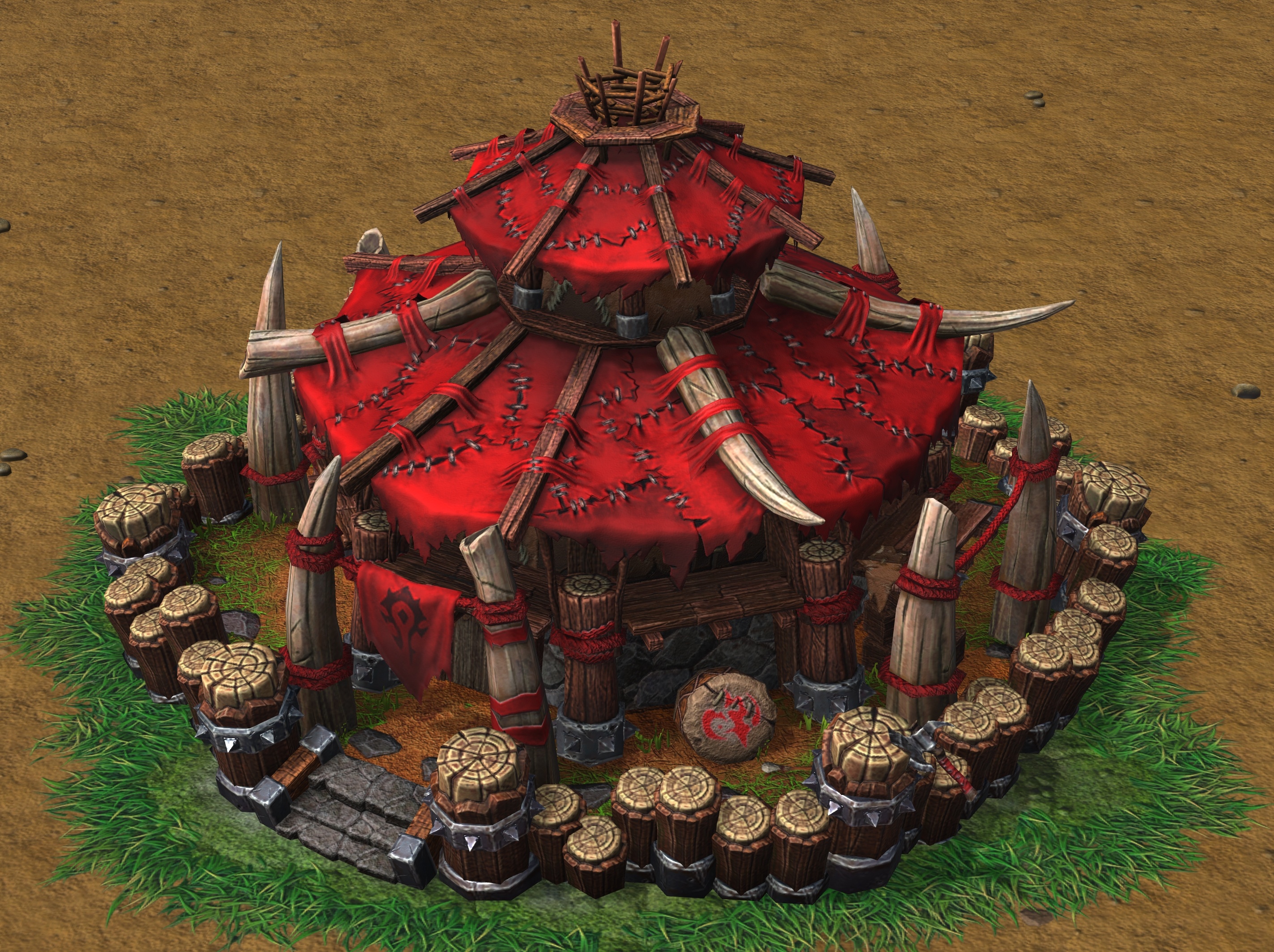
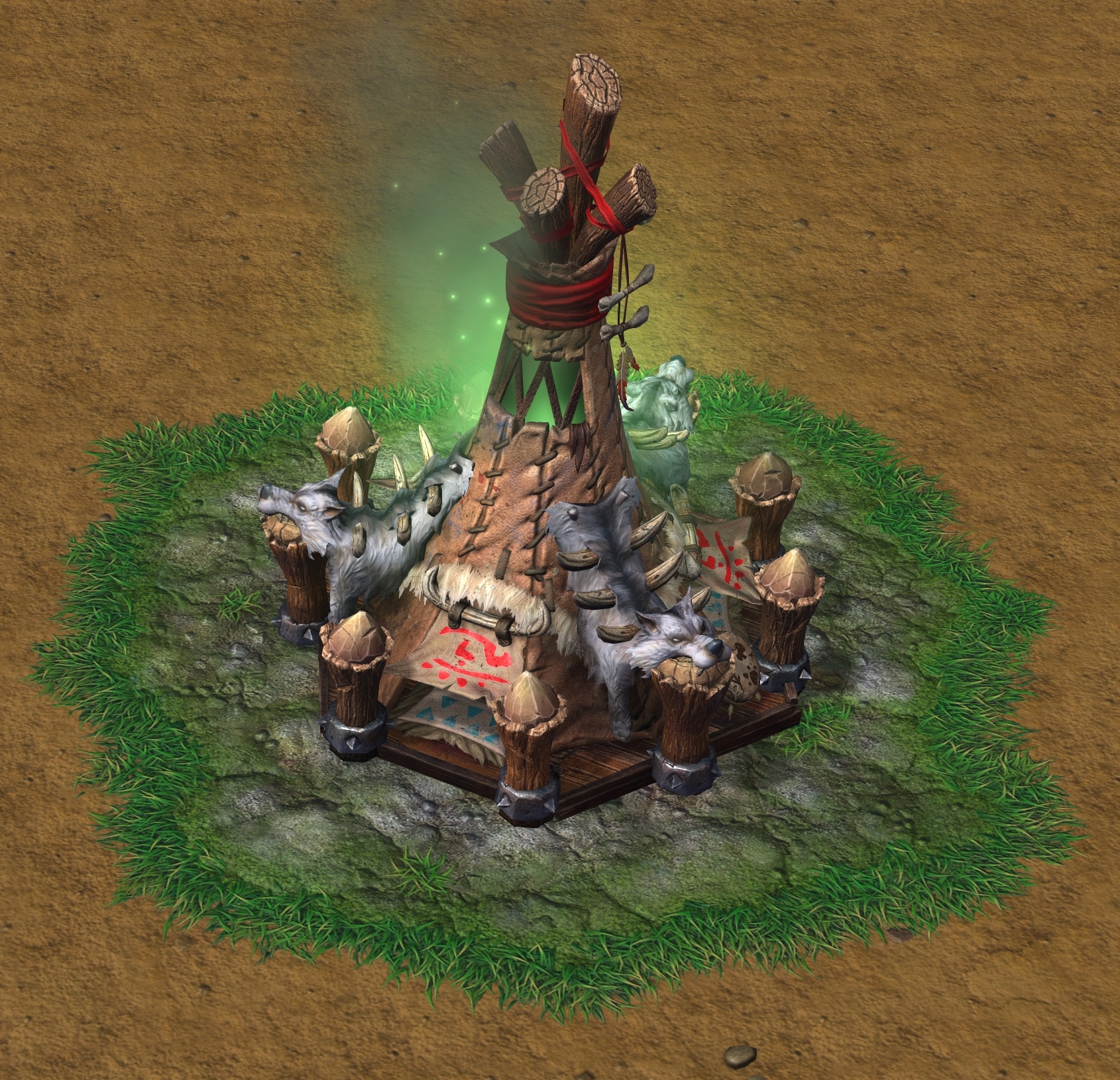
The very name horde conjure up images of something wild and untamed, something large and dangerous, an entity without number. The horde al consists of creatures that are in traditional contemporary fantasy seen as evil or villainous, be it trolls, minotaurs or Orcs. Their aesthetics and architecture conjure images of huts, bone jewellery and large ceremonial masks. They are set as the other and alien, in the case of Orcs in a rather literal sense, since they are later described as literal aliens. (Blizzard entertainment, 2002)

Source: https://www.wowhead.com/news/warcraft-iii-reforged-models-dark-portal-alliance-horde-campaign-buildings-295705

The description of the Horde cultures are often described as warlike or savage, in contrast to the more civilized and organized alliance organisations. The lands of the Horde is presented as wild mountain chains and far reaching savannas. The magical and spiritual practices in particular rely heavily on largely of shamans, totems and spirits. In particular when it comes to the Troll faction, that is explicitly “practising voodoo”. (Blizzard entertainment, 2002)

Source: https://www.wowhead.com/news/warcraft-iii-reforged-models-dark-portal-alliance-horde-campaign-buildings-295705

The horde is inescapable tied to the traditions and tropes of modern fantasy, many that has its roots in the era of Lord of the rings and other Tolkien works. While i would do a disservice by labelling the Horde as explicitly evil, it is still inportant to what the imagery of the faction tells us about them, and the work as a whole. (Blizzard entertainment, 2002)

The Alliance

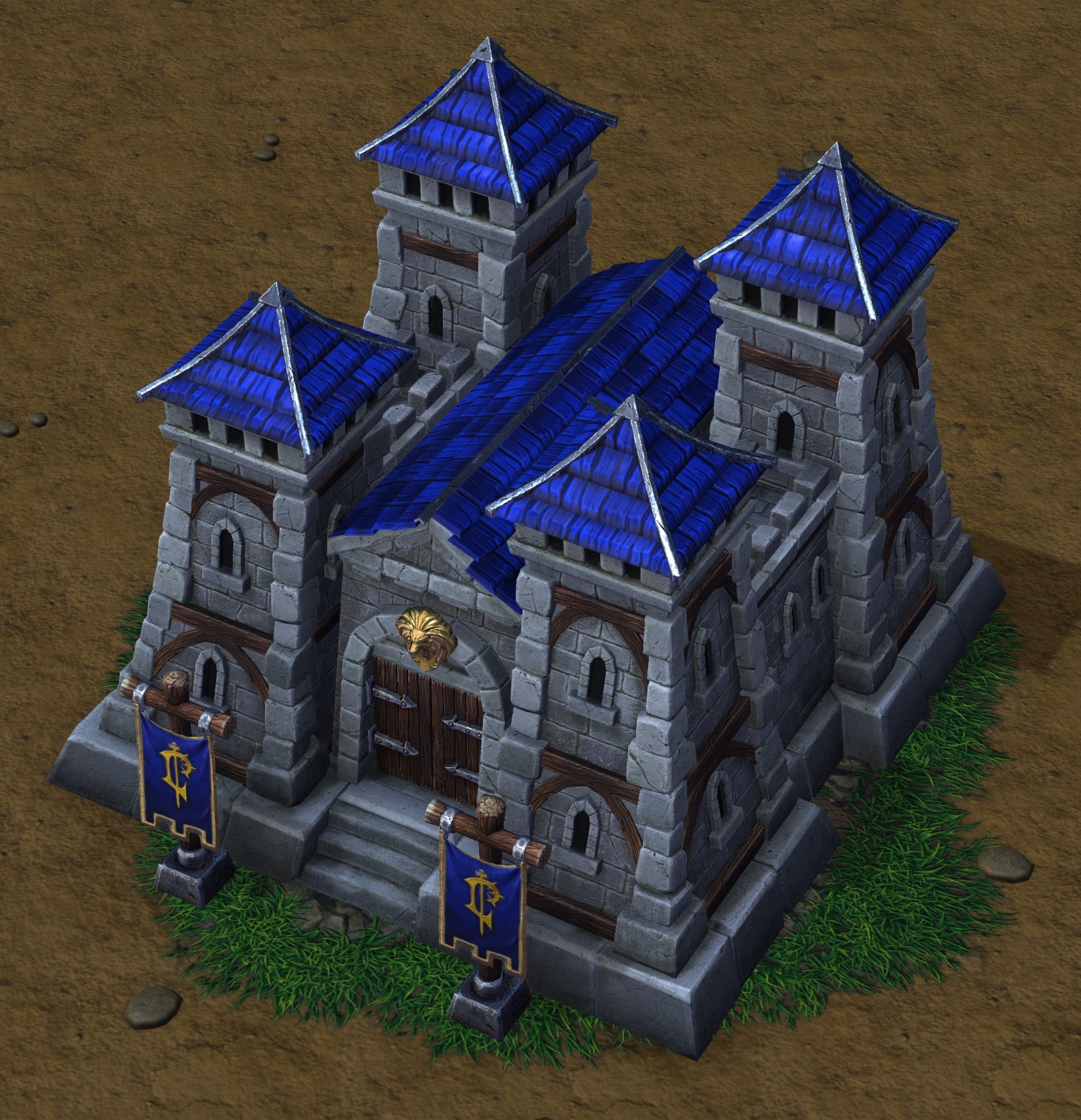
The alliance are made up of Elves, Gnomes and Humans, al races that closely resembles humans. More specificity does the alliance of warcraft 3 consists of, humans, dwarves and elves. Note that these races are often portrayed as the forces of good and order, following the traditions once again of J,R,R Tolkien. (Blizzard entertainment, 2002) The visuals of the Alliance are almost uniformly a romanticised version of renaissance and medical Europe, with grand forts, temples and factories. (Blizzard entertainment, 2002)

https://wow.zamimg.com/uploads/screenshots/normal/877429.jpg
Source: https://www.wowhead.com/news/warcraft-iii-reforged-models-dark-portal-alliance-horde-campaign-buildings-295705

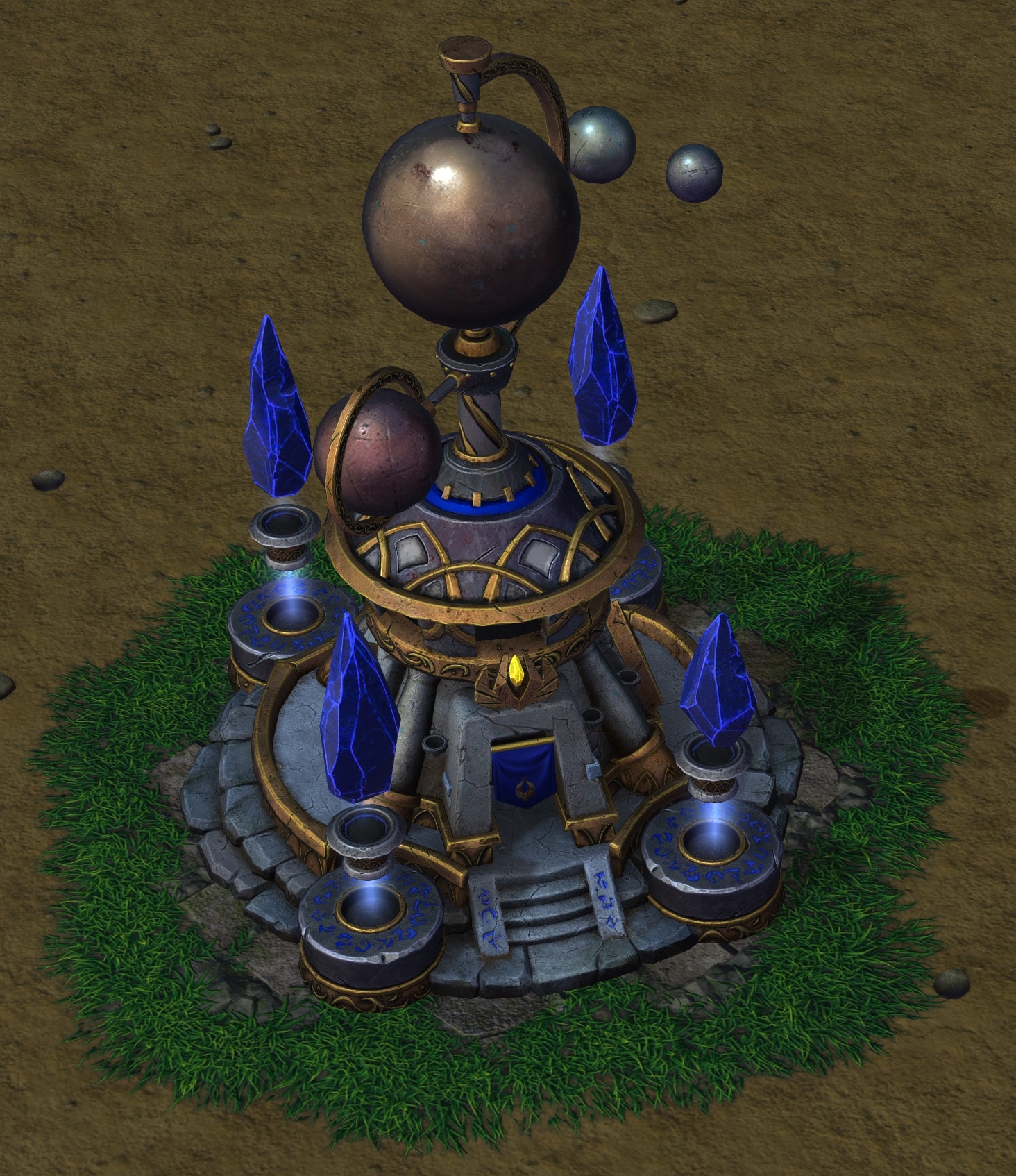
The imagery of the Alliance is uniform and ordered, even tough the trademark cartoonish and busy visual language of Blizzard entertainment shines trough. The alliance is made out of cultures of high art, order, faith and wisdom. their magical practices comes in form of learned individuals and scholars, practising their craft in grand academies. (Blizzard entertainment, 2002)

https://wow.zamimg.com/uploads/screenshots/normal/877427.jpg
Source: https://www.wowhead.com/news/warcraft-iii-reforged-models-dark-portal-alliance-horde-campaign-buildings-295705

Their religious orders are made out of pious monks and devout paladins, their armies made out of knights and heavily armoured footmen, supported by archers and black powdered artillery. This is in stark contrast to the savage and direct tactics of the Horde. (Blizzard entertainment, 2002)

https://wow.zamimg.com/uploads/screenshots/normal/877430.jpg
Source: https://www.wowhead.com/news/warcraft-iii-reforged-models-dark-portal-alliance-horde-campaign-buildings-295705

I must once again reiterate that the status of the status of the Alliance as the heroes of the narrative in Warcraft 3 is far from clear-cut, and a lot of the narrative works to subvert this expectation. None the less is it important to evaluate what the visual language tells us about these faction, and what they tell us about the narrative as a whole. By evaluation what the visual language of the coded heroes in warcraft 3, can we find trends that runs trough much of its contemporary fantasy tropes and narratives.

Conclusions

I have in this text presented a series of basic concept that I will use to further discuss the idea of othering in the Warcraft 3 narrative. I have furthermore presented some basic differentiations and touchpoints that we will return to again and again in this series. One could argue that al these differences are made explicitly to show how different the two factions are from each other, and to explain the many wars in the narrative. I would argue that it is inportant to show what these differences are, and how they are presented, and more importantly, to shine light on the real life prejudices and assumptions that created these differences in the first place.

References

Mushtaq, Hammad (2011), Othering, Stereotyping and Hybridity in Fiction: A Post-Colonial Analysis of Conrad’s Heart of Darkness and Coetzee’s Waiting for the Barbarians. Journal of Language and Literature, No. 3, Available at SSRN: https://ssrn.com/abstract=1679116

Spiecker, Tara (2011) Beat Those Sleepy Slackers!: Color-Blind Racism in World of Warcraft’s Valley of Trials, Quadrivium: A Journal of Multidisciplinary Scholarship: Vol. 3 : Iss. 1 , Article 4. Available at: https://nsuworks.nova.edu/quadrivium/vol3/iss1/4

Tally, Jr., Robert T. (2010) Let Us Now Praise Famous Orcs: Simple Humanity in Tolkien’s Inhuman Creatures, Mythlore: A Journal of J.R.R. Tolkien, C.S. Lewis, Charles Williams, and Mythopoeic Literature: Vol. 29 : No. 1 , Article 3.
Available at: https://dc.swosu.edu/mythlore/vol29/iss1/3

Warcraft 3. Blizzard entertainment, 2002.

Warhammer 40k an in depth analysis: Part 3, The Eldar: part 6, The followers of the Laughing god.

Introduction

Our final segment of this series will describe a faction, that unlike any other Eldar sub faction do not have a direct connection to any fantasy trope per say, but is instead related to a much larger trope, that of the trickster. In this chapter will I once again give a comprehensive overview of the Harlequin Eldar as a faction. Furthermore will I present the trope of the trickster, as well as the role of the Harlequin within the concept of medieval theatre.

The trickster trope and the god of tricks

To properly understand these strange and erratic Eldar, must one first understand the trope that they are build upon. The idea of the trickster is one that can be seen in numerous cultures and myths. In Norse mythology we have the great shapeshifting Loki.

Trickster deities

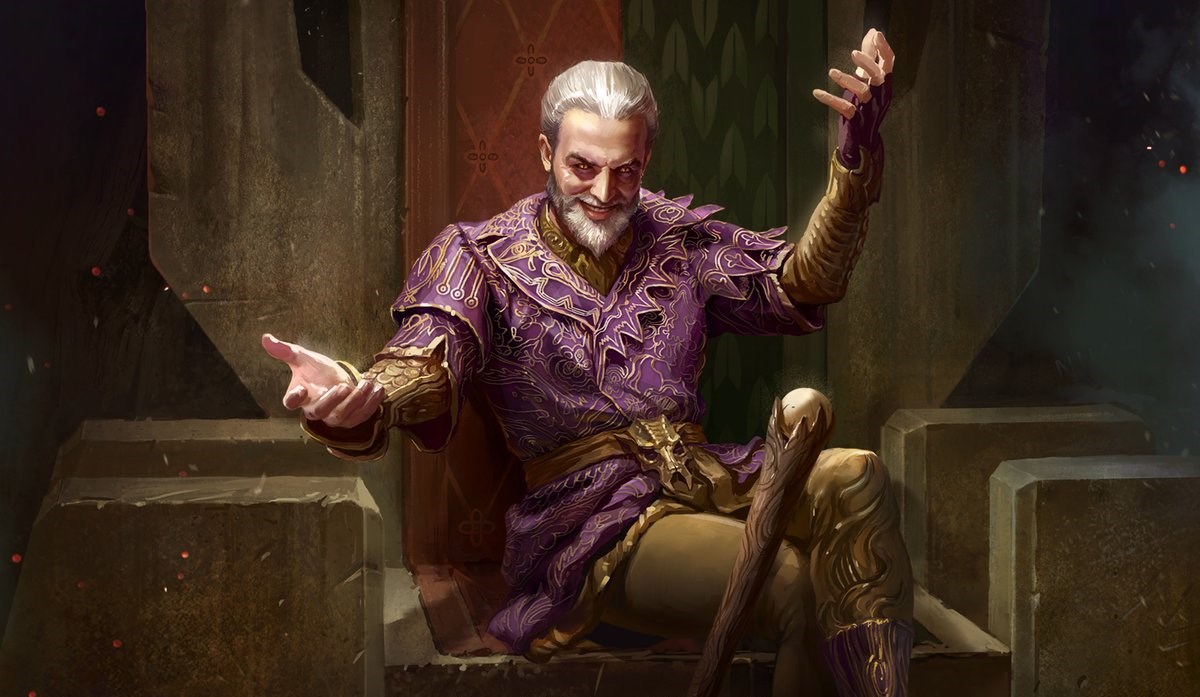
The trickster exist in one form or another within numerous faiths across the world. Sometimes in an antagonistic form, sometimes as a protagonist, but mostly they seem to switch roles as their mood changes. From pop culture we can also find examples of trickster deities, such as Sheagorath from the Elder Scrolls series. Many of these spirits or gods tends to really on their wit and intelligence, and often strive to show up their fellow gods as well as high and might mortals by tricking or pranking them in some way. The trickster gods tends to be morally ambivalent in their actions, and often simply work towards their own amusement. (Haase 2007)

https://cdn.mos.cms.futurecdn.net/dJu7rxbHZqi4ikc4EgtzaR.jpg
Source: https://cdn.mos.cms.futurecdn.net/dJu7rxbHZqi4ikc4EgtzaR.jpg

The trickster gods are often the embodiment of transgressions of norms and rules, often mixing and disregarding bounders between feminine and masculine, good and evil, homosexual and heterosexual, wise and foolish etcetera. (Haase 2007)

The character of the trickster

A trope that can be found within a large set of cultures and their written and oral traditions. Many myths and legends from the African hero Anansi the spider, to Loki of north mythology and more modern examples such as the Doctor from the series of Doctor who, and the Joker from the batman comics. (Haase 2007)

The trickster is often portrayed as a jester, clown, thief or prankster, seemingly working for no real goals other then for their own amusement. In folk lore they are often seen physically weak characters that wins the day trough their natural wit and sense of humour. (Haase 2007) They are sometimes presenters as heroes, but other times seems to live only to create chaos or acts fully for their own amusements. The tricksters roll in many narratives is to make fun out of established routines and power structures, and causing even the mightiest to fall.Fans of the Elder scrolls series are most likely familiar with the race of Kajiit, a catlike folk that in many ways honour and respect the many aspects of the trickster archetype, something we will discuss further in an upcoming series on the Elder scrolls universe! (Bethesda 2016)

The Harlequin in history and pop culture

Taking on many forms during the ages, but the version I will primarily look at today is the Harlequin of the Italian comedy school known as the commedia dell’arte. The role of the Harlequin was primarily to provide acrobatic amusements besides the more comical antics of the Joker and the clowns. Besides the acrobatic antics of the harlequin where they seminally also famous for sharp whit and mixing high and lowbrow humour.

Harlequin - Wikipedia

The Harlequin was, just as the rest of the trope, incredibly colourful dressed, often wearing a full or partial mask, as well as large patterned uniforms. One of their more common unifying features being their black masks. The most inportant tropes of the harlequin are seemingly to be to be able to combine wit with absent-minded, elegance with clumsiness, to internalise both qualities at once.

The Harlequin Eldar

As we have discussed in the introduction, are the Harlequin Eldar seen as strange and mysterious, even by their own kind. These individuals travel in troupes or small theatrical societies, and dedicate their lives to the perseveration of the cultures, myths and knowlage of the ancient Eldar empire.

The laughing god

Amongst the only one of the Eldar deities that escaped destruction at the hands of Slaanesh. Cegorach or the laughing god hides within the Webway, where he plots and schemes, and leads his followers from the shadows. The followers of Cegorach are unique amongst the Eldar, for they seem to live fully without fear for their souls. It seems as the trickster god has managed to ferry away the souls of his followers, away from the hungry eyes of Slaanesh. (Games Workshop 2015)

Cegorach plans and schemes from within the Webway, always looking for new ways to make a fool out of the great enemy, and at the end of times, the laughing god will reveal his greatest trick, and perhaps even manage to save the Eldar race. Cegorach shares many traits common to other trickster gods, both in pop culture and in ancient myths. Cegorach relies primarily on his wit and sense of humour rather then strength or magical abilities, and while the laughing god are happy to help his followers, as well as play pranks on their greatest enemy, does it seem that he is equally fine with spoiling the plans for anyone that are to high and might and sure about themselves, one would amuse that this would also entails fair amount of Eldar Far seers. (Games Workshop 2015)

The elder trickster god is not to be confused with the Necron god The deceiver. This ancient entity is seemingly the cause of the Necrons transformation in to the metallic undead creatures they later become. It is worth noting that both of these warring factions each has their own version of the trickster myth. While the Eldar god is benevolent to his followers, and uses his trickery to help them, the god of the Necrons are rather the opposite. Note that this fact does not contradict the trickster character, as they are often morally anbivilant or agnostic, and are in may ways the embodiment of such contradictions. (Games Workshop 2015)

Roles and masks

Much like a medieval theatre, and classic Greek play, are the various characters of each myth and play, represented by colourful masks and costumes. Each troupe member has at least one character dedicated to playing each inportant roll, both off and on stage. Because of the addictive and hypersensitive minds of the Eldar, will the players personality inevitably start to blend with the rolls they play. (Games Workshop 2015)

The masks themselves are constructed ins such a way that the enemies greatest fears are projected back at their enemies. In reality does these masks convey the face of whoever the Eldar is assigned to playing. (Games Workshop 2015)

Nowhere is this more true then with the Eldar that plays the role of Slaanesh themselves. The actor that plays the great enemy is revered, feared and pitted in equal measure. These individuals lives outside of even the Harlequins fractured society, appearing only when their role is needed, either on stage, or at war. (Games Workshop 2015)

The troupes of the Harlequins follows one of tree paths, dark, light and twilight. These paths inform the philosophies the Eldar follow both in and out of combat. The light path is focused primarily on the telling of grand heroes and triumphant adventures, where the dark troupes focuses on tragedy, villains and darkness, the twilight seeks to convey transitions between the paths. (Games Workshop 2015)

Female Harlequin Player Midnight Sorrow
It is not difficult to find visual cues tying the Eldar harlequin to their historical counterparts. Both parties wear full masks, as well as colourful large patterned clothing. While many of the roles played by the Eldar are tied to the traditional roles of the Harlequin, that of acrobatics and speed, will the harlequin Eldar play every single role of the traditional French comedy troupe. (Games Workshop 2015)

War as art

Even more so then then their cousins the Dark Eldar and Craftworld Eldar, does the Harlequins see conflict and warfare as another stage upon which to perform their craft. Each fighter knows their own role, and the others in their troupe fully, and completely, both when it comes to their combat roles, and their specific parts of their play. (Games Workshop 2015)

Acrobats perform daring stunts in melee, and dark jesters bring death to the enemy in the most ironic and tragi-comical way possible. Often tying each death to some sort of poetic irony, they take out their foes from afar. (Games Workshop 2015)

Al of the harlequins war machines, and specialised combat units are riddled in myths and latened with symbolic meaning. This once again ties in to how close art and war are tied, not only in harlequin performances, but in the Eldar society as a whole. (Games Workshop 2015)

The role of the trickster is one that both Cegorach and his worshipers follows rather well, as their actions are guided by tricking and fooling their enemies as much it is to defeat them. (Games Workshop 2015)

Conclusions

The harlequin Eldar is a highly interesting faction, and one that ties the other Eldar together, both figuratively, and within fiction. There are several truthiness that can be found throughout the Eldar factions, and most, if not al can be found with the harlequin Eldar. Just like the Exodietes do the Harlequin Eldar do their best to keep the old ways and traditions alive. The harlequins are endless wanderers, just as their cousins, the Craftworld Eldar, and just like the Dark Eldar do they see war more as an expression of art, then a means for survival or conquest. Note that the Harlequin Eldar seems to take their role as storytellers as seriously as they do their duties on the battlefield, and more often then not are the two closely interwoven.

The close ties to the medieval French theatre form, in many ways makes the Harlequin Eldar stand apart from the previous factions we have looked at so far. Other then perhaps the Sisters of battle have no other faction been so closely tied to such a specific cultural concept. In the Eldar harlequin we can also see ties medieval European cultures, a trend we saw time and again within the Imperium of mankind, but then from a mainly British point of view.

The role of the trickster is one that both Cegorach and his worshipers follows rather well, as their actions are guided by tricking and fooling their enemies as much it is to defeat them. (Games Workshop 2015)

References

The elder scrolls V Skyrim. (Special edition). (2016). [Rockville, Md]: Bethesda.

Donald, Haase. (2007). The Greenwood encyclopedia of folktales and fairy tales

Te Velde, H. (1968). The Egyptian God Seth as a Trickster. Journal of the American Research Center in Egypt,7, 37-40. doi:10.2307/40000633

Codex: Harelquin Eldar (7th Edition), Games Workshop, 2015 (2)

Warhammer 40k an in depth analysis: Part 3, The Eldar: part 5, Nature and the old ways.

Introduction

The Exodite Eldar was the first to leave the Empire, and the first to start their new lives away from the horrors and debauchery of the old Empire. The Exodite chose to settle down on planets that had been seeded aeons ago, to become new paradise worlds for the Eldar. We will use these Eldar to discuss and analyse two concepts, the trope of the “wood elf”, as well as the concept of nature versus civilisation.

The Exodites

This faction will be the first one we analyse that do not have an army, or a codex of its own, this means we will unfortunately have a lot less material to work with then we usually do. When mentioned in the Dark Eldar and Craftworld Eldar codexes are they usually done so as an “other”, those that has chosen another path. With that said will we do our best to puzzle together a picture of this faction from what we have.

Being the first one to leave the encroaching madness and sadism of the Old empire, can the Exodites very well be seen as an expression of keeping on to old ways and traditions. Their names being a play on the term Exodus, or mass emigration. The Exodite lives on what is called “paradise worlds”, and while very sparsely and contradictory described, are they represented as the last hope for both a bright Eldar future, as well as the preservation of the Eldars glorious past. These worlds were colonized and terraformed in the glory days of the Eldar empire to one day become the homes of rich and power full Eldar elite. One of the few defining features we get in the Exodite Eldar in the 7th and 6th edition Eldar Codexes is that of the world tree. Working much as the infinity circuit of the Craftworlds their cousins use, a World tree is where the departed souls of the Exodite Eldar go to rest, and be at once with its ancestors. The theme of a world tree is one that can be found in numerous narratives, one of the most recent example being David Cameron’s Avatar series. The concept of the world tree or the life tree is one that is worth its own chapter in the future. A few examples of the World tree in mythology would be Yggdrasill, as well as the tree of life in the Kabbalah mystic teachings.

The Eldar and nature

The themes of nature and the unnatural can be found in both the Dark Eldar and Craftworld Eldar codexes. The way that nature is described, as well as how it is used, can tell a lot about these factions, as well as how they function narratively. I have chosen the Eldar as a base for this discussion because of how their different relationships to their surrounding nature helps shape, and is shaped by the kind of society they inhabit.

Commanding nature

The Craftworld Eldar, just as their predecessors seems to have vast powers to change their surrounding to their will. In their glory day was the Eldar able to “create and destroy suns at their whims fancy”. Their ships and tools are described as being grown rather then built. These tools and structures are described as being as much organic beings, as they are inanimate constructs. The Bonesingers are described as using music to coax and lead the Wraith-bone they use in to the desired effect.

Defying nature

Much of the Dark Eldar themes circle around power, and defiance of power. The freedom of the strong to impose their will on the weak. The dark Eldar has the same mentality when it comes to dealing with al manners of natural phenomena, be it the imprisoned suns that power their city, or their constant struggle to escape entropy and death at any cost.

the most striking example of this would be the several suns that the Dark Eldar have captured and toed in to their realm, for energy and warmth. The codex makes it clear that the inhabitants look at these suns with destain, as nothing else then a tool, to be used and then discarded.

Living beside nature

The Exodite Eldar are described to have been hardened by the tough life on the Paradise worlds, and are as a result a lot more pragmatic and practical then their cousins. The paradise worlds are at once described as a harsh land full of dangers, and as a paradise, free of disease and predatory creatures. Here these Eldar lives in peace together with their, al be it genetically engineered nature. As a result can it be argued that the worlds of the Exoidets are just as artificial and constructed as the rest of the Eldar species.

Defining nature

In order to properly discuss the Exodite Eldar, must we discuss the concept of nature as a narrative and literary tool. The study of nature in literature is a branch of literary criticism known as ecocriticism, and it concerns itself partly with how nature is described in fiction, and what kind of roll and agency it is given within a certain narrative. By analysing how nature is portrayed in fiction and art, can we learn more about how the cultures that made it, view, or is made to view the concept of Nature. Ecocriticism wishes to question the very concept of Nature, and prove that it is indeed a construct. More specificity is the concept of nature meant to function as a counterweight to the idea of civilisation and the Human domain.

The pastoral

The pastoral is a trope that is found in much of modernist and later western literature. An idyllic view of the countryside the sleepy life of a fisherman and shepherd, living at the border between nature and civilisation. Here is where the “simple life” can be found, and humanity is free to live “as they should”, away from stress, smog and the evils of civilisations, while still not becoming fully “wild”. The Shire, home of the Hobbits in Tolkiens Lord of the Rings series is a great example of such a pastoral environment.

The pastoral is an other as well, one set up against the normalcy of city life. A pintoresque image, with very little, if any base in contemporary reality. The refuge where the modern man can escape from the corruption and vice of the modern world. (Tenngart 2008)

The wilderness and the walled garden

One idea of how to define nature, is to define what it is not. One way is to describe it as, “the land beyond the control of humans”. To put nature at the place where civilisation and humanity ends, and something else begins. Nature is in this sense presented as the other, the wild and strange, and sometimes, the lesser. The garden next to the woods is a good example of this dichotomy. Imagine a hedge, on one side is a neatly cut lawn, a well planned out pond with fish, and beautifully arranged flowerbeds. On the other side of the hedge is the woods, this also full of grass, flowers, and lakes full of fish. Both ingredients exits in both worlds, the only difference being that, on one side do humanity have control, on the other, they do not. (Tenngart 2008)

Some ecocriticical researchers argue that the underlying deviation between the wilderness and the walled garden is to glorify the one over the other. The philosopher Rousseau sought to uplift what he saw as the “wild and savage” indigenous human as more natural and free then the stifled and corrupt human that lived in the walls of civilisation. More materialist inclined thinkers would argue that the wilds are dangerous and savage, and it is the right, and even the duty of humanity to tame it, and save it from itself whenever possible. Both arguments have been used against marginalisation and mistreatment of marginalised groups, and used to justify colonisation and similar atrocities. (Tenngart 2008)

Nature and the feminine

Nature has also often in art and literature, especially in the west, been described as feminine. The emotional and wild, set against the masculine ordered and logical. The phrase Mother nature or Gaia perhaps comes to mind. This ties in to a wider discussion of the duality of feminine and masculine in popular myths that we unfortunately do not have time to dive in to here, but is one we will return to in the future.

This field of study falls under the term Ecofemenism, and it has as a goal to discuss how gendered rolls appears within descriptions of nature. One example would be that nature is framed as passive, against the more active civilisation, a dichotomy that is pointed out between feminine and masculine in much of feminist theory. (Tenngart 2008)

The wild Elf

The last part of our discussion will look at the trope of the Wood elf in a number of incarnations. We will once again primarily use the same texts for our basis as we did in previous Eldar texts, those being Tolkien’s Lord of the rings, Bethesda’s Elder scrolls series, Wizard of the coasts Dungeons and Dragons franchise, as well as Games Workshops Warhammer fantasy works.

The deep woods

One of the defining features of al the elves analysed is that they live in the wilderness, specificity a western European idea of the wilderness, the deep woods. The deep wood is a classic setting in many classical European myths and stories, as it was indeed a dangerous and foreboding place, full of brigades and wild animals. These areas are often seen as both hellish, as well as paradisical, where none of the normal laws of civilisation applies, at lest, not to the same extent.

The Murkmire of the Lotr, the Deepwood of the Warhammer fantasy battles franchises, and Valenwood of the Elder scrolls series al fall within this description rather nicely. Al of these areas are full of dangerous flora and fauna, and al are generally avoided by more “civilised” people and cultures.

The wild once

Another shared theme amongst al these texts, are that the Wood Elf is seen as wild, and or unpredictable. In Warhammer fantasy can we find this theme in the form of the Wild hunts. Where the wood Elves ride out and indescribability hunt humans and beasts. The Elder Scrolls Elves are described as fighting constantly with their wild selves, being represented as the ability to shape shift in to animals and other beasts. Furthermore are al of these cultures and peoples, in one way or another set as the Other. In order to be wild, there must be a civilised for one to compare themselves against. Note that the difference between civilisation and wilderness, carries different connotations in different works. (Bethesta 2016)

The Wood elves in Warhammer fantasy battles are similarly described as wild, unpredictable and violent. They are described as going on “wild hunts”, whee they attack anything and anyone in their path, murdering them indiscriminately. (Games Workshop 2013)

Children of nature

The last theme that these Elves have in common is some sort of bond with the woods they live in and off, the most extreme being the green pact of the Elder Scrolls series. The wood elves, or Bosmer, has sworn of eating any form of plant life, as well as deliberately harming any living plant. As a result do they only eat meat, and just like the Craftworld Eldar, do they sing their buildings in to existence, growing them and guiding them using magic. In return is the Bosmer given everything they could ever need. (Bethesta 2016)

The Elves in Warhammer fantasy battles also work in close proximity with the woods they live in, being sworn protectors of the woods, and in return, are allowed to use the Deepwoods as a sanctuary from the evilds of the world beyond. (Games Workshop 2013)

The Exodite and nature

Here we will combine al that we have learned so far, and try and position the Exodite to these already existing tropes and themes. Note that due to the small amount of text we have dedicated to the Exodite Eldar, compared to the other factions, can we only draw rather broad and general connections. As before will be forced to rely on the other Eldar Codexes for detentions of the Exodite Eldar.

It is worth to once again here note that the worlds that the Exodites live on are for all intents and purposes genetically and geologically engineered to be the best possible inhabitation for these civilisations. In other words can the same dichotomy between Eldar and nature not be found here, as it can in the Elven examples I presented earlier.

Conclusions

In this chapter has I introduced the reader to a series of concepts regarding nature and how it relations to fantasy, and science fiction. I have tried to further tie the Eldar race of the Warhammer 40k series to a grander trope of the Elf or Elven creature, as a symbol of the together and the mystical. I have also in this text introduced some inportant literary tools that will be useful as this series continues. The next chapter will present the last sub faction of the Eldar we will take a look at this series, the enigmatic Harlequin Eldar.

References

Tolkien, J.R.R. (1968). The lord of the rings. 1, The fellowship of the ring. (2. ed. 3. imp.) London: Allen & Unwin.

Wizards of the Coast (2014). Dungeons & dragons Player’s handbook. Renton, WA: Wizards of the Coast LLC.

The elder scrolls V Skyrim. (Special edition). (2016). [Rockville, Md]: Bethesda.

Warhammer Armies Wood Elves (8th Edition), Games Workshop, 2013

Codex: Craftworld Eldar (7th Edition), Games Workshop, 2015 (1)

Codex: Harelquin Eldar (7th Edition), Games Workshop, 2015 (2)

Codex: Dark Eldar (7th Edition), Games Workshop, 2014

Kelly,P. Troke, A .Codex: Eldar (6th Edition), 2012

Tenngart, P. (2008). Litteraturteori. (1. uppl.) Malmö: Gleerup.

Iovino, S., & Oppermann, S. (Eds.). (2014). Material ecocriticism. ProQuest Ebook Central https://ebookcentral.proquest.com

Warhammer 40k an in depth analysis: Part 3, The Eldar: part 4, Dark Eldar, The dying shadow.

Introduction

The dark reflection of the once proud Eldar empire, and the second to escape its rotting core. The represents the full indulgence of the dark and hedonistic sides of the Eldar. Living in an unimaginably large fortress city located somewhere in the vast web-way, the Dark Eldar constantly raid the galaxy for new slaves and resources, seemingly safe from any reprisal or attack.

The dark once

the first thing we will discuss in this chapter will be the Dark Eldar themselves. The Dark Eldar is in many ways described as the polar opposite of the Craftworld Eldar. This dichotomy is, as I have mentioned before, is far from exclusive to the Eldars in the Warhammer narrative?

In the case of the Dark Eldar, this differentiation comes in the form of completely and utterly oneself to the pursuit of selfish pleasures and hedonistic violence. This would be to the contrast to the Craftworld Eldars rigid and ordered lifestyle.

A slow death

The Dark Eldar did manage to escape from the initial devouring at the site of Slaanesh birth, seemingly safe within their grand Webway cities. Instead of a fast death, was the Dark Eldar instead subjugated by a much more slow and painful one, as their souls are described to be slowly and painfully being dragged in the warp by “She who thirsts”. (Games Workshop 2014)

This will slowly and painfully age the Dark Eldar, and eventually kill them, if they are not able to find a way to replenish their strength. The theme of the darker elements of the Eldar race being physically corrupted in some ways is also one that can be found in many fantasy narratives. The Orcs in Tolkien’s series is described as tortured and malformed Elves, taking the “purest” of creatures and turning them in to the most base and primal. The Dark Elves in the Elder Scrolls series can also be described in a similar tough a lot less extreme way. The Dunmer, or Dark Elves has had their skin turn grey from the volcanic grey from the lands they inhabit, and their eyes have turned jet black or blood red. (Games Workshop 2014)

DEWarrior
Source: https://warhammer40k.fandom.com/wiki/Drukhari

Feeders of pain

The Dark Eldar has managed to find one thing that will hold Slaanesh at bay, and replenish their shrivelling bodies and souls, this substance is pain. More specificity intense pain, fear and agony, by psychically absorbing the suffering of others are the Dark Eldar able to replenish their rotting bodies and keep Slaanesh at bay, if only for a short while. The more painful and honorific cruel the torture, the more nourishing will the screams of psychic pain be to the Eldar. (Games Workshop 2014)

The Dark Eldar is able to use this ability to keep their bodies young and healthy, but seemingly not their souls, as they are described as being a horrifying rotting mess of stitched together body-parts, if viewed by one with mental abilities. (Games Workshop 2014)

The concept of the Dark Eldar feeding on pain is one that is echoed in the Warhammer Fantasy Dark Elves. They to keep themselves young and powerful with the use of the suffering, in this the case the blood, of their enemies. (Games Workshop 2014)

Dark Eldar and Slaanesh

Feeling her constant grasp on their necks is it not strange that the Dark Eldar might fear She who thirsts most of all. To this end have they banned any use of psychic powers by any inhabitant of their realm, as doing so would bring the interest of Slaanesh themself. (Games Workshop 2014)

Many of the oldest members of the dark Eldar race had a direct hand in the Eldar Empires downfall, and even tough they are spared from the more direct annihilation, might they simply have traded it for a longer and more painful one. (Games Workshop 2014)

A city of nightmares

The city of Commorragh is the home of the Dark Eldar, huge beyond imagining, and twice as cruel. The city works as a good parallel to the Dark Eldar civilisation as a whole, and also one of few places in the 40k narrative that we have such distinct and details and descriptions, sometimes to specific areas of the city. Considering the nature of its inhabitants, and the similarities in its names, it is very possible that the city is at part, a reference to the Biblical city Gomorrah, one of the two cities that was destroyed by god due to their extremely sinful ways. (Games Workshop 2014)

PortofLostSouls
Source: https://warhammer40k.fandom.com/wiki/Commorragh

Architecture of madness

The geometry and shape of Commorragh is one that exists without the grasp of mortal understanding, and trying to examine it to deeply will only lead to madness. The Webway exists, partly in and around the Warp, and is as a result free from the laws of physics found in the Materium. This means that the city was free to grow outwards in every direction, including in and around itself. The city can be described as a series of satellite realms, tiny bubbles in the huge roaring sea of the Warp. Tied with portal and gateways, can these realms be travelled to in the matter of seconds, while they in real space would take many light years to reach. (Games Workshop 2014)

The unimaginably large size, as well as the contradictory and otherworldly geometrical build-up Commorragh follows the themes of scale as well as a focus on the maddening and otherworldly to create a sense of existential dread and cosmic horror. (Games Workshop 2014)

The spectacle of suffering

The main power of the Dark Eldar economy is, without a shadow of a doubt, the pain and suffering of others. The city has many ways of providing the grotesque spectacle to any Eldar with enough capital or clout. The most common form that the average citizen are myriad of gladiatorial games and public slave executions that are held at the vast number of arenas and cities trough the city.

Dark Eldar Gladiators
Source: https://warhammer40k.fandom.com/wiki/Commorragh

These venues allows the richer Eldar to be able to soak in some suffering, and spectacle, at a relatively safe distance. This is not to say that most any Dark Eldar would be above getting their hands dirty, as acts of terrorism, civil war, murder and wanton destruction are some of the most common pastimes in Commorragh.

Layers of power

The Dark Eldar culture is strictly hierarchical and complex in its levels of organization. While the system is incredibly violent and cut-throat, is it also absolutely fair. Anyone can rise to power, regardless of how lowly they started, as long as they are strong, smart and ruthless enough. No once part in the hierarchy is secure, and everyone is fair game to overthrow. (Games Workshop 2014)

The Kabals

The current ruling system of the city. The Kabals present ample opportunity for employment for al that have proven themselves to be skilled and ruthless enough. To be a part of a Kabal grants one of the most sought after luxuries available in Commorragh, protection and a small ounce of security. To attack one member of a Kabal, is to wage war on them al, and the revenge if often swift, painful and completely without remorse. (Games Workshop 2014)

Wytch cults

The gladiators and performers of the various venues throughout the grand city. Here Dark Eldar fight each other as well as strange beasts from across the Materium and the Imaterium for the amusements of the citizens of Commorragh. The term wytch is taken, unsurprisingly from the English word witch. In this context is the witches, and the witch cults, another references to the Warhammer Fantasy Dark Elves: The witch cults of the Dark Elves are responsible for the numerous sacrifices to their dark go Kain, as well as keeping the more prestiges and powerful of their ranks young and beautiful. This is a topic we will cover in much greater detail in the future. (Games Workshop 2014)

Haemonculus covens

The secretive cults of the homunculi are responsible for some of the worst atrocities enacted by the city of Commorragh. These individuals specialise in extracting as much pain as possible from their victims, as well as creating horrid monstrosities of death and suffering. (Games Workshop 2014)

DE Haemonculus
Source: https://warhammer40k.fandom.com/wiki/Haemonculi

The most favoured test subject of the Haemonculi is not seldom, themselves. They are more often then not genetic and mechanical modified beyond recognition, becoming something al together different then their fellow brethren. (Games Workshop 2014)

The term haemonculus, bears a striking similarity to the term Homunculus. A homunculus in the context of western alchemy refers to an individual created partly by the means of magical science. A common trope in fantasy and science fiction, as well as other contemporary media. A homunculus in Dungeons and Dragons is a servant to an alchemist, (Wizards of the Coast 2014) created by his talents, and several sub plots in the manga Full Metal Alchemist centred around the creation and destruction of homunculi. It is interesting to note that in al these contexts is the terms referring to the creation, while the Warhammer term referrers to a creator, tough it can be argued that the haemonculus can be seen as both. The term haemonculus, as well as referring to their trade to alchemy, once again draws a clear line between the Eldar, and a concept of the mystical or occult. (Games Workshop 2014)

Mercenaries and Xenos

There are many more then simply Eldar that lives in Commorragh, for the town is described as a haven for the depraved, desperate and outcast. Several xeno races can be found in the slums surrounding the great cities spires. Here they live a life of urban warfare and constant strife, waging war for the lucrative contracts of the Kabals. (Games Workshop 2014)

Many of the great Kabals hires mercenaries to do their dirty work for them. The inclusion of these cities and towns of alien mercenaries gives the Dark Eldar another interesting point of contention with their Craftworld counterparts. The Craftworld Eldar loathe to deal with “lesser species”, and would never. (Games Workshop 2014)

Slaves

The most numerous inhabitants of the dreaded city of Commorragh are the slaves gathered in the numerous raids of the Dark Eldar. These slaves are used in everything from factory work, to the creation of morbid art. Most importantly are they used to sustain the youth and power of the Dark Eldar. These slaves are kept without chains or cells, for escaping their compounds would only mean a more painful demise elsewhere. (Games Workshop 2014)

Pain and slaves

The Dark Eldar goes to war for two things, to collect slaves, and to cause suffering, and they have grown incredibly proficient in both. Like the other members of their species does they Dark Eldar rely on speed and skill to win their fights, relying on fear and shock tactics to take their pray by surprise. These similarities would make it highly difficult for an enemy to be sure what kind of Eldar they are being attacked by, and it is described in the Eldar Codexes, that most humans see no distinction at al between the separate factions. (Games Workshop 2014)

Due to the fact that the Dark Eldar destains and distrust psychic powers in al their forms, are their forces made to rely fully on their martial skills. This has lead them to become brutal and efficient combatants, both at range and in close combat. (Games Workshop 2014)

Raiders from the void

Only the most skilled and favoured of the many fighters and murderers of Commorragh are picked for the raids in to real spaces. The raiding fleets are manned by a kabals most skilled and seasoned troops. One again does the Dark Eladar work as a dark Shadow to their Craftwold cousins. Where the craftworld Eldar see it as their duty to protect their home and loved once, does the citizens of Commorragh consider it a privilege to get a chance to torture and enslave the foes of their fair city, using their bare hands. (Games Workshop 2014)

Machines of suffering

Like much else of the Dark Eldar war machinery, are they first and foremost created to induce fear and hopelessness in their foes, sometimes seemingly forgoing practicality in favour of spectacle. With that said is the machinery equally, if not even more deadly then those of their Craftworld counterparts. (Games Workshop 2014)

Some of these machines are manned and maintained by the same Kabals that lead the raids, others are taken in from allied Haumunculi covens and Wytch rings. The machines of the Haumunculi in particular is the stuff of nightmares. (Games Workshop 2014)

Performers of torment

Like the harlequins, and the Craftworld Edlar, do their darker cousins see warfare partly as a form of art. The Dark Eldars performances is not a show of mastery of skill and the beauty of perfecting a strategy, but rather sheer spectacle. Their goal is to create as much as pain and suffering in as many of their victims as possible, before escaping with large quantities of slaves and loot. By waging war in this way, can the combating Eldar feed on the essence of their fallen foes, and grow stronger from it. (Games Workshop 2014)

No other troops in the Dark Eldar army represents this doctrine better then the gladiators of the Wytch cults. Well practised in the art form entertaining jaded Dark Eldar nobles with strange new forms of cruelty, are they more then suited to work their same skills on the battlefield, sowing fear and pain wherever they go. (Games Workshop 2014)

Conclusions

As mentioned already in the introduction is the Dark Eldar the darker and repressed side of the Eldar species. They represent hedonism, debauchery and shameless indulgence. At the same time do they also represent a society of absolute fairness, no one is safe, and everyone is a fair target. Anyone, at least as long as they are Eldar, can rise to the top of the food chain, as long as they are clever and underhanded enough to do so.

Next chapter will be dedicated to the wood elf allegory in the 40k world. I will take this time to introduce you to the study of nature in literature, and how a work describe nature, can tell us a lot about the work, as well as the context in which it was written.

References

Tolkien, J.R.R. (1968). The lord of the rings. 1, The fellowship of the ring. (2. ed. 3. imp.) London: Allen & Unwin.

Wizards of the Coast (2014). Dungeons & dragons Player’s handbook. Renton, WA: Wizards of the Coast LLC.

The elder scrolls V Skyrim. (Special edition). (2016). [Rockville, Md]: Bethesda.

Warhammer Armies High Elves ( 8th Edition), Games Workshop, 2017

Codex: Craftworld Eldar (7th Edition), Games Workshop, 2015 (1)

Codex: Harelquin Eldar (7th Edition), Games Workshop, 2015 (2)

Codex: Dark Eldar (7th Edition), Games Workshop, 2014

Kelly,P. Troke, A .Codex: Eldar (6th Edition), 2012