Warhammer 40k an in depth analysis: Part 2, The Warp: part 1, The Materium and the Immaterium

Introduction

This chapter will mark this blogs official return to the Warhammer 40k franchise. In this series discuss the epic and daunting fictional series set in the 40th millennium. With this chapter will we start looking at one of the largest cornerstones of the Warhammer 40k franchise, that of the warp. We will begin with trying to describe the Warp, and how it relates to other similar worlds.

The Materium

The physical world or material world of Warhammer 40k. This would be the allegory of our Real world. The Materium is the place of physical laws and life. The Materium more or less follows the same laws of physics that our world does. The biggest difference being the direct connection to to the warp. One of these connections are that some individuals are given (or cursed) with special special powers. These powers are referred to as magic or psychic powers interchangeably, depending on who describes them. (Games Workshop 2016)

The Immaterium

In contrast to to the Materium, the Immaterium is void of any form of physical matter, at least in any traditional terms of the word. The Immaterium is described a misty sea of smokey clouds of vapour and colour, impossible structures of impossible size and angles fill this wiling space, constantly moving and changing. Within the warp does the laws of physics, time and causality seise to exist. The warp is described as an unknowable landscape of dreams, emotions and fears. The warp itself can not be seen, heard touched or smelled, it is a realm built up entirely of abstract ideas. (Games Workshop 2016)

Everything within the Warp is a reflection of the beliefs, hopes and fears of the inhabitants of the Materium. Every sentient creature has a an effect on the landscape of the Warp. Similar emptions clump together, and forms a strange landscape of rives, lakes and mountains of love fear and hatred. They eventual form in to what can be seen as rudimentary forms of life.(Games Workshop 2016)
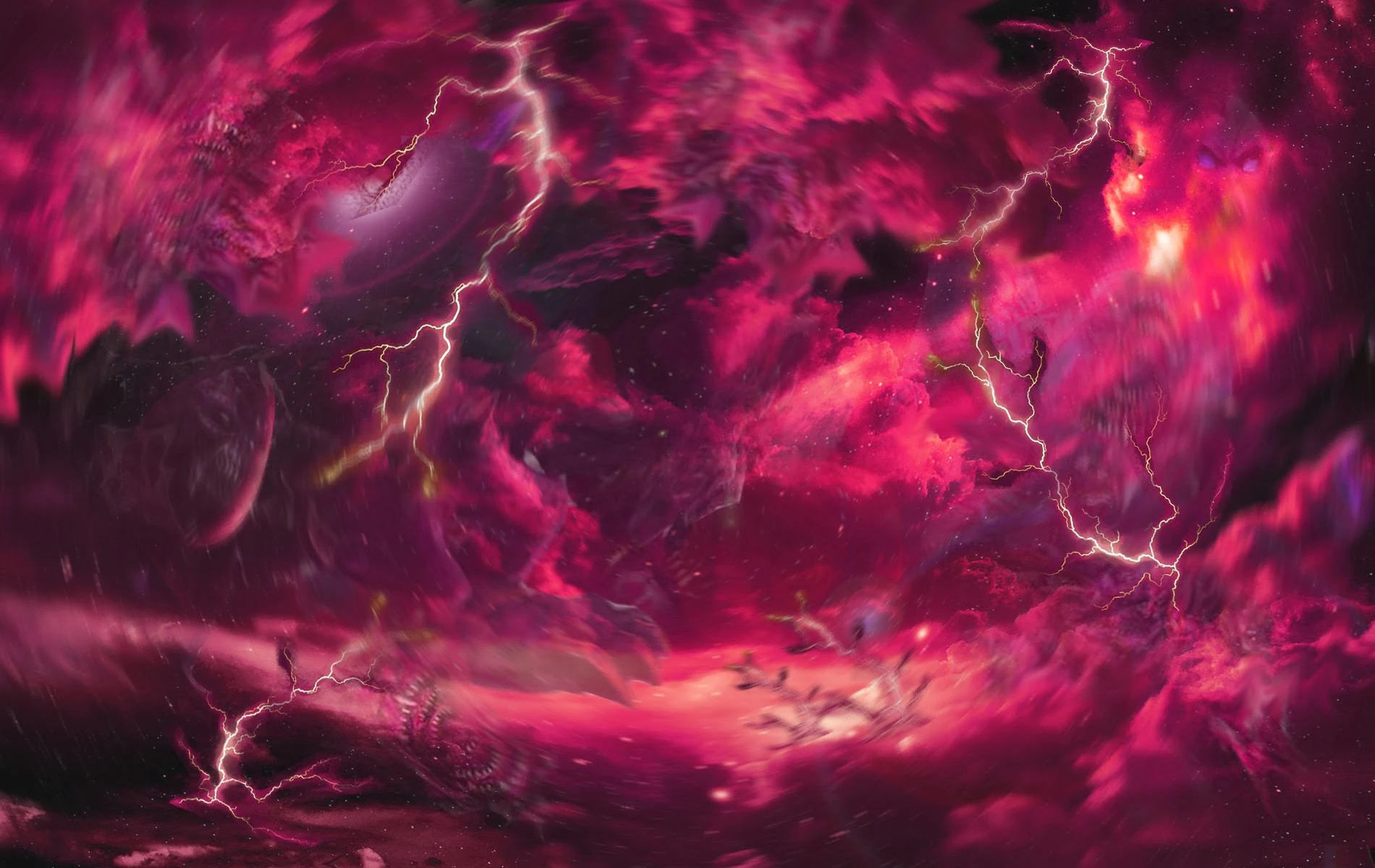
The ever shifting tides of the Warp. Source: https://vignette.wikia.nocookie.net/warhammer40k/images/3/36/Waves_of_the_Warp.jpg/revision/latest?cb=20160211182552

These life forms with time forms a sentience of their own, with wants and desires, these reflections is what is most commonly known as gods within the 40k universe. The Orks project their image of grandeur in the form of the titans of Gork and Mork, the Eldar has their gods of old, and the strife and struggles of the Imperium has given birth to three chaos gods, as well as a projection of the Emperor of mankind himself. These creatures battle in endless wars, stuck in struggles with no clear end or starting point. The warp exists outside the confines of time, causality and logic, as does its inhabitants. These gods and daemons of the Warp can not directly effect the physical world of the Materium, but must instead act trough followers and servants. (Games Workshop 2016)

The world beyond

The duality that the Materium and the Immaterium represents is far from a new idea. To visualize this point will I present a series of examples of similar worlds in philosophy as well as fiction. These universes all have the same dichotomy of duality. One world is physical and tangible, while the other is abstract and incorporeal in one way or another. Al of these worlds are also deeply intertwined with their double.

Plato’s world of duality

The concept of Plato´s cave is well known to anyone that has studied any level of philosophy. The basic tenements is that there exists a natural world of physical items, and an ethereal eternal world of ideas. The physical world is mere reflections of the ideas present in the ethereal world.

The world of ideas, is ethereal, endless and never-changing. Each and every object that exists within the physical world is a mere reflection of its true self within the idea-world. The physical world is a mere reflection of the true world of the idea world. (Plato 1892)
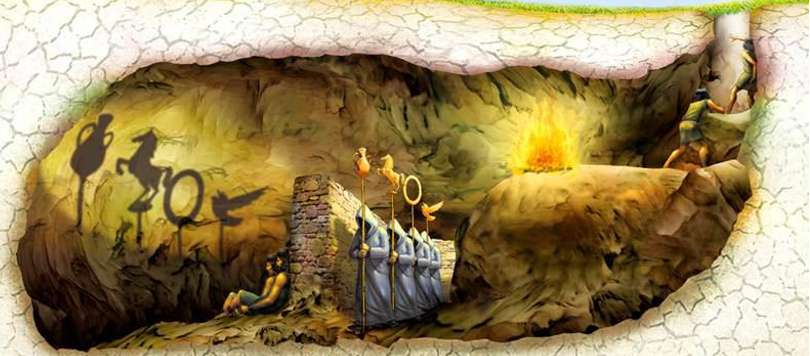
A visualization of Plato’s Cave. Source: https://sociable.co/wp-content/uploads/2017/08/platos-cave.jpg

Lovecrafts other-world

The world of Lovecraft is described as being separated in to the world of the mundane, and the world of the supernatural. Much of the horror in Lovecraft fiction comes from the world of the supernatural in one way or another bleeds in to the realm of the mundane. The Old gods, deities of Lovecrafts world, are said to have escaped from the world beyond, to settle in to the mundane reality of humans. The world of the supernatural is said to be abstract and beyond the realm of mortal comprehension. (Lovecraft 2008)
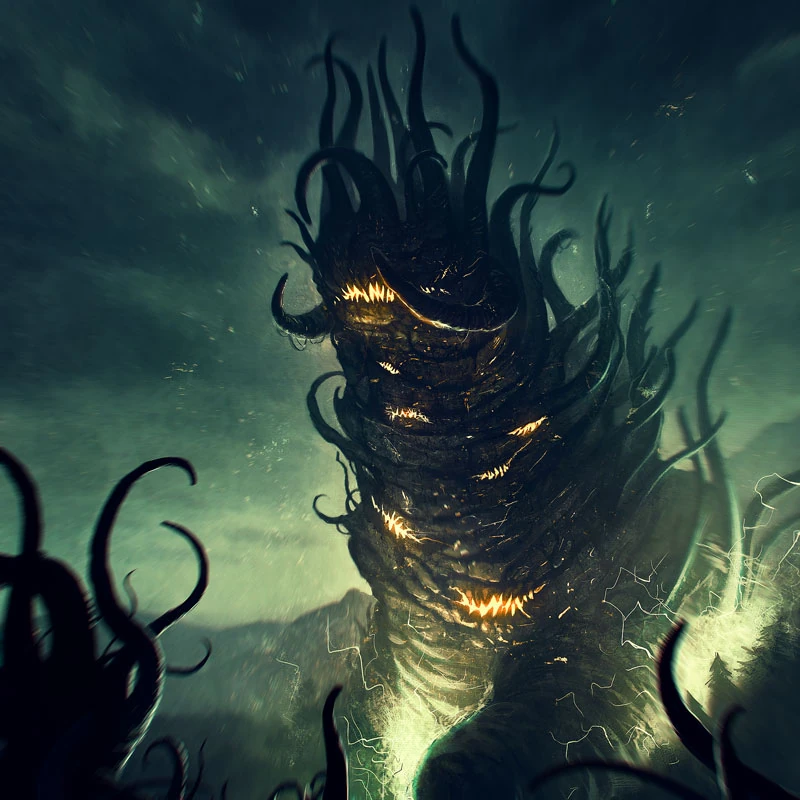
Bildresultat för lovecraft old gods
A visualisation of Shub-Niggurath: https://vignette.wikia.nocookie.net/lovecraft/images/c/c8/Tumblr_n72r7hKWR91s748a0o1_1280.jpg/revision/latest?cb=20140818055056

Digimon

The other-world within Digimon is called the Digital World, and was created when the first Digital computor on this narratives real world (earth), was started for the first time. This created the foundations for this words physics and ground rules. Its explained as the expansion of digital communication, the digital world has expanded rapidly. (Bandai 2001)

These are but a few examples, but enough to five us a general idea about these kinds of worlds, and how they are represented elsewhere.

The Warp and its uses

It is possible for the Immaterium to spill out in to the world of the Materium, when this happens it is often referred to as a tear or a storm. When a tear in the Materium occurs, the abstract representations and fears of the warp pour in to the world. As one can imagine by a galaxy beset on al sides by war, sickness and strife, are the reflections in the warp, just as, or even more terrifying then the galaxy that willed them in to existence. (Games Workshop 2016)
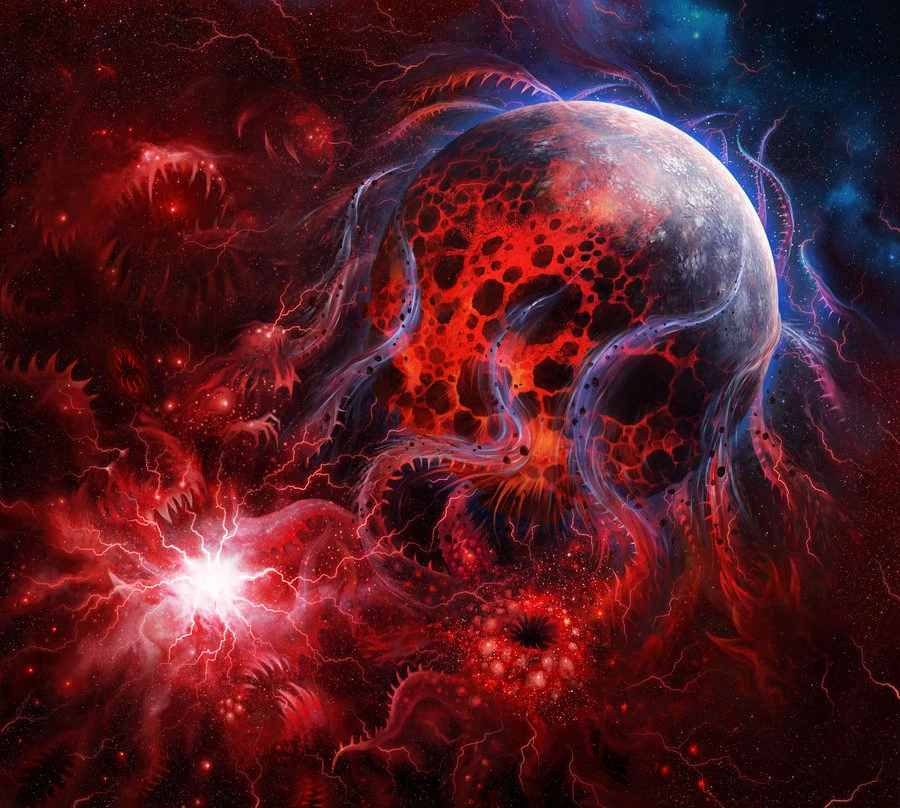
A warp rift consuming a planet. Source: https://vignette.wikia.nocookie.net/warhammer40k/images/8/8c/Warpstorm_.jpg/revision/latest?cb=20151013183924

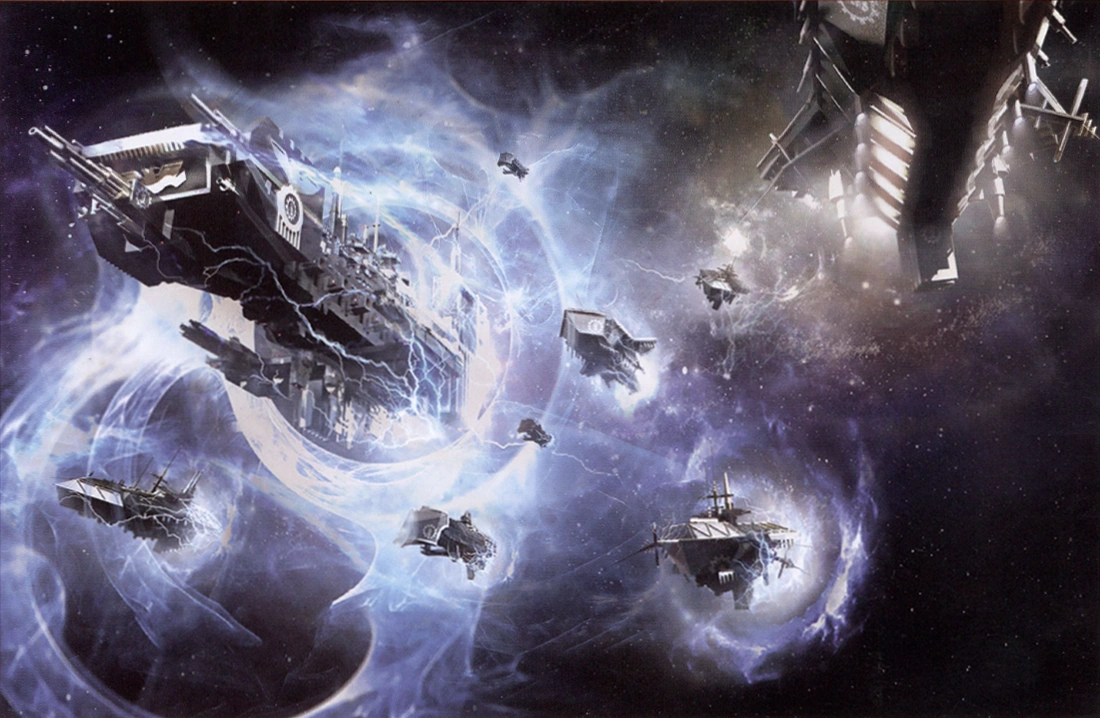
To breach in to the Immaterium from them Materium is indeed also very possible. This is a highly dangerous and unpredictable process, but a very useful one, if done correctly. Because of the fact that the warp exits outside of time and space as mortal minds understand it, is it possible for physical objects (such a s a space craft), travel over immensely vast distances. The Warp needs to have a connection point to the Materium in the shape of a psychically sensitive sentient individual. These psykers can use their powers to draw forth powers from the warp, as well as to travel in to it (Hill 2016). This power can be used to navigate space ship safely trough the Immaterium, call forth storms of pure Warp energies, or even to send messages trough vast distances of space. I will go further in to the details on how the different races and species handle and work with the warp in a future chapter. (Games Workshop 2016)

Ships entering real space from the Warp. Source: http://img3.wikia.nocookie.net/__cb20140415161335/warhammer40k/images/d/d9/Iron_Hands_Fleet_Arrives.png

The gods and their worshippers

The gods of the Warp grows as the emptions that first birthed them grows. This influence grows either by direct worship, or by the creatures that willed them in to being, feel certain sensations. For example, every time a human feel ambition or lust for knowlage, the power of the god of knowlage Tzeentch grow.

Bildresultat för tzeentch warhammer
A representation of the physical form of Tzeentch. Source: https://1d4chan.org/images/thumb/9/97/Tzeentch_the_Architect_of_Fate.jpg/500px-Tzeentch_the_Architect_of_Fate.jpg

This is true of al the sentient races of the galaxy (with the possible exception of the Tau). The larger and more successful a species become, the larger of an imprint will they have on the warp. In aeons past, the Galaxy was ruled by a species known as the Aeldari (or the Eldar), and as a result was the warp a reflection of their hopes, dreams and fears. In the 40th millennium the Galaxy is fought over, and more or less ruled over, by humanity, and their strife and homes and fears help shape most of the warp. I would argue that humanity is the birthplace of a number of Warp entities, more specificity Nurgle, Korn and Tzeentch (Games Workshop 2016). These entities are feared by some and worshipped by many others others. The Orks for example are adamantly loyal to their representations in the warp Gork and Mork. Most humans hate and fear their reflections in the warp, but some choose, or are forced in to their service and worship. Yet again will we discuss the pantheon of the Warhammer 40k setting in a much deeper detail in later chapters. (Plato 1892)

Conclusions

This is a basic introduction to how the Warp operates and how it relates to the world of the Materium. We have compared it to the ideas of Plato’s idea world, as well as a few other similar fictional worlds. I have trough this chapter shown that the narrative of the dual worlds exists in many places of the world, within classical as well as modern narratives. I have also tried to lay the groundwork for further discussion of the Warp, and ids significances for forming the rest of the Warhammer narrative. Next time we will start discussing how the different factions and races handle and look upon magic and psychic powers.

References

Hill, DisclaimerJ.D. (2016). Astra militarum. Games Workshop. Lenton, Nothingham.

Plato. (1892). The Republic [Electronic recurse]. Auckland: The Floating Press.

Games Workshop (2016). Codex: Chaos daemons . Games Workshop. Lenton, Nottingham.

Games Workshop (2015). Codex: Orks. Games Workshop. Lenton, Nottingham.

Bandai (2001). Digimon Tamers: Brave Tamer. Tokyo, Japan.

Lovecraft, H.P. & Jones, S. (2008). Necronomicon: the best weird tales of H. P. Lovecraft. (Commemorative ed.) London: Gollancz.

The art of the bootleg: An aesthetic analysis of copyright infringement.

Introduction

We will in this post take a look at the consent of the Bootleg. Specificity will we look at the bootleg products created after the image of pop culture. The definition of bootleg we will use is the following: any material or content created for consumption by the public, without the knowlage and/or approval of the copyright owners involved. In other words using the visuals or themes of an already established trademark in order to make profit. Note that fan works do not fall within this genera, even if they are sold. This is solely confided to companies making unlicensed product relating to another companies intellectual product.

we will start this chapter by giving a few examples of influential fictional properties, before making a more overarching analysis of the overall similarities between the different franchisees of bootlegs. Note that in this text will we only be discussing bootlegged toys, as including things like bootlegged movies and games etc would make this chapter al to big to handle within a reasonable time frame.

Star Wars bootleg

Star Wars is a monolith of a franchise, that barely requires any introduction. The iconic star wars font, together with their highly marketable characters are seen on everything from billboards to happy meal boxes. It is difficult to overstate the importance of this franchise on contemporary pop culture. The visage of Darth Vader is recognizable to people not even familiar with the franchise.

These intellectual properties might be explicit like the example of this figure of “R2-CP30”. That both mention the franchise Star Wars and two character (R2-D2 and CP30) by name. It also clearly uses the trademarked type font, as well as two characters from the series of movies.


Source: https://m.imgur.com/CpuaB46

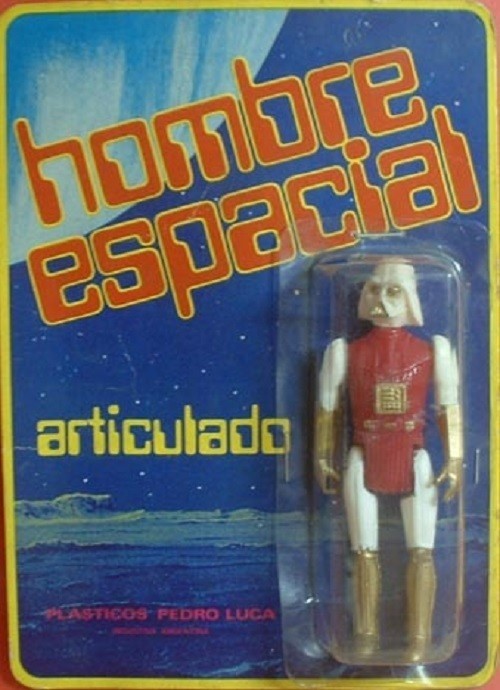
Or more subtly as with this toy of “space man” (my translation), that can be linked to star wars trough the helmet that looks early similar to the helmet and chest plate worn by the iconic character Darth Vader.

Source: http://runt-of-the-web.com/wordpress/wp-content/uploads/2015/12/star-wars-bootleg-darth-hombre.jpg
Source: http://static.srcdn.com/wp-content/uploads/Darth-Vader-Rogue-One-details.jpg
Bildresultat för star wars bootlegs
https://www.pinterest.se/pin/469218854907697489/?lp=true

Lastly we have an interesting one, with very few if any visual ties to Star Wars in the toy itself. The only thing that clearly ties it to the larger Star Wars franchise is the title as well as the type font used on the name.

As we see from just these two examples does bootleggers take a number of strategies in order to sell on the iconographic value of the Star Wars franchise. Note that both of these were released before the Disney buyout.

Star Wars has a very recognizable aesthetic, from the characters to the world, to even the type font itself, as a result is it prime materials for bootlegging, as you need very few means to tie it to the series itself.

Harry Potter

Another franchise that has become almost universality known, but in a much shorter time frame. A lot of the bootlegs related to Harry Potter I was able to find in my searches was relatively straight forward.

Bildresultat för harry potter bootleg toy
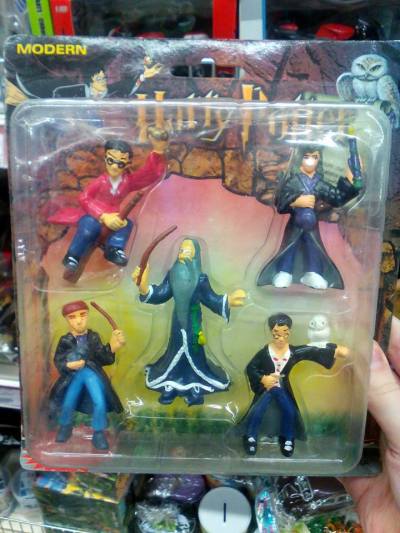
https://www.google.com/url?sa=i&rct=j&q=&esrc=s&source=images&cd=&cad=rja&uact=8&ved=2ahUKEwj4sZz1y_3kAhUQxcQBHY90DI8QjRx6BAgBEAQ&url=https%3A%2F%2Fknowyourmeme.com%2Fphotos%2F1036953-bootleg-knock-off&psig=AOvVaw28hFmwmzXnFDE7dJ7veOum&ust=1570106248846915

We can see here a good example getting the inportant details right, yet staying completely out of legal territory. The boy shares traits with harry yes, like the glasses and short hair, but still has another hair colour. He comes with a broom and a staff, but not once that tie directly to the franchise visually. The font as well, hints at the famous Harry Potter font, but only vaguely.

https://66.media.tumblr.com/f2d08e4af9afad46f749f77b9ffc3bc8/tumblr_ol2hoqEvVB1uxkzdxo1_400.jpg

Yet again we here have a much more overt tie between the bootleg and the franchise it is copying. each character has clear ties to who they are supposed to be copying. The product also clearly uses the name of Harry Potter in the trademarked font.

We here see examples of the explicit as well as implicit ties to the franchise the bootleg is trying to copy.

Miscellaneous and mixed bootlegs.

Even more interesting are those bootlegs that wildly mixes and matches different franchises and intellectual properties. These products tries to tie itself to as many franchises as possible, amusedly to cater to as many fans as possible.

Bildresultat för harry potter obama
https://bootlegtees.bigcartel.com/product/harry-potter-obama-sonic

The So called Harry potter Obama backpack, is quite infamous, to the point of even having its own merchandise. Something we will dive deeper in to later in this esse. The backpack has a differently coloured version of Sonic the hedgehog on it, and the name Harry Potter, as well as, Obama, the name of the previous president of the united states of America.

https://i.pinimg.com/236x/c7/76/ca/c776ca247a4af4b95dc89392543590ed–pokemon-memes-pokemon-mashup.jpg

This toy, seems to be a recolour of the Star wars character Bobba Fett (to which it also share its name), and the Pokemon Venusar. In the back is a Pikachu. Most interesting is the title of this series “Poké wars” which refers to both the franchise of Pokemon as well as Star Wars, with the wonderfully cryptic tag line “the power that is inside”. Here we can yet again see the use of a copy writen type font to more clearly tie the product together with the franchise it is copying.

Bootlegs and textuality

The bootleg raises interesting questions around paratextual connections, and what i and what isn’t considered Canon. I would like to preface this discussing by mentioning that we will not be discussing legality or the morality inherently tied to bootlegs. This text will solely by dedicated to discussing their visual and narrative implications.

Intertextuality

The concept of intertextuality refers to, as discussed in the chapter on Undertale, to the link between one text and another (see Undertale). More precisely are we going to discuss how these illegal toys ties to the legal representations of these franchises.

As discussed in the Undertale chapter, can you not point directly at an Intertextual connection within a work, unless of course directly tied to with a link or a reference.

With this logic would the ties between the the official and unofficial merchandise are equally as strong. At least from a purely Intertextual viewpoint. Does the connection of the bootlegged Star Wars toy being named Darth Vader, make it any less of a valid connection, that the on that the official toy with the same name makes?

Paratextuality

Paratextuality, as mentioned in the same chapter (see Undertale) refers to any connection point that is not found directly in the text itself. It is usually within this realm that ties between primary texts, such as books and movies, and secondary texts like toys and posters are found. A classic example is the use of a uniform type font and visual format.

The most easy reason that comes in mind is that canonical materials are al made by the same author. This of course falls apart, when we look at examples like Star Wars, where several authors. Th this point cant a single individual be called the source of the canon. The same thing can be said about a company, it is simple to try and tie al the canonical texts to a certain company. But what happens when several companies al produces texts individually and independently of each other. Should one of the companies texts be considered more canon then others, yet again the most simple solution would be to tie the canonical texts to those with the power over the copy-write. With this logic will the current copywrite-holders has the power to decide what is and what isn’t canon. This has some very strange implications for larger franchises and collections of texts, especially if the copywrite-holders change hands, like happened for example when Disney bought up Lucas-arts. This model of course falls apart, when we discuss things that no longer has an official copywrite-holder and has landed in the public domain.

Conclusions

The art of the bootleg is a fascinating one, and one that requires many revisits. At this juncture I mainly wished to introduce my readers to this wonderful world of wonky logic and near illegality. We have in this text managed to raise two interesting questions, as well as starting to answer them. These are questions of style and of authenticity.

Firstly have we managed to discern two schools of tough in the design of bootlegs, the direct and the abstract. The direct approach aims to get the likeness as close a possible while still being legally distinct. The abstract school goes in the other way, and tries to capture, an essence or vague concept of the original, and staying mostly visually distinct.

In the second part of this text did will endeavour to try and find or disprove canonical connections between the original and the bootleg. We failed to prove or disprove any ties intertextually, or within the texts themselves. We did manage to tie these bootlegs paratextualy to the original, but could not find any clear way of establishing if these ties were more or less valid then the ties between official materials, and other official materials. As mentioned before is this not a exhaustive analasys on the topic but rather meant to be an introduction to the topic, as well as an invitation to further discussions.

Undertale: an example of multileveld textuality.

Warning: This text do contain several major spoilers for the game Undertale. We will in this examine the games narrative in its entirety. As a result we ask you to only read this paper if you have already consumed the medium in question, or don’t mind being spoiled on key parts of its narrative.

Introduction

Undertale is an indie game created in 2015 by Toby Fox. Undertale is s classic turn based role-playing games in the vein of Earthbound and the early Final fantasy games. The unique mechanic of Undertale is that every single foe can either be killed or befriended, as well as, the game saving everything you do contiguously, regardless of the players own saving and loading.

This is not going to be the focus of this paper tough, rather this text will focus on how Undertale plays with different narrative and textual levels. This text will begin with a small introduction to the terms and general theories this analasys will be based on, followed by an in depth analysis of the text concluded with a concluding discussion on the analasys as well as tips on further reading materials on the subject.

Terminology

Before we start with the analysis of Undertale itself, will I present a series of terms that we will use in this, and future texts like this. It is inportant when writing any kind of academic text to always clarify how You the author will use the terms used. A term like text or contextulity will have different meanings, and it is vital to specify which meaning you will use.

Text

Firstly the term Text will refer to everything that is traditionally considers to be part of a video game, graphics, music, game mechanics, dialogue etcetera. In other words is the term text not limited to the written word. In this chapter will text mean the game Undertale.

Textuality

This is a breakdown of the different textualists we will examine in this chapter. We will also analyse how these levels interact with each other.

Text– Everything that is explicitly part of the narrative or story itself. Characters, plot, game mechanics, items, rooms etc, game assets. The text encompass everything that can be part of the text itself, this is different between genera and media forms.

Subtext– Everything that is implied or offered by the author in the text. Themes, morals lessons etc. These themes are not directly mentioned openly in text, but inferred using allegory or hints left for the reader to find for themselves.

Intertextuality– Anything connecting this text with another text, for example Toby Foxes other games or games in similar genera. The most common example of intertextuality is between the texts within the same series. In the terms of literary theory is there no connection between, for example, part 1 and part 2 of the Harry Potter series. These ties are instead left for the reader to create, just as the subtextual connections. Intertextuality more difficultly means the narrative ties between books. Titles, the text on the back and the numbering of series, falls within the category of paratextuality.

Paratextuality– Surrounding texts not part of the text, including the code, the title screen and border etc. These are part of what is sometimes reoffered to as the “artefact” or the object of study. Code, the box, the background blurb.

Analysis

The text we are to analyse today is a video game titled Undertale, its tag line being “a friendly game where no on needs to die”.

Undertale is constructed as a traditional turn based RPG where you traverse several game maps or “rooms” and fight enemies on a “battle screen”. By battling you gain either experience or money. You get money by choosing to ”spare” an enemy, and you get XP for killing an enemy.

Battle menu, source: Havoc teh Raven

The picture above represents the battle screen in Undertale. Here you have a series of options presented to you, you can do one of the following things on your turn, fight, act, use an item or try to spare your opponent. Here you also see your level and your current hit points.

The large black screen is representing the enemy attacks, and here you will dodge, their attacks in the vein of bullet hell shooters1. This area is, as described earlier very much a physical plane within he game world. Other characters can very much influence this seemingly purely mechanical plane. This fact become even more apparent within the games so called ”dating hub”.

Papyrus discussing dating hub, source: Havoc teh Raven
The dating hub, source: Havoc teh Raven

The paratextual connections, are used very often as a narrative device. This can most most easily be seen in the border window of Undertale, this border is not what we would consider part of the normal text. The border is often used as a narrative device, this is done by either changing the title of the game or moving the program around the desktop in various ways.

Papyrus has his special ability stolen, source: Havoc teh Raven

A second layer of paratextuality is a lot more closely tied to the text. This layer consists of the gameplay vs story. The battle screen is most often considered a semi real plane, existing only to drive the story forward. The most obvious moment being, the fight with Papyrus being interrupted by the annoying dog physically stealing his ultimate attack. A more obscure example is that the different areas within the world is know as ”rooms”. Rooms are usually what these areas are called within game terms. These rooms are then tied together, with ”doors” or ”portals”. The character Sans ability to teleport can be, the ability to freely enter these rooms out of order. These doors can at different points also lead to different areas, something we will discuss later.

Relaterad bild
Save screen, source: Nasıl Yüklenir

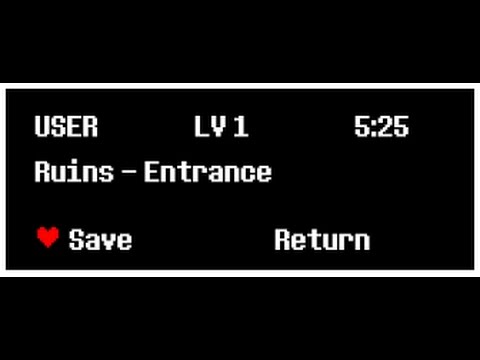
Lastly we need to discuss the concept of Loading and Saving. I here refer to the ability to create a ”save state”, this save state can later be returned to by loading a save state. The power of loading and saving is something that some characters have this ability to ”save” and ”load” at will. More specificity do you the player, and the main antagonist share this mechanics laden ability. This ability in game lets you return to a previous ”save state”, and fix potential problems and or misses you may have done. From a gameplay perspective does saving not actually create a save state per say, but rather moves you along a different narrative path, the game instead autosaves whenever the game is closed. This fact become apparent rather quickly as your player character has reactions to characters they meet for ”the first time”. Certain characters like Sans, and the shop keeper Temmie also seems to be able to keep track on whenever you load and save.

Subtext and the mystery of Gaster in the code.

In this last segment will indulge ourselves in some theorising on some materials not directly tied to a first hand source. In this area we will partly discuss things found within some second hand sources, mostly in the form of Wiki pages and other peoples analysis of Undertale. The character known as Gaster can only be encountered if some very specific criteria are met in the games algorithms. These algorithms are known in the games files as “fun values”, and are used to calculate a series of random events occurring.

One of the more interesting random events bring that of the character Gaster. Hem as well as any character related to him, can only be met if certain fun levels are met. One of these individual explains that Gaster was “lost in his own creation”. This could either relate to the grand power plant known as the Core, witch he supposedly created, or that he got lost in the very code itself.

Conclusion

The narrative style of Undertale takes up on a rich tradition of fourth wall breaking. This tradition was common in certain schools of theatre and film. These breaks go further then the simple acknowledgement of the audience, and makes both the game and the player itself, part of the narrative.

Different characters, such as Flowey, Sans and Asgore al have some sort of power to influence the game mechanics or objects on a Paratextual level. These are but a few examples of the various ways Undertale plays with differencing levels of textuality. I will leave it to the readers if the wish, to discover the rest for themselves.

Footnotes

1The genre of games where you play as a ship or other small object, dodging a series of bullets or other fast moving objects.

References and further reading

Click to access Narrative%20in%20Games.pdf

https://www.jesperjuul.net/text/clash_between_game_and_narrative.html

Analyzing the Game Narrative Structure and teqnice – Huaxin Wei

Undertale – Full Pacifist Play-through – No Commentary: Havoc teh Raven

Undertale Save File Nasıl Yüklenir

https://undertale.fandom.com/wiki/W._D._Gaster

Introduction to literary studies: part 1, sources and reliability

This will start a shorter series discussing the different terms and themes commonly used in art and culture studies. This first chapter will give a general idea of how to think about sources and how they can be, and cant be used.

Today will start our Wednesday series on general literary and art studies. Today’s topics is on sources and how to properly evaluate them. This series is designed to help future and current Humanities students, as well as general readers of my blog.

The level of sources

We will begin with dividing our sources in different level. These levels is related to how close, or far away they are from the original text we are studying.

First hand source: The artefact itself, in other words the object of study. In this case the object of study is the game Undertale. In most cases are the first hand sources to be proffered in any kind of serious analysis.

Second hand source: a text about the artefact, in our case the second hand sources is going to take the form of Game wiki pages about Undertale, as well as other discussions about the first hand source. If the first hand sources is not available to you, then second hand sources can be used. The first hand source may be rare, or lost, or difficult to handle in one way or another.

Third hand source: usually an analysis or compilation of second hand sources. These types of sources will not be very important in the case of this study in particular, but they are important to keep in mind none the less. Third hand sources can be used when talking about wider concepts about the Artefact, but they should be avoided when making the actual analysis.

The origin of the source

It is inportant to always keep in mind where a source comes from, and who is the sender of said source. By examining the source of a text, can we learn a lot about the credibility of the text, as well as the intention of the sender.

Some things to look out for:
a) Does the source has a clear sender/author?
b) Do the source mention any form of references?
c) Is the book/magazine/website well known?
d) Do the source seem to be pushing a specific angle?

Keep in mind that these are mere guidelines and not exact rules for research. A source can still be interesting even if it comes from a dubious origin, as long as you are aware of, and transparent with this dubiousness as you work with the source.

Conclusion

When selecting your sources, keep in mind on how it relates to the text, as well where it comes from. This is but a short introduction to the subject, but it will let you start thinking about sources, and how to properly use them.

Warhammer 40k an in depth analysis: Part 1, IoM, part 9, Final thoughts

Introduction

This will be the final chapter in our introduction to the humans of the Warhammer 40k universe. We will in this chapter combine what we have learned in previous chapters to create a uniform image of the Imperium of Mankind. Furthermore, will we deepen and contrast these themes with each other to see how they work together to create a coherent whole in a way that we will not see in many of the other factions in the Warhammer 40k franchise.

Knowledge and Faith

One defining feature of the different factions we examine, is how they view knowledge and the use of said knowledge. In the case of the IoM is knowledge, and the pursuit of knowledge, deeply tangled in with the pursuit of theological enlightenment and purity, this is particularly true in the case of the cult of the Adeptus Mechanicus (see Adeptus Mechanicus).

Magic and science

The British writer Arthur C. Clarke said the famous quote “Any sufficiently advanced technology is indistinguishable from magic.” This statement is most assuredly true when it comes to the scientific and technological advancements of the Imperium of Mankind. As described earlier are technology and knowledge highly mistrusted and mystified amongst most of the citizenry of the Imperium.

The members of the Imperium that do follow scientific pursuits uses terms of mysticism and magic rather than pursue science. A good example of this is that Chemistry is referred to as Alchemy, and the psychic powers of many races, are referred to interchangeably as magic. Furthermore is the term Miasma and similar terminology frequently used within fiction, giving us a good idea of how the scientific outlook works within the Imperium of man.

The last point is something that we have not yet had a chance to go into detail about, the concept of the “Machine Spirit”. The Machine spirit or, or the “Prime motivating force” is the name that the Adeptus Mechanicus has given to the force responsible for the function of al machinery in existence. This force is sentient and have wants and needs. As a result are machines not seen as tools to be used, but allies to be cooperated with, and in some cases, deities to be venerated. This further blurs the line between magic, science and faith. (Sanders, R 2016)

Doctrine vs innovation

As we have discussed previously, is innovation highly frowned upon, and in some cases, illegal. This taboo is particularly true within the Adeptus Mechanicus, and their punishment of supposed “Techno heretics”, goes far beyond that of their own priesthood. Citizens as well as members of the Imperial military has felt the ire of the Adeptus Mechanicus for “unlawful modification” of holy machines. To try and carelessly modify or invent new technology would be to put oneself above the wisdom of the ancients.

Most research stations and laboratories of the Imperium are described to be worked by several generations of scribes and scientists. It is rare that any of these scholars knows the original purpose of their research, even rarer for them to see any form of results within their own lifetime. This further drives home the idea of hopelessness, helplessness and overwhelming scale, as even such an innovative and creative task as research is turned into a series of monotonous and seemingly pointless tasks.

There are exceptions to this rule tough, for example does the Space Marine chapters personal engineers (known as Tech marines), often modify, or even create new forms of war gear. This blatant breaking of the status quo creates even more tension within an already fractured imperium.

Technology and religion

Lastly do we have the subject of technology and how it pertains to faith. The Adeptus Mechanicus are the most obvious of these connections, as they literally and metaphorically worship technology and knowledge, In this search do they willingly sacrifice flesh for metal in their quest of spiritual purity.

The Adeptus Mechanicus is far from the only area where technology and religion melds. We see it in the weapons they wear, the mechanical angels and statues, and the warships and tanks they use in battle. They are all used to give the feeling of the machines superiority over thee human. The venerated machines such as the bolter, is also valued many more times higher than that on any individual life.

The warrior culture of mankind

Throughout the narratives focused on the IoM, there is the notion of omnipresent war, a culture that is so deadest on victory and conquest, that peace is al but inconceivable.

Divine destiny

We have already discussed this concept earlier, but now we have a fuller understanding of the faith and philosophies of the Imperium, we can dig further into these concepts.

Both the pre and Post Horus Heresy Imperium is lead by a distinct notion of an ultimate destiny, that the galaxy is the property of humanity by birthright. The biggest difference between the two, would be that one crusade was done in the name of logic and reason, while the other was made in the name of faith and duty. The end result is tough, arguably still the same.

Be it the Imperial truth or the Imperial faith, both are highly strict doctrines, that meets any opposition with extreme violence. We see it in the Emperor’s crusade, where all those human civilisations that had no interest in joining peacefully were brutally torn down, and again where the Word Bearers were forced to watch as their cult to the Emperor were utterly destroyed before their very eyes. The same sort of unforgiving rhetoric is very much present in the current era of the Imperium, it can be found in the aggressively anti alien propaganda of the public officials, the strict and unforgiving teachings of the Ecclesiarchy and Adeptus Mechanicus, and in the uncaring and brutal methods of the inquisition. (Games Workshop 2013)

The cult of war

War is in general described as glorious within the Imperium of man, and a society is often measured by how skilled and or powerful their warriors are. One of the greatest imperial planets, is the Planet of Cadia, here the concept of a civilian do not exist, and most have gotten their first kills at the age of 14. This kind of dedication to war and combat it is seen as a sign of great cultural strength within the Imperium.

Another good example of this is the sector of Ultramar, the homeland of the mighty Ultramarines. The strength of this system is described to come from their “noble and warrior like citizens”. The greatest honour is to be chosen in to the grand space marine chapter. (Games Workshop 2017)

The individual and the masses

The dichotomy of the faceless masses and the lone hero is one that go through all the texts we have examined so far. This theme more than anything signifies the themes that strongest represent the Imperium of Man.

The hero and the expendable masses

The dichotomy between the faceless masses, and the heroic individual is most clearly seen then in the Astra Militarum. The organisation is described as unimaginably large, and one that sacrifices countless lives each day. Despite these facts, are the actions of single individuals, or small groups of valiant heroes been said to save the day constantly. This might also be meant to represent the large amount of propaganda the Imperium is constantly producing. The story of a lone hero in a large and careless world, is an interesting one when put next to the further narrative of the 40k universe, and one that we will surely come back to at a later date. (Hill, J.D. 2016)

Grand names and grand wars

The Warhammer narrative is usually signified by large distances, and long spans of time, this is often done to further drive home the idea of the vastness of the world, and the hopelessness of the characters struggles.

There are characters that are seemingly immune to the effects of time and space, that can freely travel large distances, and be able to have large sway over world changing events, sometimes even, galaxy spanning once. A good example of this would be during the Horus Heresy related texts. Here a few named individuals take up central and leading roles in a galaxy spanning event, spanning over decades if not centuries. We will discuss the Horus Heresy later, once I have presented a more complete image of the Warhammer 40k narrative as a whole. (Games Workshop 2013)

These examples can easily be explained away using “narrative convenience”, these breaks of the fictional rules needed to happen in order for the narrative to flow. With that said, are these points still important to keep in mind as we move forward.

The horrors of The Imperium

Lastly we will take a look at our final unifying theme, that of horror and dread, be it from the body horror of the twisted technology of the Imperium, to the existential dread of the Adeptus Militarum, is dread something that is always lurking beneath the surface.

Icons of horror

The iconography of horror and death is one that has run through most, if not all of the areas we have looked at through this series. The most easily recognizable one is that of the skull, it is a unifying sign throughout the Imperium, often as a sign of power or authority. This symbol can easily be tied to death, for obvious reasons.

The horror of scale

This is other tool of producing terror we have seen time again and again throughout the series. The size of the enemy armies, the vast distances between the characters and possible salvation, the size of the Imperium itself, al is is use to further a sense of dread and despair. One excellent examples of scale used to build dread, would be the Manufactorum with its endless scribes, protocol’s and barley functioning logistics. Another example is, the size of the galaxy itself, and the time and effort it takes to send a single message from one star system to another, not to mention, physical space travel.

Conclusion

With this analysis have we managed to create a coherent image of the Imperium of mankind, as well as presented some of the tools we will be using in the rest of the series. We have so far presented an image of our subject as a Xenophobic, highly religious civilisation that values war, and venerates as well as worships technology. I have during this series tried to show the coherency of these themes, as well as to categorize them into the three different areas presented above. We will give each faction the same analysis, and when we have a good grasp of the subject matter, will we use this as a platform to discuss smaller and intricate subjects.

This wraps up our first chapter on the Warhammer 40k franchise, the next few series of episodes will be shorter one offs to cleanse our pallet, before returning and taking a deep dive into the strange and intriguing world of the Immaterium.

References

Games Workshop (2013). Codex: Inquisition. Games Workshop. Lenton, Nottingham.
Hill, J.D. (2016). Astra militarum. Games Workshop. Lenton, Nottingham. Games Workshop (2017). Codex Space Marines . Games Workshop.
Sanders, R. (2016).Adeptus Mechanicus . Games Workshop.

Copyright Disclaimer

Under section 107 of the Copyright Act 1976, allowance is made for “fair use” for purposes such as criticism, comment, news reporting, teaching, scholarship, education and research. I do not claim to own an of the pictures in this post. Al copyrighted materials belongs to their respective owners.

Warhammer 40k an in depth analysis: Part 1, IoM, part 8, The holy God Emperor

The Emperor of Mankind is a symbol of many things, some which are direct contradictions of each other. In this chapter we will try to explore the major themes, as well as relate them to the rest of the Imperium of man as a whole. By understanding the Emperor of mankind can we get a more clear picture of the rest of the faction, as well as the narrative of Warhammer 40k as a whole.

The hidden saviour

The Emperor is described as being an ageless stoic giant, silently leading humanity from the shadows. It was only at the 30th Millennium, during humanity’s greatest struggle that he first chose to reveal himself. He arrived at the head of a group of  genetically engineered soldiers known as Thunder Warriors, the precursor to the Space Marine. They rapidly unified the Earth under one banner, his banner. With his home now united once more, with his genetically engineered sons at his side, he set his gaze on the winder galaxy.

The image of a lone saviour  can be found in many faiths and mythological stories. To keep the catholic allegory, the easiest connection would be to Jesus, the saviour of the catholic faith. This is, though far from the only example we find of this character trope.

Due to the fact that the material we have discussed so far does not deliver very far into the past of the Emperor, then neither will we do so here.

https://vignette.wikia.nocookie.net/warhammer40k/images/5/50/EmperorsWisdom.jpg/revision/latest?cb=20110727213356
Source: https://warhammer40k.fandom.com/wiki/Emperor_of_Mankind

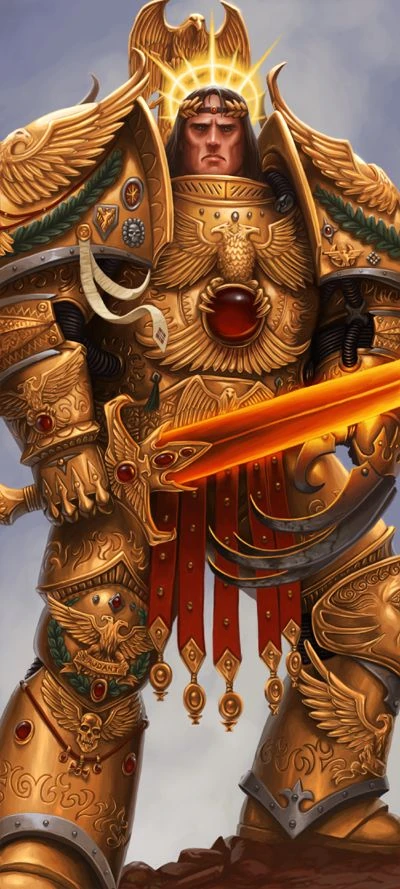
Above we see an image of the Emperor of Mankind leading the Imperium across the stars. Some of the common imagery, such as the seal and the skull are here overshadowed by another icon, one we have yet to discuss. This icon is the two headed eagle, a common symbol for Empires and Imperiums through history. (Chariton 2011)  

In the context of Warhammer 40k does the two headed eagle represent the two leading powers of the IoM, the Lords of Terra, and the Tech Mages of Mars. While this icon is widely used within the imperium of Mankind, especially within the imperial guard (hill 2016), this icon has been joined by the symbol of the Ecclesiarchy and the Inquisition, amongst others to show the might of the Emperor and his might Imperium. (Games Workshop 2013) 

The great crusade

The great crusade here refers to the time where the Emperor set out from earth to conquer the stars in the name of humanity. The term crusade once again makes connections to the Christian faith, via the Catholic crusades. The term Great crusade refers in the context of Warhammer 40k, to the time where the Emperor set out from Earth to conquer the stars in the name of humanity. The term crusade once again makes connections to the Christian faith, in particular to the Catholic crusades against the people they saw as infidels and heretics.

The imperialistic themes and undertones of the Great Crusade are hard to ignore, tying it closer to the themes of colonialism discussed in earlier chapters. The biggest difference being that the Emperor’s great crusades, and those carried out by the catholic faithful, was not made in the name of any god. The Emperor in fact, banned all forms of magic, mysticism and occultism. These crusades were, much like the British colonization, made under the mantra of reason, logic and civilisation (see Manifest destiny). One can argue, that due to the fact that the Emperor, were in several ways a god, even before he became the centre of a monotheistic religion, was the Crusades a perfect example of the will of god.(Games Workshop 2017) 

The father and his sons

During the time of the great crusades the Emperor of mankind perfected his thunder warriors. The Thunder Warriors had proven themselves to be violently unstable and prone to going into psychotic murderous rages from where there was no stopping them. The Emperor eventually managed to create the Primarch Space marines from his DNA, and from these templates he created the space marines. The grand forces of Chaos, the big evil of the 40k narratives conspired and managed to kidnap the primarches as children, and spread them across the universe. All of them seemed to land on planets that reflected their specific sentiments, talents and personalities, for better or worse.

After being separated from his sons by the forces of chaos (explained further in a future chapter) he slowly reunited with them as his great crusade progressed, giving them commands of legions of their own lesser clones, or sons. These Primarches have been moulded by the life they have lived away from their gene father, as well as by the various genetic mutations they had endured. These changes ranged from differences in eye and hair colour, to having fangs or even wings in the case of Sanguinius. These genetic differences later showed up in their clones to a greater or lesser degree.lones to a greater or lesser degree. The Space Marines of a certain chapter seemed to also take on the mentalites and quirks of their gene fathers, be it as mild as the Salamanders sharing their Genefathers humbleness and love for craftmanship, to the more sever anger of the Blood Angles, or the almost obsessive cybernetic enchantments of the Iron Hands.

The Emperor, the Primarchs and the Space Marines, all use terms like father, son and brother when referring to the relationship to each other. The Emperor created the Primarchs from his own genetic makeup, though despite this, it would be more accurate to call them his creations rather than his children. Note that this repudiation of heritage was made without sexual repudiation, a theme common in both post-humanist and futurist works.

The Space Marines see their Primarchs, as well as the Emperor both as deities and as their parental figures. It is true that the Space Marines share some genetic materials via their implants (see Space Marines),but other than that they do not necessarily share family bloodlines. Note that the term brother is also a reference to battle brothers, as well as brothers of the same convent, much like a priest or monk would speak about his equal. The term Father, may also be used in the same way as the elder or superior member of the same religious order would be addressed. The term Son would be similarly be applied by this superior member while addressing his lesser. (Games Workshop 2017)

Conflict, betrayal and defeat

During the great crusade, the Emperor was forced to rely more and more on his Primarchs. This left them alone and leaderless for long periods of time, and some started to resent their gene father. Some felt used, treated like nothing more than a tool by their creator, Magnus the Red felt scorned by the ban on Psychic powers, that greatly limited his and his sons research. But none were as resentful as Logar.

Logar had, despite his father’s wishes, started a religion venerating his immortal creator. On each planet he and his sons would conquer, they would erect huge temples, and form cults in his father’s honour. This, of course, went against the Imperial Truth, and the wishes of the Emperor himself. Logar was forced to kneel and watch, as his most prized achievement, a city sized monastery and temple was burned to the ground. He was also forced to swear off worship of the Emperor, as well as any other form of deity or god.

Instead of following his gene fathers wishes, Logar instead, simply found other gods, darker more sinister gods. These gods, the Ruinous Powers, will be discussed in a later chapter. He proceeded to try and convince his fellow Primarchs to join him, and his new gods.

This rebellion would be known as the Horus Heresy, so named after the general, Horus, chosen to lead the rebellion. TThis rebellion would be known as the Horus Heresy, so named after the general, Horus, chosen to lead the Emperor’s armies in his fathers absence. This rebellion saw half of the Space Marine legions join the rebellion, as well as leave much of what the Emperor had built in ruins. This rebellion was eventually stopped, at holy Terra itself, this victory was not without great cost though. Chief amongst them, being the Emperor being left mortally wounded by his son Horus. (Games Workshop 2017)

The absent leader

After defeating, and being mortally wounded by War-master Horus, the Emperor was entombed in an archaic machine known as the Golden throne. This golden throne keeps the Emperor clinging to life, using poorly understood science, and the sacrifice of a thousand souls each day. This throne keeps the Imperium’s beloved god Emperor alive, but also works as a beacon for interplanetary space travel for the Imperium.

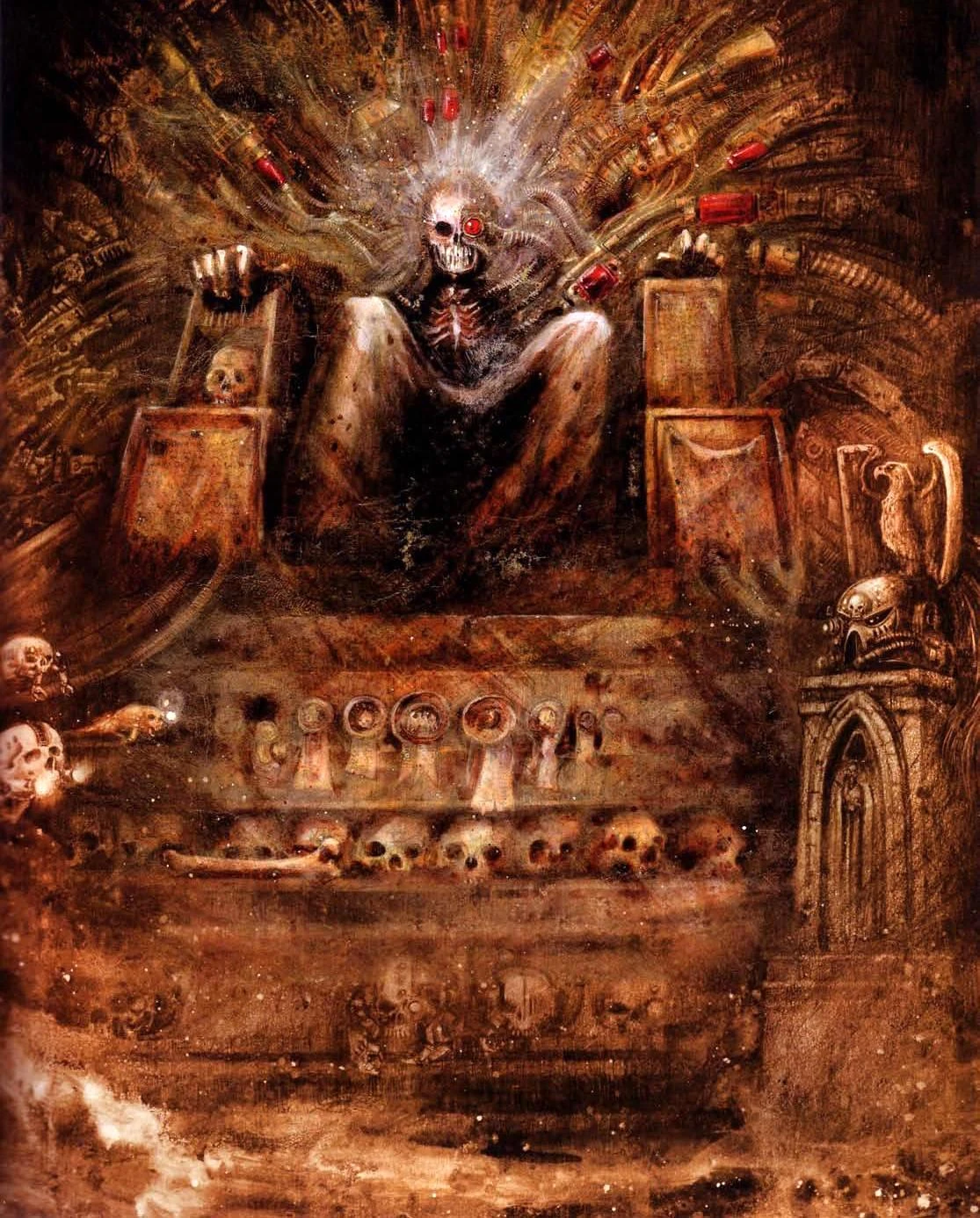
https://vignette.wikia.nocookie.net/warhammer40k/images/2/25/Emperor_Upon_Throne.jpg/revision/latest?cb=20110726003909
Source: https://warhammer40k.fandom.com/wiki/Emperor_of_Mankind

Many of the same visual themes are present here, as in much of the other artwork we have seen representing the IoM. The Emperor is an amalgamation of machine and man, there are sigils as well as themes of Gothic and catholic Much of the same themes we have found in earlier visual designs is present in the representation of the Emperor in his Golden throne. The Emperor is an amalgamation of machine and man, there are sigils as well as themes of Gothic and catholic architecture in the form of the dust, holy statues and arches covering the throne. Skulls are once again prevalent, both in the form of the Emperor himself being a literal skeleton, but also in the iconography and decoration of the Golden throne itself. The dust driving home the point of how ancient and poorly kept this machine truly is, and the row of skulls is an apt metaphor for the millions of lives lost every day to keep the machinery running. This allegory works both for the Golden Throne, but also for the Imperium itself. (Games Workshop 2017) 

Conclusion

As we can see from this quick breakdown is many of the themes we have discussed earlier present here as well, with that said are they for the most part subtly, or not to subtly altered. This further drives home the scale and timespan of the narrative within the 40k universe. The most striking of these differences, would be the Emperor’s “ascension” from leader, to godhood in the eyes of his followers, a move he himself adamantly opposed. This ascension is common in man

We can once again see several different themes return in the design of the Emperor himself. The mystical blend of magic and science return both in the Golden Throne as well as the Primarches. The focus on gothic architecture and death is present in the throne itself. The fact that the Emperor himself is, literally in life support, drives home a certain inevitable horror of a grand collapse and slow painful death. The Imperium as a whole holds a similar fate in the not too distant future.

Time once again placid a major part in the narrative. One of the major examples would be the Emperor’s ascension from leader, to godhood in the eyes of his followers, a move he himself adamantly opposed. The change of Emperor from secular leader to mythical deity closely mirrors that of the Imperium´s change from a secular society honouring technology and research, to a conservative theocracy.

We now have all the pieces we need to more fully understand one of the major parts of the Warhammer 40k narrative, the Imperium of Mankind. Next chapter will be focused on combining all these pieces to form a coherent picture of the faction. Next series will focus on the mystical dimension of the Warp and the gods of the Warhammer 40k universe that reside within it.

References

Games Workshop (2013). Codex: Inquisition. Games Workshop. Lenton, Nottingham.

Chariton. J (2011) The Mesopotamian Origins of the Hittite Double-Headed Eagle

Hill, J.D. (2016). Astra militarum. Games Workshop. Lenton, Nothingham.

Games Workshop (2017). Codex Space Marines . Games Workshop.

Copyright Disclaimer

Under section 107 of the Copyright Act 1976, allowance is made for “fair use” for purposes such as criticism, comment, news reporting, teaching, scholarship, education and research. I do not claim to own an of the pictures in this post. Al copyrighted materials belongs to their respective owners.

This blog post was spell checked and edited for readability at 2021-07-03

Warhammer 40k an in depth analysis: Part 1, IoM, part 7, In the service of the Emperor

Introduction

In this chapter we will take a look at a series of different factions, all related in one way or another to the primary religion of the Imperium of Man. This religion goes by the name of the Imperial faith, and shares some similarities to the European Catholic Christian faith. These similarities will quickly become apparent as we move forwards. The different factions we will be looking at are in this chapter are the Ecclesiarchy, the Adeptus Sororitas and the Inquisition. We will also examine the visual and theological similarities between the Imperial faith and the Catholic Christian faith.

The Imperial faith

The Imperial faith is the official, but far from the only, religious belief within the IoM. The tenements of the Imperial faith is straight forward, the will of the Emperor is law, and the Emperor wishes humanity to rule the stars, so rule then, humanity will.

The only problem is that, the Emperor (for reasons we will explore later) has not been able to speak for over ten millennium, and this has resulted in interpretations of interpenetrates of his original words, ranging over decades of dogma and scholarly debates. The original ideology preached by the Emperor himself was in fact known as “The Imperial Truth”, and while equally as dogmatic, was it focused on knowledge, truth, and the rejection of the supernatural in all its forms. It based on learning and initiative, tough it still thought humanities superiority over every other form of life, sentient or not.

This rejection of all thing supernatural, will as will learn, later become the Emperor’s downfall. The Emperor indeed forbade al sort of worship of gods and spirits, especially the worship of him. In the Emperor’s absence has this belief in initiative and exploration transformed in to a faith of dogma and submission. To question the Imperial faith is to question the Emperor himself!

The Ecclesiarchy

This is the main governing body of the Imperial faith, and has risen to power after the events of the Horus heresy, and has become the dominant spiritual organisation in the Imperium, and their faith is strictly enforced by the various governors and interplanetary organisations of the Adminstrarium.

The Ecclesiarchy follows the belief that the Emperor is the force of ultimate good in the universe, and that the humans are his messengers and servants. Humanity, as a result, can do no wrong, as long as they work in the Emperor’s will.

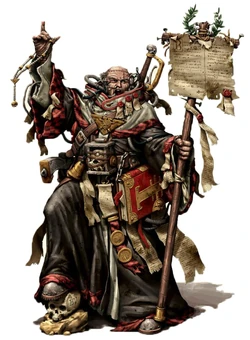
Cleric
Source: https://warhammer40k.fandom.com/wiki/Adeptus_Ministorum

The Ecclesiarchy, just like many other aspects of the IoM are visually heavily inspired by the catholic church. Noticeable similarities being the robes, seals and rosaries, al commonly attributed to the Catholic church.

The Adepta Sororitas

Known as the standing army of the Ecclesiarchy. This organisation of warrior-nuns and diplomats follows a similar naming scheme as many other organisations in the IoM. The adeptus being a Latin amalgamation of “belonging to” or “serving”, and Sororitas, as you might have figured out, translates to, “sisterhood”. In other words “in the service of the sisterhood”.

Using a loophole that excludes the Ecclesiarchy from employing “Men at arms”, does the Sororitas, only consist of women. This, as well as the Sisters of silence, is the only “female only”, organization within the IoM.

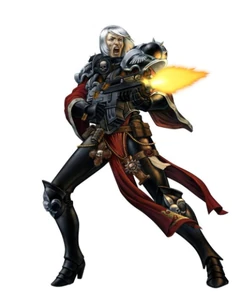
SisterofBattle2
Source: https://warhammer40k.fandom.com/wiki/Adepta_Sororitas

As we have seen in earlier examples, does the incents and and the regalia give them a clear connection to the catholic church. (Games Workshop 2011) The fleur de leis also invokes the other major inspiration for the Adepta Sororitas, that of the historical figure of Jeanne d’Arc, famous general, warrior and pious believer.

The The Adepta Sororitas are organized in chapters, not unlike their Space Marine brethren, tough unlike the decentralized and isolationist organization of the Astartis, does the Sororitas follow strict hierarchies and works closely with other chapters. The Sororitas also have several chapters that are not dedicated to fighting, but instead serve functions as diplomats, administrators, teachers or healers, al of them, in some way, helping in spreading and preserving of the Imperial faith. This shares a fair number of simulates to how real life Catholic convents have different voes and serves God and the church in different ways. (Russell 2007)

Much of the Sororitas work are concerned with of matters of fate in al its forms. The sisters often fight enemies that goes against the Emperor’s will in one way or another, be it aliens, humans of different faith or any other criminal that would be branded heretical in the eyes of the ecclesiarhy. This sacred mission, combined with the fact that the sisterhoods preferred weapon is fire, makes connection between them and the medieval witch-hunts pretty easy to make. (Games Workshop 2011)

The Inquisition

This faction is the easiest to relate to their real life counterpart, or at least, the myths of it. The most well known real life instances of an Inquisition, would most likely either be, the Spanish Inquisition, or one of the many separate Inquisitions involved in hunting witches al across Europe during the medieval witch craze.

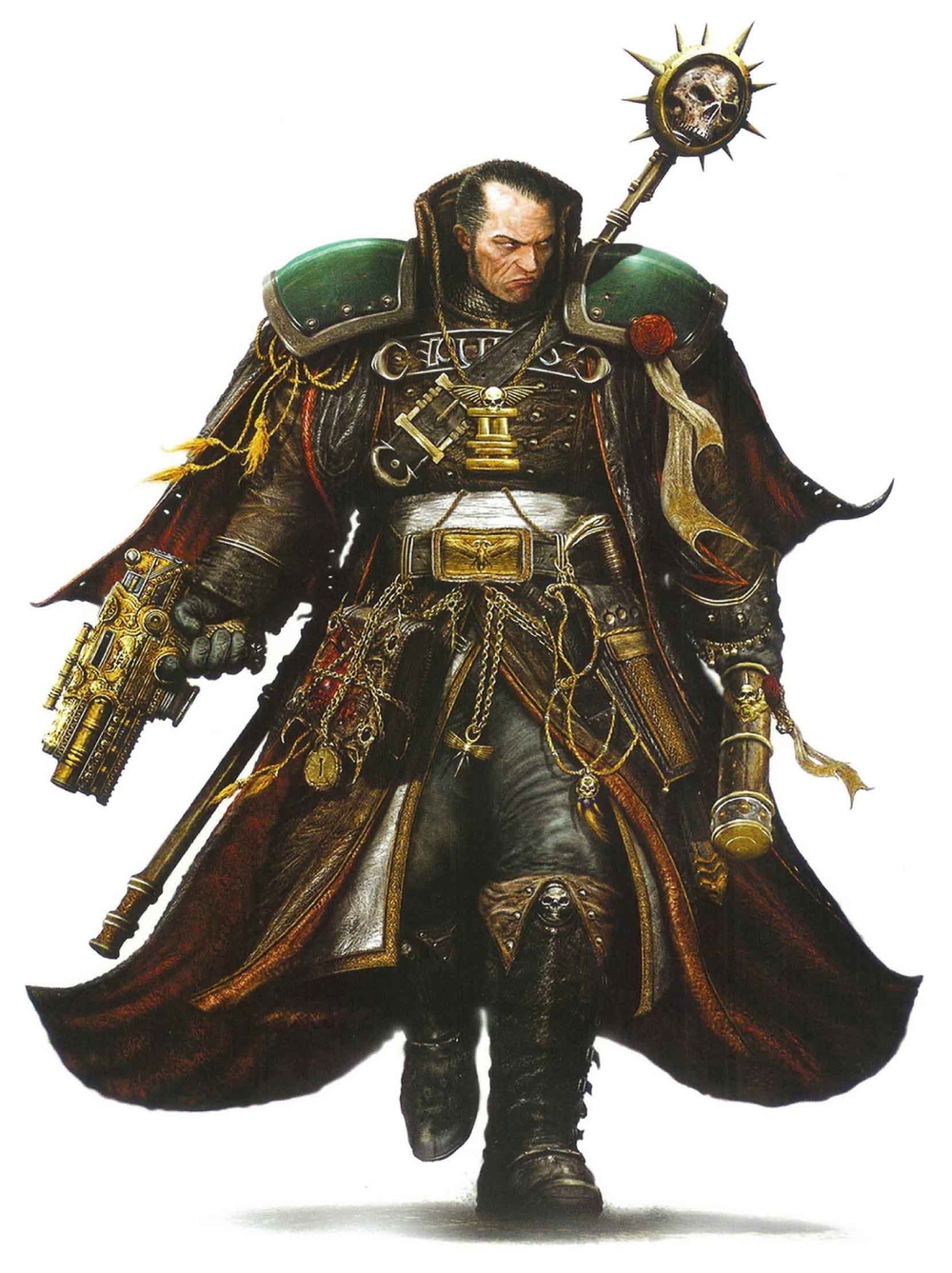
The Inquisition in Warhammer 40k is in many ways the ultimate authority in all things concerning the safety of the Imperium, and they are seen as the ultimate arbiters of the Empires will. The inquisitors are mysterious, all-powerful people, with the utmost authority, only answerable to one of their own rank. The in universe Inquisition faces a large variety of threats, but the once we are interested in today, relates to perpetrators of “heresy”, this branch is, helpfully enough, named “Ordo Hereticus”, or the “witch hunters”. (Games Workshop 2013)

The real life European inquisition was a lot less organized, but did hold some authority in the matters of a heretical nature, thanks to Pope Jon XX II who give the Inquisition the authority to any sorcerer they encountered on trail, as well as to doll out punishment to those found guilty. (Russell 2007)

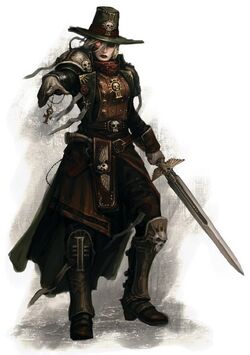
OrdoHereticus Inquisitor
Source: https://warhammer40k.fandom.com/wiki/Inquisition

The same visual cues, can be seen in the inquisition, as we have seen in the other factions that we have looked at today. The seals of purity, the skulls and the various religious regalia. It is not as obvious as with the other two, but the visual themes are still there. the Ordo Hereticus, are in charge of, as it sounds, heretics, but what is a heretic according to the Imperium? (Games Workshop 2013)

Heresy

Heresy takes many shapes and forms within the Imperium of Mankind. Most of them are related to helping, or concerting with the “enemies of mankind” or researching “forbidden lore”. (Games Workshop 2013)

These enemies are the Chaos gods, aliens and mutants. Forbidden lore concerns knowledge of magic, the chaos gods, alien technology as well as technology from the “dark age of technology” something we looked at in the Adeptus Mechanicus chapter. (Games Workshop 2013)

This might seem incredibly harsh and draconian, that the IoM punishing its own citizen for not strictly following the creed of its rulers. But, as we saw in the Adeptus Mechanicus chapter, are many of these rules set in place for a reason. Dark age technology was highly powerful and destructive, and the reliance on it inevitably led to humanity’s downfall. Magic, and its use draws from the incredibly dangerous dimension of the warp, where the chaos gods reside, and many of the alien species humanity has encountered has indeed been hostile. (Games Workshop 2013)

Conclusion

We can here see further ties to real life institutions and events, and slowly does a picture form of how we can critically analyse the IoM as a mirror and exaggeration of certain western traditions and institutions.

Here we once again how dramatic irony is used to further the sense of dread and fear within the narrative. At face values, the actions of the Imperium of Man are deplorable, and completely unjustifiable, but at a further inspection we learn what would happen if one of these measures of control fails.

Once again, this has been an incredibly short introduction to these concepts and factions, and I highly suggest you looking up further materials for further information, the reference giving you a good starting point. Next time we will look at the final piece of the puzzle, the Emperor of Mankind himself.

References

Doorn-Harder, P.V. (1995). Contemporary Coptic nuns. Columbia, S.C.: University of South Carolina Press.

Russell, J.B. & Alexander, B. (2007). A history of witchcraft: sorcerers, heretics and pagans. (2nd ed.) New York: Thames & Hudson.

Games Workshop (2013). Codex: Inquisition. Games Workshop. Lenton, Nottingham.

Games Workshop (2011). Codex: Sisters of Battle. Games Workshop. Lenton, Nottingham.

Copyright Disclaimer

Under section 107 of the Copyright Act 1976, allowance is made for “fair use” for purposes such as criticism, comment, news reporting, teaching, scholarship, education and research. I do not claim to own an of the pictures in this post. Al copyrighted materials belongs to their respective owners.

This blog post was spell checked and edited for readability at 2021-06-14

Warhammer 40k an in depth analysis: Part 1, IoM, part 6, The Emperors chosen.

Introduction

Last time we briefly discussed how the most numerous and expendable rank and file troopers of the Imperium of Man are presented and represented. We also previously discussed possible real life inspirations for these armies. This chapter we will take a look at the opposite, the elite and superhuman Space marine, or Adeptus Astartes. As with earlier chapters will this one serve as a simple introduction, a starting point on which we can later discuss more deep and complex subjects. This text will be focusing on describing the Space Marine, as well as their place in a long line of fictional, genetically engineered superhumans.

To begin with, we will start with some fast simple comparisons. A marine is a type of soldier, being trained to fight primarily at sea, and is in Science Fiction often a shorthand for specialist soldier. Adeptus, as we know from earlier chapters, roughly translates to servant of, or belonging to something. I have on the other hand not been able to find a direct translation to the word Astartes, though the simplest explanation would be that it is a simple pun on the term Star, so in other words, servant of the stars or belonging to the stars.

The Marine

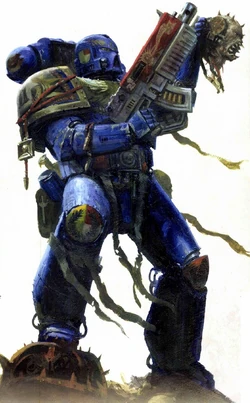
The Space Marine is a hulking monstrosity of a human, breed from early age to fight. Later augmented with a series of artificial organs, they are turned from a normal human into a several feet tall monster of pure muscle and devotion. Clad in their signature power armour, and wielding their famed Bolter, they strike instantly recognizable image, often being used as the primary mascot of the franchise as a whole.

Ultramarines Artificer Armour

Source: http://warhammer40k.wikia.com/wiki/Ultramarines

A Space Marine is raised from the age of fourteen to become a loyal servant and instrument of the will of the Immortal Emperor of mankind. In order to reach this goal the individual is systematically broken down and built up from the ground up, both mentally and physically. This is done by inhumane mental and physical training, as well as with the implementation of powerful artificial organs. This procedure is extremely dehumanizing and dangerous, many die or get irreversibly disfigured during the process.

Standing several heads over the tallest mortal human, with the body proportions more akin to an early 90s superhero comic, then any form of real life anatomy, the Adeptus Astartes makes for an imposing figure. This grander than life size and stature is further enhanced by their armour, a fully sealed suit of armour powered by several motors and other assist systems. The Space Marine seem almost mythical, inhuman next to their unaugmented kin.

The Astartes, or Space Marine is raised by, and indoctrinated into a brotherhood of warriors, a cult of fully devoted soldiers, with a singular purpose, to serve the Emperor of mankind. The Astartes live a Spartan life, away from temptation and vice, their days being filled with prayer, drills and combat training. Everything to keep their mind and bodies occupied, and to stop them from turning against their creators. This fear is not without precedent, as their genetic ancestors rebelled against the Emperor himself at the order of Primarch Horus, a story we will cover at length in later chapters.

The Astartes has in essence, shredded himself, and become something non-human, in order to protect the very thing he has sworn off forever. For an Astartes there is no retirement, no leave of absence, no end to the struggle, for only in death does his service end. They know no other joys than battle, have no other goals than the safeguarding of all of Imperial space.

The superhuman

The myth of the superhuman is not a new one in science fiction, or in literature and storytelling in general for that matter. From the Greek myths to the modern super hero classics, can we find examples of individuals that through birth or other means become more than human.

The first allegory we will look to is that of the Jewish myth of the Golem. The Golem has become a standard stable of much of contemporary fantasy as well. The Golem being a sentient magical being, often made out of clay. This Golem is animated by holy texts and is said to follow the owners commands unquestioningly, until it is told to stop. The Marine is also a large loyal servant, created in much, with the use of holy scriptures and religious dogma.

The theme of super human soldiers is, as mentioned before, a long lasting staple of science fiction narratives. From Captain America and Bane to Solid Snake and Agent 47, only to mention a few, are contemporary fiction filled with genetically modified humans, breed to fight in humanities wars or other conflicts.

An imperfect system

As you will see in this series, the Imperium of man’s narrative is full of imperfect, broken or seemingly arbitrary laws, ideas or organisations. This imperfect state helps to further the feeling of dread, hopelessness and frustration that we have discussed earlier. Much of these emotions are created via the use of dramatic irony. Dramatic irony is a narrative tool, where the audience knows more than the actors in the story. The most well known example being, a couple sits at a restaurant, and there is a bomb under the table, the audience knows, but the couple do not. Alfred Hitchcock famously used this example to illustrate how he liked to build suspense in his stories.

Much of the drama and tension that the Astartes creates comes from a similar notion, for despite rigorous testing, and check-ups, are each Space Marine potentially flawed, unstable or disloyal. The creation of new Astartes is achieved using genetic materials of their predecessors, with the help of science beyond even the most skilled of the Imperium´s scholars. The Imperial scholars can not improve, nor reproduce the systems involved in the creation of new Astartes, only replicate it. This fact further helps create tension, and drama. To create a new Astartes, the organs and hormones needed for the process, must be extracted from an Astartes corpse. This means, if a Astartes corpse is lost, not only is he lost, but so is every possible successor that could be created using his genetic materials. These facts are well known to the readers, but not to the majority of the actors within the various narratives where the Astartis appears.

The inherent flaws of the Space Marine, and the Primarches, is the basis for one of the more popular and elaborate narratives within the Warhammer 40,00 franchise, the Horus heresy. We will tackle the setting, narratives and overall presentation of the Horus heresy in a later series.

The warrior cult

The last thing I like to discuss is how the Marine relates to the overall faith of the Imperium, more specifically The Imperial Creed, a subject which we will also discuss in a later chapter.

The Adeptus Astartes do not follow this general faith of the Imperial Creed, but rather have their own, unique cultures of devotion. The Astartis follow their own form of worship and traditions. All loyal Astartes, just like the rest of the Imperium, worship the God Emperor in one form or another. These traditions may vary from solemn prayer and contemplation, to worship through creation of art and weapons, or even severe self flagellation. These religions and cultures are a tightly guarded secret by the chapter, and are all but unknown to outsiders, something that further spreads paranoia and fear through the Imperium regarding the super human Astartis.

This dedication and secrecy further cements the Space Marines as more than just a fighting force, they are a devoted warrior cult, full of secrets and mysterious practises.

Conclusion

This chapter has been a short introduction to one of the major elements of the Warhammer narratives, the Space Marine. We will return to this topic many times in the future, but for now, this will be enough for us to be able to continue and explore the more complex parts of the Warhammer 40k narrative. Next time we will take a look at the Ecclesiarchy, the Imperiums official religious organisation, as well as the secretive polishing organ known as the Inquisition. 

Source

Games Workshop (2017). Codex Space Marines . Games Workshop.

Copyright Disclaimer

Under section 107 of the Copyright Act 1976, allowance is made for “fair use” for purposes such as criticism, comment, news reporting, teaching, scholarship, education and research. I do not claim to own an of the pictures in this post. Al copyrighted materials belongs to their respective owners.

This blog post was spell checked and edited for readability at 2021-06-14

Warhammer 40k an in depth analysis: Part 1, IoM, part 5, The Astra Militarum

Introduction

In this chapter we will be diving into the Imperiums most numerous military organisation the Astra Militarum. We will take a look at the standing forces of the IoM, and what their portrayal can tell us about how warfare is presented within the Warhammer 40k narrative. This text will be based on the seventh edition of the Warhammer narrative primarily. This chapter will be divided into two parts, each delving into the two seemingly opposing views of warfare presented in the Astra Militarum codex. These sides are a view of war as horror and one of war as heroics. (Hill. 2016)

The terror of logistics and dehumanisation

The wars of the Imperium are presented to be fought on a galactic scale, the size of their war machine too large for a single person to understand even less comprehend by any one member that is part of it. Each life is presented as a mere statistic, each death a decimal point in the eternal bureaucratic machine. Most die unnamed and unremembered. (Hill. 2016)

Each human soldier is described to be little to no match, to the other inhabitants of the universe. Individual people, nations, or even planets would easily be destroyed by humanity’s many foes. The Astra Militarum do not win their war through the strength of their soldiers, but rather the sheer volume of troops and war machines at their disposal. Populations of entire planets can easily be sacrificed with few lasting negative effects on the Imperium as a whole. The Astra Militarum is often described within fiction as “the Sledgehammer of the Emperor”. Regiments are raised and sacrificed in the millions, entire planetary populations are kept in brutal savage conditions simply to ensure a good “fighting stock” for the Imperium’s armies. (Hill. 2016)

The Manufactorum is a grand example of the massive scale, and incredibly dehumanising tactics that the Imperium of Mankind is described to employ. The bureaucratic and logistical branch of the Imperium`s armed forces, The Manufactorum is presented as an interplanetary organization of bureaucrats and scribes numbering the billions. Each carrying out jobs that they barely understand to reach goals they understand even less. Sending reports and orders back and forth, each typo leading to catastrophic errors such as a regiment being sent into combat without any ammunition, or a fleet being sent several light years of course, delaying arrival by months. (Hill. 2016)

The lone hero

Despite these themes of mindless sacrifice and dehumanisation, there is a parallel narrative. The narrative of a lone hero, or a small group of heroes saving the day at a critical moment. The codex describes a series of heroic men (for all the named major characters in the codex are male), that in one way or another through their cheer, bravery or genius saves the day. This trope is not something unique to this narrative, but is indeed a common vehicle for many war narratives. Saving private Ryan, apocalypse now, bad company etc, all follows small groups of soldiers facing great odds to finish their mission. (Hill. 2016)

The theatre of war

The aesthetics of warfare of the Astra Militarum is interesting to deconstruct. Most of the illustrations in the codex are depicting the regiments known as the Cadian shock troopers.

File:Img008.jpg
Source: http://wh40k.lexicanum.com/wiki/Cadian_Shock_Troopers

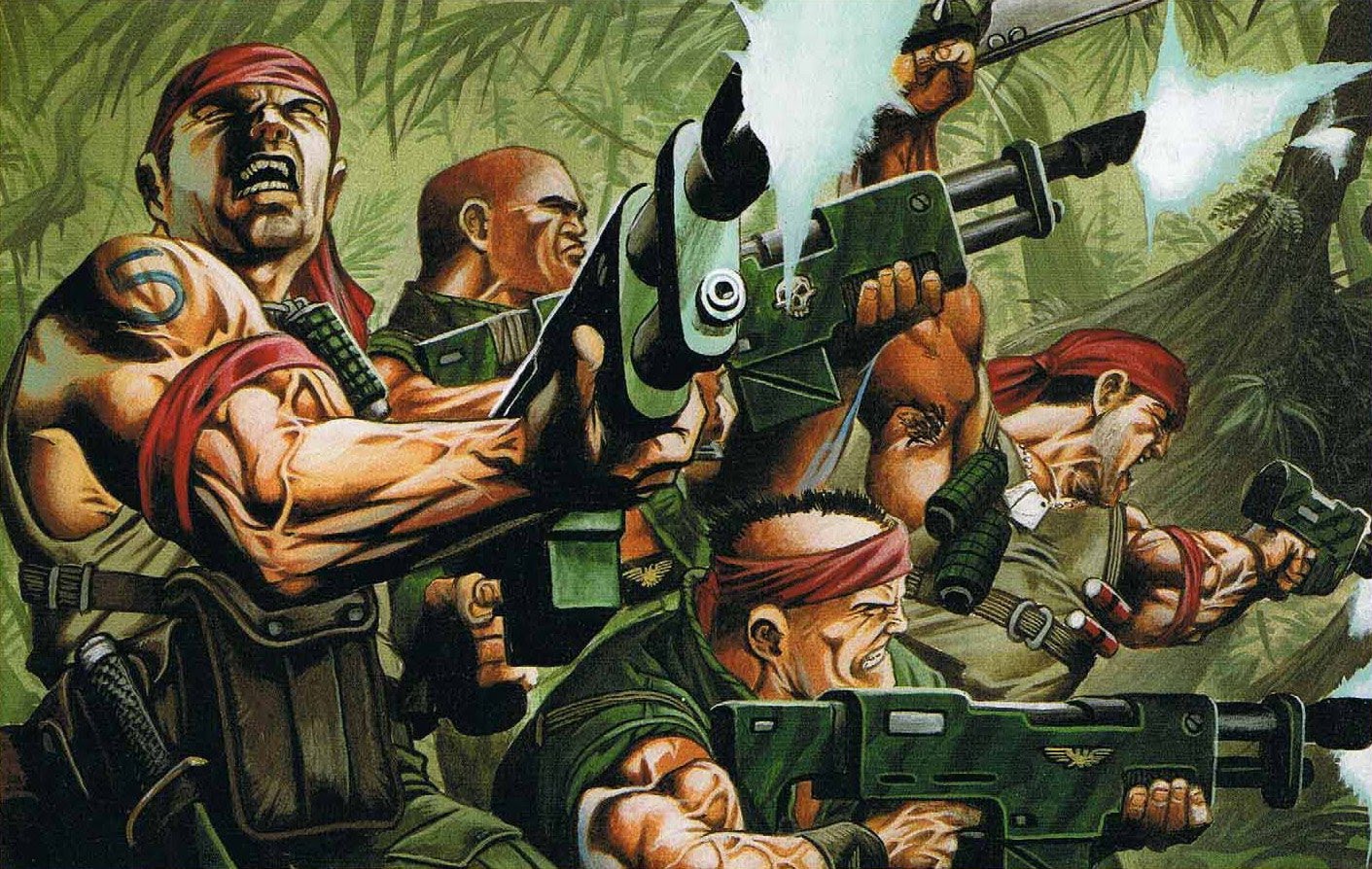
The most iconic visual of the Astra Militarum is the Cadian Shock troopers, reminiscent of the aesthetics of late world war 2 warfare. But these are far from the only representation of popular war narratives presented in the codex. These different historical war zones are represented by different regiments from different planets. For example are the Catachan jungle fighters an overt reference to the Vietnam war. As well as Vietnam inspired media such as the movie Predator.

Astra Militarum Regiment Tactics & List: Catachan | Frontline Gaming
Source: https://www.frontlinegaming.org/2017/10/31/astra-militarum-regiment-tactics-list-catachan/

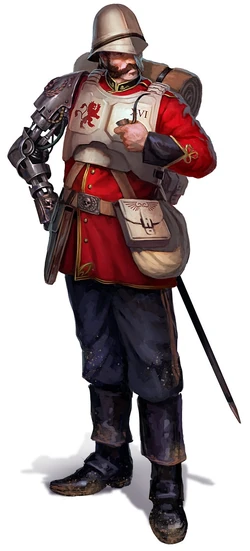
The praetorian guard are modelled on British colonial forces. A visual that is especially interesting in light of our earlier discussion on Colonialism. (Hill. 2016)

https://vignette.wikia.nocookie.net/warhammer40k/images/d/d0/Praetorian_sgt_by_diegogisbertllorens.jpg/revision/latest/scale-to-width-down/250?cb=20140619031051

We have the Death Korps of Krieg, which both in name and appearance and name appearance are referencing the German war machine during WW1. (Hill. 2016)

File:Krieg Guardsman.jpg

Source: http://wh40k.lexicanum.com/wiki/Death_Korps_of_Krieg

Lastly we have the Tallarn Desert Raiders with their desert war curved swords might be attributed to the Ottomans, with the rest of their wargear remenicant the desert battles of WW2. (Hill. 2016)

File:TallarnDesertRaiderMal'harof.PNG

Source: http://warhammer40k.wikia.com/wiki/Tallarn_Desert_Raiders

The armies presented in the codex are much more numerous then these, I simply aim to present a small example of some of the more clear references to real life theatres of war. As you can see, the war narratives presented within the codex are highly varied and draw from several different real life influencers. This lets Games Workshop a great deal of flexibility in the stories they tell. (Hill. 2016)

Conclusions

As we can see from this chapter alone, is the Astra Militarum a large and complex subject, both narratively and within the fiction itself. We will return to these soldiers several times throughout the series, but this has served as a quick introduction into how the Imperium of Mankind fights most of its wars.

Hill, J.D. (2016). Astra militarum. Games Workshop. Lenton, Nothingham.

Copyright Disclaimer

Under section 107 of the Copyright Act 1976, allowance is made for “fair use” for purposes such as criticism, comment, news reporting, teaching, scholarship, education and research. I do not claim to own an of the pictures in this post. Al copyrighted materials belongs to their respective owners.

This blog post was spell checked and edited for readability at 2021-06-14

Warhammer 40k an in depth analysis: Part 1, IoM, part 4, in service to the machine.

Introduction

This chapter will be our first in depth look at one of the numerous sub-factions of the Warhammer 40k franchise. With subfaction I am referring to a specific organization, culture or species that has a meaningful impact on the narrative, but is part of a greater faction, such as the IoM. This chapter will, as  mentioned in previous chapter, be focused on the religious order/scientific institution by the name of Adeptus Mechanicus. In this, as well as similar future chapters, we will discuss the factions codex (see part 1) as well as some supplementary materials. We will do this to get a base understanding of how this faction is presented, and what part they play in the narrative as a whole. We will later contrast and complicate this image by comparing them with real life ideologies, historical events and organisations and institutions. In doing so we will be creating a more complex and intriguing view of the franchise as a whole.

First and foremost, this will not be an exhaustive explanation of all the lore surrounding each faction. as This would be too much of a time and space consuming process. I will simply present enough context to make my arguments in a precise and understandable manner, even for newcomers to the franchise. Links to further reading will be provided at the end of the text.

Aesthetics

Arguably one of the most iconic images of the Adeptus Mechanicus is that of the “tech priests” and “magus”. The hooded individuals in long red robes, enveloped in machinery and religious artefacts.

Source: http://warhammer40k.wikia.com/wiki/Tech-priest?file=Techpriest2.jpg

Here we can clearly see a mix of the technological and the arcane that we discussed last chapter. This individual is completely engulfed in machines, wires and cybernetics, yet wears a robe and incense that makes us think of a catholic monk. We can also clearly see Games Workshop’s love for including skulls in their designs This is a theme that continues in the emblems of the Adeptus Mechanicus.

Source: http://warhammer40k.wikia.com/wiki/Adeptus_Mechanicus?file=Adeptus_mecanics.jpg

Here we see a heavily stylised human skull next to a mechanically reconstructed version of the same skull. Note that this skull is a recurring design within Games workshops visual aesthetics.

In universe history

The history of the Adeptus Mechanicus arches back to the colonisation of present day Mars. These colonies, with time, developed completely differently than the nations of Earth. Science and technology was highest regard, and with time became the basis for their art, culture and religion. Binary code and technical instructions was made in to poetry and prayers. Vital mechanical functions were fashioned to be provocative art, and simple activation routines were styled into rituals and prayers. (Sanders, R. 2016)

With time, and a series of crises, (which I will go into later) these texts and rituals eventually lose their context and meaning, but not their function. What was once written as a celebration of science, ingenuity and art becomes strict dogma and scripture, to be followed without questions. These arcane rituals are the only things that stand between humanity and complete and utter loss of their advanced technologies. (Sanders, R. 2016)

Structure and beliefs

The structure of the Adeptus Mechanicus is one of traditions and strict hierarchies. With the initiates at the bottom and the Mages at the top. The Magus have sole access to the most sacred and arcane knowledge.

The official religion of the Adeptus Mechanicus is named Cult Mechanicus. This religion is based on the previously mentioned rites and prayers, as well as a set of tenets and warnings displayed below:

The Mysteries

  • 01. Life is directed motion.
  • 02. The spirit is the spark of life.
  •  03. Sentience is the ability to learn the value of knowledge.
  •  04. Intellect is the understanding of knowledge.
  •  05. Sentience is the basest form of Intellect.
  •  06. Understanding is the True Path to Comprehension.
  •  07. Comprehension is the key to all things.
  • •08. The Omnissiah knows all, comprehends all.

The Warnings

  • 09. The alien mechanism is a perversion of the True Path.
  • 10. The soul is the conscience of sentience.
  • 11. A soul can be bestowed only by the Omnissiah.
  • 12. The Soulless sentience (i.e. the Necrons) is the enemy of all life.
  • 13. The knowledge of the ancients stands beyond question.
  • 14. The Machine Spirit guards the knowledge of the Ancients.
  • 15. Flesh is fallible, but ritual honours the Machine Spirit.
  • 16. To break with ritual is to break with faith.

Omnissiah

The being of Omnissiah, or the Machine spirit, is said by the Mechanicus to be the primary motivating force in the universe, especially within mechanical constructs. Each machine is said to have a will and spirit of its own. When a machine breaks down or fails to function it can be attributed to an angry or otherwise upset machine spirit. To appease the machine spirit, certain rites of repair, maintenance and prayer must be conducted. Rites must also be conducted to properly start, control and shut down any machine. The more ancient or complex the machine, the more complex and time consuming the rites needed to properly operate and maintain a certain machine. A simple rifle might just need a prayer of thanks and some sacred oils to function, while the great war machines called Titans, might need days or weeks to properly prepare. The supposed existence of the machine spirit is also why Artificial Intelligence (known as Abominable Intelligence by the Mechanicus), is seen as such a crime against the machine spirit, as this intelligence removes agency and freedom from said machine spirit.

At first glance it is easy to interpret these rites simply as misunderstood maintenance and repair routines, and that is defensibly a valid read. Here I will introduce one of the more interesting concepts of the 40k narrative. There exist two interlinked dimensions in the universe of Warhammer 40k. First of all there is the physical plain of the Materium, or the world of matter. Secondly is the Immaterium or the Warp, this dimension is a world of raw and pure emotions, reflecting the wishes, fears and feelings of every living creature in the Materium. If a group of individuals believes in something enough, it will manifest within the Immaterium and become real. For example, the citizens of the Imperium believe their Emperor to be a god, so he becomes one in the Immaterium. As a result it is possible to argue that even though these rites started as purely practical, the Mechanicus has enough faith to conjure their Machine god into existence. (Sanders, R. 2016)

The individual

These tenets outlines a faith of furthering the individuals personal growth of understanding, but also outlines a strict guidelines and paths to thread in order to learn this knowledge. Many avenues of research is completely outlawed, particularly alien machines, and as mentioned in earlier chapter, any form of artificial intelligent. The name Cult Mechanicus further paints the Mechanicus in the realm of mysticism. The status of cult is further cemented by the comparison to the Ecclesiarchy, that is presented as the official faith of the Imperium of mankind. The Ecclesiarchy will be the subject of a future text, but for now al we need to know that its a quite heavily exaggerated version of the catholic church.The Mysteries and the Warnings outline a doctrine designed to furthering the individual’s personal growth of understanding, but also outlines strict guidelines and paths to thread in order to learn this knowledge. Many avenues of research are completely outlawed, particularly alien machines, and as mentioned in earlier chapters, any form of artificial intelligence. The name Cult Mechanicus further paints the Mechanicus in the realm of mysticism. The status of cult is further cemented by the comparison to the Ecclesiarchy, which is presented as the official faith of the Imperium of mankind. The Ecclesiarchy will be the subject of a future text, but for now all we need to know is that it’s a quite heavily exaggerated version of the catholic church.

Progress vs history

The Mechanicus are guardians, distributors and producers of all of humanities more advanced technologies. These technological wonders are scarcely understood are exclusivity from humanities glorious past. Any and al innovation is me. The Mechanicus are guardians, distributors and producers of all of humanity’s more advanced technologies. These technological wonders are scarcely understood, and present relics from humanity’s glorious past. Any and all innovation is met with extreme suspicion, both from the Adeptus Mechanicus, and the general Imperium. To innovate is to question the masters and the Mechanicus itself, as a result any form of innovation is strictly forbidden. The goal of the Mechanicus is in other words, not to lead humanity into a new age of prosperity, but rather to fight to preserve what can be saved from humanity’s golden past. (Sanders, R. 2016) 

Here it is interesting to mention two terms used universally within the 40k narrative. These terms being miasma and alchemy. Both of these terms were at one point seen as the height of science, but have later been replaced by other terms and concepts as science evolved. In the place of miasma (the theory that illness was caused by “bad air”) was replaced with germ theory, and in place of alchemy we have the study of chemistry.

As we can see from the mysteries and warnings, knowledge and understanding are set in highest regards. Yet to go against previous knowledge is the highest form of taboo. The focus lay on traditions and honouring the old ways, rituals and old truths are beyond question. (Sanders, R. 2016)

Traditions vs innovation

The Mechanicus, like any cult, follows a strict series of rules and traditions to the point that they lose their original meaning. Everything from production of new tanks to the maintenance of a simple rifle is seen as a sacred duty that must be done following proper rites and rituals. These rites have taken the place of any meaningful scientific research and discovery in the IoM.

The Mechanicus might seem extremely conservative and needlessly complicated, but as is with most things in the IThe Mechanicus might seem extremely conservative and needlessly complicated, but as is with most things in the Imperium of mankind, this is for a reason. The universe is full of old alien or human technological wonders that are unimaginably dangerous. Not to mention the numerous agents of the mirror dimension known as the warp, and the dark gods that rule there (see chapter “the Immaterium”). Many reckless adventures have been undone when they stumbled upon a secret of the universe that would have been best left undiscovered. Considering the fragmented and often contradictory knowledge the Mechanicus has about the things they study, it’s understandable that a more caucus and calculated approach was adopted.

Data vs knowledge

Other than technology, the Mechanicus collects data, about anything, big or small. Any reading is important, and they are all fed into a great central computer, that will one say reveal the Truth. Data is in other words not a means to an end, but the end itself. The members of the Mechanicus use data as a currency amongst themselves. One interesting definition of knowledge to keep in mind is the following. 

Data is to be seen as raw numbers, figures, readings etc, a description of the real world but void of any context or further meaning. Information is data organized, and put in a further context to be able to constructively use said data. The last part that I will use is the term knowledge. Knowledge is the same information internalised within a person, and absorbed with other pieces of information previously internalised by the individual to make up what an individual knows. Not for the Mechanicus, who see data as the purest form of knowledge and tirelessly strive to collect as much as possible.

The Dark Mechanicus

The Dark Mechanicus is the first example of the “dark and corrupted” version of a IoM faction we encounter. This corruption occurs when the individual in question willingly or unwillingly gets in contact with the mirror world known as The Warp. In the case of the Dark Mechanicus does this corruption manifest in innovation, creativity and mixing of sciences. These heretics dares to go against many of the warnings, chiefly exploring alien technology as well as improving on or even disregarding the knowledge of the ancient masters of Mars. (Sanders, R. 2016)

Conclusion

The Adeptus Mechanicus is a good example of what happens when rituals and traditions lose context and meaning. The traditions themselves become deified and become beyond question. We can also see how these misunderstandings and dogmatism are made true, through the power and influence of the Immaterium.

Here we also see the first dynamic of loyalist vs heretics and how Warhammer 40k toys with what ideals are assigned to protagonists and antagonists. Here the loyalist and “good” Mechanicus is dedicated to dogmatically following traditions and rituals, at the expense of innovation and the self, while the corrupted renegades seek new and innovative discoveries, at the cost of morals, traditions and themselves.

References

Sanders, R. (2016). Adeptus Mechanicus. Games Workshop.

Copyright Disclaimer

Under section 107 of the Copyright Act 1976, allowance is made for “fair use” for purposes such as criticism, comment, news reporting, teaching, scholarship, education and research. I do not claim to own an of the pictures in this post. Al copyrighted materials belongs to their respective owners.

This blog post was spell checked and edited for readability at 2021-06-08