
Warhammer 40k an in depth analysis: Part 1, IoM, part 3, Dark age of techonology

Introduction

The Warhammer 40k franchise is at its core based in the tradition of science fiction, as a result, technology and science are essential themes to the narrative. Technology and discussions of scientific discoveries being a cornerstone in much of modern as well as classic science-fiction.

As with earlier parts, we are going to discuss these phenomenons through the lens of the Imperium of Mankind, the representation for humanity within the Warhammer universe.

We will later discuss how science and technology is presented in the franchise as a whole. For now what you need to know is that within the universe there exists a source sometimes referred to as magic and sometimes referred to as psychic powers. The line between these powers and technology is often highly blurred, as well as the line between magic and psychic powers. It is with this setting in mind that we will discuss the technology of the IoM. (Hill 2016)

Analysis

The imperium of mankind is described as stagnant at, or rapid regression at worse. Much of their technological advancement is lost to time, and what small slivers of technology that remains are seen with fear and suspicion. Especially any form of artificial intelligence is strictly forbidden. In the core Codex for the faction Astra Militarium (Hill 2016) this ban is described to be a result of superstitious and conservative ways of the Adeptus Mechanicus. This religious order is tasked with taking care of, and researching what technological wonders humanity still has left. Were one to read closer though, further texts discuss a war between man and armies of man and  an army of artificially intelligent robots. This war is the true reason for the outlawing of many technologies. (Hill 2016) This is just one example of how the Warhammer 40k franchises uses unreliable narrators and conflicting narratives are used to create a fuller universe as well as a sense of mystery and intrigue. With unreliable narrators I am referring to that can be implicit or explicit, who present a wholly or partly false picture of the events in the narrative. This narrator often presents a third person narrative, but at some points, such as with letters and other metafictional texts, presents their text in a second person narrative.

In the Imperium of Mankind is a human component used to compensate for many advanced mechanics components that have been lost to time. One example of these human and machine hybrids in the service of humanity are droids known as “servitors”.

Servitor_by_andreauderzo

Source: http://warhammer40k.wikia.com/wiki/Servitor

The picture above is an example of a mindless servitor used universally within the IoM. They do everything from help navigate star ships to harvest crops. Some of the more advanced servitors are wired directly into larger machines. These lobotomized humans are used as a loophole to keep using the technology that originally used artificial intelligence without breaking the taboo set by the Adeptus Mechanicus.

https://1d4chan.org/images/5/55/Servitors.jpg

Source: https://1d4chan.org/wiki/Servitor

As you can tell from these two pictures these Servitors are as varied in use, as they are in design. The Imperium also uses so-called “servo skulls”. Human skulls adorned with technological components capable of carrying out simple tasks. (Hill 2016).

These machine/human creations help further the atmosphere of stagnation and backwardness to the IoM. These creations also add an element of body horror to the setting. Humans are quite literally being made into the machinery that they work and die for.

Scrolls, quills and papyrus are common visual elements of the Imperium of Mankind, as well as candles and other primitive forms of lighting. These elements are often paired with highly technologically advanced elements such as robots, lasers, advanced prosthetics or huge spaceships. This apparent disparity is what we are going to discuss in the remainder of this chapter.

Source: http://warhammer40k.wikia.com/wiki/Adeptus_Administratum

Many of the visual cues, such as skulls and scrolls can also be prevalently seen in Games Workshops other tabletop series Warhammer Fantasy (Cruddace 2011). Skulls and scrolls are a particularly common theme in this setting. As both franchises are owned and produced by the same company, it’s understandable that some visual elements carry over. In fact the trend of mixing sci-fi tropes with elements from their Fantasy series is something that we will see more and more of as this series continues. Candles and parchments make us think of the medieval dark ages, of monks and scribes of old. This leads us to how knowledge creators and preservers are depicted in the setting. By this I mean, individuals that is responsible for creating, distribution and curating knowledge. There are the above mentioned adeptus mechanicus, but also what Hills (2016) text call scribes and clerics of the adeptus administratum. Both departments take their names from Latin, or “high gothic”. Adeptus being able to be translated to overtaken or belonging to something, and mechanicus and administratum being engineer and administrator respectively. These titles would suggest that the individuals have been overtaken by their profession. Above we see a member of the Administrarium, as you can see he is dressed in a robe much like a western medieval monk.

All these elements bring together  to create a very archaic feeling of stagnation. If we tie these elements with what we discussed in the earlier chapter, will we start to get a notion of what kind of place the Imperium of mankind truly is.

Next time to follow up on the same theme, we will take a closer look at the Adeptus Mechanicus and discuss more deeply how the 40k franchise uses dramatic irony to produce a sense of dread and horror.

References:

Cruddace.R (2011). The Empire. Games Workshop. Lenton, Nothingham.

Hill, J.D. (2016). Astra militarum. Games Workshop. Lenton, Nothingham.

Adeptus. (2017, June 27). In Wikipedia. Retrieved June 3, 2015, from

https://en.wiktionary.org/wiki/adeptus

Copyright Disclaimer

Under section 107 of the Copyright Act 1976, allowance is made for “fair use” for purposes such as criticism, comment, news reporting, teaching, scholarship, education and research. I do not claim to own an of the pictures in this post. Al copyrighted materials belongs to their respective owners.

This blog post was spell checked and edited for readability at 2021-06-08
Warhammer 40k an in depth analysis: Part 1, IoM, part 2, A Gothic future

To be able to talk about the aesthetics of the Imperium of Mankind, we must first discuss how the narrative of the Warhammer 40.000 franchise is presented. We will divide the various narrative parts in to different levels. I will break down these narratives in the following structure:

1, rulebooks and expansions

2 Codexes

3 Novels

4 “Out of house” productions such as movies, card games, promotional materials etc.

The largest reason for this division is that it gives a much more flexible approach to analysing the different texts, as well as helping with the problem that some layers are considered more canonical than others.  Canonical is here used to mean “what is real or true within the limitations of a fictional universe”.

In this part we will focus on the second level of the narrative structure. More specifically the way that the Imperium of mankind is presented visually both in writing and illustrations within their Codexes.

The decision to base this analysis solely on only the second level is partly because  because I believe most readers comes in comes in contact with the Codexes first, as well as being the most consistent when it comes to tone and theme. This level is also under the tightest control of Games Workshop.

As the title suggests, I will in this text compare the visual aspects of the Imperium of Mankind to that of the Gothic aesthetic movement. Now, a disclaimer before continuing, my knowledge in this field is limited, so I apologize in advance for any errors that may occur.

In this chapter we will primary discuss the architecture of buildings, starships as well as war machines, and how they help to set a certain tone within the narrative, but first of all I would like to draw a parallel between the term Gothic, and the term for the two common human languages of the IoM, this being high and low Gothic. High Gothic being represented by a tongue and cheek take on Latin is presented as the language of the rich and learned. Low Gothic on the other hand is represented as English, and is the tongue of the commoner and uneducated (Hill, J.D 2016). Here we can see a clear nod to the Gothic movement.

Before we begin to discuss the visual aspect of the IoM, I will define what I mean with the term Gothic architecture. I will base my definition of the book Gothic architecture  (Banner, R. 1961) In this text he outlines the history of the style, as well as a series of defining features. These features include spires, prominent buttresses and a focus on verticality and scale in the design. The architecture in many parts mimics that of medieval fortresses. High Gothic architecture in particular was meant to make the onlooker feel small and insignificant. Branner ends his book by describing the Gothic architectural movement in the following manner:

“Gothic was the final expression of the medieval world, of the concepts of a mystical cosmos and a transcendental universal religion” (Banner 1961)

Keep this description in mind as you continue to read this series. This definition will become quite striking when we have a more complete picture of how the Imperium of Man is being described. First we will take a quick look at some buildings of the Imperium of man.

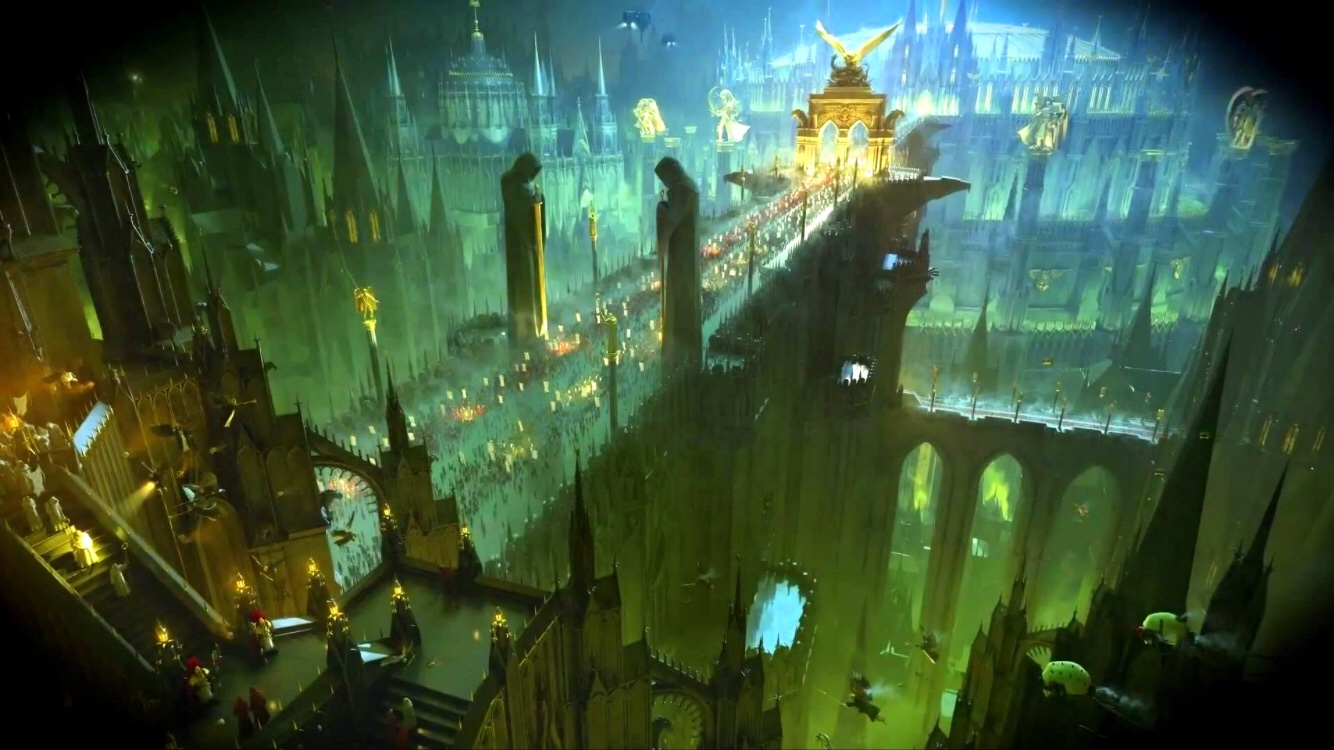
Source: http://warhammer40k.wikia.com/wiki/Imperial_Palace?file=Imperial_Palace_Terra2.jpg

As you can see from the picture above, there are many of the aforementioned details such as large spires,  prominent buttresses as well as an overall fortress-like design. Furthermore does the sensation of size and impression of grandeur permeate the works, making the humans next to buildings look miniscule and insignificant.

Imperial_vs._Chaos_duel.jpg

Source: warhammer40k.wikia.com/wiki/Battlefleet_Scarus

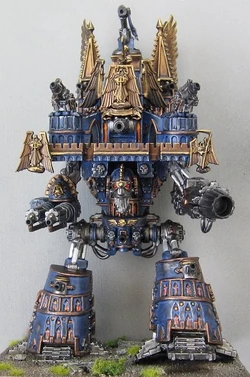
These design elements can also be seen on many of the Imperium s larger space ships. These designs can also be seen on many of the Imperiums larger space ships. These ships do not only include spires and buttresses, but also a notion of scale and a sense of a “larger than life” impression. These aesthetic elements can also be seen on many of the Imperium`s war machines such as the Imperial Titan, (a terrifyingly large walking gun platform used by some powerful Imperial officials), as well as the Imperiums more extravagant tanks.

Imperial Imperator Titan

Source: http://warhammer40k.wikia.com/wiki/Titan

http://wh40k.lexicanum.com/wiki/Fortress_of_Arrogance

At this point most readers will have noticed the prevalent use of religious iconography, more specifically to the Christian catholic faith. The connection between Warhammer 40k and the catholic faith, can partly be explained by the fact that the company responsible for it series is based in Great Britain, a land with a history of Catholic faith, as well as grand Gothic architecture. I will discuss faith and religion in the Warhammer 40k franchise in a later chapter. Lastly I would like to draw the attention to how dark and imposing this architecture appears, with dark colours and imposing size. I believe that the use of Gothic architecture is meant to enhance the tone of oppression and horror in the narrative.

Next chapter we will continue to discuss this topic by taking a  look at the Imperium use of technology.

References:

Branner, R. (1961). Gothic architecture. New York: George Braziller.

Hill, J.D. (2016). Astra militarum. Games Workshop. Lenton, Nottingham.

Copyright Disclaimer

Under section 107 of the Copyright Act 1976, allowance is made for “fair use” for purposes such as criticism, comment, news reporting, teaching, scholarship, education and research. I do not claim to own an of the pictures in this post. Al copyrighted materials belongs to their respective owners.

This blog post was spell checked and edited for readability at 2021-06-08

Warhammer 40k an in depth analysis: Part 1, Imperium of Mankind: part 1, Manifest destiny.

This begins a series of looks into the large and complex narrative of the Warhammer 40k franchise. We will begin this series by taking a look at the Imperium of mankind (IoM). We start with the IoM for a number of reasons, firstly does the IoM represent humanity within the narrative, and is as a result easiest to explain without further context. Secondly do IoM take part in, or work as a point of reference in the other factions narratives. Lastly, does IoM by far have the most material written about it. In the first part of this series we will discuss how one can find similarities between the IoM and Colonial Great Britain, more specifically how both cultures exhibit traits of colonialism and nationalism. The Imperium of Mankind can be seen as a glorification as well as a stark criticism of these concepts (1).

The Imperium describes itself as the “universe’s sole and rightful ruler” (.J.D. 2016) The Imperium is ruled in theory by The Emperor, a glorified corpse of a man, kept in semi-life by the sacrifice of millions of human lives. In reality an unimaginable large governmental body of scribes, bureaucrats, rule makers and statesmen rules in his stead. This organisation, just like Colonial Britain, is centrally controlled. In the case of the IoM this central entity is known as the High Lords of Terra (Hill 2016). The rule of both Empires was in fact quite decentralized due to the distance between the seat of power and her colonies. Greater decisions, and of course the collection of taxes is left to the central rulers. The biggest difference between the two empires being the mind bogglingly large scale of the IoM. Despite these long distances and independent rule, do the planets and space stations under mankind’s Control have an obligation to pay large amounts of taxes to Terra. These civilisations and communities are also expected to stay true to the “true Imperial values and customs”. This again, can be linked to how Great Britain ruled their colonies (Pennycook 1998). It is said that amongst all of the colonial powers, Britain was most eager to spread their culture to their colonies (Pennycook 1998). For example, did the British start cricket leagues in several of their colonies for this purpose, and it’s said that while Germans built railroads, Brits made horse racing tracks. Likewise does the IoM bring their creed, customs and religion to each planet they colonize or recapture. Like with the real life colonial counterparts, some cultures and people encountered became what was called “sanctioned aliens”, many others were destroyed (Hill 2016). To further cement the allegory to the British colonies are the rulers of Imperial planets named “planetary governors”, not unlike the title colonial governor given to the rulers of British colonies.

Next we will get into the most controversial and difficult topic of this comparison, how the IoM see “the other” and how this compares to their real life contemporaries.

The British Empire as well as the other contemporary colonial powers has a well documented and bloody history with what they saw as “the local savages”.These natives were never met on equal terms, always seen as the “lesser”. To further understand how the British colonial power saw the other, we must first discuss how it saw itself. The British empire is always described as cultivated, intelligent, mature and masculine. In comparison the “other” is seen as lesser, savage, childish and feminine (Pennycook, A. 1998). As you can see, does the British empire need others to define itself as superior.

The Imperium of Mankind follows a similar ideology, only expanded on a galactic scale, and against not just humans, but different sentient species as well. The IoM has several “others” to prove itself more superior than, alien species, heretical human societies and mutants can always be used to prove its superiority against. The virtuous do differ slightly between the two empires, but some, such as strength, civilisation, and purity, seems to exist within both cultures. (Hill 2016. Pennycook 1998).

Lastly will I discuss how these two colonial powers justify their conquests and exterminations. Part of the strategy of colonial Britain was to paint the colonization effort as a great adventure, where great men went on journeys of grand discoveries, slaying monsters, and (hopefully for the rulers), die som heroic death somewhere in the great wilderness. The actual reasons can more concisely be narrowed down to economical and political reasons, as well as a need to “educate and help” the local population (Pennycook, A. 1998). In the Warhammer universe there is a similar comparison to the wanderlust in the Rogue Traders faction, which will be explored in a later chapter. The Imperium of Mankind is on the other hand described as to follow a sort of Divine plan. It was their will of their Immortal God Emperor that humanity would rule the stars. And as their god commands, so shall it be. In other words, a literal form of divine destiny (Hill. 2016 Pennycook 1998).

In conclusion, we can see several ties between the fictional Imperium of Mankind and the real colonial powers, and colonial Britain in particular. This chapter has been but a small taste of our further discussion in order to familiarize the reader with my arguments and the topics we will discuss. Next chapter will dive into how the Imperiums aesthetics is presented and what that can say about the faction and the narrative at large.

(1) My choice to compare the IoM with just the great Britain is because the franchise creators Games Workshop is based in Great Britain, they use a lot of inspiration from their homeland in their work. Something that will only become more apparent as we move forward.

Referensers:

Hill, J.D. (2016). Astra militarum. Games Workshop. Lenton, Nottingham.

Pennycook, A. (1998) English and the Discourses of Colonialism. London: Routledge, 133-144.

Copyright Disclaimer

Under section 107 of the Copyright Act 1976, allowance is made for “fair use” for purposes such as criticism, comment, news reporting, teaching, scholarship, education and research. Al copyrighted materials belongs to their respective owners.

This blog post was spell checked and edited for readability at 2021-06-08
Canon: an introduction

This article will serve as an introductory look into the term canon, and how we will use it in the rest of this blog. The term canon is most commonly used to group a series of works together. Usually you discuss  one or two connections. The first is a real world, or para-textual connection such as the canon of an author (Culler, 2011). The second is a fictional, or intertextual connection, like the Star Wars canon, or canon or non canon episodes of Fresh prince of Bel Air.

In this series we will mostly focus on the second definition. This is not to say that the other definition is any way less of a form of analysis, but this will be what we mostly focus on. More specifically, we will focus on what is considered “true” within the framework of certain pieces of media. It’s equally important for any canonical study to look at what isn’t included in a collection, as what is.

Culler, Jonathan D., Literary theory: a very short introduction, 2. ed., Oxford University Press, Oxford, 2011

This blog post was spell checked and edited for readability at 2021-06-07

The game: a definition

Several definitions of games exist within and without the academic world. With this text I will make the case for one of them. This definition goes as follows, “each game must have an implicit or explicit player” Furthermore we will define the player as “Someone with implicit or explicit control over the actions in a game”.

An observant reader might have noticed that the two definitions are intertwined, there is a point that we will come to later. But first let’s break down these two definitions into smaller parts. Let’s begin with the definition of a game, this is a modification of a literary definition. “A text is a text if it has an explicit or implicit reader”. The distinction between explicit and implicit reader is important. This way a text is not only a text if it would be to read, but also if it had the potential to be read. The same logic applies to or definition of a game. A game is still a game, even if no one ever plays it, as long as there is a possibility that someone could play it.

The next step is to define the player that is mentioned in our games definition. It’s important to define the term player for two reasons. First of all, the term is not as directly obvious as that of a reader. Secondly, the term player is used in several different scenarios, which leads to a need for further clarity to avoid confusion.

These definitions clear up two things, a game must not have been played, in order to be discussed or analysed as a game. Finally these definitions together means one very important thing. In order for a game to be considered a game in our discussion, it must have one thing. It must be possible for a player to take control over, in other words change something in the game. Note that this control does not need to have any meaningful result on the game itself. There must exist a deliberate interaction between the game and the player.

When we in the future discuss games of any kind, from board games to video games to slot machines, this is the definition I will use.

This blog post was spell checked and edited for readability at 2021-06-07