Gwylim notes on Skyrim: Fictional essays and their use in worldbuilding

I have previously written about the importance of in game stories and nonfiction books in world building and storytelling, especially when it comes to fantasy and sci fi. In this text I wish to go even more granular and discuss a genre that is close to my heart, the essay. Often more loose in form than a report or a paper, essays are great for presenting ideas and concepts in a condensed yet easy to understand format. 

Essays often exclude some of the contexts needed to understand the texts if it’s common knowledge. This allows the text to focus more on the topic at hand. This makes essays uniquely suited to give a player tidbits about the world a game is set in, without needing to present a lot of information all at once. Essays allow you to bring small packets of information in a condensed format. It allows the player to put together the information themselves over the length of the game’s narrative.

Essays have a further advantage of having a more personal voice in its writing. This allows you to not only tell stories with the essay itself, but also be able to create a writer of essays. A person that allows for a unique point of view. It is this point of view character that makes the essay such a vital tool of narratives.

The Elder scrolls series is no stranger to in-universe texts, some have gotten physical releases as well. Elder scrolls has several texts that not only discusses parts of the world, but argues for or against certain assumptions of the narrative. For example, the many schools of magic are hotly debated in a number of texts. Necromancy in particular is debated and arguments for and against.

Likewise many historical events of the narrative are discussed in great length. In this text  I would like to discuss two such texts in particular. The life of Barenziah and the mystery of the Dwemer. Both are excellent examples on how elder scrolls play with the idea of an objective reality in its narrative.

Dwemer, myths and misinformation

The disappearance of the Dwemer is described as one of the largest mysteries in the narrative of The Elder Scrolls. Their obsession with science, their alien philosophy and of course their sudden disappearance from Nirn all together have fueled discussions both in game and amongst fans. There are many texts discussing and arguing the minutiae of Dwemer, science and beliefs. Some texts like On Dwemer law and the Dwemer series are written as serious scholarly attempts to try and get to the bottom of Dwemer culture, and what impact they have had on Dunmer and Altmer culture.

There is also the series of Ancient Tales of the Dwemer. That presents the Dwemer in a very different light. The Dwemer described in these tables are considerably kinder, more peaceful and overall friendly than the Dwemer that can be found in other texts. 

This discrepancy is something the players will find for themselves when devling into the many Dwemer dungeons and facing the many sadistic traps and torture chambers of the old Dwemer holds.

This is a point that the scholar Hasphat Antabolis discusses in his text Dwemer History and Culture. He argues that the tales discussed in the Ancient Tales of the Dwemer are in fact re-packaged folk tales that have been rewritten to be given a certain exotic Dwemer flair.

That the kind and friendly Dwemer became a lot more palatable for the middle class reading rooms. These texts have as a result been spread and read by thousands, and are today still very prominent, despite the fact that they have been thoroughly debunked. The idea of a historical narrative remaining true even after decades of disproving is something that can be found in many places in real life.

The text brings up ideas of how dark and brutal histories and cultures can often be softened and simplified in order to make them more palatable to the general public. This is a wonderful example of how Skyrim uses real life phenomena within history and anthropological research to make its game world feel more complex.

The life of Barenziah and Biography of Barenziah

The controversial character of Barenziah has two texts written about her. One official series of biographies titled Biography of Barenziah paints her as the first and only Dunmer empress and describes the struggles of her life with a kind and borderline naive tone, breathlessly praising her numerous grand qualities. The second unofficial text written by an anonymous scribe titled The Real Barenziah is scandalous, provocative and deeply judgmental with poorly hidden sexism and racism contained through the text. The role of Straw the stable boy is one of the decisive differences.

What is interesting about these texts is the transparent intent of the authors behind both series. One series is describing in short and somewhat dry terms the life of the only Dunmer ruler of the empire. The other is a series of character assassinations and brutal accusations of promiscuity and debasement. Sadly this is a tactic that has, and still is used to discredit many women who have been in power. Furthermore, the first text is written as a simple document that retells major events in Barenziah life, while the second is written like a serialized romance novel, with rich descriptions of events and lengthy dialogues.

The stark difference in the texts presented narrative forces the player to look at this one historical figure from separate points of view. While the text of Skyrim makes it clear in the presentation of the texts which one is the more probable and reliable. It does nonetheless make a clear case that not every text that the player encounters can or should be trusted. Like in real life are all narratives created by a person, a person with a specific worldview, historical background and motivations. Both texts have clear biases, and both have clear goals with their narratives. It is up to the player what parts to believe.

Final thoughts

I like to conclude this essay by discussing another series, Rising threat, a series describing the rise of the Thalmer from an Altmer point of view. It is interesting for several reasons, one of them being the only purely Altmer narrative in the game, as well as for giving well needed context to the rise of the organization. This series explains how the Thalmer monopolized the sudden end to the Oblivion crisis, and claimed that they were the true heroes of the calamity.

Despite this falsehood eventually being disproven, has it nonetheless become a truism within the history of the Altmer. Furthermore, the texts are interesting for the disclaimer made by Praxis Erratuim that warns the reader not to take some of the more fanciful speculations of the texts all too seriously. Like with the Anecdotes of the Dwemer this text presents the idea that history is sometimes not created by the most reliable facts, but by the most prevailing of narratives.

My goal with this text is to present my reader with a  few examples in how ambiguity and contradictions can be used to deepen a narrative and make a fictional world feel more complex, more nuanced and more alive. I would also like to argue for the use of books and journals for the furtherance of narratives and lore that would be unwieldy to present in direct or ambient dialogues.With all this said, this kind of narrative presentation has some serious shortfalls. The chief being that the player needs to first find, and then read the text to get the information needed. I will discuss a few of these pitfalls in a future Skyrim essay: Books and magical excavations.

Oakendale Academy

Enroll in the prestigious Oakendale academy, one of the Empire’s most prestigious academies for studying the arcane arts. Learn about the cultural and historical roots of arcane practices, study herbology and ecology and so much more.

This is a small demo where you are introduced to the school, its philosophy and its teaching practices. You will also be introduced to a few of your fellow students as well as the faculty of the academy. This demo is rather short and will not take more than a few hours to complete. You can save the game at any time by visiting your dorm room.

Oakendale academy by SamRandom

This is my first attempt at a text adventure, the demo is free to play and runs in your browser! I hope to be aböe to create many more games in the future, in many formats, not just text adventures.

Writing update

So, funny story. I have several papers cooking, but none of them are finished for today! One, almost was. But would make no sense without the other. So here’s a little rundown of upcoming topics!

Gwylim notes on Skyrim: health potions and visual shorthand

This is the next part of my Skyrim series, it needs some more research done, and I need to take some reference photos before it’s ready but the base is there.

The potion bottle is a staple of the fantasy game genre, and can be found in most every game of the genre, from Dark souls to legend of Zelda. In Skyrim are the potions easily labeled and color coded to the stat that they refill, green for stamina, blue for mana and red for health. What I wish to discuss in this text is their prominence in the game world.

Health potions can be bought by vendors for sure, but can also be found in caverns, dungeons and most interestingly, inside people’s homes. While this makes sense from a gameplay sense, it does lead to some interesting narrative consequences. At some points are you able to hand these magical potions to an npc, that indeed does get better. Others you are forced to leave to their death. It is worth noting that Elder Scrolls Online is much more guilty of this crime than Skyrim.

Gwylim notes on Skyrim: Books and magical excavations

This will be a continuation of my exploration of books and their use in narrative building in Skyrim and Oblivion. I want to lay a fair bit of groundwork before I post this one. There is a fair bit of research to do for this, and the other essays in the series.

Books are a fundamental part of the narrative building of the Elder scrolls series, they can often bring context to the greater narratives as well as specific quests. In this essay I will discuss four different quests, two from Oblivion and two From Skyrim.  The unifying themes for these quests is that, except for one, they get a lot of context from the lore books surrounding, or being part of the quest.

In this way I will discuss the strengths and weaknesses of relying on a player to read a book, and when in the narrative the book becomes available to the player.

Warhammer essay: Wild creativity and measured preservation

I have slowly been working on more Warhammer essays, but currently are the Skyrim essays taking precedence. I need to get my hands on a few lore books first if I want to be able to discuss Warhammer properly again, as a lot of the texts I have are either too old, or too new for what I want to write about.

Warhammer fantasy as well as warhammer 40k has an interesting relationship to the concept of creativity, knowledge and the art of creation. There are two opposing forces that are present in much of the texts. These are of innovation and of tradition, as well as carelessness and caution.

Each faction lands somewhere between these parameters, and a lot of the faction’s philosophy, morals and history can be gleaned from these traditions. There are some ideas that returns again and again. Tradition often comes with stagnation and loss of generational knowledge. On the other side is carefree innovation leading to explosive results. I will present a few examples of these themes in this essay, but they are by my way exhaustive.

Umvelon: City of magic

I have been writing a lot on a lore supplement for my homebrew setting Landhurst. I have posted a bit of this project on my patreon, so if this sounds like something that is interesting to you, you can find more information there. I want to present the introductory text here, to give my readers an idea of what I have been working on.

Introduction

Umvelon is Landhurst’s third largest city, and the second largest centre for education in the entire nation.  It is most importantly the undisputed centre for arcane education, research and regulation. The seemingly ancient city is in fact one of the younger cities in the nation’s history.

After the Elven defeat did the nascent mage guilds take the arcana rich site to be their centre of learning and research. From the humble campus on top of a ruined Elven metropolis did the mighty city of today take shape. Spreading ever downwards towards the muddy waters of the surrounding swamplands that keeps the city isolated from the mainland.

Magic education and bureaucracy.

Umvelon is the seat for higher arcane learning, and the only place where one can learn the many trades that require a full time commitment, such as battle mage, alchemist or healer. While the rest of the nation have rudimentary research and safety training for proper arcane use is it only in Umvelon that one can become a full fledged member of the mage guilds.

Furthermore the city is the centre for the governing body of the mage guilds. It is from here that arcane disasts, corruption and other dangers are investigated and rooted out. The dreaded Mage hunters, the personal juridical wing of the mage guilds also have their headquarters in the city, brazenly displaying their clandestine operations in broad daylight.

Patrons of art and education

Besides the arcane colleges there are several smaller academic institutions present in the city, not least of them the Librarians and archival collage, as well as the academies for History and the liberal arts. These campuses can be found all across the city, but everyone boasts at least one lecture hall on the coveted Campus hill in the fourth ring of the city.

Beyond the official institutions is the city sprawling with museums, bookstores and coffee shops that hold unplanned lectures and readings for anyone interested. Most of these institutions are free for citizens and are paid for by the many rich trade families that have made the city their home. A grand payment to one or more of the educational institutions of the city not only garners good will with the citizens, but also gives them rather generous tax cuts from the city’s mayor and mayoral staff.

Arcane trade

Umvelon is the centre of all arcane trade in Landhurst, and all arcane items are either made here, or made by someone who has been educated here. The guilds keep a close eye on all wares of an arcane nature that moves through the nation’s many waterways. Close, but not so close that smuggling and bribery is not permitted, solely to make sure that research and production runs smoothly ofcourse.

Arcane artifact

While many of the bulk products such as magically enchanted ammunition, scrolls, crystals and potions are made in large warehouses elsewhere, the city is still full of production. It is unsurprisingly full with the kind of production that will not disturb a college professor’s mid day nap with its noise, or the kind of smell that makes a high society lady reach for her perfumed handkerchief.

Umvelon news

I have been working a lot on a lore supplement for D&D 5e in the last few weeks. This is the second sample from this work. This is an excerpt of a mechanic I aim to implement, where the players can get quests and news from reading newspapers and pamphlets. Updating the traditional job boards and tavern crawls of classic D&D.

Subscribe to continue reading

Subscribe to get access to the rest of this post and other subscriber-only content.

Gwylim notes on Skyrim: The joys and frustrations of in game book hunting

I am sure that many of my readers have had the joy of finding a specific book in an obscure bookshop or lurking in a digital archive somewhere. The frustration when you are missing but one text in your collection, the unwillingness to start a project before you know that you are all the texts you need to start. I admit that this is not a problem that many people have, but I am sure that at least some of my readers can empathise with my plight!

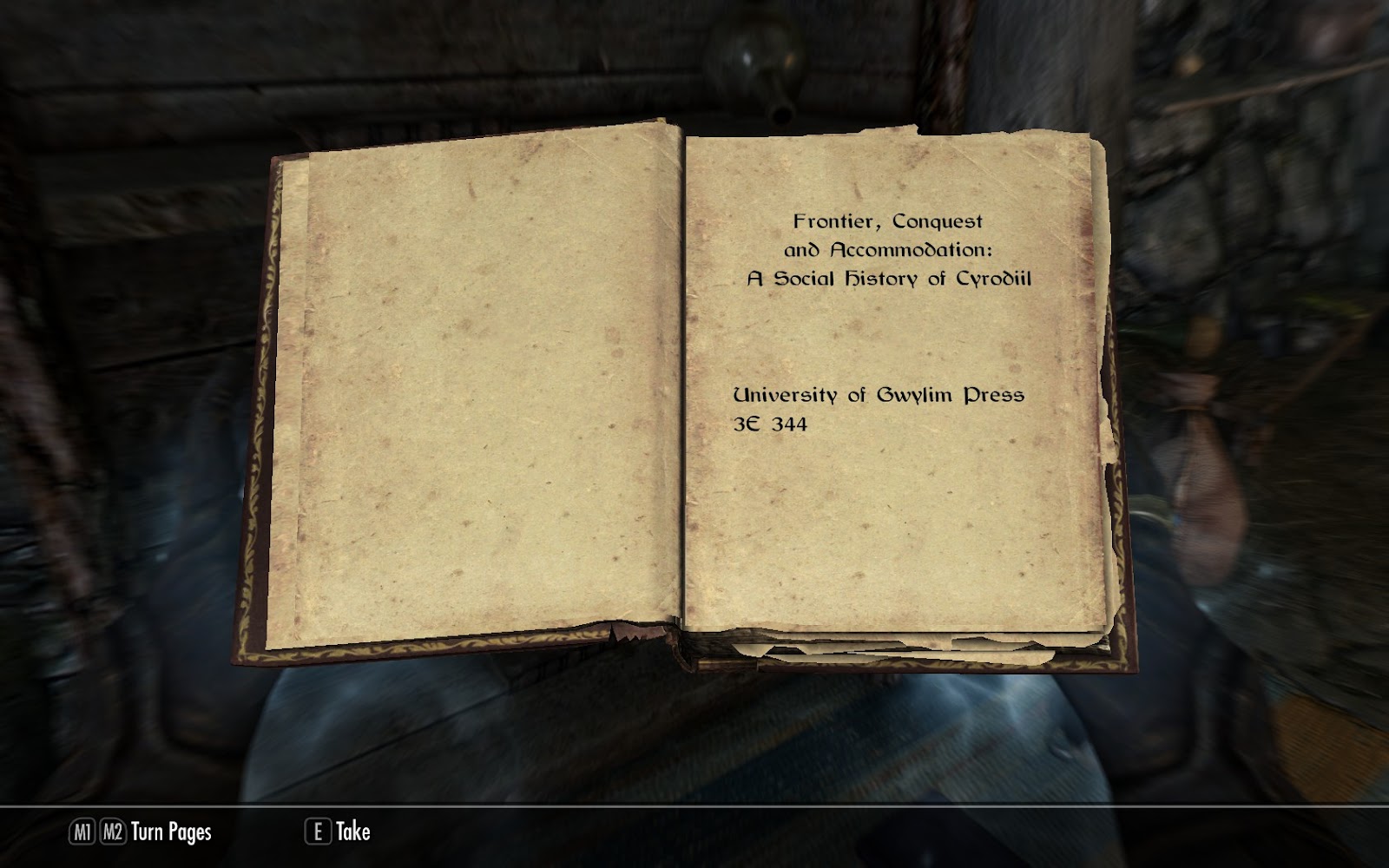
A book from Skyrim in the reading view of the game.

I have had a similar experience in skyrim recently. I have discussed the wealth of reading that can be found in the elder scrolls series many times. There are novels, poems, essays and unhinged ramblings to be found in all of the main games. In many of these games there also exist book sellers in where to easily and effectively acquire this reading materials, as well as libraries aplenty.

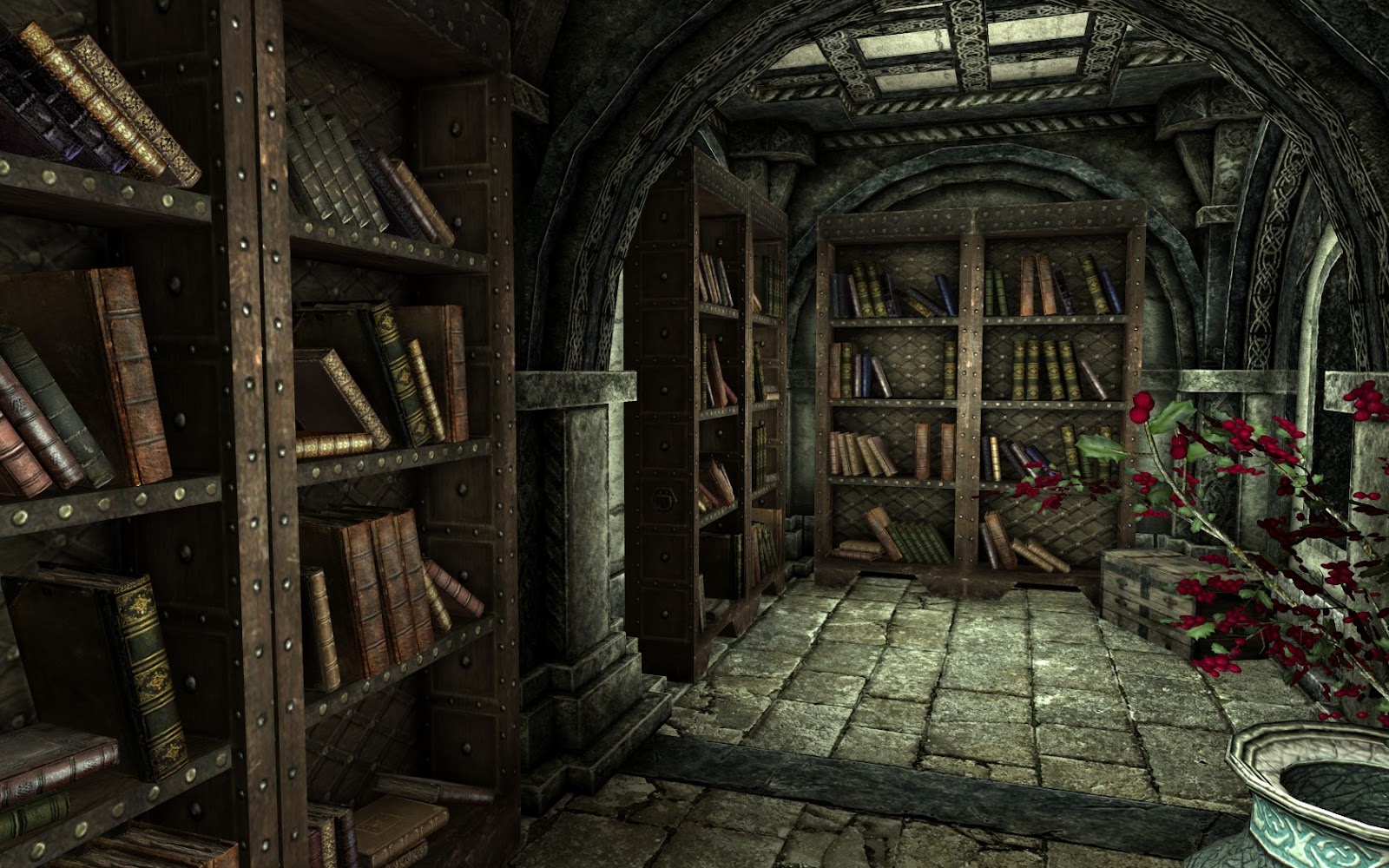
Skyrim is different in this regard, as it is the general store sellers that sells but a paltry few books. The only libraries available to the players are also located at either the seats of power, or at Skyrims two seats of learning, the bards college and the College of Winterhold, the primary location to learn the arcane arts.

The second of the two colleges have an especially stringent and suspicious librarian. Due to his dour nature, or due to a lack in coding, can you in fact Not borrow books from this library, though he does sell some of the texts he stores there. Due to a quirk in the book shelves in the Winterhold library can you only read the majority of the books if you steal them from the shelves, as they are not located in the regulair open style bookcases.

There are on the other hand other ways to acquire reading material in Skyrim. First and foremost does the otherwise uninterested populus of Skyrim own a fair few books themselves, as at least two or three can be found in each household. Likewise does it seem that everyone from blood crazed necromancers to cut throat bandits have a bend for reading. As a result the dungeons are populated by sentient races often surprisingly full of books, journals, scrolls and other reading material.

Many of these seemingly brutal and bullheaded robbers seem to have an interest in obscure history and advanced magical theories. As it is more common to find a thesis on Mysticism next to a bandit bed, then it is to find something salacious like The Lusty Argonian Maid.

This means that the best way to expand your library is to either delve into a dungeon, or go thieving in the neighborhood. I want to make the argument Skyrim has moved away from the cities being as much of a hub as they were in Oblivion and Morrowind. The wilderness and the quests and adventures that take place in the wilderness between the cities, has taken over much of the time spent in the cities, especially Oblivion. In the earlier games most quest givers lived in the cities, as well as large part of the quests themselves taking place in, or near cities.

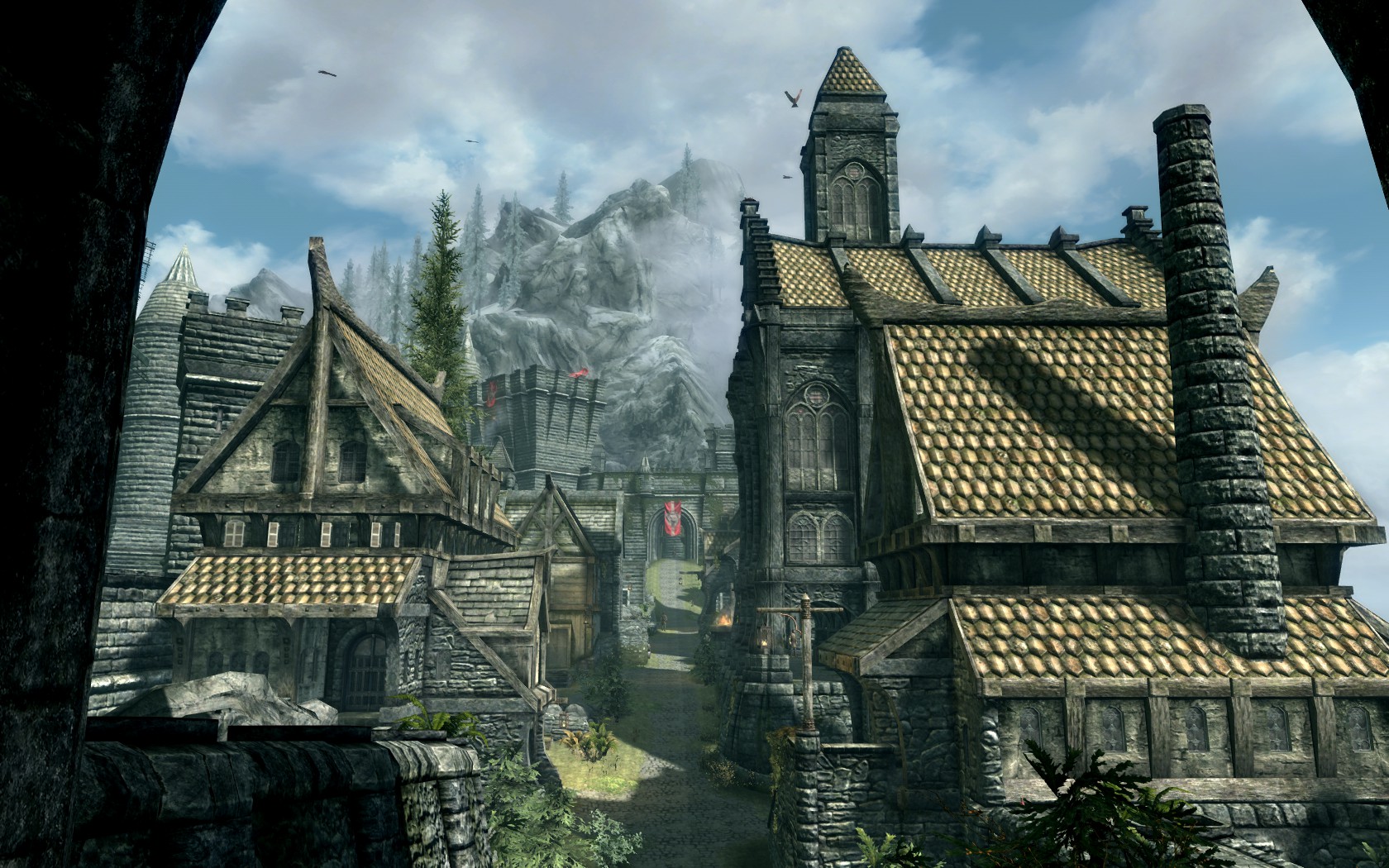
An in game view of the city of Solitude from the game Elder Scrills: Skyrim

As a result would it make sense that much of the amenities that the player needed, weapons, potions, books and other gear would be available to them in the cities. Likewise does the specialized stores help create a sense of urban life in both Morrowind and Oblivion that I believe is deliberately absent from Skyrim.

It makes sense for the seat of the mage guild to have a dedicated staff shop for example. Likewise would it make sense for Vvardenfell capital with its many educational and administrative centres to have a well stocked bookstore available. These shape the narrative of the world itself.

Skyrim is a much more rugged place, but also a different game. Many quest givers meet the player on the road, or in small villages, and when they are located in the cities do they more often than not direct the player to a cave in the wilderness. The courier is another mechanic that delivers quests to the players with the constant letters and requests. Specialized stores that only accepts certain kinds of loot would slow down the game loop of:

Visit town, get quest.
Visit wildernets, finish quest and get loot.
Visit town, sell loot, repeat.

A book from Skyrim in the reading view of the game.

All of this gives the gameplay a much more mobile feeling to its gameplay. I would argue that the lack of specialist stores have also had an effect on this. You are less likely to spend time in a town when every single town offers the same, smithy, general store and alchemist as the next.

All these design choices make Skyrim feel differently from their predecessors. You explore and interact with it in different time scales and relate to space in different ways. The way you interact with the hour to hour gameplay is subtly different in many small ways. For example how the player interacts and considers the loot from dungeons and quests.

As a result is it only natural that you would need to interact with the lore book in different ways. While I do miss The First Edition from Oblivion very much, I must admit that a bookstore in Skyrim would not fit into the differently phased and organized gameplay that the game works around.