Highways and industrial complexes: the melancholy world of eurotruck simulator 2

Introduction

Simulator games are uniquely limited in scope and place where its narrative takes place. It is the only form of art where the players have the need to traverse the text’s narrative physically, where so much focus is put on the very action that the game aims to recreate. In the focus on the very executions of actions and interactions in a game world, do the text inevitably put focus on where these interactions end. Where the simulation stops, where the game, due to budget or usability or technological reasons, ends.

This essay aims to explore two instances where the simulation makes itself known, where gameplay necessity and immersiveness meet. Where technical limitations and real world expectations rub off on each other in interesting ways.

Highway meditations

Eurotruck simulator 2 is a game, where you drive a truck in primarily Europe. You are tasked with delivering cargo from one major city in Europe to another. These destinations are either large population centres, or well known destinations. The game limits tedium and creates a more enjoyable experience by drastically shortening the distance between these points. The game hides this shortening partly with the help of a severely sped up clock. One hour in the game is 3 minutes in real time. Twentyfour hours being roughly half an hour in real time.

The game further hides this space and time warping by having you drive on highways and other central connective roads. Not only does this make sense from a narrative perspective, you are after all trying to get from spot a to spot b as fast as possible. This decision to focus on larger arterial roads also lets the devs get away with fudging a lot of the granular details of long distance travel. Highways are often rather sterile and homogeneous, and the sensation of being on a highway is kept mostly intact even in their scaled down format.

This illusion is helped by the player now and then needing to take a sideroute or a smaller country road between highways or going in and out of towns. These diversions into the countryside are tightly designed and help to make the world you drive in feel more real, more alive. 

Eurotruck Simulator uses glowing yellow X:es to denote when a road or lane is not in the game. These barriers are easy to hide behind off ramps and junctions in highways, but become all the more apparent on small roads and small towns, where streets and roads has a tendency to snake off into small areas, or lead off to service paths.Towns in particular made the screening of of parts of the game world highly apparent, even more so when the player can see cars drive from and through these barriers that are not available to them.

The endless warehouse district

Considering the choice of scaling, as well as the apparent and obtrusive cutting off of areas from the players, is it not difficult to understand why the devs have chosen to primarily set the game in industrial areas outside of cities. This again makes sense from a narrative perspective, as the player takes the role of a long distance trucker, and is as a result rarely involved in the “last mile” part of the delivery. From the vantage point of thoroughfares and warehouse districts is it easy to present the player with identifiable skylines and landmarks.

Intended or not, does this approach to world design lead to a separation between the world of the game and the player, a sensation of always being on the way towards something, but never truly arriving. The devs have alleviated this sensation in a small but rather effective way. Many of the warehouses where you pick up and drop off your cargo have a security guard or worker on break somewhere on the lot. They passively observe as the player comes and goes, but effectively anchor the game and stop it from becoming what could easily be a rather alienating and surreal experience.

The game similarly have work crews situated near new constructions, as well as police giving tickets of npc drives, as well as rescue personnel standing around car crashes and other accidents. It all comes together to create an experience that succeeds in feeling authentic, not because it tries to hide its limitations, but because the game shows them so clearly.

Do you like my writing and want to help me write more? Please take a look at my patreon, it has several essays, and would help me create a lot more: https://www.patreon.com/cw/SamRandom13

Gwylim notes on Skyrim: Fictional essays and their use in worldbuilding

I have previously written about the importance of in game stories and nonfiction books in world building and storytelling, especially when it comes to fantasy and sci fi. In this text I wish to go even more granular and discuss a genre that is close to my heart, the essay. Often more loose in form than a report or a paper, essays are great for presenting ideas and concepts in a condensed yet easy to understand format. 

Essays often exclude some of the contexts needed to understand the texts if it’s common knowledge. This allows the text to focus more on the topic at hand. This makes essays uniquely suited to give a player tidbits about the world a game is set in, without needing to present a lot of information all at once. Essays allow you to bring small packets of information in a condensed format. It allows the player to put together the information themselves over the length of the game’s narrative.

Essays have a further advantage of having a more personal voice in its writing. This allows you to not only tell stories with the essay itself, but also be able to create a writer of essays. A person that allows for a unique point of view. It is this point of view character that makes the essay such a vital tool of narratives.

The Elder scrolls series is no stranger to in-universe texts, some have gotten physical releases as well. Elder scrolls has several texts that not only discusses parts of the world, but argues for or against certain assumptions of the narrative. For example, the many schools of magic are hotly debated in a number of texts. Necromancy in particular is debated and arguments for and against.

Likewise many historical events of the narrative are discussed in great length. In this text  I would like to discuss two such texts in particular. The life of Barenziah and the mystery of the Dwemer. Both are excellent examples on how elder scrolls play with the idea of an objective reality in its narrative.

Dwemer, myths and misinformation

The disappearance of the Dwemer is described as one of the largest mysteries in the narrative of The Elder Scrolls. Their obsession with science, their alien philosophy and of course their sudden disappearance from Nirn all together have fueled discussions both in game and amongst fans. There are many texts discussing and arguing the minutiae of Dwemer, science and beliefs. Some texts like On Dwemer law and the Dwemer series are written as serious scholarly attempts to try and get to the bottom of Dwemer culture, and what impact they have had on Dunmer and Altmer culture.

There is also the series of Ancient Tales of the Dwemer. That presents the Dwemer in a very different light. The Dwemer described in these tables are considerably kinder, more peaceful and overall friendly than the Dwemer that can be found in other texts. 

This discrepancy is something the players will find for themselves when devling into the many Dwemer dungeons and facing the many sadistic traps and torture chambers of the old Dwemer holds.

This is a point that the scholar Hasphat Antabolis discusses in his text Dwemer History and Culture. He argues that the tales discussed in the Ancient Tales of the Dwemer are in fact re-packaged folk tales that have been rewritten to be given a certain exotic Dwemer flair.

That the kind and friendly Dwemer became a lot more palatable for the middle class reading rooms. These texts have as a result been spread and read by thousands, and are today still very prominent, despite the fact that they have been thoroughly debunked. The idea of a historical narrative remaining true even after decades of disproving is something that can be found in many places in real life.

The text brings up ideas of how dark and brutal histories and cultures can often be softened and simplified in order to make them more palatable to the general public. This is a wonderful example of how Skyrim uses real life phenomena within history and anthropological research to make its game world feel more complex.

The life of Barenziah and Biography of Barenziah

The controversial character of Barenziah has two texts written about her. One official series of biographies titled Biography of Barenziah paints her as the first and only Dunmer empress and describes the struggles of her life with a kind and borderline naive tone, breathlessly praising her numerous grand qualities. The second unofficial text written by an anonymous scribe titled The Real Barenziah is scandalous, provocative and deeply judgmental with poorly hidden sexism and racism contained through the text. The role of Straw the stable boy is one of the decisive differences.

What is interesting about these texts is the transparent intent of the authors behind both series. One series is describing in short and somewhat dry terms the life of the only Dunmer ruler of the empire. The other is a series of character assassinations and brutal accusations of promiscuity and debasement. Sadly this is a tactic that has, and still is used to discredit many women who have been in power. Furthermore, the first text is written as a simple document that retells major events in Barenziah life, while the second is written like a serialized romance novel, with rich descriptions of events and lengthy dialogues.

The stark difference in the texts presented narrative forces the player to look at this one historical figure from separate points of view. While the text of Skyrim makes it clear in the presentation of the texts which one is the more probable and reliable. It does nonetheless make a clear case that not every text that the player encounters can or should be trusted. Like in real life are all narratives created by a person, a person with a specific worldview, historical background and motivations. Both texts have clear biases, and both have clear goals with their narratives. It is up to the player what parts to believe.

Final thoughts

I like to conclude this essay by discussing another series, Rising threat, a series describing the rise of the Thalmer from an Altmer point of view. It is interesting for several reasons, one of them being the only purely Altmer narrative in the game, as well as for giving well needed context to the rise of the organization. This series explains how the Thalmer monopolized the sudden end to the Oblivion crisis, and claimed that they were the true heroes of the calamity.

Despite this falsehood eventually being disproven, has it nonetheless become a truism within the history of the Altmer. Furthermore, the texts are interesting for the disclaimer made by Praxis Erratuim that warns the reader not to take some of the more fanciful speculations of the texts all too seriously. Like with the Anecdotes of the Dwemer this text presents the idea that history is sometimes not created by the most reliable facts, but by the most prevailing of narratives.

My goal with this text is to present my reader with a  few examples in how ambiguity and contradictions can be used to deepen a narrative and make a fictional world feel more complex, more nuanced and more alive. I would also like to argue for the use of books and journals for the furtherance of narratives and lore that would be unwieldy to present in direct or ambient dialogues.With all this said, this kind of narrative presentation has some serious shortfalls. The chief being that the player needs to first find, and then read the text to get the information needed. I will discuss a few of these pitfalls in a future Skyrim essay: Books and magical excavations.

Gwylim notes on Skyrim: Stairs, gameplay and narrative guides

Introduction

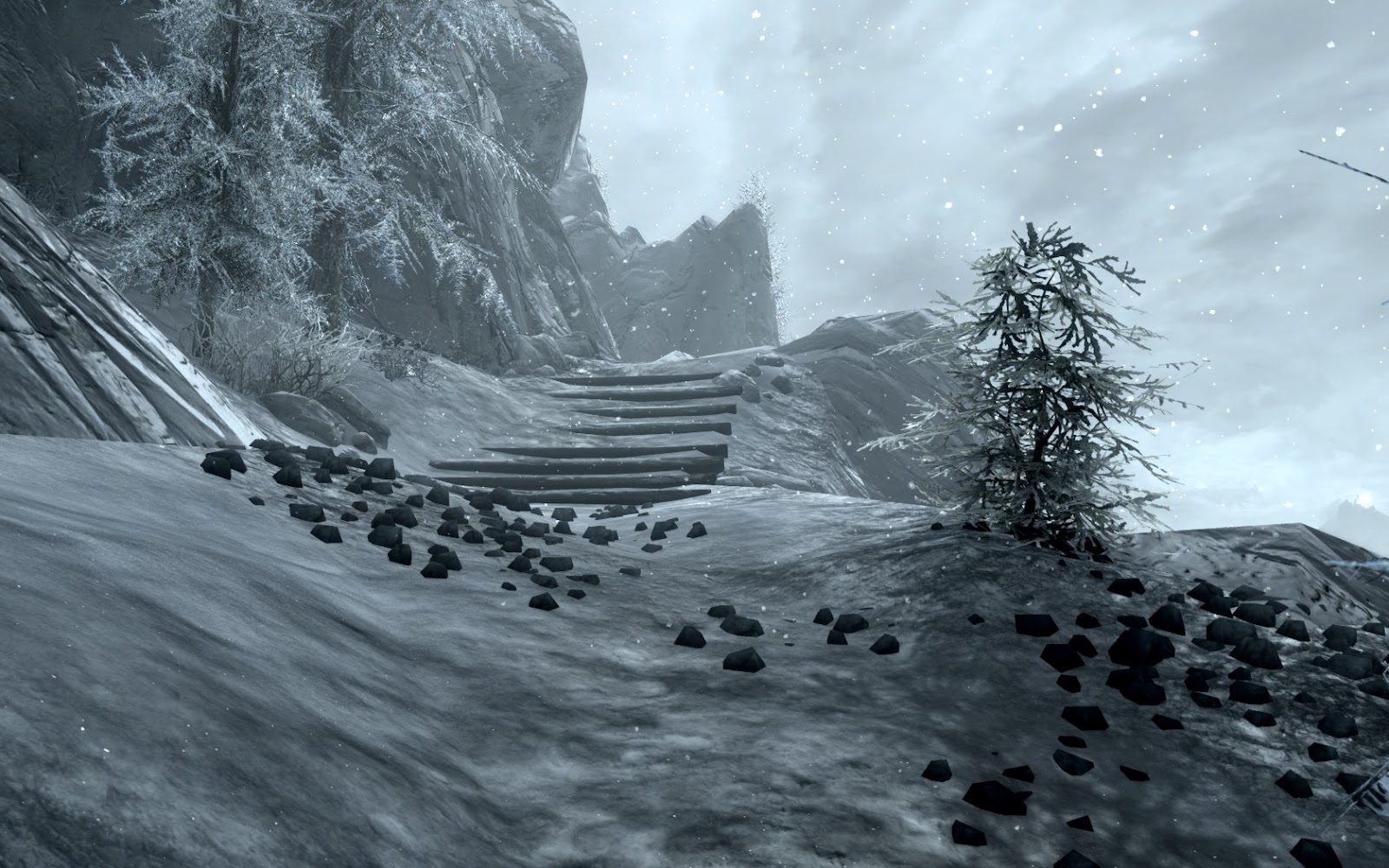
Skyrim is the latest installment in the Elder scrolls series. The game series is an open world rpgs filled with magic, monsters and intrigue. Skyrim is set in the fringed northern land of the same name. This land is deeply inspired by a romanticized version of Viking and Nordic culture. The land is rugged and mostly barren, with a few scattered cities hidden behind grand walls. There are small farms scattered amongst the landscape, so are strange stone formations, caves, old temples and many many burial mounds. Skyrim is a mountainous land, and very few areas are completely flat. 

This makes the inclusion of stairs feel like a very natural part of the environment. One of the problems with open world games, especially those that are as large as Skyrim is the risk of players getting lost. Skyrim has many clever way of leading the player towards points of interests, from stone canines, small rocks statues, and dirt paths. One of the greatest way that the game leads the players is with stairs, low stone stairs that do not impede the players walking speed, but that subtly show that there is something important nearby. 


Height has also been used with great effect in Skyrims two latest predecessors. Cyrodiil in Oblivion is markedly bowl shaped, with the imperial city in the centre of the bowl. The effect is that if the player goes downhill they will eventually end up in the Imperial city. A logical design considering how vital the city is for the game both narrative and gameplay wise.

Vvardenfell in Morrowind is likewise built around a specific geographical feature, namely the red mountain. The cause of the red fever and home of Dagoth Ur. The presence of the red mountain in the centre of the map, in combination with the constant belching of smoke gives the game a constant sense of dread and urgency.

The player often simply needs to look up for a reminder of what they are fighting for, and trying to destroy.

Mountains and cliffs

The decision to make Skyrim a very mountainous area further helps to funnel the player in to areas of interest. Roads snaking along valleys and across vaistas is an easy way to lead the player towards points of interest. This strategy is very much enhanced by the combination of stairs leading up otherwise unscalable hills and cliffs. The world design takes great advantage of its mountainous areas to create breathtaking vistas from many of the games key locations.

The dragon priest ruins having several high points from where they practiced their Thu’um also makes for great vantage points to the players. Mountains also make for natural barriers, and while they do not often work like that in practice, mountains are great theoretical barriers to keep the players away from certain areas, or from taking unintended routes.

The introductory road to Riverwood being a great example of this, as the players snake along the road down the cliff they are faced with the vastness and emptiness of Skyrim’s wilderness.

Miraaks temple is placed on a hill, at one of the highest points of the island. The castles of the vampires and the Dawnstar are both located on an elevation, letting them loom over the players as they approach.

Cities and stairs

The main cities of Skyrim all use elevation in interesting, and often historically accurate ways. Windhelm is very clearly stratified around elevation, with the jarls kept at the top, leading down to great families, then the traders and last the common citizen. Morthal has a similar design with the temple of Diala and the jarls keep rather literally lording above the lower levels of the city. The poor are literally forced underground, while the rich live in cliffside residents. 

Winterhold is rather flat, with two exceptions, the docks and the grey quarters are both located at the bottom of steep stairs, putting them at a both spiritual and visual lower level then the ruling nord classes. It also increases the sense of isolation and destitution of these areas

Solitude has an interesting dip in the middle of the city, as well as a hill approaching it. This detail means that both the blue palace and the imperial fort are located uphill. The player will always approach these structures from below. Riften has the most obvious height dichotomy, with its most poor literally living underground, while the Jarl fort is also located at the top of a small hill.

The college of winterhold also is kept at a distinct elevation from the ruins of its former patron city. Finally at the greybeards located at the highterst top of the world, both in literal and spiritual sense.

Conclusions

Height and the traversal of height is a vital part of Skyrim, both from a narrative and gameplay point of view. The ways that Skyrim uses height can be mirrored in the way that Oblivion and Morrowind uses height. The concept of elevation can be used both as a gameplay tool, and as a narrative tool.

The volcano of the Red Mountain in Morrowind both works as a goal, but as a deterrent to the player. Doubly so with the addition of the ghost fence cutting the player off from the peak for most of the gameplay. It is a deterrent, but also a sign of the ultimate goal for the player.

Oblivion uses its bowl shape to give the player a constant reminder of the Imperial city, the seat of power for the empire, and the very thing that the player is working to save. From a gameplay perspective does Oblivion use the high tower of the Imperial city as well as its central location as a tool for the player to navigate, and find their way back to the central hub of the game.

Skyrim likewise uses elevation, and stairs both for narrative and gameplay use. The narrow valleys help guide the players towards points of interest, and the elevation of certain buildings relative to its surrounding can tell the player a lot about a place without saying it expressly. 

Gwylim notes on Skyrim: The joys and frustrations of in game book hunting

I am sure that many of my readers have had the joy of finding a specific book in an obscure bookshop or lurking in a digital archive somewhere. The frustration when you are missing but one text in your collection, the unwillingness to start a project before you know that you are all the texts you need to start. I admit that this is not a problem that many people have, but I am sure that at least some of my readers can empathise with my plight!

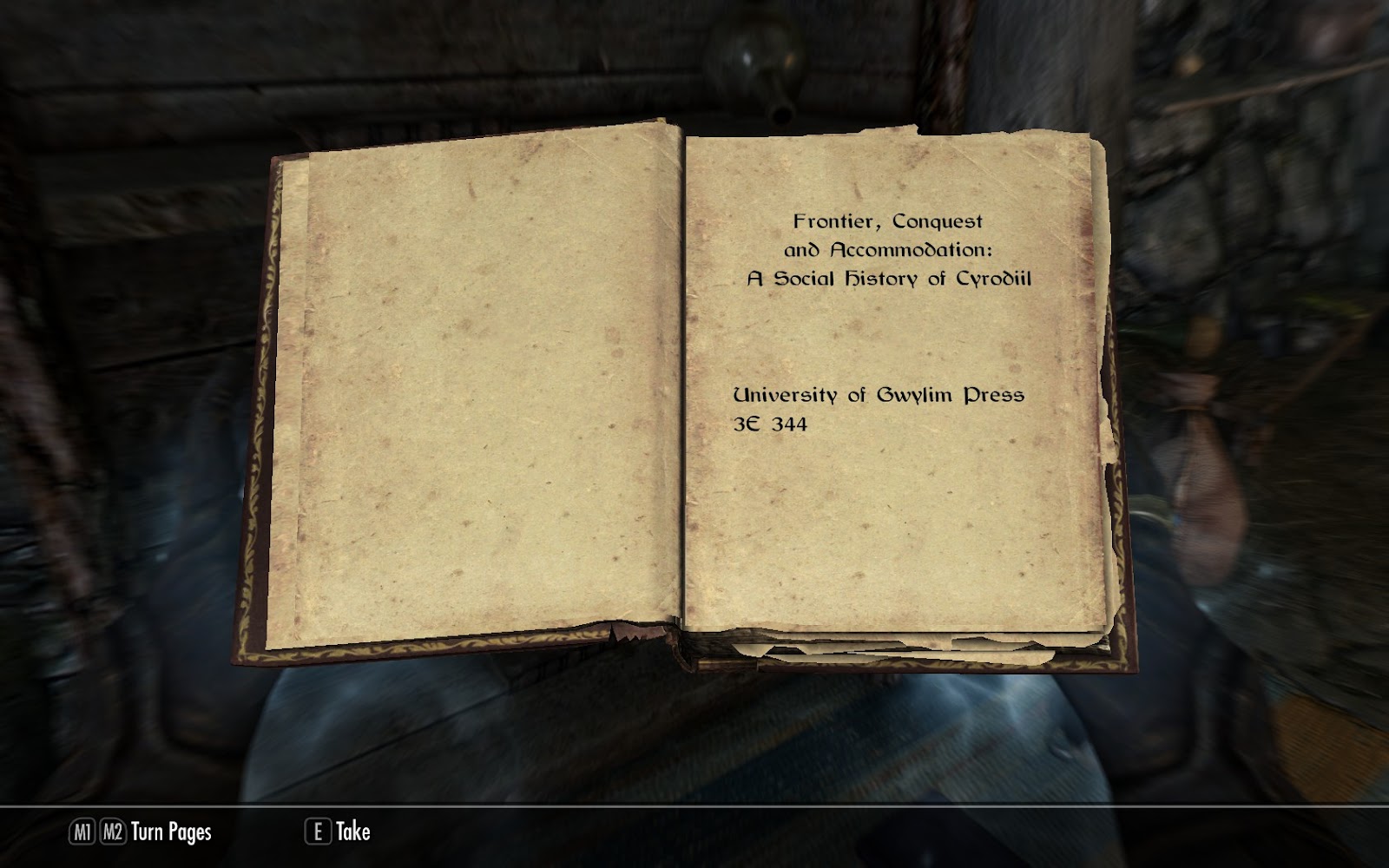
A book from Skyrim in the reading view of the game.

I have had a similar experience in skyrim recently. I have discussed the wealth of reading that can be found in the elder scrolls series many times. There are novels, poems, essays and unhinged ramblings to be found in all of the main games. In many of these games there also exist book sellers in where to easily and effectively acquire this reading materials, as well as libraries aplenty.

Skyrim is different in this regard, as it is the general store sellers that sells but a paltry few books. The only libraries available to the players are also located at either the seats of power, or at Skyrims two seats of learning, the bards college and the College of Winterhold, the primary location to learn the arcane arts.

The second of the two colleges have an especially stringent and suspicious librarian. Due to his dour nature, or due to a lack in coding, can you in fact Not borrow books from this library, though he does sell some of the texts he stores there. Due to a quirk in the book shelves in the Winterhold library can you only read the majority of the books if you steal them from the shelves, as they are not located in the regulair open style bookcases.

There are on the other hand other ways to acquire reading material in Skyrim. First and foremost does the otherwise uninterested populus of Skyrim own a fair few books themselves, as at least two or three can be found in each household. Likewise does it seem that everyone from blood crazed necromancers to cut throat bandits have a bend for reading. As a result the dungeons are populated by sentient races often surprisingly full of books, journals, scrolls and other reading material.

Many of these seemingly brutal and bullheaded robbers seem to have an interest in obscure history and advanced magical theories. As it is more common to find a thesis on Mysticism next to a bandit bed, then it is to find something salacious like The Lusty Argonian Maid.

This means that the best way to expand your library is to either delve into a dungeon, or go thieving in the neighborhood. I want to make the argument Skyrim has moved away from the cities being as much of a hub as they were in Oblivion and Morrowind. The wilderness and the quests and adventures that take place in the wilderness between the cities, has taken over much of the time spent in the cities, especially Oblivion. In the earlier games most quest givers lived in the cities, as well as large part of the quests themselves taking place in, or near cities.

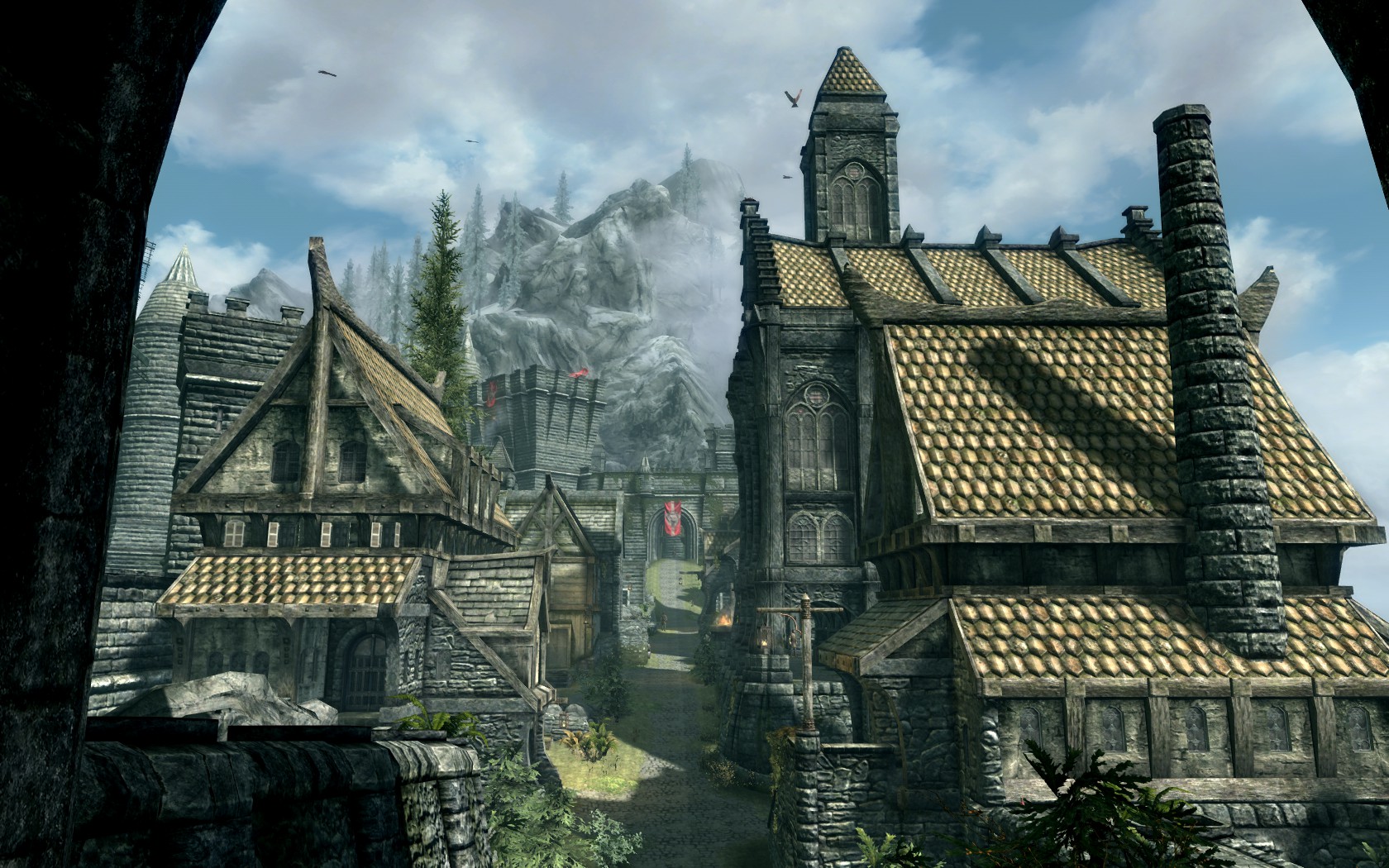
An in game view of the city of Solitude from the game Elder Scrills: Skyrim

As a result would it make sense that much of the amenities that the player needed, weapons, potions, books and other gear would be available to them in the cities. Likewise does the specialized stores help create a sense of urban life in both Morrowind and Oblivion that I believe is deliberately absent from Skyrim.

It makes sense for the seat of the mage guild to have a dedicated staff shop for example. Likewise would it make sense for Vvardenfell capital with its many educational and administrative centres to have a well stocked bookstore available. These shape the narrative of the world itself.

Skyrim is a much more rugged place, but also a different game. Many quest givers meet the player on the road, or in small villages, and when they are located in the cities do they more often than not direct the player to a cave in the wilderness. The courier is another mechanic that delivers quests to the players with the constant letters and requests. Specialized stores that only accepts certain kinds of loot would slow down the game loop of:

Visit town, get quest.
Visit wildernets, finish quest and get loot.
Visit town, sell loot, repeat.

A book from Skyrim in the reading view of the game.

All of this gives the gameplay a much more mobile feeling to its gameplay. I would argue that the lack of specialist stores have also had an effect on this. You are less likely to spend time in a town when every single town offers the same, smithy, general store and alchemist as the next.

All these design choices make Skyrim feel differently from their predecessors. You explore and interact with it in different time scales and relate to space in different ways. The way you interact with the hour to hour gameplay is subtly different in many small ways. For example how the player interacts and considers the loot from dungeons and quests.

As a result is it only natural that you would need to interact with the lore book in different ways. While I do miss The First Edition from Oblivion very much, I must admit that a bookstore in Skyrim would not fit into the differently phased and organized gameplay that the game works around.

Warhammer exploratory essay: Who gets to be human

Introduction

I have alluded to the idea of personhood in earlier chapters, but in this text I will discuss it in more clear terms. All the playable factions are humanoid in one way or another. The non-human factions are either adjacent to humans like Elves or dwarves, or they are more inhuman like Lizardmen, Skaven and Goblins. All of them have humanoid characteristics and keep some sort of human culture.

What became clear when I started researching this topic is just how human centric the Old World is. Humans as humans, exist in Europe, Africa and Asia, with clear, if often tokenized versions of their real life counterparts cultures. There are humans in fantasy Arabia, even the undead of the setting version of Egypt are still decidedly human, despite their undead appearance. It is this prevalence of humans and human adjacent races like Elves that makes the less than human races stand out so much more.

The humanized

The humanised creatures are those that are clearly based on a real human culture, and also has humanizing features. Here you can find the Dwarves, and the Elves, both are staple of the fantasy genre when the setting was made, as they still are today. THe dwarves are proud and the Elves are arrogant, both see themselves as better than the short lived humans. Wood Elves are likewise seen as more wild but yet arrogant and in many ways superior to humans in most ways.

The lizardmen live in the south of the Old Worlds version of Africa, as well as the southern version of South america. The aesthetic of the Lizard men are hard to miss, living in large stone cities with grand temples to golden serpent gods, gods that require living sacrifices in large numbers. While still a sympathetic depiction, there are still some connotations to certain conspiracy theories that makes them a bit uncomfortable to consider. As part of being reptilian are to varying degrees been described as unemotional and mechanical, going from almost pure automata at their inception, to the strange and otherworldly, but yet fully sentient creatures in the later editions.

The second example of the use of human cultures for nonhuman creatures is less easy to explain away. The Ogres, the hungry, dumb and brutal race of giant humans, are both located where real life Mongolia is, as well as sharing some physical features and stereotypes of Mongolian men.

With thick eyebrows and rather characteristic mustaches, their connection to gluttony, violence and stupidity is a rather unfortunate one to say the least. But with this said, are they still considered moral in one way or another, and are often seen as neutral, if not good. Vampires and undead, are likewise seen as monsters but are still human when it comes down to it. This is in rather starch contrast to some of the other humanoid factions in the setting.

The inhuman

There are two factions that I wish to discuss when it comes to dehumanised, or monstrous versions of humans in the Warhammer fantasy universe, first of them are the Orks and Goblins, playing much the same role that they do in dungeons and dragons and similar fictions of the time. They are violent and aggressive, and live only for combat. They are the stereotype of a villain. They soely exist to fight, destroy and eat, but unlike their ogre counterparts do they have very few humanizing features, or seen as capable of any good. THis pigheaded and absurd evil is often played as a sort of comic relief, playing off the improbability of their civilizations to begin with.

Orks are strong, resilitand and sprout out of the ground, being grown from fungi.They have absolute faith in all that they do and can never be persuaded to leave their path of destruction for one simple reason, they are finding it all too fun. Goblins are ted tibet as the menial cast of the faction, working, carrying, farming and building, though the quality of these efforts are often described as subpar at best. They also trade and barter, giving the faciton their only hire non violent connection with the other factions.

The second faction to discuss is the Skaven, a fascinating society of half ratmen, that lives under the cities of all the world’s major factions and civilizations. The Skaven are depicted as man’s worst qualities, selfish, greedy and ambitious, each Skaven lives only for themselves, and will not hesitate for a second to sacrifice another of their kind if it meant gaining an upper hand in their competitive and cut throat society.

While some are vaguely human in their organisation and culture, are they not as closely tied to a certain culture or nationality. Both the Orks and the Skaven are clearly meant to be parodies or exaggerated versions of some of humans’ worst sides, and vices. Even more so then the followers are chaos are these races often used as dark or warped mirrors of humanity. Orcs are aggressive and ambitious in the extreme, while Skaven are greedy and cowardly in the extreme.

Conclusions

The question of who gets to be human and who doesn’t is not a question that is unique to warhammer, but is one that tends to turn up in many high fantasy settings. For example does the Elder scrolls make a clear distinction between, elves, humans and “the bestial races” of orcs, argonians and khajiit. The concept of having other or near human races is not a problem in and of itself.

It is a great way to add some variety and texture to the world. Likewise is it not a problem in itself to base these races on specific human cultures, Elder Scrolls argonians for example shares their mesoamerican inspiration with the Lizardmen of Warhammer fantasy. Problems can arise when certain races are tied to both a specific culture and a specific negative trope tied to that culture. For example the brainded hunger of the Ogres, or the cold and alien Lizardmen.

Furthermore can a non human race become rather flat and simplistic if it is only allowed to have one cultural expression. This is especially apparent, if like in the elder scrolls series, there are several human cultures but only one Argonian culture. The Warhammer examples are very good at making a varied and complex set of cultures, even amongst the more comedic races. There is a large difference between the plague worshipers of Clan Pestilence and the quirky engineers of Clan Skryre. Despite this do the races as whole have a uniforming feel and cohesion that makes them easily recognized.

The tokenization and alienation of real cultures is not a problem unique to Warhammer, but can be seen across many series and settings. The Kajiit of the Elder scrolls used to talk, and to some degree do in a stereotypical Romani coded voice, and are also depicted as being semi nomadic, and known for thievery. To take another example, the goblins in Harry Potter are only seen working in banks- They are long nosed, greedy and untrustworthy, a sadly still all too common anti semitic trope in fantasy.

It is only through nothing but biases and assumptions in writing that we can become better writers. If we wish to aim to write a more true and inclusive fantasy world, must we first explore what inspiration we draw from real life and why. That is why it is vital to listen to voices different from your own. I am not innocent of this as well, there are many times I have had to step back from my writing and re-evaluate, when I am getting too close to tokenizing or orientalising a culture or race in my writing. Tokens and stereotypes are powerful because they are easy to recognize to a reader, and a useful shorthand as a writer. This makes it even more important that we use them with respect and caution.

Altdorf misadventures: the comedic joy of warhammer fantasy writing

Introduction

The reason that I started writing and researching warhammer again has been the joy reading materials for the roleplaying game Warhammer Fantasy, specifically the supplement Altdorf: Crown of the Empire, the supplement that allows you to play adventures in the capital of the Empire. There are large collections of descriptions of quest hooks, characters and storylines, as well as a large amount of descriptions of the streets, districts and institutions that are present in the town. I wish to discuss the setting, the characters as well as the tone and writing style of the supplement as well as the rest of the series.

Comedy and grounding

One thing that I have discussed earlier and that are very much part of this supplement is the tone of the writing. There is a reference to everything that is written in the supplement. The Altdorfer’s like to see themselves as master engineers, artists and aristocrats. but are in fact quite the opposite. The buildings of Altdorf are described both in drawings and in descriptions to be quickly built, hastily prepared and rickety. except for the buildings either built by Elves or by Dwarves.

The grand cultures enjoyed by all are theatre, in a deeply Shakesperian tone, that most pretends to enjoy for the visuals of it. On the streets are things like pig chasing and pie eating contests enjoyed by nobles, learned and peasants alike. The city itself is described as smelly and almost unbelievably so, with a reeking river going through the centre of the town. There are many strange districts of the city, from the warped magic district to the deep and dark slums. 

There are many organizations, from the high and mighty royal houses that pretends to care about the poor while taxing them deeply. There are also the revolutionary factions of P.L.A.N.T that despite their egalitarian and positive goals are sadly engaged in infighting and any official critical power. Despite this is it clear that the narrative is always with the poor, revolutionary and the downtrodden.

By now will the setting remind you of another setting, namely Ankh Morpork of the Discworld series by Terry Pratchett. This is indeed an apt comparison, and I found a lot of comparisons to the british writer as well, to the point where the supplement has their own version of Captain Sam Vimes in the setting, a gruff captain of the guard, forced in to leading a progressive new guard while he would rather drink and patrol all night.

The Pratchian comedy can be found in many places, as well as the target of the comedy, as in there are always the cruel, powerful and hypocritical that are the target of this derivement. All of this leads to a very enjoyable read, and is a breath of fresh air compared to a lot of the other things that the company has released, especially in the Warhammer 40k setting, see my earlier series.

Queerness and minorities (woke, actually)

Fantasy has sadly never been the most inclusive of genres, and I am afraid that warhammer fantasy in general has not been an exception to this. Warhammer fantasy has often fallen into a trope of writing that plagues many Games Workshop franchises. This would be the concept of the girls club. Where the women of a faction are truly and definitely a part of the faction’s army, it just happens that all of them are in their own little corner of the faction, put in a unit, army or group made out of all women. Not to mention other minorities or anyone that falls outside of the genre of straight, cis, and white. 

Warhammer RPG is a breath of fresh air in this regard. There are women, there are queer individuals, and most interestingly is there an open transman in the form of the ship’s architect Herr Arnold Spald. It is made clear in the text that his crew is fully on his side, and that anyone that has a problem is “politely made to remove themselves”. There are also openly gay and lesbian characters as well as individuals from outside of the empire described at the same level as the ones from inside the empire.

Justice and revolution

There is a clear political message in the Warhammer Fantasy setting regarding the Empire. The Empire itself is shown to be inefficient, somewhat corrupt and ruled by the inept elite and the zealous and cruel. There is one grand exception to this, the downtrodden and the poor, as well as those that fight for equal rights, while having jokes written about them are always seen in the right, and always having the sympathy and empathy of the narrative. It is always clear that the corrupt and lazy lords are always in the wrong.

 The rich are seen as dumb, cruel and simpleminded, partly by the Altdorf students organizations of the Karl Franzers. A bullying fraternity that makes fun and territories the so called Inkies, or students that have joined higher learning for learning itself. There’s a clear divide between those that are studying by birth and those that are studying by skill. Fans of Pratchett’s work will recognize the same dynamic in the Assassin’s Guild.

This class struggle is one that can be seen on many modern campuses, even more so when the money your parents had directly decided if you had the right to learn to read or not. The rich and powerful are often depicted as just as uneducated, and often dumber than the general public.

These are themes that very much echoes their inspiration of Terry Pratchett’s Discworld. And there are in fact many comparissons that can be found both in defense of queerness, and in the defense of those that are oppressed and abused on the socioeconomic ladder. Like terry pratchett are these not a black and white picture, and there are indeed those in a privileged position that tries and do go good.

Gods, magic and silliness

Magic is described in the Warhammer Fantasy world to be something truly amazingly dangerous, and mind bendingly evil. It has the power to turn you into a multiplied several mouthed monstrosity or break your mind beyond repair. What makes the text interesting is that it still keeps the comedic side to the much darker descriptions of magic that can be found elsewhere. 

It is true that magic is still very dangerous, and magic users are shunned and many factions would like to see them killed. With that said is the area where the arcane college is described with an air of dark comedy, the area is described as often being transformed in strange and mysterious ways. Entire streets have been transformed in wonderful and majestic ways, except for the streets of the pyromancy department, they were simply burnt down. 

The wizards themselves are described as strange and eccentric, and their personalities are to some degree exaggerated by the various forms of magic, so fire mages are easier to anger, and nature mages find towns and cities claustrophobic.

Peppered around the description of the pantheon of Sigmar are the mentions of the old gods, and their workshop. These are often given a lot more empathy than the very catholic coded Sigmarites. The aesthetics might be a bit condescending and tonification of the Celtic faith, but they are mostly treated with respect. At some parts they are seen as primitive and strange for wanting to bathe in sacred springs, but this is more seen as eccentricities than anything malicious.

Sigmarites, the followers of Sigmar are often seen as zealous, aggressive and brutal in their treatment of others. Witch hunters are a thing that exists within the universe and they do exactly what their name entails, as well as hunting vampires and demons. The Sigmarites are made up of several factions, one more jealous than the other, all looking at themselves as the true faith. I imagine I don’t need to point out the obvious allegories ast play here.

What makes the Sigmarites and Witch Hunters interesting in Warhammer Fantasy is that they are mostly right. That is to say, untrained and unsupervised magic users are objectively dangerous. If you cast a fireball spell wrong you might summon a horde of demons to your doorstep, or turn yourself inside out, or unleash a plague of blood boils on your neighborhood. This is a narrative point that Games Workshop loves using. The protagonist’s human factors often do incredibly heinous and repressible things, but they are often justified by the universe being so much worse.

Final thoughts

In this essay have I gone through the one text that made me inspired to go back to the Warhammer series again. The pure joy I had reading through this text made me inspired to once again get back into text analysis and discussion. The text itself is in my opinion well worth picking up even if you are not interested in Warhammer, but are a fan of fantasy, and especially if you are a fan of Terry Pratchett’s work.

The text is a grand example of the fact that Warhammer is not always grim and dark and can often be rather humorous. It is a setting that keeps its inspiration on its sleeves, and for its good I would say. There is darkness and horror, yes, but there is also space for levity and humor, as well as the sensation that the person that the thing happens to kind of had it coming in one way or another. It is an interesting dichotomy to the often serious and depressingly dark fiction that one finds in Games Workshop’s writing.

Propaganda and subtle bias

No one is immune to propaganda, and all artistic expression is inherently political. These are two statements to keep in mind, as we approach this year’s eurovision song contest, and examine what choices were made, and which were not. There is much we can learn, simply from the roster of this year’s competition, as well as what arguments have been used where.

Each message has a meaning, and a purpose, even if that purpose is to have no meaning. This is particularly true in the measured and planned messages that are art, public speaking and entertainment. Deliberate choices have led to this year’s European Song Contest looking the way it does. Many are aesthetic, or economical, or even made due to crass necessity, but all of them were  made in a direct or indirect political context.

Russia has been excluded from the ESC due to their invasion of Ukraine, and been condemned for their war crimes against the people of Ukraine. The exclusion is an act that is hard to see as anything but political. Israel, another state that has invaded its neighbor, and committed well documented war crimes against its civilian population has been allowed to participate on the basis that The Eurovision contest.  This decision  has loudly been defended on the base that the ESC has is, and has always been an apolitical contest.

But, keep in mind what I mentioned before, with this statement in mind about messages and art. Is it possible to have an apolitical musical competition, especially one that has as many politically charged entries as the ESC. I want to argue in this text that there is a distinct difference between apoliticality and politics so agreed upon it becomes invisible. Expected truths, the statue que, and ofcourse, successful propaganda are often seen as apolitical, but are in fact, simply invisible.

In Sweden the ESC is exclusively played on SVT, Sweden’s state television, as is the national competition leading up to the ESC. The competition is touted and lauded as the people’s contest, by everyone and for everyone. Is it then possible to understand the directions that are made in the name of the ESC as anything other than political? To be of the people, and indirectly, of the nation, is to be explicitly political.

I would argue that it is easy to see things that we agree with as apolitical, especially if these things happen to fall within the purview of the statue que. Media becomes political in the mind of many viewers once it expresses opinions or emotions that goes against this status quo, or for that matter when the nature of the subject as political becomes unavoidable, or impossible to ignore.

Representation of minorities, such as POCs and queer individuals is a good example of this phenomenon. Their absence is part of the status quo and as a result, not political, and their inclusion, as a result is. This would be a great example of subtle biases, of expectations and what breaks with these expectations. For a long time have the explicit or implicit exclusion of the queer community been almost a given, at least until the monetary value of these groups became apparent. The same exclusion has been, until fairly recently, set on Russia and many of the former eastern bloc countries, on the not so subtle grounds on political affiliations with the former USSR.

The Russian revolution was clearly done on explicitly political grounds. More precisely as a punishment and statement of Russia’s invasion of their neighbor Ukraine. This is an invention that has recently been subtly reframed to be an Unlawful invasion, in contrast to Israel’s Lawful retaliations against Gaza. 

This  distinction makes Israel’s war seem, part of the common narrative in the west, as a simple fight against evil insurgents.  The decision to include them seems to be  apolitical as a result, while Russia’s actions so infidelity aberrant, and their exclusion as apolitical, or at least, understandably political.

Apoliticallity is always a choice, and it is a choice that very few of us have the privilege to make. Keep in mind that if a subject seems apolitical to you, it is more than often that you are blessed to not experience the negative part of said topic. Propaganda and bias is a lot easier to miss, if you have the option to be blind to the problem to begin with.

Warhammer 40k an in depth analysis: Part 5, The Orks: part 4, Comedy and the importance of narrative points of view

This chapter will discuss how the Orks points of view turns atrocities and horrific events into darkly comedic situations using context and dramatic irony. The primary role of the Orks, besides their use as a constant antagonist to the major point of view factions humanity, do they also serve as a form of comic relief. The Orks are often featured in comedic cartoons and comics, and the narrative that follows them as the major point of vire characters are always centered around comedy and more often than not, slapstick.

The Ork mentality and War

I discussed in earlier chapters that the Orks are not affected by warfare and strife like any of the other races are. To them mortality is not something to consider or worry about, and war is nothing but a fun and exhilarating adventure. This mentality allows the reader to temporarily join the Orks in this mentality via suspension of disbelief. Note that this narrative form seems to mainly be used against other Orks, where both sides of the conflict are equally as unfaced by injury, trauma or death.

The Orks are furthermore described as having little to no empathy for the suffering of others, and when they do show concern for another, or even save another of their kin, it is always a close friend, and the interaction is soon forgotten. Lastly, are the Orks shown to be irredeemably violent, destructive and by most definitions evil. This description makes it easier for the reader to laugh at the struggles that the Orks suffer and are subjected to. Games Workshop primarily uses the Orks as a comedic foil in this manner when they are facing other military forces, or other foes that are capable of fighting back in one way or another. An Ork act of genocide of civilians or any similair atrocities are mostly described as the tragedy it is, and the image of the comedic relief is instead replaced with that of a faceless, remorseless murderer.

For an Ork, there is little to no difference between besieging a planet, and fixing the rear axle of a truck, both are equally pedestrian in the lives of the Orks. This, if anything, shows the mundanity that warfare takes up in the lives of the Orks. 

Enthusiasm and slapstick

The Orks are given an eternal can-do attitude, and endless energy. They are not describe as being dumb, just short sighted and overly eager. The first solution is always the best, and that solution is often poorly thought out, dangerous and most importantly, funny. It is easy to draw parallels between the Orks shortsighted plans of, for example ramming a rocket in to the side of a wall before firing it “to make sure it hits”, and the convoluted antics of Tom from Tom and Jerry, or the Calories from Loony Toons. The audience’s knowledge of the inevitable failure, contrasted by the character’s ignorance is where a lot of the comedy comes from in this form of comedy, and the buildup is just as important, if even more so then the finale.

One example of such logic comes from the Ork campaign in the game Dawn of War 3, where the Orks after building an enormous gun, realized they had no way to bring it back. After realizing that the gun was not properly secured and would violently jump every time it was fired, the logical solution was to simply shoot it all the way back to the base!

This kind of mentality and the situations they create is at the base of much of the comedic relief that the Orks bring to the setting. By approaching each task, regardless of how bloody, painful and pointless with a sense of pure enthusiasm, do the Ork work as a great contrast to the otherwise bleak, hopeless and dread filled setting of Warhammer 40k.

Dramatic irony

The concept of dramatic irony pertains to the idea that the reader understands things that the characters in the narrative do not, or have information they are not allowed to have. This allows the reader to make connections that the characters in the text are robbed from making. This narrative device is often used to underscore tragedy or tension. 

Much of the comedy, as well as the drama relating to the Orks lies in the fact that the Orks can never truly understand the pain and suffering they are bringing on to the rest of the universe. Likewise are the rest of the races in the franchise unable to grasp the logic and emotions behind the Orks’ seeming acts of random and unprovoked violence. This tension between viewpoints, and the lack of information that each faction has about their opponents is what drives most of the drama of the setting, and as I have shown with the Orks, also the comedy.

Final thoughts

By presenting the Orks in the way that Games Workshop does, can they inject an element of comedy, if not a decisively dark one, without sacrificing the grim and depressing tone that permeates most of the franchise as a whole. It can be argued though that the series of Warhammer 40k has gotten less deliberately comedic and more serious in tone as the franchise has gone on.

The flexibility of the Ork depictions allows them to be used as both a comedic foil, and as a horrifying threat as the narrative needs it. I am aware that the Orks are far from the first, or the only way that slapstick and dark humor has been used this way. The Orcs in the Peter Jackson films for example both play the role of primary antagonists, and foils much of the movie’s comedy. While many of Warhammer 40,000’s characters and themes can become comedic by the nature of their grandness and extremeness, I would argue that the Orks is the only place where this is done fully intentionally. 

Next chapter will conclude this part of the series, as I will combine all the parts of the Orks as a narrative device and set of characters, and combine them into a unified whole.

Warhammer 40k an in depth analysis: Part 5, The Orks: part 3, Futurism and facism

Modern facism is intrinsically linked with futurism in their love for violence and glorification of warfare. Power and the subjugation of the week are also concepts that both movements share. These are ideals that can be found amongst the Orks. 

I will not dive too deeply into either of these movements in this chapter, and I will mainly show enough evidence to present certain similarities between the Orks in Warhammer 40k and the aforementioned movements. 

I want to start with specifying that my arguments here are somewhat of a simplification of the movements and their motivations. There is for example, an anxiety over economic and cultural values being diluted that exists within facism that have little or no direct links to the Orks. Futurists, and fascists alike like to point towards a corruption in the current system and a need for change that is not present in the Orks, as the Ork society itself is already in constant flux and change.

Futurist Orks

Depictions of Orks tend to reflect some elements of Italian futurism. Italian futurism was founded and spearheaded at the beginning of the 1900s by Filippo Tommaso Marinetti and some like minded artists in order to escape the decadence and corruption they saw in their society. They believed that the past had forever entrapped their nation in a state of stagnation and decay. They saw ruins of ages past, and museums dedicated to old masters and they despaired. The Orks do not make history, and have no interest in preserving their own or others. (Games Workshop. 2014, Rye. 1972)

The futurists, as their title entails, praised the future and a forward motion, and despised the past and traditions. A purist futurist would burn all the world’s museums and exhibits, and would expect their followers to do the same. The new world was one of automation, speed and war, of thrills, fast cars and big guns. The future was for the bold, strong and young. The Orks are likewise obsessed with guns, fast machines and loud sounds. (Games Workshop. 2014, Rye. 1972).

Machines and cars

The speed and novelty of the car and motorbike is something that tends to appear in Futurist art. Futurist art tends to display the glorification of these machines, and most specifically for the speed it provides. One needs only to look at the Futurist manifesto to find several examples of the joy of speed and the allure of industry. The power that comes from driving a large, fast or powerful machine, or from the heavy industry that takes part in its manufacture, the Orks are likewise obsessed with speed and machinery. (Rye. 19722)

The thrill of speed and loud engines is something that fascinates the adrenaline hungry Ork. The Speed freaks are the most prevalent example of the Orkish need for speed and the allure of the reave of engines and the smell of gasoline. Like many other of the Ork, and Futurist obsessions does the love of machines steam from the sensation of adrenaline, danger and power that they exude. This is particularly true for large, fast or otherwise dangerous machines. (Games Workshop. 2014)

Guns and war

The Futurists despised pacifism, moralism and what they weakness in any form. Many times this was professed through their love of weaponry and war. It was only through the conquest and killing of the weak that the strong may rule. But more importantly, the act of wanton destruction and violence was in and of itself, an expression of art and freedom. (Rye. 19722)

The links to the war hungry and weapons obsessed orks is not a difficult one to make. Just like the futurists, the Orks also seek war for its own sake, and destruction for the joy of it. The act of shooting a gun, or burning down a building is very much seen as expressions in and of themselves, and acts that are enjoyed not for the outcomes they bring, but rather for the joys of performing them. (Games Workshop. 2014)

Kill the past!

A grand statement of the Futurists was their object hatred of the past. To burn down the libraries and museums of the past, to let the foundations of the old cities were seen as ultimate expressions of freedom, and a way to lead humanity into the future. The Futurists lived for the future, yes, but more importantly they lived in the present, and they embraced the fact that one day they too would be discarded for the future generations. (Rye. 19722)

While the Orks do not have an outspoken hatred for the past, they do not spend much time or energy in preserving it. Besides some storis and legends carried by the Runtherders, an Ork profession dedicated to slavery, are they not described as creating any lasting monuments, cities or works of art. An average Ork is described as being a creature of the present, rarely having a plan further than to his next meal. They live purely for the moment, and for the violent and turbulent experiences of the present. (Games Workshop. 2014)

Orks often end up destroying and burning the past of other races in their conquests, many of who have their own relationship to their past. The Eldar as described earlier are representations of a bygone age, of the glory of the past, a trope depicted by the Elves first in Tolkien’s works, and then in later fantasy novels that followed in his wake. Humanity is depicted as being in fear and reverence of their past in equal measures, and the Necrons are creatures of the past brought into the present. In other words, does the Orks not necessarily follow the Futurists hatred for the past, or their wish for its destruction, but their actions non the less leads to these goals. They are an expression of Futurist goals, if not intentions. (Games Workshop. 2014)

The asexually reproducing warrior

It is impossible to speak of the Futurists without mentioning gender. As the astute reader have already noticed does the interests of the Futurists, and the Orks fall within activities that would in the 1910s, as well as today, fit into a stereotype masculne stereotype. The love of war and guns, the need for speed and industry are all traits that are labeled as masculine. The hatred of the femenine and as a result, the queer is something you once again only need to look at the Futurist manifesto to find. To detest women and feminism is clearly and overtly stated as one of the primarily goals of the Futurists. Womanhood and femininity is seen as weak, nurturing and pathetic. One of the Futurists dreams were to device a way for many to be able to reproduce asexually, without the need of women. Creating an unbroken line of voulent, adrenaline hungry men.  (Rye. 19722)

While the Orks are not openly antagonistic towards women, they are described as despising many of the traits stereotypically related to women. Empathy, emotions and softness are traits that are often given to the Orks enemies, by the Orks. More importantly are the Orks all depicted as masculine, being referred to, and referring to themselves as He. The Orks also reproduce Asexually, once agian expressiong Futurist goals, if not intentions. (Games Workshop. 2014)

Facism and the right of might

Many of the same questions and goals that drove early Italian Futurism also came to drive both German and Italian facism during world war 2, and beyond. The ideas of facism has been discussed in the Imperium of man segment at large, but I will go over some of the points again here, as I relate them to the Orks.

The hierarchy of might

One of the founding tenets of facism in its many forms has always been, the fact that might, gives the right to rule.  While this might be physical in the case of the Orks, this is not always the case. This might come from perceived breeding, intelligence or ideology. The important part is that a group uses a perceived superiority to control another, and that it is the fate of said group to be ruled by their supposed  supperiors. (Nathan Crick. 2022)

The Orks, as I have shown, is a highly hierarchical society that uses violence and intimidation to keep those under them in line. It is quite literally the rule of the strong. Orks do not care for intelligence, carisma or vision in their leaders, only strength, brutality and fearlessness. The Orks are described as being instinctively receptive to follow the biggest, meanest and strongest of their kind. (Games Workshop. 2014)

Us and Them

In order to have a society of might, you must have clear definitions of a we, and a them. In order to have a superior class of rulers, there must always be an inferior one to be ruled. This distinction is the basis of many alt right movements, the Italian fascists included. In order for the ideology of facism to truly work, there must be an eternal enemy, an eternal theme that We can show superiority ovcr. For a facist narrative to work, they must first present an in group of the We. Most often is this we took the shape of a nation state or a specific political organization (Nathan Crick. 2022).

Facism often grows in the wake of discontent and worries. The facist arguments works by taking these negative emotions, and forcing them on a real or projected other. Immigrants, national or religious minorities, social and medical others are all common targets for this other (Nathan Crick. 2022).

When it comes to the orks is this distinction is twofold. Firstly there is the distinction of the Orks and the rest of the universe, then there is the distinction between the Orks of different clans, and even Orks within the same clan. Though not ideologically driven most of the time, the Orks seem to primarily use this us and them mentality as a justification to start fights with everyone around them. (Games Workshop. 2014)

The eternal war

As mentioned before, does facism in its many forms need an enemy to show its superiority over. This always necessitates an eternal war or struggle against this other. In order to unite the we, there must, scoring to facist rhetoric, be a they to unite against. To be superior, there must be an Other than can be inferior. Facism can not last without an enemy to fight. There can, in other worlds never be a peace, as peace would imply that there is no longer an Other to use to put the self in relationship to. If an external enemy can not be found, I would argue that an internal one needs to be created, something that we have examples off in Nazi Germany, but also Stalinist Russia.  

The Orks are quite literal in this sense, as they can not thrive, quite literally, without being at war. The concept of peace is not only undesirable, but utterly outside of the Orks world of understanding. Life is strife and war, and fighting, there exists no peace, only periods where there is currently no fighting happening. (Games Workshop. 2014)

When the Orks can not find an external enemy to fight, they are more than happy to fall upon each other in civil wars, vendettas and enslavements and destruction. Due to the ways that the Orks are described to work, does this lead to a net positive for the Ork society as a whole. The Orks are in other words proof that, at least for them, the Facist doctrine does work, war and strife, where the strong survive, is truly the only way towards success as a civilisation.

Divine destin

A grant part of the facsit mythos is the idea of a divine, or preordained destiny, of the We. A destiny to rule all others. For example did the nazi ideology in based on the concept that the Germans were the rightful inheretor of the Arian race, and are destined to rule al of the Euriasuan continent. Divine destiny is something we have discussed before, and I indeed dedicated an entire chapter to the concept when discussing the Imperium of man. Many movements, be they religious, like the Crusades, or secular like the European colonial projects, have used the justification of a divine or otherwise preordained plan to justify their atrocities. (Nathan Crick. 2022)

The Ork version of this is known as Ragnarork, the myth that one day we’ll all of the galaxy be covered in war and strife, and on this day the Ork gods will materialize into the moral realm and lead their children to ultimate victory. The Orks, as most of the other factions in the franchise, see themselves as the galaxy’s true and justified ruler. (Games Workshop. 2014)

Conclusions

As I have attempted  to show in this chapter, do the Orks follow or live up to many of the Facist and Futurist aspirations, while not always having the same motivations. The Orks live the life of a warrior and destroyer, while existing within a deeply structured and hierarchical society. Many  core concepts liek asexuality and eternal conflic ois something that is fully, and intricate built in to the Ork society, and the Ork as an individual.

My second goal with this chapter was to introduce the reader to a deeper understanding of both Facism and Futurism, as well as to point to how these two movements are linked with each other.  As facism, and its justification is a big part of the Warhammer 40k setting, especially when it comes to the Orks and to the Imperium of man, is it vital to have at least a surface level understanding of these concepts.

References

Games Workshop. (2014) Codex Orks 7th Edition

Nathan Crick (2022). The Rhetoric of Fascism [Elektronisk resurs]. University of Alabama Press.

Rye, J. (1972). Futurism. London: Studio Vista.

Warhammer 40k an in depth analysis: Part 5, The Orks: part 2, nature of the beast

Introduction

This chapter is meant to be an introduction to those of my readers new to the franchise. This series will focus on the seventh edition Orks, to keep with the rest of the series continuite. These Orks do look a bit different from their modern counterparts. This notroduction will be crucial to understand the rest of my arguments in this series. I will make plentiful references back to this chapter throughout this mini series, so feel free to return back here whenever you need it.

Nature and nurture

The Orks are some of the primary antagonists of the Warhammer 40k setting, an ever present evil that forever threatens the other races with their warfare and raiding. Described to be one of the oldest races of the galaxy, the Orks were with the Necrons and the Eldar at the beginning of the beginning of the history of the Warhammer universe. The Orks are described as being genetically engineered by the Old Once, woh created the Orks toghter with the Eldar to fight the tyrannical Necrons. The Old Once play the role of the predecessor trope, common to many sci-fi settings, as well as conspiracy theories. Notable examples are the Alien series by Ridley Scott, and the Old once in HP Lovecrofts series, a source of inspiration I have mentioned earlier in this series.

The Orks are described as being musculair built with very little body fat, no hair, and with a height that would outstrip a human if they “would just stand up straight”. They have small red eyes, almost non existent noses and  the huge sharp teeth of a predator. Everything in the descriptions of the Orks physical appearance aims to convey the sensation of a creature breed to kill. The are for all intent and purpose, purebred killing machines. The Orks are secribed as reproducing asexually, and reproduce by relesing spores in to their environment throughout their lifetime.

Furthermore the Orks are depicted to get stronger from the strife and pain they endure. More specifically, Orks grow stronger, bigger and tougher from the act of violence, be it a bar room fight with another Ork or a prolonged firefight with an alien army. All these sensations of violence are described to be highly beneficial to the Ork in question. Even the act of preparing for a violent act, such as making weapons or preparing once armor is described as beneficial to the Ork. The fact that the Ork, unlike most of the galaxy, requires this form of activity to remain strong and healthy, is the basis for much of the setting’s conflict, as Orks has no real choice then to seek out conflict wherever they can.

Warfare as culture

As mentioned above, are Orks dependent on a steady diet of foolhardy violence much in the same way as a human is in need of food and sleep, and will go to great lengths to acquire this stimuli, including taking any opportunity to start a brawl with a fellow Ork. These acts of random bloodshed would make the Ork society highly self destructive if it were not for their toughness and positive reactions to violence, as well as their instinctive desire to follow those bigger and stronger than themselves.

The Ork society is deeply rooted in the notion that might makes right, and it only seen as natural that the bigger has the right to boss over the smaller. In the hierarchy of the Orks, there is almost always someone smaller than you to bully. For each large Ork there is a smaller Ork, and for each smaller Ork, there is a Gretchin etc etc.

Much of what an Ork knows, and believes, he gets directly from his DNA. An Ork is predisposed to have certain traits, such as a need to go fast, or have an unquenchable thirst for looting, depending on what faction that each individual Orks grew from. Ork experts, such as engineers and medics are also born with a rudimentary knowledge of their craft, that they can later improve by experimentation. While the Orks have specialists, the most prominent fields being engineering, and medical care, much of their advances in technology and science are described to be due to their ability to will a certain reality into existence.

Mind and matter

I have discussed in earlier chapters the concept of the Warp, and the psychic energies that flow from there. While humans and Eldar are able to directly affect and direct these energies, are the Orks not as much in control of psychic energies, as they exude them. The Orks are described as creating a sphere of energy around themselves that subtly changes reality to what the Ork in question believes it to be. For example, does many Ork guns work, partly because the Ork wielding it believes it to work.

The Orks are in other words projecting their own reality onto the “objective” reality around them. The extent of this ability varies from edition to edition, and writer to writer. In some cases is this psychic power able to make any form of machinery work as long as they roughly look the right shape. In other cases does this ability simply provide the last push needed to get a barely functioning device or weapon to work.

A large quantity of Orks has the ability to draw others to its kind, if they happen to be part of a particularly intense battle, or if a particularly powerful leader is preparing an invasion. This combined invasion, colonization effort and sacred war is what’s known in universe as a Waaagh!. Many narratives are started, or fully driven by the arrival of a Waaagh! on a planet, or in a star system.

The kingdom of shrooms

Lastly, I will spend a little time discussing another point that makes the Orks such an interesting antagonist and driving force of the Warhammer 40k franchise. I mentioned before that the Orks reproduce by leaving spores to create new Orks, but this process creates far more than just Orks.

At first this process will only create more mushrooms, large fields of them in caves and other shaded areas. These mushrooms will form the basis for the Ork diet, as well as provide everything from fuel to medicine to alcohol. Next comes the Snotlings, weak miniature Orks whose only purpose is to tend to the mushroom fields and the squigs that form alongside them. Squigs are aggressive reptilian creatures that form all manner of functions in the wider Ork society, from food to tools, these creatures make the backbone of the Ork ecosystem.

Following the Snotlings and Squigs are the Gretchin, larger creatures that share many of the tropes of a fantasy goblin (source), in that they are malicious, greedy and not very smart. The Gretchin function as the slave class, making everything from builiding shelters and carrying supplies to making breakfast and shining boots.

Lastly does the Orks emerge, taking the longest to form. When they do emerge, they do so to an environment custom tailored to their comfort and approval, with food, medicine and servants enough to focus all their time and energy on waging war on anyone in their reach. The Orks are in other words, not only designed perfectly to fight, but their entire society grows organically to make sure they can spend all their time doing so.

Conclusions

The information in this chapter will form the basis of my analysis into the world of the Orks in Warhammer 40k. This chapter is not meant to be exhaustive by any means, and as usual if you wish to get the full experience I suggest you go and read the source for yourself. This rundown is simply meant to give enough background that a reader with no prior knowledge of the setting will be able to follow along with my reasoning and discussion.

Next chapter will focus on the ties between Facism and Futurism, and how both cultural movements can be seen within the depiction of the Orks in Warhammer 40k.

Games Workshop. (2014) Codex Orks 7th Edition