
Here you find a list of every essay I have written in cronological order, to explore a specific topic, please use the drobdown menues.
Media literacy 101: the Text, how to analyse it
Introduction Specificity is vital in all forms of science, that includes the humanities. One part of specificity is the specification and standardisation of terms. Models can be made first when the parameter for that model has been created. These terms can often seen strange or alien for those outside of a specific field. These terms…

Gwylim notes on Morrowind: Seyda Neen, the anatomy of a tutorial area
Introduction All players of Morrowind start their adventure by leaving their prison ship, and entering through Vaardenfell costumes office. They enter the game as a prisoner, brought to Vadeenfell under unclear circumstances, with only a cryptic dream of Azura to guide you. The Sedya Neen port is a customs office, giving the game a perfect…

Gwylim notes on Morrowind: Guild quests, the value of mundanity
Mundanity is a powerful tool of storytelling, it helps anchor and expand the narrative, it gives the reader a chanse to recover from a particularly intense chapter. This last part is especially important for games where the players take a more active role than in for example film watching or reading. Morrowind has several organically…
Highways and industrial complexes: the melancholy world of eurotruck simulator 2
Introduction Simulator games are uniquely limited in scope and place where its narrative takes place. It is the only form of art where the players have the need to traverse the text’s narrative physically, where so much focus is put on the very action that the game aims to recreate. In the focus on the…
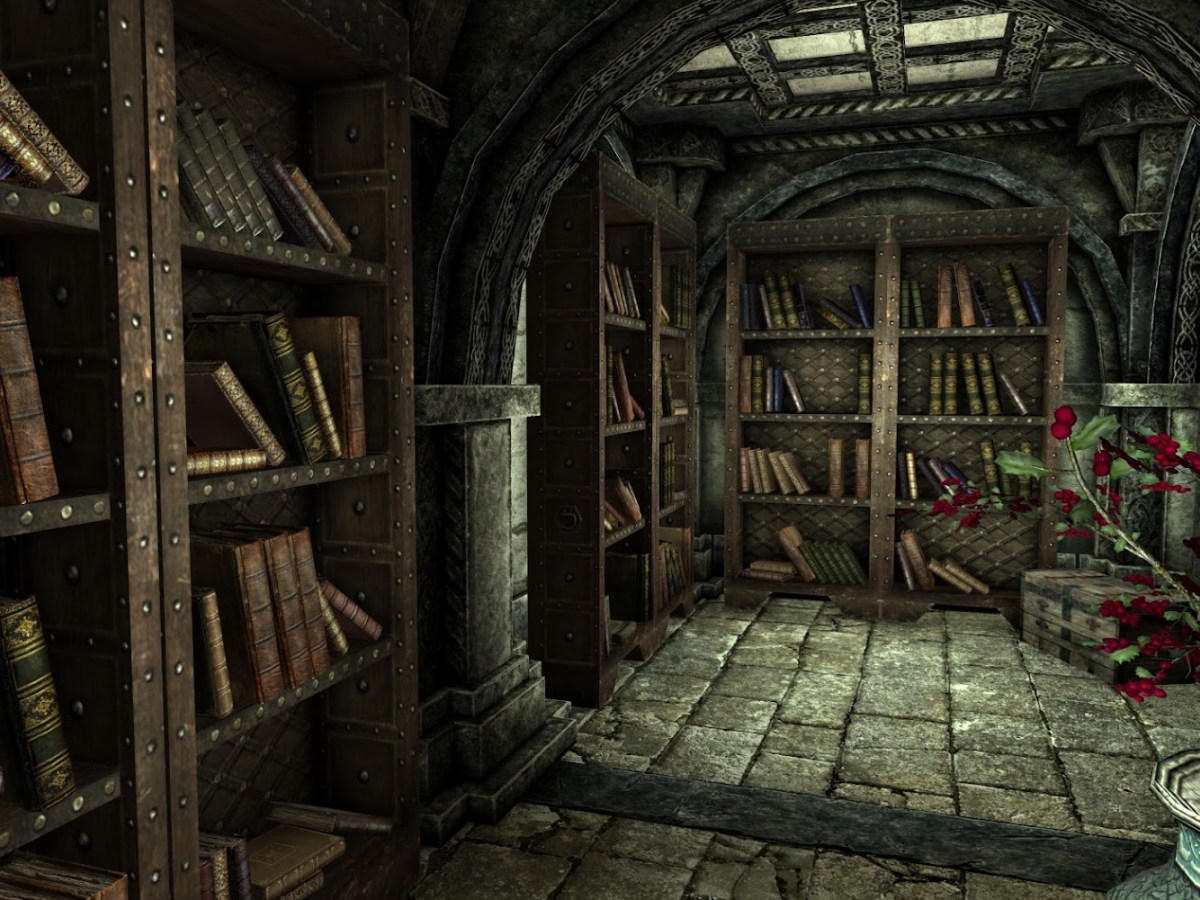
Gwylim notes on Skyrim: Books and magical excavations
Introduction Books are a fundamental part of the narrative building of the Elder scrolls series, they can often bring context to the greater narratives as well as specific quests. In this essay I will discuss four different quests, two from Oblivion and two from Skyrim. The unifying themes for these quests is that, except for…
Gwylim notes on Skyrim: Fictional essays and their use in worldbuilding
I have previously written about the importance of in game stories and nonfiction books in world building and storytelling, especially when it comes to fantasy and sci fi. In this text I wish to go even more granular and discuss a genre that is close to my heart, the essay. Often more loose in form…
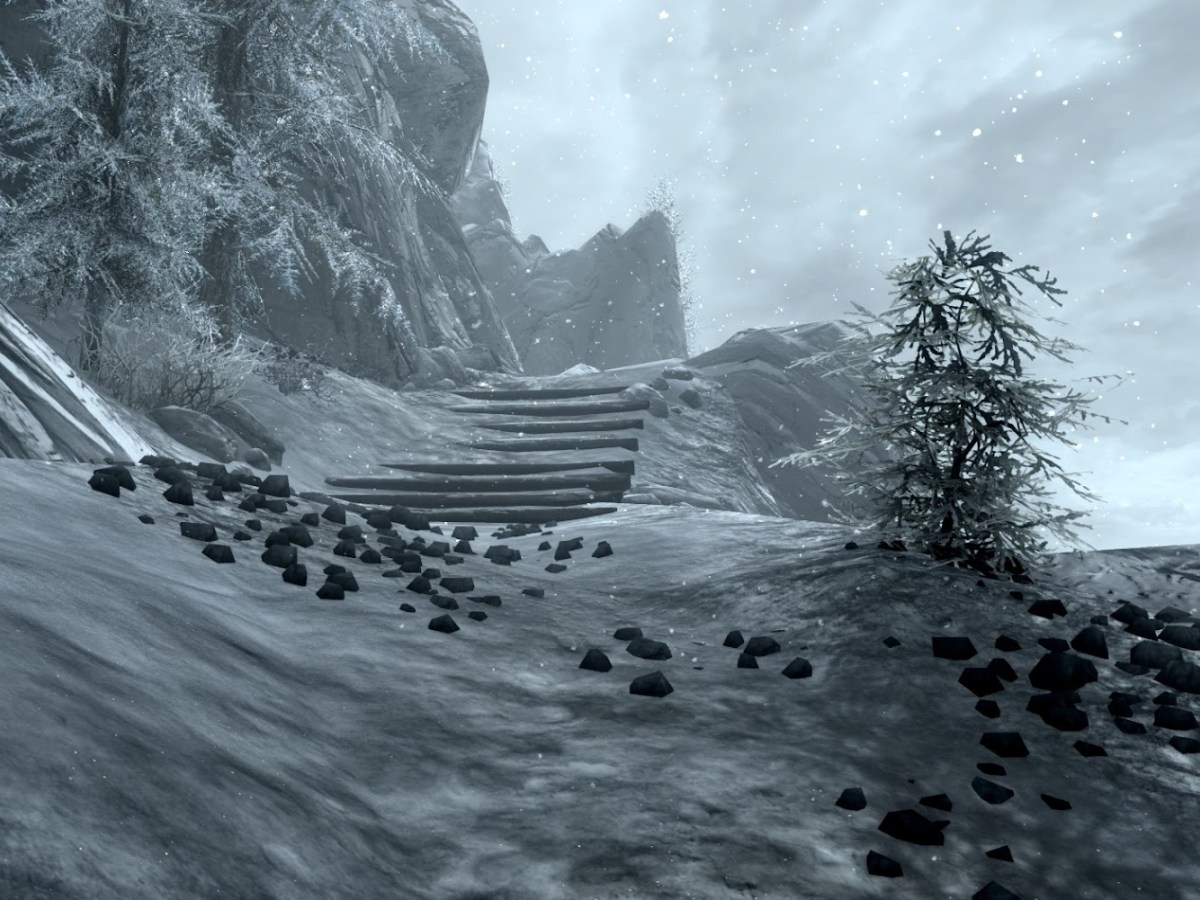
Gwylim notes on Skyrim: Stairs, gameplay and narrative guides
Introduction Skyrim is the latest installment in the Elder scrolls series. The game series is an open world rpgs filled with magic, monsters and intrigue. Skyrim is set in the fringed northern land of the same name. This land is deeply inspired by a romanticized version of Viking and Nordic culture. The land is rugged…
Gwylim notes on Skyrim: The joys and frustrations of in game book hunting
I am sure that many of my readers have had the joy of finding a specific book in an obscure bookshop or lurking in a digital archive somewhere. The frustration when you are missing but one text in your collection, the unwillingness to start a project before you know that you are all the texts…
Warhammer exploratory essay: Who gets to be human
Introduction I have alluded to the idea of personhood in earlier chapters, but in this text I will discuss it in more clear terms. All the playable factions are humanoid in one way or another. The non-human factions are either adjacent to humans like Elves or dwarves, or they are more inhuman like Lizardmen, Skaven…
Worldbuilding and context: the existential questions of Pixar films
Introduction When creating a narrative, it is up to the author to make the world around the text itself. When it comes to real world stories is this a relatively straightforward task. The references exist to draw upon, and more importantly, there are already rules that the reader will understand. The more removed from this…
Altdorf misadventures: the comedic joy of warhammer fantasy writing
Introduction The reason that I started writing and researching warhammer again has been the joy reading materials for the roleplaying game Warhammer Fantasy, specifically the supplement Altdorf: Crown of the Empire, the supplement that allows you to play adventures in the capital of the Empire. There are large collections of descriptions of quest hooks, characters…
Warhammer exploratory essay: Humans in warhammer
Introduction This chapter will go trough and present some of the basics of the human factions in both Row and Aos. Being human ourselves it is easy to see how this faction, above even the other more humanoid fractions, had been the one that authors have found the easiest to relate to and write about.…
Warhammer exploratory essay: Old Worlds and new
Introduction Warhammer fantasy has existed for decades in one form or another. What started as a roleplaying game with models and rather simple and generic fantasy settings has transformed and morphed with time into something very unique indeed. In a series this old, and with so many creative voices is it inevitable that changes happen.…
Propaganda and subtle bias
No one is immune to propaganda, and all artistic expression is inherently political. These are two statements to keep in mind, as we approach this year’s eurovision song contest, and examine what choices were made, and which were not. There is much we can learn, simply from the roster of this year’s competition, as well…
The library of odd things: A home for obsolete media, and rare finds: part five: Who decides what a library should be
Introduction The question of who gets to decide what a library should and should not be is deeply ingrained to what I aim to discuss in this series. There are several forces that need to be taken into account for this discussion, specifically librarians, patrons and policy makers. Each group has their own biases, needs…
New years eve, a liminal study in gray
New years is a time of liminality, of barriers and of new beginnings. In the western hemisphere it is also a time of transition between the darkness of winter, and the light of spring, between snow and flowers. Greyness is in and off itself a form of liminality, between black and white, and often seen…
The library of odd things: A home for obsolete media, and rare finds: part four: Inspire or provide
Introduction To build on my last chapter, I would like to ask this question; if it is up to the library to provide new experiences, or to provide for existing wants. This problem lies at the center of this essay. The question of what kind of collections a library should have, and how it should…
The cost and importance of internet security
If you have been online for any time in the last decade, you have undoubtedly realized just how much information is being gathered about you. Everything from your full name, to phone numbers and home addresses seems to be something that more and more websites get from you. And this is just mentioning the things…
The library of odd things: A home for obsolete media, and rare finds: part three: Known and unknown needs
Introduction This text is the third installment in a series of essays discussing a hypothetical new form of public library, the Library of odd things. This form of library focuses on providing new, old and novel experiences to their patrons, unbound by the need to show usefulness or to cater to statistics and loan numbers.…
The library of odd things: A home for obsolete media, and rare finds: Part two, quailty and quantity
This is the second part in an essay that I wrote about media curation and the role of public libraries in Sweden, as well as how it can be handled differently. I discuss the concepts of quality and quantity in this chapter, as well as the implications these definitions have on media curation, both in…
The library of odd things: A home for obsolete media, and rare finds: Part one, introductions
What you are about to read is the first part of a longer essay that I have decided to split into smaller chapters for ease of reading in a blog setting. In this essay I will discuss several concepts regarding how the Swedish library system works, and the role of the Swedish public library. Later…
Essay: the mushroom and the soil
Today’s essay partly comes around thanks to a wonderful series of video essays, exhibitions and talks hosted on the Serpentine museums official youtube site. Many of the speakers helped me to open my eyes to what soil can be and what it means to us as humans and living creatures. In this text I would…
Essey: Alcohol and the self: A study in drug use and self perception
Trigger warnings: Alcoholism, mentions of abuse and implied assault. Disclaimer: I want to begin with a series of disclaimers. First and foremost, I must make it clear that I myself do not drink alcohol and have not been truly drunk even once in my life. However, I, like most people, have had experiences with seeing…
Media literacy 101, part 4: The voice of the narrator
In the previous chapter, I discussed the role of the antagonist and protagonist within most narratives, and how understanding these roles can help us understand a text as a whole. Just like the point of view of these leading characters, can the point of view of the narrator also tell the reader a lot about…
Essey: mellodifestivalen, a tale of big egos and low expectations
Melodifestivalen is the Swedish regional part of the eurovision song contest. Here is where Sweden’s representation is chosen in a several week long media spectacle. Seeing how this is the Swedish broadcast networks (SVT) biggest crowd pusher of the year, it is no surprise that the company wants to get as much out of it…
Essay: Mental health in roleplaying games, a case study
Vampire the Masquerade and Elder scrolls, playing the mad The depiction of mental health in fiction has had a long and dark history. Often has mental health been used as a mark of otherness, evil or as comic relief. Maniac killers, sadistic monsters or babbling clowns are often seen in popular media for the last…
Media literacy 101, part 3, Protagonsits, antagonists and point of view
The roles of protagonists and antagonists are to drive a narrative forward. The distinction of protagonist and antagonist has been used to describe and define the main characters since ancient times. Today I will discuss how these two terms function and how it can help you analyze and enjoy fiction more deeply. By analyzing the…
Warhammer 40k an in depth analysis: Part 5, The Orks: part 4, Comedy and the importance of narrative points of view
This chapter will discuss how the Orks points of view turns atrocities and horrific events into darkly comedic situations using context and dramatic irony. The primary role of the Orks, besides their use as a constant antagonist to the major point of view factions humanity, do they also serve as a form of comic relief.…
Warhammer 40k an in depth analysis: Part 5, The Orks: part 3, Futurism and facism
Modern facism is intrinsically linked with futurism in their love for violence and glorification of warfare. Power and the subjugation of the week are also concepts that both movements share. These are ideals that can be found amongst the Orks. I will not dive too deeply into either of these movements in this chapter, and…
Warhammer 40k an in depth analysis: Part 5, The Orks: part 2, nature of the beast
Introduction This chapter is meant to be an introduction to those of my readers new to the franchise. This series will focus on the seventh edition Orks, to keep with the rest of the series continuite. These Orks do look a bit different from their modern counterparts. This notroduction will be crucial to understand the…
Warhammer 40k an in depth analysis: Part 5, The Orks: part 1, Introduction
This chapter will serve as an introductory chapter to the Orks as well as to the concepts I will discuss in this part of the series. Because the Orks are the ever present antagonist of the franchise, as well as somewhat of a comic relief, I have decided they are worthy of their own series…
Essay: Ebooks, and the tactile feeling of turning a digital page
I have thought about why the sensation of reading things on Archive.org or in games like Skyrim had a much more satisfying feeling than reading something on a pdf. The reason is the tactile feeling these texts have. In this text I will explore the sensations of tactility, and their effects on the sensation of,…
Warcraft 3 and the otherness of the Horde: Orcs
The archetype of the Orc is perhaps most well known today as the primary foil for the heroes of the series Lord of the Rings as well as many Dungeon and Dragons campaigns. The Orcs, just as the other factions discussed in this series have had a history of being portrayed as villains and monsters,…
Media literacy 101, part 2, The author
In this chapter I will present the reader with a number of ways we can approach the concept of the author, and how to critically deconstruct and analyze it. All the methods I mention here are viable and used in media and art analysis. I will present the various methods in a rough historical order.…
Essay: Abandoned digital spaces; part 2, Second life, Life amongst the relics
Introduction Second Life was a popular three dimensional chat room in the early 2000s, following in the footsteps of several programs and applications. What sets these chatrooms apart is the fact that they are fully modeled 3 dimensional spaces you can explore and interact with, much like in a first or third person video game.…
Media literacy 101: part 1, introduction
This series will be a quick introduction to the concepts and goals of media literacy, as well as why it is important to everyday life. This series will aim to answer three questions, as well as to arm the reader with a powerful set of tools to use in their everyday contact with a wide…
Warcraft 3 and the otherness of the Horde: Trolls
Introduction In the previous chapter of this series, did we get a glimpse on what in Anthropology for many years has been known as the “noble savage”. The so-called others that the European explorers encountered, individuals and communities though seen as other, and in many cases lesser, they were still seen as “good”, and in…
Warhammer 40k an in depth analysis: Part 4, The Necrons: part 2, The ancient terrors
Ancient Egypt has for decades inspired modern man with their mystery, and seeming fixation with death and reincarnation. The mystery hieroglyphs and monuments of this long lost civilisation has inspired fantasy, horror sand sciense fiction writer since the early 1800s. In this chapter will we delve in to the origins of these tropes, as well…
Warhammer 40k an in depth analysis: Part 4, The Necrons: part 1, The deathless once
The ancient enemy of the Eldar, and the Old once, they gave their souls in return for endless life. The Necrons represents an ageless, unknowable evil in the Warhammer 40k setting, their technology so advanced, they seem to have magical powers. Introduction As always will I begin my series with a quick rundown on the…
Warcraft 3 and the otherness of the Horde: The Tauren
Introduction The image of the Native American “noble savage” has persisted for decades in the public continuousness of the Western world. The image that mostly comes to mind seems to be the red skinned man, dressed in a large feather headdress and speaking “old truths of nature and the spirits”. In this text I aim…
Essay: Abandoned digital spaces; part 1, introduction
This text is the second in a series of informal essays where I present a more causal argument then my normal analytical texts. I this text will be the first in a series discussing abandoned spaces of digital landscapes, and how they may seen as mirrors of their real life equivalents. This chapter will discuss…
Essay: The immersive world of Morrowind
This text will be my first in a series of essays, more informal texts that are more opinion oriented then my normal research oriented texts. The topic of today’s text is brought to you by Daipanda, a loyal viewer of my twitch stream. If you like to have your own topic suggestion featured on the…
Warcraft 3 and the otherness of the Horde: An introduction
Introduction The concept of othering an individual, or more often a group, is a way of building one’s own identity. By defining what the other is, the individual defines what they are not. In this chapter we will take a look at how the otherness of the Horde faction in Warcraft 3 is used to…
Warhammer 40k an in depth analysis: Part 3, The Eldar: part 6, The followers of the Laughing god.
Introduction Our final segment of this series will describe a faction, that unlike any other Eldar sub faction do not have a direct connection to any fantasy trope per say, but is instead related to a much larger trope, that of the trickster. In this chapter will I once again give a comprehensive overview of…
Warhammer 40k an in depth analysis: Part 3, The Eldar: part 5, Nature and the old ways.
Introduction The Exodite Eldar was the first to leave the Empire, and the first to start their new lives away from the horrors and debauchery of the old Empire. The Exodite chose to settle down on planets that had been seeded aeons ago, to become new paradise worlds for the Eldar. We will use these…
Warhammer 40k an in depth analysis: Part 3, The Eldar: part 4, Dark Eldar, The dying shadow.
Introduction The dark reflection of the once proud Eldar empire, and the second to escape its rotting core. The represents the full indulgence of the dark and hedonistic sides of the Eldar. Living in an unimaginably large fortress city located somewhere in the vast web-way, the Dark Eldar constantly raid the galaxy for new slaves…
Warhammer 40k an in depth analysis: Part 3, The Eldar: part 2, Craftworld Eldar, glory of the past.
Introduction The first factions we will take a look at is the stoic and noble Craftworld Eldar. The Craftworld Eldar follows a strict rules of life, in order to try prevent the past from repeating itself. The Craftworld Eldar stands for an age gone by, and the glory of the long lost past. This chapter…

Warhammer 40k an in depth analysis: Part 3, The Eldar: part 1, The children of the Old once
Introduction In the world of Warhammer 40k does the Eldar represent the largest amount of mystical and arcane undertones. This is partly due to their many distinct ties and references to the Elves found in Games Workshops other series, Warhammer fantasy. We will start this series by describing some of the simulates, as well as…
Warhammer 40k an in depth analysis: Part 2, The Warp: part 7, Chaos: Conclusions
Introduction This will mark the last of the chapters dedicated to the topic of the Warp for a while. We have now gone trough the entire human pantheon of deities, both evil and benign. We will return to the Warp periodically across the series as we explore new factions and explain how these unique civilisations…
The use of hallways in Fiction
The hallway has been used as a number of symbolic objects in fiction, from doorways to other worlds, to extensions of characters mood and emotions. I will in this essay present three genres of fiction, and their use of hallways in wildly different ways. Namely will we examine fantasy, science fiction and horror, and their…
Warhammer 40k an in depth analysis: Part 2, The Warp: part 6, Chaos: Slaanesh, Master and mistress of excess
Whenever a creature gives in to the pleasures of sensuality and excess so does the master of pleasure of pain share in it as well, for they are the ruler of al sensation big or small. Slaanesh is the master of excess in al things, as well as the architect of the destruction and removal…
Warhammer 40k an in depth analysis: Part 2, The Warp: part 5, Chaos: Khorn, The father of murder and war
For every murder, for every sentient being struck down in fear, anger or vengeance, there is a corresponding ripple in the warp, Khorn is the culmination of al those sensations. Every time a life is taken in anger, is the power of Khorne increased. Skulls for the skull throne No other of the chaos gods…
Warhammer 40k an in depth analysis: Part 2, The Warp: part 4, Chaos: Tzeentch, Master of magic and schemes
Whenever a human lie to another, or schemes against them, Tzeentch hears, and uses them as a puppet on a string. The changer of ways sees and hears al, the ultimate master of manipulation and trick. He is the patron god of politicians, generals and scholars, for he promises his followers endless knowlage and power.…
Warhammer 40k an in depth analysis: Part 2, The Warp: part 3, Chaos: Nurgle, the god of death and rebirth
Every advanced emotion felt by enough sentient species is reflected within the warp. No feeling is so universal, and so often felt then the fear and relief related to the trails and tribulations of death and disease. It is these emotions, these fears, hopes and dreams that fuels Nurgle, the god of death and suffering,…
Warhammer 40k an in depth analysis: Part 2, The Warp: part 2, Travelling trough hell
Introduction Warp travel is a large and mostly deliberately obfuscated topic within the 40k narrative. This is partly because of the first or second hand accounts the writes often uses to describe the world of Warhammer (link here). In other words, does the Imperium for example know very little about warp travel, and how their…
Warhammer 40k an in depth analysis: Part 2, The Warp: part 1, the mage and the psyker
Introduction The powers of the warp has many names, and take numerous forms. In this chapter will we discuss a few of them. This discussion will mostly have a focus on the Imperial side of the narrative, because it is the side that I have introduced so far, and as a result are the easiest…
Warhammer 40k an in depth analysis: Part 2, The Warp: part 1, The Materium and the Immaterium
Introduction This chapter will mark this blogs official return to the Warhammer 40k franchise. In this series discuss the epic and daunting fictional series set in the 40th millennium. With this chapter will we start looking at one of the largest cornerstones of the Warhammer 40k franchise, that of the warp. We will begin with…
The art of the bootleg: An aesthetic analysis of copyright infringement.
Introduction We will in this post take a look at the consent of the Bootleg. Specificity will we look at the bootleg products created after the image of pop culture. The definition of bootleg we will use is the following: any material or content created for consumption by the public, without the knowlage and/or approval…
Undertale: an example of multileveld textuality.
Warning: This text do contain several major spoilers for the game Undertale. We will in this examine the games narrative in its entirety. As a result we ask you to only read this paper if you have already consumed the medium in question, or don’t mind being spoiled on key parts of its narrative. Introduction…
Introduction to literary studies: part 1, sources and reliability
This will start a shorter series discussing the different terms and themes commonly used in art and culture studies. This first chapter will give a general idea of how to think about sources and how they can be, and cant be used. Today will start our Wednesday series on general literary and art studies. Today’s…
Warhammer 40k an in depth analysis: Part 1, IoM, part 9, Final thoughts
This will be the final chapter on our introduction to the humans of the Warhammer 40k franchise. We will here combine al that we have learned in to a uniform image of the Imperium of mankind.
Warhammer 40k an in depth analysis: Part 1, IoM, part 8, The holy God Emperor
The Emperor of Mankind is a symbol of many things, some which are direct contradictions of each other. This chapter will work somewhat differently to the previous has, as we will here chronologically follow the life, death, and rebirth of the Emperor.
Warhammer 40k an in depth analysis: Part 1, IoM, part 7, In the service of the Emperor
In this chapter we will look at series of different factions al related in way or another to the faith of the Imperium of Man.
Warhammer 40k an in depth analysis: Part 1, IoM, part 6, The Emperors chosen.
This chapter we will take a look at the opposite, the elite and superhuman Space marine, or Adeptus Astartes. As with earlier chapters will this one serve as a simple introduction, a starting point on which we can later discuss more deep and complex subjects.
Warhammer 40k an in depth analysis: Part 1, IoM, part 5, The Astra Militarum
The wars of the Imperium is presented to be fought on a galactic scale, the size of the war machine to large for a single person to understand even less comprehend. Each life is presented as a mere statistic, each death a decimal point in the eternal bureaucratic machine. Most die unnamed and unremembered. (Hill.…
Warhammer 40k an in depth analysis: Part 1, IoM, part 4, in service to the machine.
This chapter will, as mentioned in previous chapter, be focused on the religious order/scientific institution by the name of Adeptus Mechanicus. In this, as well as similar future will we discuss the factions codex
Warhammer 40k an in depth analysis: Part 1, IoM, part 3, Dark age of techonology
A continued view on the technologies of the Imperium of mankinds technology.
Warhammer 40k an in depth analysis: Part 1, IoM, part 2, A Gothic future
In this chapter we will primary discuss the architecture of buildings, starships as well as war machines, and how they help to set a certain tone within the narrative, but first of all I would like to draw a parallel between the term Gothic, and the term for the two common human languages of the…
Warhammer 40k an in depth analysis: Part 1, Imperium of Mankind: part 1, Manifest destiny.
This begins a series of looks into the large and complex narrative of the Warhammer 40k franchise. We will begin this series by taking a look at the Imperium of mankind (IoM).
Canon: an introduction
This article will serve as an introductory look into the term canon, and how we will use it in the rest of this blog. The term canon is most commonly used to group a series of works together. Usually you discuss one or two connections. The first is a real world, or para-textual connection such…
The game: a definition
Several definitions of games exist within and without the academic world. With this text I will make the case for one of them. This definition goes as follows, “each game must have an implicit or explicit player” Furthermore we will define the player as “Someone with implicit or explicit control over the actions in a…
Consider a state
Today we will follow up on our earlier discussion about the state as a concept. Historicity has states, as defined by Hobbes, exist as long as humans have lived in any form of organized tribe. Today we will focus on defining the “modern nation state”. With this term I refer in this text, specifically to…
Conider a country part 1
Consider a country, consider it bearing in mind all we have considered before in these texts considering roads, towns, cities, cars and people. From above imagine the network of roads, towns, houses and businesses and lives. These collections are both independent, and completely dependent on each other. Note that these dependencies do not end at…
Consider a city, part 2
We continue by examining other buildings of our city. The buildings in which we do not live, but yet spend much of our time. These would be the buildings of professions, either of ours, or of those needed for our lives and well being. Let us begin with the prior category. This is your location…
Consider a city part 1
Today we are going to continue where we left off, with a city or town. Full of rooms which, through complex norms, rules and social contracts, are considered homes. Homes that may be more or less yours. Though these buildings make up so much of the actual city, their use and significance are rarely considered.…
Apartment blocks
Have you ever considered what makes up an apartment block? A cube of glass, stone, maybe wood that makes up so many towns, that so many people do and don’t call their home. First of all is a physical thing. Big, imposing a brick. Man made, yet it seems almost natural, like a hill, or…
 An Unused Frequency