Gwylim notes on Morrowind: Seyda Neen, the anatomy of a tutorial area

Introduction

All players of Morrowind start their adventure by leaving their prison ship, and entering through Vaardenfell costumes office. They enter the game as a prisoner, brought to Vadeenfell under unclear circumstances, with only a cryptic dream of Azura to guide you. The Sedya Neen port is a customs office, giving the game a perfect excuse to ask the players questions about their race, name and profession. The office effectively presents the player with the workings of the Empire and your role within it.

This is a goal that Skyrim also achieved by having you give your information to the executioner. Morrowind shows the bureaucratic rigour of the Empire, while Skyrim shows the cold and careless part of the same bureaucracy. Both approaches are useful, and have their positives as well as negatives. While Morrowind’s approach is more diegetic, is Skyrim’s approach doubtlessly more action oriented..

The ship and the dock

The game slowly introduces you to the controls of the game, moving, talking and interacting, as you travel through the
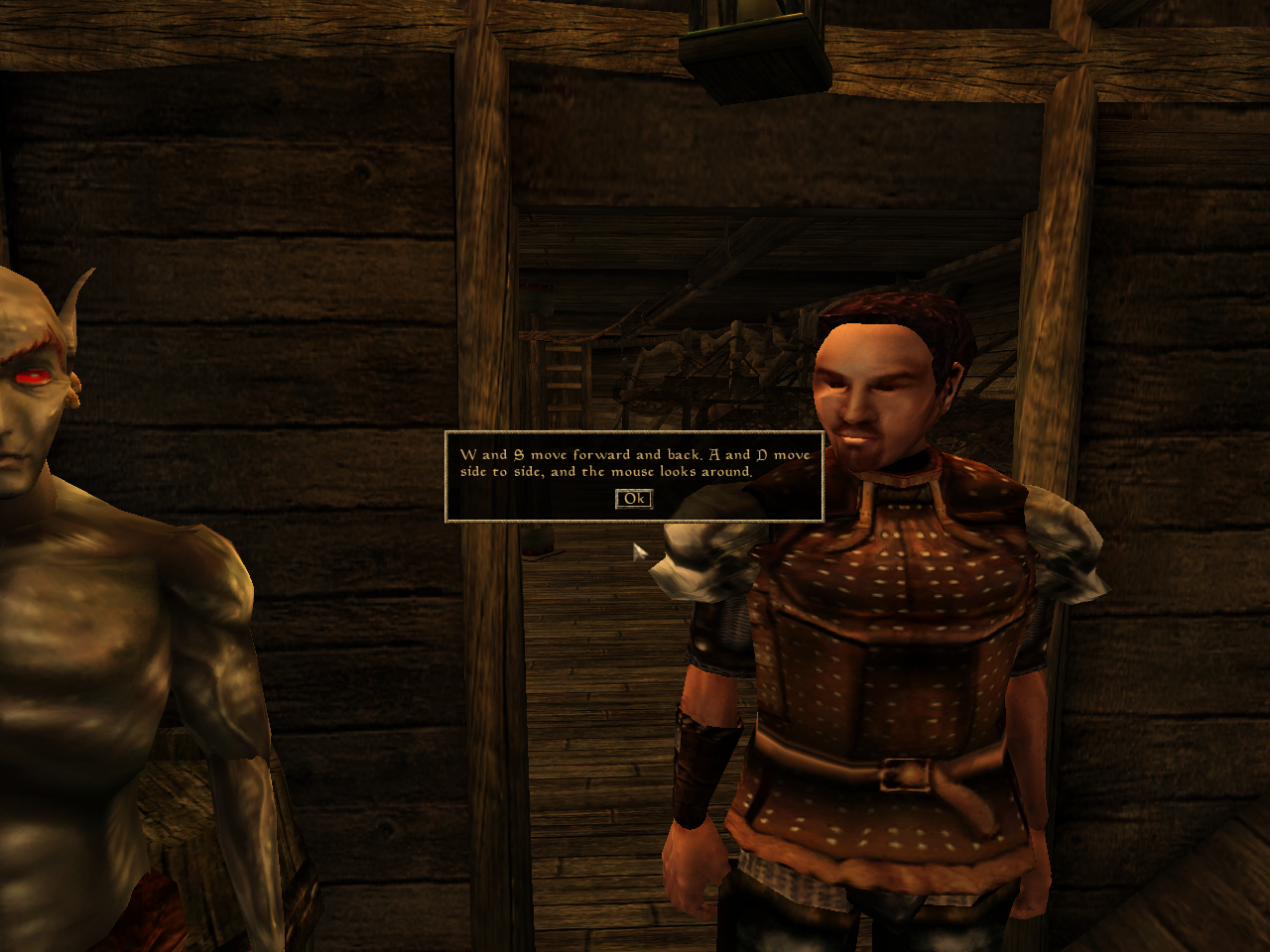
ship and interact with your jailor. As you leave the ship you are asked to tell the first clerk where you are from. This being the game’s way of making the player choose their race diegetically.

The landing area is small, verdant with life, and completely closed off from the rest of the gameworld. The player is situated directly in front of the entrance to the survey office as they leave the ship. This gives the player a clear goal, while also giving them small glimpses of the world beyond the introduction area.

Getting registered

Entering the customs office you are met by an elder Imperial man, asking you to fill in your paperworks. He dryly explains that there are a number of ways that this can be achieved, and that the choice is up to the player. Here the player can make their own class, pick one from the list of premade classes, or answer a few questions to let the game pick a class for you.
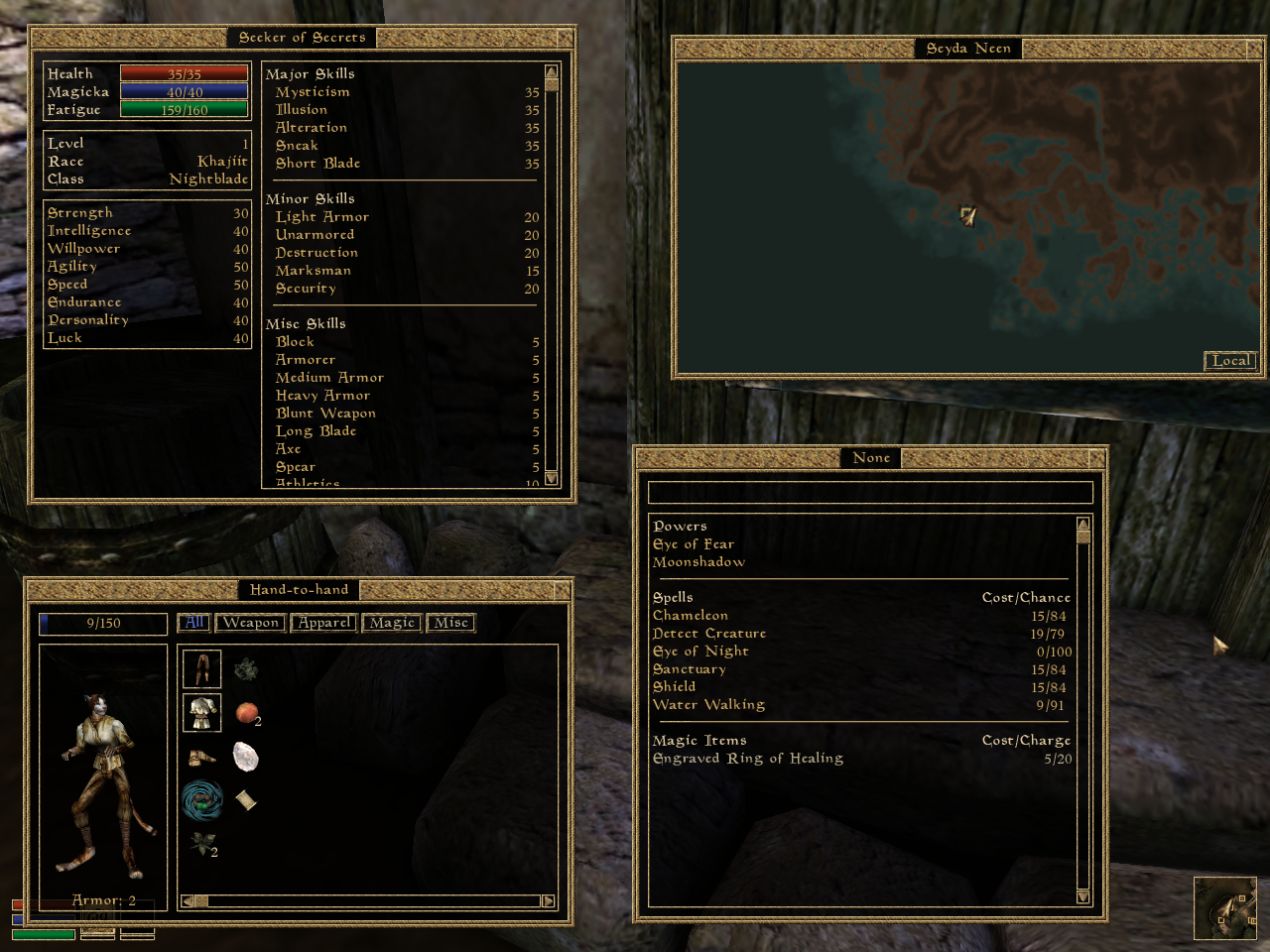
While these questions are rather strange and surreal in the context of the registration for entry, the game has done enough groundwork for it not to be too immersion breaking. As you fill in your race, class and birth sign, is your character menu likewise filled in with the relevant information, making the UI feel like a natural extension of your characters paperwork. You get one last chanse to correct anything you are not happy with before leaving the character creation process. At this you are ordered to grab your papers of registration and show them to the guard at the end of the room.

Exploring the halls

Leaving the costumes office you are briefly left to your own devices in a series of small rooms. Here you can find a few interesting objects that I will explain later in more detail, as well as plenty of trinkets books. Right ahead of the player is a small set of stairs, leading to a number of barrels and boxes, containing clutter items as well as alchemical ingredients,as weöö as gemeral nicknacks.

Directly to the right is a room that is far more inviting in its decor and overall layout. Here the player will find a book case, a locked chest, a dagger and a lockpick. Picking up the dagger or the lockpick gives the player a small tutorial window relating to combat and lock picking, the game suggests that the player tries to pick the lock of the small coin chest in the same room. The drinks and the bread can be picked up, leading to the same short tutorial on alchemy described earlier. Leaving the dining room leads the player to a small outdoors area.

The ring, the knife and the lockpick

It is in this walled off outdoors area that the player finds their last tutorial item in a barrel, a magic ring. The barrel is located in such a way that it is almost impossible for the player not to have it directly in their line of sight as they enter the area. The knife and the lockpick is similarly located in the player’s direct line of sight, with the dagger being called out in a corresponding note.

Picking up any of these items gives the player a small explanation on how they work, and how they are equipped, slowly introducing the players to the game mechanics as and when they become relevant. While not the most interactive tutorial mechanics available, are they effective at the goals that they aim to achieve. At the end of the tutorial area, most players will be informed about the game systems of magic fighting and lick picking. Leaving the open area leads you to the last room of the tutorial area.

Release, getting your orders

The player enters the last small office, populated by a single guard that instructs the player to take a packet of contact in Balmora. The player is given a package as well as some instructions on how to carry out this task. This being the only guidance the player gets besides their cryptic dream from the introduction cutscene for quite some time. This approach teaches the player that Morrowind’s secrets are many, and that they need to find them out for themselves.

The player can ask the guard a series of questions regarding a number of topics, as well as trying their hands on the persuasion system. The player learns through the dialogue tree that asking certain things can lead to new topics being discovered. When the player is ready to leave there is a door at the opposite end of the room.

Epilogue, choices and consequences

Leaving the costumes office, the player is faced with the last mechanic that the game will teach them for a while. A Bosmer man wanders outside of the costumes office, apparently he has had his prized magic ring confiscated recently. The same ring the player just picked up. Here the player learns about unavoidable text options in the form of red text snippets.

Here the player is forced to make a choice, to give the ring up, or to keep it. Keeping the ring allows the player to cast a spell they would otherwise not be able to for some time, while handing the ring over raises the disposition of the Bosmer man. The man also hints that mentioning this to the local shop keeper will give you better prices. If the player were to help the man, and mention it to the shopkeep, they will indeed be rewarded with better prices at the store.

From here the player is free to explore at their leisure, with a stern but gentle suggestion that they should travel to Balmora first, to get that entire prisoner business dealt with. So begins all games of Morrowind, heading out from the confined tutorial area of the Seada Neen customs office.

Do you like my writing and want to help me write more? Please take a look at my patreon, it has several essays, and would help me create a lot more: https://www.patreon.com/cw/SamRandom13

Gwylim notes on Skyrim: Stairs, gameplay and narrative guides

Introduction

Skyrim is the latest installment in the Elder scrolls series. The game series is an open world rpgs filled with magic, monsters and intrigue. Skyrim is set in the fringed northern land of the same name. This land is deeply inspired by a romanticized version of Viking and Nordic culture. The land is rugged and mostly barren, with a few scattered cities hidden behind grand walls. There are small farms scattered amongst the landscape, so are strange stone formations, caves, old temples and many many burial mounds. Skyrim is a mountainous land, and very few areas are completely flat. 

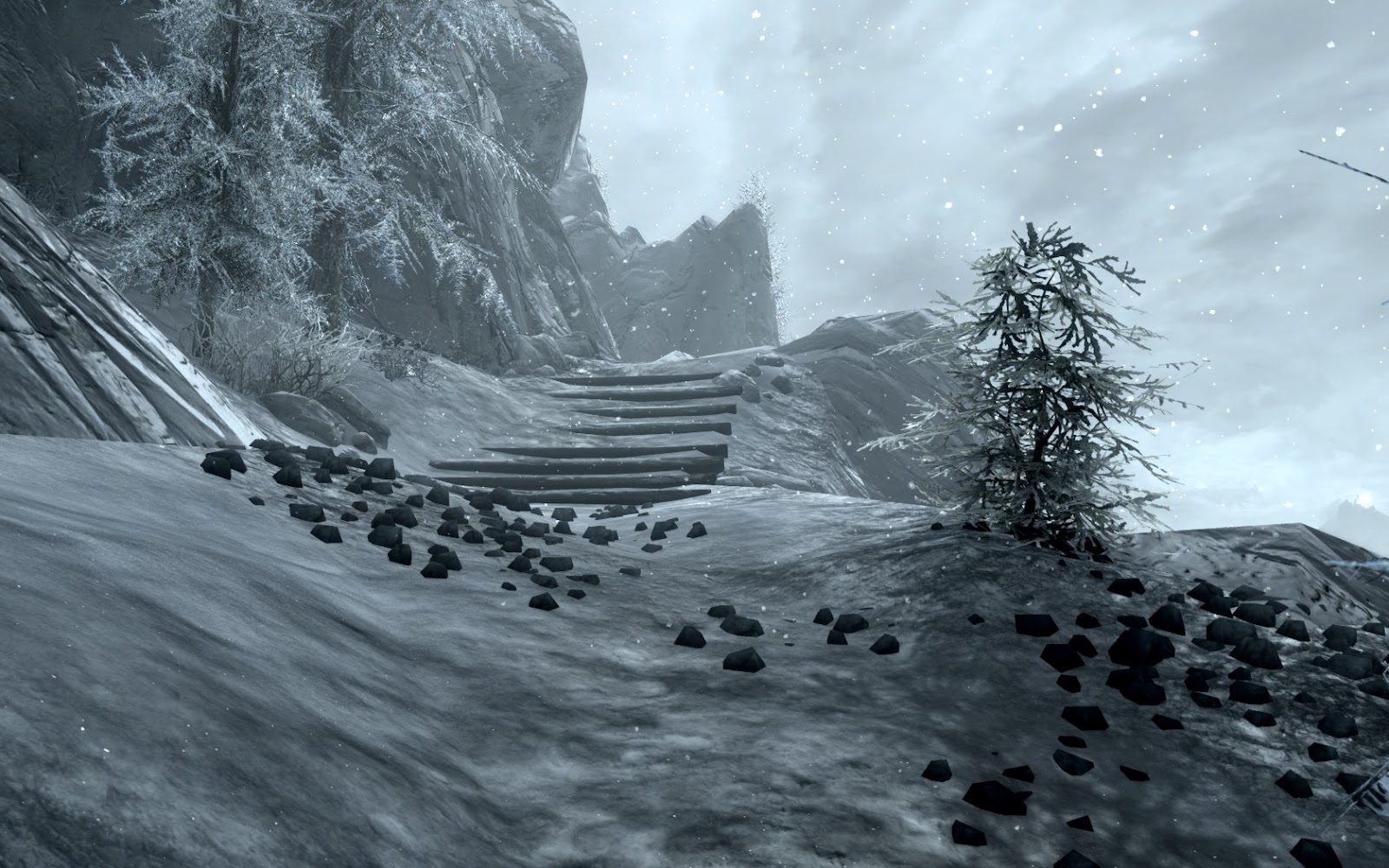
This makes the inclusion of stairs feel like a very natural part of the environment. One of the problems with open world games, especially those that are as large as Skyrim is the risk of players getting lost. Skyrim has many clever way of leading the player towards points of interests, from stone canines, small rocks statues, and dirt paths. One of the greatest way that the game leads the players is with stairs, low stone stairs that do not impede the players walking speed, but that subtly show that there is something important nearby. 


Height has also been used with great effect in Skyrims two latest predecessors. Cyrodiil in Oblivion is markedly bowl shaped, with the imperial city in the centre of the bowl. The effect is that if the player goes downhill they will eventually end up in the Imperial city. A logical design considering how vital the city is for the game both narrative and gameplay wise.

Vvardenfell in Morrowind is likewise built around a specific geographical feature, namely the red mountain. The cause of the red fever and home of Dagoth Ur. The presence of the red mountain in the centre of the map, in combination with the constant belching of smoke gives the game a constant sense of dread and urgency.

The player often simply needs to look up for a reminder of what they are fighting for, and trying to destroy.

Mountains and cliffs

The decision to make Skyrim a very mountainous area further helps to funnel the player in to areas of interest. Roads snaking along valleys and across vaistas is an easy way to lead the player towards points of interest. This strategy is very much enhanced by the combination of stairs leading up otherwise unscalable hills and cliffs. The world design takes great advantage of its mountainous areas to create breathtaking vistas from many of the games key locations.

The dragon priest ruins having several high points from where they practiced their Thu’um also makes for great vantage points to the players. Mountains also make for natural barriers, and while they do not often work like that in practice, mountains are great theoretical barriers to keep the players away from certain areas, or from taking unintended routes.

The introductory road to Riverwood being a great example of this, as the players snake along the road down the cliff they are faced with the vastness and emptiness of Skyrim’s wilderness.

Miraaks temple is placed on a hill, at one of the highest points of the island. The castles of the vampires and the Dawnstar are both located on an elevation, letting them loom over the players as they approach.

Cities and stairs

The main cities of Skyrim all use elevation in interesting, and often historically accurate ways. Windhelm is very clearly stratified around elevation, with the jarls kept at the top, leading down to great families, then the traders and last the common citizen. Morthal has a similar design with the temple of Diala and the jarls keep rather literally lording above the lower levels of the city. The poor are literally forced underground, while the rich live in cliffside residents. 

Winterhold is rather flat, with two exceptions, the docks and the grey quarters are both located at the bottom of steep stairs, putting them at a both spiritual and visual lower level then the ruling nord classes. It also increases the sense of isolation and destitution of these areas

Solitude has an interesting dip in the middle of the city, as well as a hill approaching it. This detail means that both the blue palace and the imperial fort are located uphill. The player will always approach these structures from below. Riften has the most obvious height dichotomy, with its most poor literally living underground, while the Jarl fort is also located at the top of a small hill.

The college of winterhold also is kept at a distinct elevation from the ruins of its former patron city. Finally at the greybeards located at the highterst top of the world, both in literal and spiritual sense.

Conclusions

Height and the traversal of height is a vital part of Skyrim, both from a narrative and gameplay point of view. The ways that Skyrim uses height can be mirrored in the way that Oblivion and Morrowind uses height. The concept of elevation can be used both as a gameplay tool, and as a narrative tool.

The volcano of the Red Mountain in Morrowind both works as a goal, but as a deterrent to the player. Doubly so with the addition of the ghost fence cutting the player off from the peak for most of the gameplay. It is a deterrent, but also a sign of the ultimate goal for the player.

Oblivion uses its bowl shape to give the player a constant reminder of the Imperial city, the seat of power for the empire, and the very thing that the player is working to save. From a gameplay perspective does Oblivion use the high tower of the Imperial city as well as its central location as a tool for the player to navigate, and find their way back to the central hub of the game.

Skyrim likewise uses elevation, and stairs both for narrative and gameplay use. The narrow valleys help guide the players towards points of interest, and the elevation of certain buildings relative to its surrounding can tell the player a lot about a place without saying it expressly. 

Gwylim notes on Skyrim: The joys and frustrations of in game book hunting

I am sure that many of my readers have had the joy of finding a specific book in an obscure bookshop or lurking in a digital archive somewhere. The frustration when you are missing but one text in your collection, the unwillingness to start a project before you know that you are all the texts you need to start. I admit that this is not a problem that many people have, but I am sure that at least some of my readers can empathise with my plight!

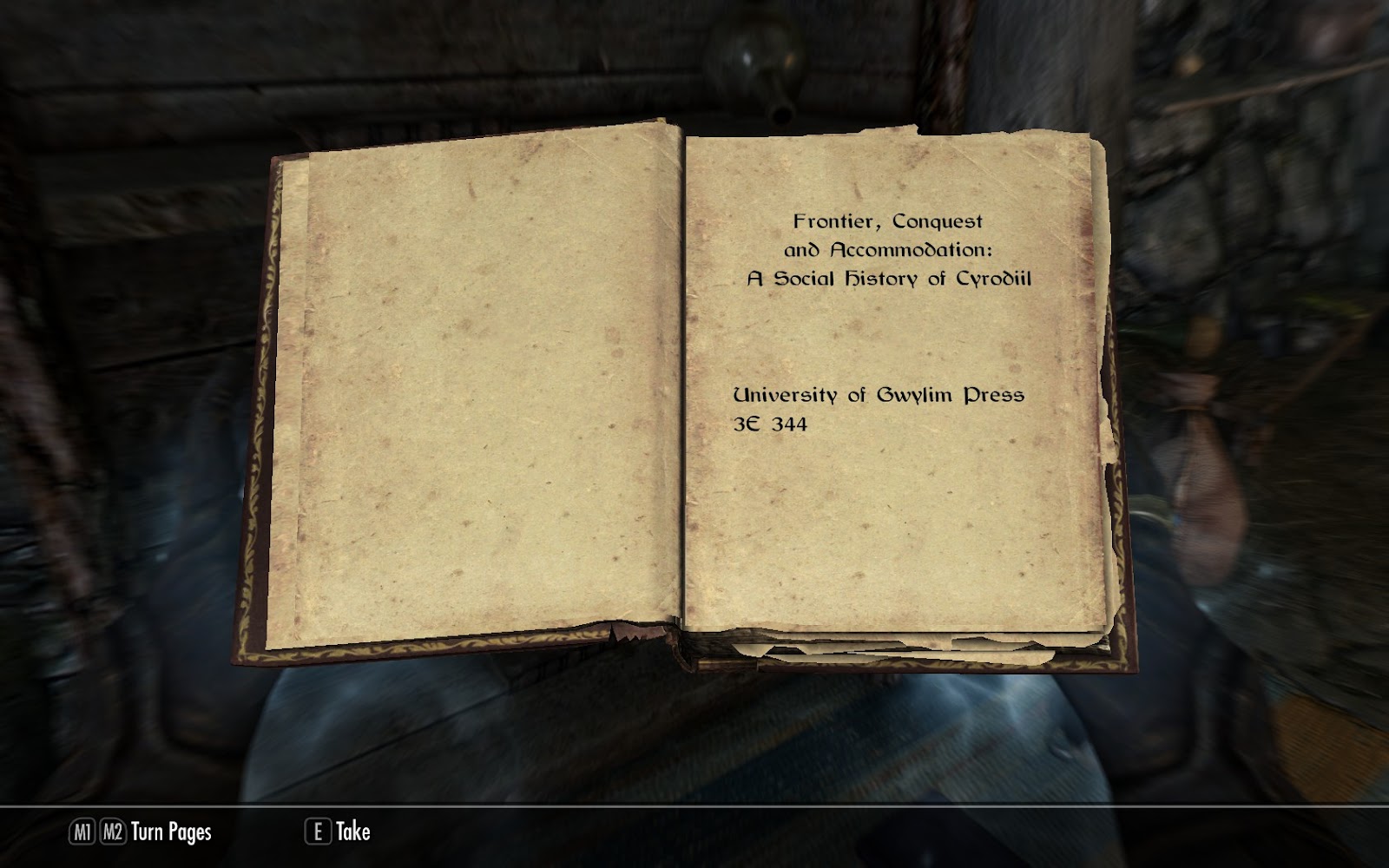
A book from Skyrim in the reading view of the game.

I have had a similar experience in skyrim recently. I have discussed the wealth of reading that can be found in the elder scrolls series many times. There are novels, poems, essays and unhinged ramblings to be found in all of the main games. In many of these games there also exist book sellers in where to easily and effectively acquire this reading materials, as well as libraries aplenty.

Skyrim is different in this regard, as it is the general store sellers that sells but a paltry few books. The only libraries available to the players are also located at either the seats of power, or at Skyrims two seats of learning, the bards college and the College of Winterhold, the primary location to learn the arcane arts.

The second of the two colleges have an especially stringent and suspicious librarian. Due to his dour nature, or due to a lack in coding, can you in fact Not borrow books from this library, though he does sell some of the texts he stores there. Due to a quirk in the book shelves in the Winterhold library can you only read the majority of the books if you steal them from the shelves, as they are not located in the regulair open style bookcases.

There are on the other hand other ways to acquire reading material in Skyrim. First and foremost does the otherwise uninterested populus of Skyrim own a fair few books themselves, as at least two or three can be found in each household. Likewise does it seem that everyone from blood crazed necromancers to cut throat bandits have a bend for reading. As a result the dungeons are populated by sentient races often surprisingly full of books, journals, scrolls and other reading material.

Many of these seemingly brutal and bullheaded robbers seem to have an interest in obscure history and advanced magical theories. As it is more common to find a thesis on Mysticism next to a bandit bed, then it is to find something salacious like The Lusty Argonian Maid.

This means that the best way to expand your library is to either delve into a dungeon, or go thieving in the neighborhood. I want to make the argument Skyrim has moved away from the cities being as much of a hub as they were in Oblivion and Morrowind. The wilderness and the quests and adventures that take place in the wilderness between the cities, has taken over much of the time spent in the cities, especially Oblivion. In the earlier games most quest givers lived in the cities, as well as large part of the quests themselves taking place in, or near cities.

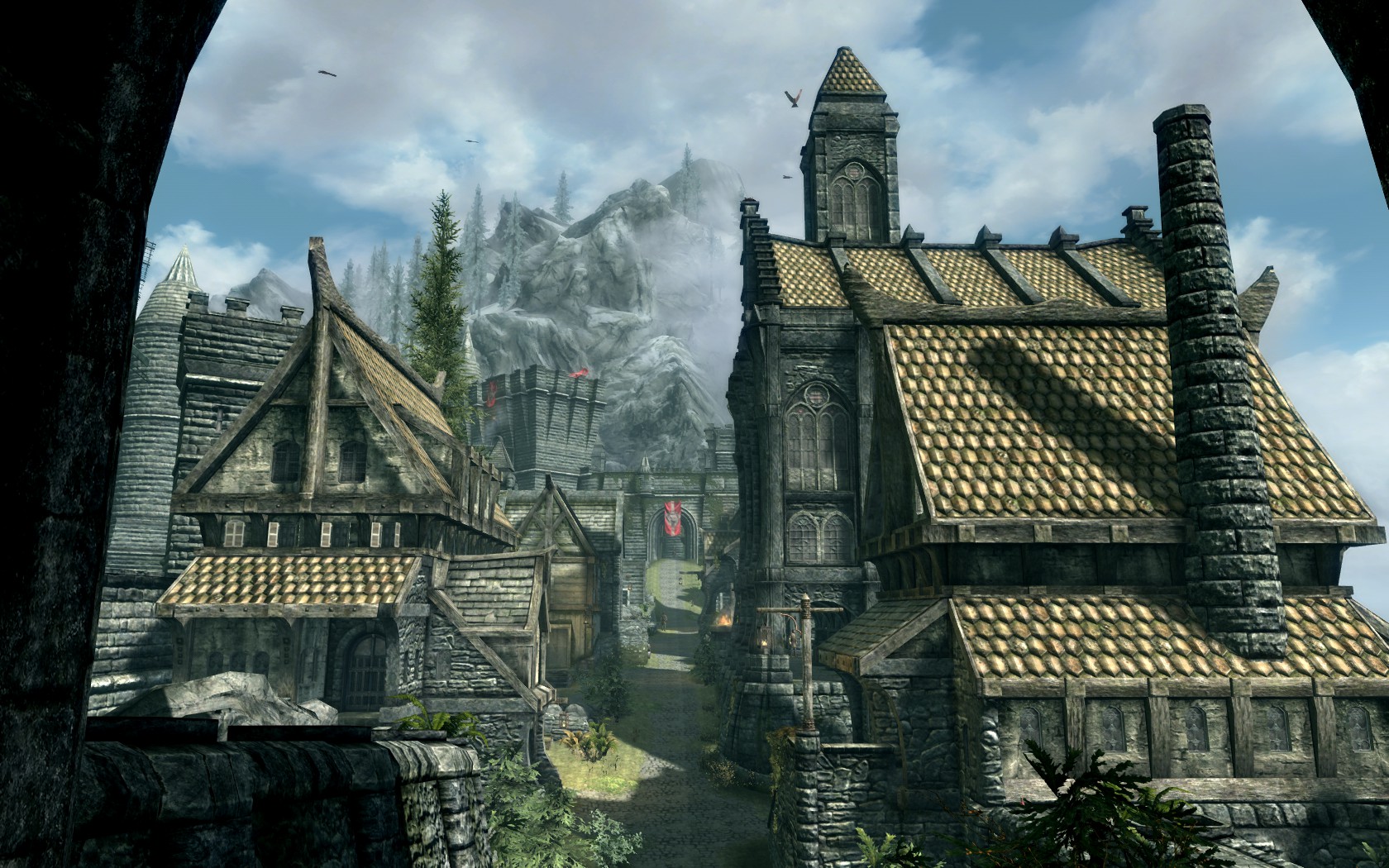
An in game view of the city of Solitude from the game Elder Scrills: Skyrim

As a result would it make sense that much of the amenities that the player needed, weapons, potions, books and other gear would be available to them in the cities. Likewise does the specialized stores help create a sense of urban life in both Morrowind and Oblivion that I believe is deliberately absent from Skyrim.

It makes sense for the seat of the mage guild to have a dedicated staff shop for example. Likewise would it make sense for Vvardenfell capital with its many educational and administrative centres to have a well stocked bookstore available. These shape the narrative of the world itself.

Skyrim is a much more rugged place, but also a different game. Many quest givers meet the player on the road, or in small villages, and when they are located in the cities do they more often than not direct the player to a cave in the wilderness. The courier is another mechanic that delivers quests to the players with the constant letters and requests. Specialized stores that only accepts certain kinds of loot would slow down the game loop of:

Visit town, get quest.
Visit wildernets, finish quest and get loot.
Visit town, sell loot, repeat.

A book from Skyrim in the reading view of the game.

All of this gives the gameplay a much more mobile feeling to its gameplay. I would argue that the lack of specialist stores have also had an effect on this. You are less likely to spend time in a town when every single town offers the same, smithy, general store and alchemist as the next.

All these design choices make Skyrim feel differently from their predecessors. You explore and interact with it in different time scales and relate to space in different ways. The way you interact with the hour to hour gameplay is subtly different in many small ways. For example how the player interacts and considers the loot from dungeons and quests.

As a result is it only natural that you would need to interact with the lore book in different ways. While I do miss The First Edition from Oblivion very much, I must admit that a bookstore in Skyrim would not fit into the differently phased and organized gameplay that the game works around.

Essay: Mental health in roleplaying games, a case study

Vampire the Masquerade and Elder scrolls, playing the mad

The depiction of mental health in fiction has had a long and dark history. Often has mental health been used as a mark of otherness, evil or as comic relief. Maniac killers, sadistic monsters or babbling clowns are often seen in popular media for the last hundred years. Today I will discuss another form of madness in fiction, one that has a long history in many cultures around the world, madness as inspiration.

Setting the stage

The image of the mad or deranged seer is not a new archetype by any sense of the word. Many examples can be found within Greek and Roman mythology, Cassandra the seer being one of the more famous examples of this. A woman with absolute clairvoyance, but cursed to be seen as mad or as a liar by all that hears her. These examples are indeed the basis for my first example, the Malkavian clan of vampires in Vampire the Masquerade. Being that the setting is deeply rooted in Abrahamic traditions, it is not surprising that Roman and Greek tales and fables would be integral to the setting, considering their importance the development of christianity.

The Malkavians are depicted to be blessed, or cursed with a form of sight, to be able to see into the future, past, as well as the realities behind their own. They are furthermore cursed, or gifted by one or several forms of mental illness or neurodivergence. The willing or unwilling followers of Sheagorath is likewise both cursed and blessed. As most if not all of them are artisticly or intelectually talanted in some form or another. While this is not always the case, there is more often then not a tie between artistic and intelectual prowers, and madness. It seems that seeking to deeply or to greedily in to the secrets of the world of Elder scrolls is a sure way to have your mind warped in some way.

The family of the mad and the free

Each bloodline of the vampires, think of them has heradatary lines from one generation to another, has a founder or original creator. In the case of the Malkavian, this original creator was known as Malkov. A seer and wiseman that said to have drunk to deeply from the veins of his master, and gleemed secrets no mortal should witness.

With this wisdom came visions, visions of the future, and the past. This made him feared, and loathed by his simplings and fellow vampires. Their ire grew so large, that one day he was dismembered, and like the god Osiris, burried in seperete points of the earth. But, unlike Osiris, he was never put toghter, he was never saved, but insted left to suffer and rage in his many prisions, for a man of such great power and evil, is not so easily destroyed. Instead of making his body whole, instead his influense spread just as far as his mortal form now had. By infiltrating and connecting all the minds of his children, he was able to be everywhere, and nowhere at once. This connection to Malkov, and between his children is known as the madness network.

The Malkavian vampires of the modern setting of Vampire the masqauarade is directly or indirectly tied in to the madness network, and can use it, concsly or unconcisly to pull forth emoptions, memories and knowlage of other members of the Clan Malkavian. This trade is far from safe tough, and it easy to catch more then you asked for when diving in to the subconcious of hundreds of undead individuals. The madness network is not called for no reason, and each individual inflicted with Malkavian vampyrism is in one way or another afflicted with some sort of mental divergence, or have their old once enhancesd or even replaced. Madness is in the case of the Malkavians directly tied fo the concept of forbidden or esoteric knowlage, and the Malkavians are indeed able to see beyond the mundane dimentions of even the supernatural realms of vampires and ghosts, in to the beyond. So strong is this power that they can even change the very fabric of the world around them, foming it more to fit their own view of how things truly are.

This connection was not always present with the Malkavians, and there was a time that they tried, in an attempt to blend better in with their vampire brethren of the Camarilla they gave up, or at least stemmed some of their more outlandish powers, and they hoped, their neourises. The Camarilla is an organization that thrives on normalcy, tradition and hiding in plain sight, all things that the Malkavians had a dificulty to follow. Unlike their chaotic brothers in the Sabbat, that fully embraced their curse, did the Camarilla Malkavians for a time manage to stem their affliciton, at least outwordily. The act of “blending in” or “acting normal” is one that I am sure that many of my fellow neurodivergent readers recognise. And it was just an act for the Malkavians, an act mostly for themselves, and despite the fact that they had sucesfully cut themselves of from their more strange and disturbing powers, were the same, strangeness or otherness still there, just muted or repressed. The real life allegories here are not hard to spot, and the extremes of either repression or fully embracing once otherness is not uncommon in the real life. I to have been forced to learn certain social codes or behaviours to fit in, or hide my angsiety or obsessive tought patterns to others. and I known many others that have been forced to do the same.

This mask did not hold for long, and the madness of Malkov is back in full force in the modern Malkavian, if not even stranger. Their Sabbat brethren, due to their brutal and cruel ways have intertwined even deeeper in to the Malkavian madness network, to the point where they more resemple collection of hiveminds then individuals.

The real life allegories here are not hard to spot, and the extremes of either repression or fully embracing once otherness is not uncommon in the real life. I to have been forced to learn certain social codes or behaviours to fit in, or hide my angsiety or obsessive tought patterns to others. and I known many others that have been forced to do the same. Likewise is the Sabbat Malkavians an example of how destructive and manipulative social structures can make such mental ilnesses and divergences even worse, and in some cases lead to co-dependenices.

One of the more striking features of playing a Malkavinan is that you can not choose, not to be “mad” in some form or another. Every player can choose to have have negative traits, one of them being what the game calls Derangements, but a Malkavian can not choose, they Have to take at least one of these derangement. The Malkavian is in other words forced in to the roll of a form of other via the mental divergence of their blood. This divergence also comes with higntened senses, intuison or artisitc abilities they did not have as a mortal. This consept does make the Malkavians very dificult to play, and even more dificult to play well, as it is easy to fall in to clyshes or turn your character in to a comedic parody. Thankfully the player handbook does a good job of introducing the players that may not have had a personal experience of mental divergence, and sheperds them trough the process of seeing the world trough another view. For as the proverb goes, “the mirror is cracked, but surprisingly clear”.

To become madness, and to witness the mad

Elder scrolls take a different route when it comes to its relationship to madness, as it is often represented by a god, in the form of Sheogorath, the god of madness but also the patron of poets, artists and intellectuals to some extent. Sheogorath himself is shown to be arbitrary, petty and childish, but also frighteningly intelligent and quick witted. He often plays an antagonistic role, and seems to take great pleasure in humbling the proud and arrogant, a trait he also shares with the Malkavians.

In this chapter I will focus on the expansion adventure to Elder Scrolls Oblivion called The Shivering Isles, where the player not only aims to save the realm of the mad god, but eventually to become the mad god themselves. Through this adventure the player is confronted with many facets of what the game calls madness, primarily divided into Mania, the land of excess, euphoria and mania, and dementia, representing depression, paranoia and dysphoria. The tale is filled with subtle and not so subtle references to mental health, medication as well as creativity and obsessive creation.

The leader of Dementia is a cruel woman driven by her paranoia that makes her jump at every shadow, and see evil and ruin everywhere. The leader of Mania is on the other hand a man addicted to powerful drugs that helps with his manic depressive moods. While many of the examples of madness are written off as a joke, are there some genuinely interesting or tragic characters in the Isles. One example is a man in Dementia that wishes you to kill him, as committing suicide would lead him to have to endure great torments from the land itself, as Sheagoorath himself has instructed. If you agree to help this man, you will gain access to his house, where you find his journal as well as a Ring of happiness. Here the man describes how he has dissociative episodes, and suffers from grave depression. He later describes how a mage nade him the ring of happiness, and while it did make him feel less empty and hollow, it also made him feel less of himself, numb and strange, as a result he stopped wearing it. This is a clear allegory to antidepressants, and how it is not uncommon for individuals to feel that something of themselves is lost in the use of them.

What makes this take on madness so different then the Malkavian example, is the fact that the player, from the very start is told that, You do not belong. Your character is not seen as one of the true citizens of the isles, and is as a result coded as, for the lack of a better word, sane. Note that you are, as a player, still put in the role of an outsider, but for very different reasons. Instead of being pulled into the role of the mad or manic is the player instead presented as the one sane individual in a land of the mad. Here it is worth noting that the act of any open world rpg character, can in no way be described as sane or normal for that matter, but that is a discussion for another time.

What is interesting is that, despite the player being given this label of sanity, do you still turn into the god of madness at the end. Despite your status as an outsider, are you quite forcefully pressed into the role of not only leading the game’s idea of madness, but to fully embody it. While the Elder scrolls series takes a lighter and more shallow approach to mental health and mental health struggles, is it still worthy to take up as an example here. One of the reasons being the more traditional and shallow approach that the work takes.

Conclusions

The biggest differences, besides tone and depth, is the player characters’ relationship to the other in the form of the mad. Elder scrolls series, and many other media forms presents the player as a spectator or outside observer to mad or divergent, even after becoming the Mad god, you are never truly a part of it. Playing a Malkavian on the other hand, forces you into the mind of the other, you become the mad, you become the other. Few pieces of media have, in my opinion, managed to toe the line of forcing the reader into the mindspace of the other and the divergent, without needing to resort to images of illusions and hallucinations.

The madness of Elder scrolls is loud and external, and something you encounter and interact with. The madness of Malkov is often silent, internal, and something you have to face and either accept and internalize, or fight and suppress.

Essay: The immersive world of Morrowind

This text will be my first in a series of essays, more informal texts that are more opinion oriented then my normal research oriented texts. The topic of today’s text is brought to you by Daipanda, a loyal viewer of my twitch stream. If you like to have your own topic suggestion featured on the blog, please visit Twitch.tv/samrandom13 for more information.

Introduction

This text will discuss the many aspects of world-building found in the video game Elder Scrolls: Morrowind, and how they in tern leads to a number of role-playing possibilities for the players. I have recently been playing trough the game at my twitch channel, and have as a result spent a lot of time analysing its story and world building aspects. I will today discuss three aspects that I have found of special note, the faction system, the in game dialogue, as well as the in game books and other texts of Morrowind.

Factions

Elder Scrolls: Morrowind uses a series of reputation systems, one being a personal disposition system for non playable character, that ranges between zero and hundred, that gauges how friendly each character is towards the player character. A second system, and the one I am the most interested in today is the faction reputation system. This system similarly scales between zero and a hundred, and dictates the player characters options while dealing with said faction, as well as dictating the base level for NPCs personal base disposition with the players. Bring in good standing with a faction will allow the player to use certain traders, get better prices, as well as to get specific quests from them. Being in bad standing will lock the players out of many of these features, and in some cases, will turn the entire faction hostile towards the player. Al factions starts with varying degrees of like or dislike toward the player, and some will always despise the player cahracter, regardless of what they do.

The most interesting aspect of this faction disposition system is that, besides affection the relationships between the player character and the faction, do also play a role between the factions themselves. Each faction has a set disposition ration to every other faction. For example will the two major magical factions, the mages guild, and House Telvanni, have a negative disposition towards the others members, due to them competing for the same markets, namely magical services.

When a player joins a faction, these negative modifies will be calculated in to the disposition of every other faction. <in some cases, like with the great houses, it is impossible to join more then one, and joining one of them will permanently stop the players from joining the others with said player character. Due to the immense powers struggles being a major theme of the setting of Morrowind, will it be made clear to the player right a way that joining one of these great houses will swear them in to said house, and bar them from joining any other. The actions of the player will, as they progress trough their chosen house storyline put them in direct conflict with the other houses, and as a result will their personal and faction wide disposition go down with each of the NPCs pertain to said faction.

Other factions conflicts are more obscure and easy to miss, and several are deliberately obtuse, one well known example comes to mind early in he game, where he player is first introduced to the staple factions of the Elder scrolls series, the mages, thieves and fighters guilds respectively. The players are initially able to join both the thieves and fighters guild at their leisure, but are at one point tasked with retrieving a certain item, a book containing sensitive information, for both factions. both factions will have vested interest in this book, and the players will be forced to chose a side, with some outcomes leading to the players being unable to join one of the factions in the future.

By forcing the players to take sides in these and many other conflicts does the game enforces the idea that the character the players is in fact, part of is a part of a greater narrative and world, and by forcing the player to make these decision is the player incentivised to crystallize an identity with said world. The player is not a omnipresent being that exits outside the narrative, or indeed the ultimate hero for al inhabitants of the world. They are a part of a wilder narrative, if a very crucial part of it.

Dialogue

As is the case with many role-playing games, is the interactions with player cahracter one of the bigger parts of Elder scrolls Morrowind. This is primarily doe by approaching an npc and engaging in a dialogue, here the players will be presented with a series of topics that they can ask this specific npc about. These topics vary greatly from npc to npc. The players are normally allowed to ask about as many of these topics as they like, and as many times as they like.

In some rare cases are the players forced in to a decision, here the dialogue box is frozen, and the player is presented with to or more red dialogue options, that they must pick one off, before they can continue. With this mechanic will the player be forced to conciser the context in where they ask certain questions, and take up specific topics.

One last note on the dialogue options of Morrowind, is that many of the characters will give fully, or partially incorrect information to the players, rather due to ignorance, or wilful malice. In no area is this as obvious as with the case of directions, that is often obtuse by the original quest givers, forcing the player to wander around the countryside, or look for alternate directions form other npc`s in the area.

Books

The last facet I want to touch on is the large number of books, scrolls and booklets that the player can find and read trough the game. These range from travel guides, and instructional manuals on proper trade conduct, to theological discussions and series spanning high fantasy novel series.

These books gives an incredible depth and nuance to the setting as as a whole, by giving examples of fiction and no fiction alike. Books like “The true nature of the Orks” and “The wild Elves” presents thoughts and biases of the various nations of the world, and tales and poetry describing the war of the red mountain gives grand examples on how the various cultures and nations of the Elder Scrolls series perceives the same historical event.

One of the more interesting facets of the books and scrolls in the Elder Scrolls series has always been the numerous contradictions and arguments that can be found within many of the non fictional texts. These contradictions do not come form sloppiness or oversight in the writing, rather the opposite in fact. The world of Elder scrolls is full of various cultures, and al with their own varying groups of philosophers, researchers, magicians and academics. The differences and arguments that the player will most often find is of a theological nature, more specifically on the nature of the divinity, or lack there off, of the living gods of the Tribunal, a topic that I promise I will return to in a more academic text later on!

The way that a lot of the information and lore of the elder scrolls series, and especially Morrowind, is presented in the way of books and scrolls. As with much of real life information and texts, is there always a sender with a message and a goal. By presenting the world via these complex and sometimes contradictory explanations on everything form the nature of the gods to how to best cast a fireball, will the players be incentivised to think critically about every text and piece of information they come across, and slowly puzzle together the truth, just like a scholar living in Morrowind would.

Final thoughts

Elder Scrolls: Morrowind uses a number of strategies to draw the player in to its world, chief amongst them obfuscation, and forcing the players to take sides. By obfuscating some of the information that is presented by the player, and presenting conflicting narratives, does the game force the player to conciser each new piece of information from various sides and angles. Furthermore, by presenting some of the information from the npcs in a similar contradictory way, are the players forced to think of them less as objective directions given by a story, and more like subjective interpretation of various real life people.

By forcing the player to choose between various factions are the player encouraged to form a more uniform image of their character, one that is slowly formed from a blank slate in to an individual by the choses they make along the way. The player character is formed as much by the factions they join, and friends they make, as by the once they choose, or are forced not to join. The lack of ability by the player to join every faction, to see every side of each debate, at least in one playtrough, further drives home the subjective and splintered nature of the narrative in Elder Scrolls: Morrowind.

I would argue that these two facets of Morrowinds storytelling greatly helps the immersion and ability for the player to fully play the role of their chosen character, and is a contributing factor to why the game is still played, and talked about to this day. I will return at a later stage with a more in depth analysis of many of the subjects touched upon in this text, especially the concept of ambiguity in the presentation of the texts of the Tribunal and other faiths.