Highways and industrial complexes: the melancholy world of eurotruck simulator 2

Introduction

Simulator games are uniquely limited in scope and place where its narrative takes place. It is the only form of art where the players have the need to traverse the text’s narrative physically, where so much focus is put on the very action that the game aims to recreate. In the focus on the very executions of actions and interactions in a game world, do the text inevitably put focus on where these interactions end. Where the simulation stops, where the game, due to budget or usability or technological reasons, ends.

This essay aims to explore two instances where the simulation makes itself known, where gameplay necessity and immersiveness meet. Where technical limitations and real world expectations rub off on each other in interesting ways.

Highway meditations

Eurotruck simulator 2 is a game, where you drive a truck in primarily Europe. You are tasked with delivering cargo from one major city in Europe to another. These destinations are either large population centres, or well known destinations. The game limits tedium and creates a more enjoyable experience by drastically shortening the distance between these points. The game hides this shortening partly with the help of a severely sped up clock. One hour in the game is 3 minutes in real time. Twentyfour hours being roughly half an hour in real time.

The game further hides this space and time warping by having you drive on highways and other central connective roads. Not only does this make sense from a narrative perspective, you are after all trying to get from spot a to spot b as fast as possible. This decision to focus on larger arterial roads also lets the devs get away with fudging a lot of the granular details of long distance travel. Highways are often rather sterile and homogeneous, and the sensation of being on a highway is kept mostly intact even in their scaled down format.

This illusion is helped by the player now and then needing to take a sideroute or a smaller country road between highways or going in and out of towns. These diversions into the countryside are tightly designed and help to make the world you drive in feel more real, more alive. 

Eurotruck Simulator uses glowing yellow X:es to denote when a road or lane is not in the game. These barriers are easy to hide behind off ramps and junctions in highways, but become all the more apparent on small roads and small towns, where streets and roads has a tendency to snake off into small areas, or lead off to service paths.Towns in particular made the screening of of parts of the game world highly apparent, even more so when the player can see cars drive from and through these barriers that are not available to them.

The endless warehouse district

Considering the choice of scaling, as well as the apparent and obtrusive cutting off of areas from the players, is it not difficult to understand why the devs have chosen to primarily set the game in industrial areas outside of cities. This again makes sense from a narrative perspective, as the player takes the role of a long distance trucker, and is as a result rarely involved in the “last mile” part of the delivery. From the vantage point of thoroughfares and warehouse districts is it easy to present the player with identifiable skylines and landmarks.

Intended or not, does this approach to world design lead to a separation between the world of the game and the player, a sensation of always being on the way towards something, but never truly arriving. The devs have alleviated this sensation in a small but rather effective way. Many of the warehouses where you pick up and drop off your cargo have a security guard or worker on break somewhere on the lot. They passively observe as the player comes and goes, but effectively anchor the game and stop it from becoming what could easily be a rather alienating and surreal experience.

The game similarly have work crews situated near new constructions, as well as police giving tickets of npc drives, as well as rescue personnel standing around car crashes and other accidents. It all comes together to create an experience that succeeds in feeling authentic, not because it tries to hide its limitations, but because the game shows them so clearly.

Do you like my writing and want to help me write more? Please take a look at my patreon, it has several essays, and would help me create a lot more: https://www.patreon.com/cw/SamRandom13

Gwylim notes on Skyrim: The joys and frustrations of in game book hunting

I am sure that many of my readers have had the joy of finding a specific book in an obscure bookshop or lurking in a digital archive somewhere. The frustration when you are missing but one text in your collection, the unwillingness to start a project before you know that you are all the texts you need to start. I admit that this is not a problem that many people have, but I am sure that at least some of my readers can empathise with my plight!

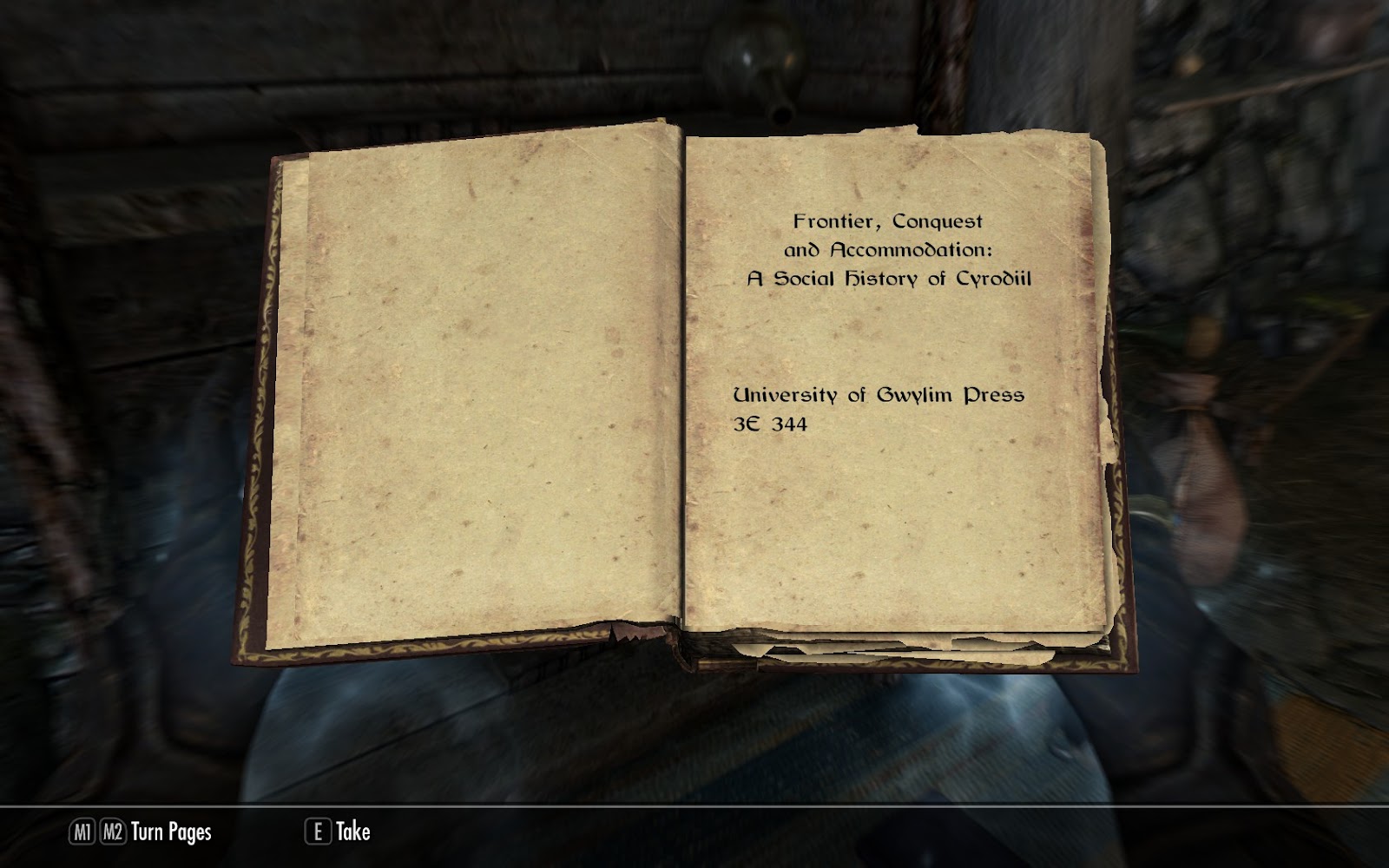
A book from Skyrim in the reading view of the game.

I have had a similar experience in skyrim recently. I have discussed the wealth of reading that can be found in the elder scrolls series many times. There are novels, poems, essays and unhinged ramblings to be found in all of the main games. In many of these games there also exist book sellers in where to easily and effectively acquire this reading materials, as well as libraries aplenty.

Skyrim is different in this regard, as it is the general store sellers that sells but a paltry few books. The only libraries available to the players are also located at either the seats of power, or at Skyrims two seats of learning, the bards college and the College of Winterhold, the primary location to learn the arcane arts.

The second of the two colleges have an especially stringent and suspicious librarian. Due to his dour nature, or due to a lack in coding, can you in fact Not borrow books from this library, though he does sell some of the texts he stores there. Due to a quirk in the book shelves in the Winterhold library can you only read the majority of the books if you steal them from the shelves, as they are not located in the regulair open style bookcases.

There are on the other hand other ways to acquire reading material in Skyrim. First and foremost does the otherwise uninterested populus of Skyrim own a fair few books themselves, as at least two or three can be found in each household. Likewise does it seem that everyone from blood crazed necromancers to cut throat bandits have a bend for reading. As a result the dungeons are populated by sentient races often surprisingly full of books, journals, scrolls and other reading material.

Many of these seemingly brutal and bullheaded robbers seem to have an interest in obscure history and advanced magical theories. As it is more common to find a thesis on Mysticism next to a bandit bed, then it is to find something salacious like The Lusty Argonian Maid.

This means that the best way to expand your library is to either delve into a dungeon, or go thieving in the neighborhood. I want to make the argument Skyrim has moved away from the cities being as much of a hub as they were in Oblivion and Morrowind. The wilderness and the quests and adventures that take place in the wilderness between the cities, has taken over much of the time spent in the cities, especially Oblivion. In the earlier games most quest givers lived in the cities, as well as large part of the quests themselves taking place in, or near cities.

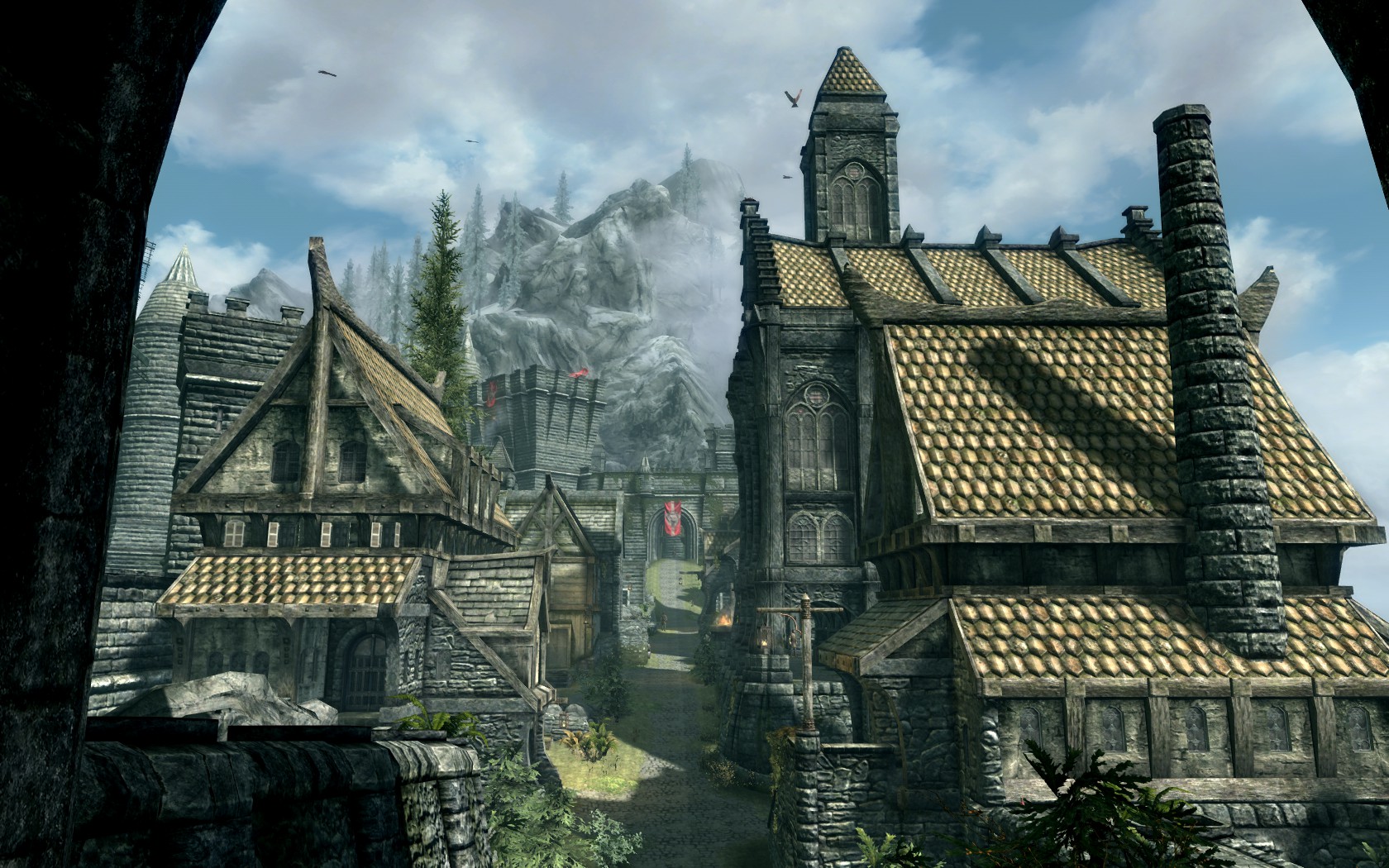
An in game view of the city of Solitude from the game Elder Scrills: Skyrim

As a result would it make sense that much of the amenities that the player needed, weapons, potions, books and other gear would be available to them in the cities. Likewise does the specialized stores help create a sense of urban life in both Morrowind and Oblivion that I believe is deliberately absent from Skyrim.

It makes sense for the seat of the mage guild to have a dedicated staff shop for example. Likewise would it make sense for Vvardenfell capital with its many educational and administrative centres to have a well stocked bookstore available. These shape the narrative of the world itself.

Skyrim is a much more rugged place, but also a different game. Many quest givers meet the player on the road, or in small villages, and when they are located in the cities do they more often than not direct the player to a cave in the wilderness. The courier is another mechanic that delivers quests to the players with the constant letters and requests. Specialized stores that only accepts certain kinds of loot would slow down the game loop of:

Visit town, get quest.
Visit wildernets, finish quest and get loot.
Visit town, sell loot, repeat.

A book from Skyrim in the reading view of the game.

All of this gives the gameplay a much more mobile feeling to its gameplay. I would argue that the lack of specialist stores have also had an effect on this. You are less likely to spend time in a town when every single town offers the same, smithy, general store and alchemist as the next.

All these design choices make Skyrim feel differently from their predecessors. You explore and interact with it in different time scales and relate to space in different ways. The way you interact with the hour to hour gameplay is subtly different in many small ways. For example how the player interacts and considers the loot from dungeons and quests.

As a result is it only natural that you would need to interact with the lore book in different ways. While I do miss The First Edition from Oblivion very much, I must admit that a bookstore in Skyrim would not fit into the differently phased and organized gameplay that the game works around.