
The strange, fully functioning phasing of Ratchet and Clank 1

Ratchet and Clank 1 shares a lot of the same quirks as the first Crash Bandicoot game, created by the teams contemporaries, that of being the first. There is a sense of being on uncertain grounds and throwing everything at the wall. The player is thrown between rail grinding, shooting and puzzles within the first hour. A lot of the early game quests feels like after thoughts, you often travel to a planet solely to get a tool to solve a puzzle on another map. On several places the way to advance is to ignore the obvious path and go exploring. What makes the game so fascinating, is that it all works.

The game throws you from planet to planet, from play-style to play-style at a truly breakneck phase, yet never feel rushed. No one mechanic never truly comes to overstay its welcome. Like with the companies other start title Spyro, are these segments not nearly as jarring as one would expect.

The narrative of the game is primarily moved forward by the acquisition of data-bots. Small floating robots with screens for mouths, that sometimes, but not always runs away from you. These robots gives the player a cut scene tangentially related to the next plot beat, as well as the coordinates needed for the player to reach the next planet. More then once is the acquisition of these robots not tied at all to the main objective of the game.

A striking example of this narrative stricture is at the x research star base, where Ratchet suggest they should got to find a scientists to interrogate, in order to find the big bad, the owner of said space ship.

The player does indeed find a scientists on the station, and talk to him, but instead of getting any form of information out of him, the player is forced to buy a pair of grind boots to progress. These frequent hurdles exits throughout the game, and often requires the player to find more bolts, the games currency, or save up the bolts they find naturally. The problem being that these same bolts are also used to buy weapons, and ammunition, some being prohibitively expense. Teaching the player to early on be fiscally conservative with their bolts.

The data bot needed to progress is placed in a seeming side path, a quest to find rare tech. Thankfully the map design is made in such a way that the players vision first lands on the shuttle used to travel to the seemingly optional side quest. The game early on presents the player with these side paths, but only some are in fact optional.

The game is understood drastically differently if its either seen as a single game, or as the first game in a series. The first game in isolation has a strange sensation of trial and error, and unfinished ideas, but also of novelty and strangeness. When put in the context of the sequels does the vision become more clear, and the strange choices become more apparent and put in a larger context, just as with Crash Bandicoot and Spyro.

This era is full of games that never got the chance to leave this stage of novelty and strange experimentation. Glover and Rosco McQueen likewise falls in this genre of experimental third person platforms, all tying their creation to lesser or greater extent to the innovation that was the dual-shock controller. A revolution halfway trough the lifespan of the PlayStation one, it drastically changed how the players could navigate and look around a virtual space. No longer limited to workarounds like Z targeting that plagued so many Nintendo 64 games.

Many of these experimental games never got the squeal they needed to fulfill its promise, Ratchet and Clank was one of the exceptions, it got not only a sequel, but an entire series. It is trough this lens that I will return to Ratchet and Clank next.

Dredge: The Iron Rig and expansion in World Building

Introduction

Drege is a fishing simulation and exploration game, where you are set to take over when the old fisherman disappeared

mysteriously. The game takes clear inspiration from Lovecraftian horror and tackles themes of loneliness, regret and isolation. There is something very wrong with the waters around your little peninsula, the fish turn strange, and murderous visions haunt you in the night.

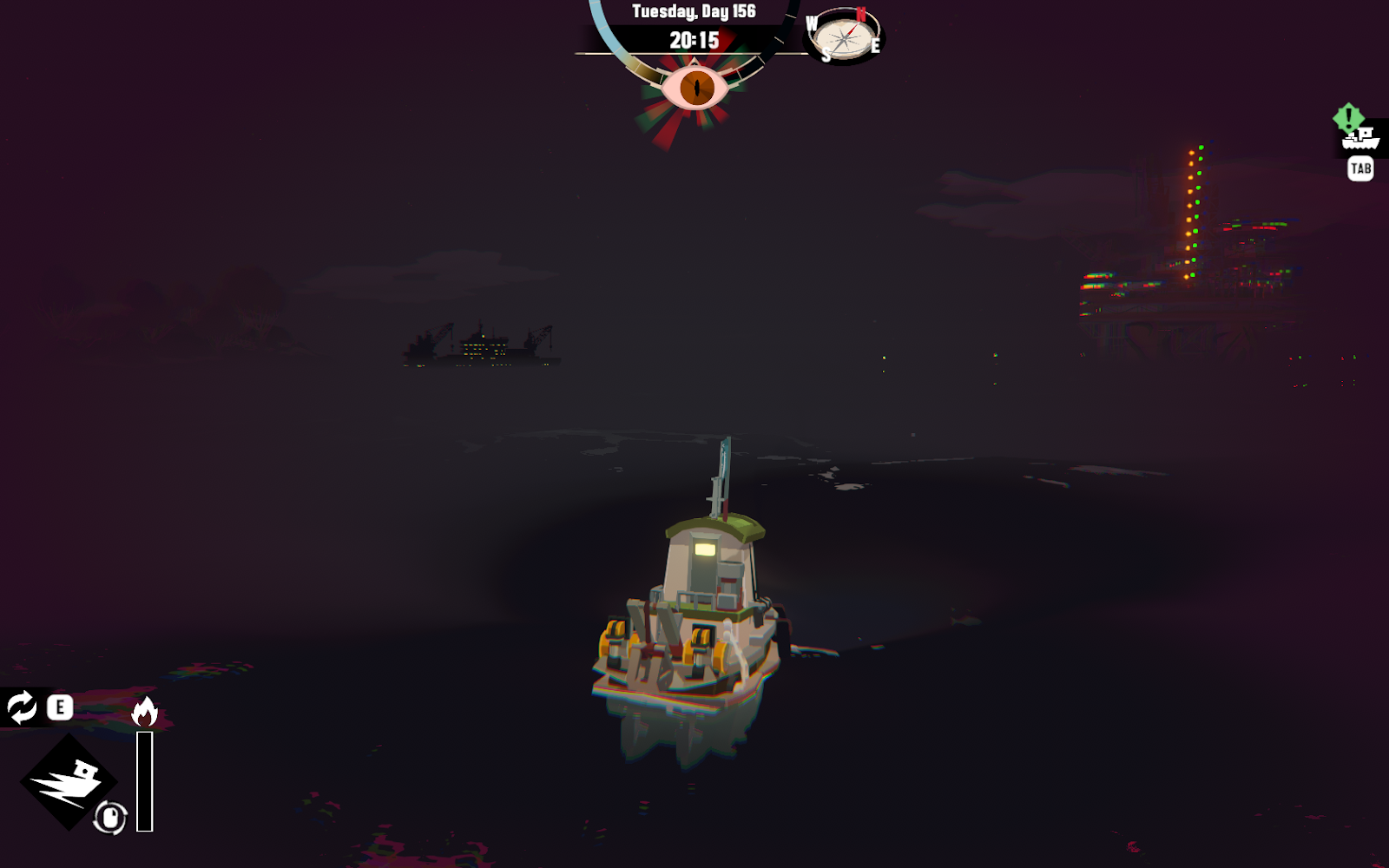
Dredge is a game about personal tragedies with the background of cosmic horrors beyond anyone’s understanding. The tragedies that take place in this strange island paradise are distinctly personal. This all changes with the introduction of an oil rig in the dlc The Iron Rig. The rig itself dominates all around it, at night it almost outshines the lighthouses that used to be your guiding light in the darkest of nights.

The player is tasked with helping to ferry cargo to the rig, as all the companies transport ships have run ashore or otherwise been lost to the depths of the sea. A fact that the foreman is not concerned or surprised by. As you build the rig, more and more upgrades and tactical items become available to the player. The rig’s chief scientist further tasks the player to investigate and take samples from a series of new fish that seemingly appeared after the start of the rigs operations.

The oil rig as the other

The image of the oil rig brings with it notions of exploitation and destruction, of pollution and depletion of the natural resources. Fishermen like that one you are playing are part of those that would have their livelihood threatened by the arrival of an oil rig. Even if there is no oil rig would the disturbance to the seabed as well as the transport ships make your work harder. The Ironhaven Corporation is depicted as a ruthless corporation that cares little for those they hurt in the process. The title of the corporation itself hints at their brutal and cold exterior.

The writing makes it clear that there are those that are with the company, and those that are not. You as the fishermen, are clearly not one of them. Your presence is only tolerated as long as you can be of use to the corporation, and not a second longer. 

The rig invades your seas with oil spills and strange mutated fish, but it also invades your nightmares. The ghostly visions of fishing boats and safe harbors are slowly replaced by ghostly cargo ships and phantom oil rigs, tempting you to your death in the deep seas. Mentally and physically the oil rig dominates its surroundings.

They KNOW

The writing makes it clear from the very start that the company is not here to dig for oil. The chief operator casually notes that they have very little capacity to hold whatever it is they are supposed to be digging for, be that oil or minerals. The rig also has a surprisingly large staff of scientists and technicians, the chief scientist in particular seems to have no interest in the operation of oil mining, but a deep fascination with the area’s strange fish.

Your fears are justified with the arrival of the CEO of the company that seems hellbent on keep digging into the seabed, despite numerous attacks on the rig itself. He excitedly claims that “there is just one layer left”. He insists on digging despite the danger to his life and the lives of his crew. It is made clear by the text that the company, whatever they used to be before they went into oil mining, are fully aware of what they might find in your little archipelago.

While the rig is destroyed at the climactic end of the DLC, are the company still out there, the CEO being seen escaping on his helicopter at the final attack. The message is clear, you are no longer alone with the secrets of the deep sea. The outside knows to, and they will return one day.

Final thoughts

The Iron Rig effectively broadens the world of Dredge with a few well developed features and characters. Many of the activities of the rig have direct consequences for your friends in the surrounding fishing towns. The DLC opens the world by having it conveniently assert itself in your very backyard. It manages to hint at a much larger world without needing to make the game world itself much bigger at all. The DLC only has one new location, and it was previously an empty part of the map. The developers have managed to expand the world narratively without making the playable area much larger or complex. The dlc is a good lesson for other game devs, me included, you don’t need to make a new setting for your dlc to make your world feel bigger, you simply need to remind the player that there is a world outside the setting of the game.

Do you like my writing and want to help me write more? Please take a look at my patreon, it has several essays, and would help me create a lot more: https://www.patreon.com/cw/SamRandom13