
Introduction
All players of Morrowind start their adventure by leaving their prison ship, and entering through Vaardenfell costumes office. They enter the game as a prisoner, brought to Vadeenfell under unclear circumstances, with only a cryptic dream of Azura to guide you. The Sedya Neen port is a customs office, giving the game a perfect excuse to ask the players questions about their race, name and profession. The office effectively presents the player with the workings of the Empire and your role within it.
This is a goal that Skyrim also achieved by having you give your information to the executioner. Morrowind shows the bureaucratic rigour of the Empire, while Skyrim shows the cold and careless part of the same bureaucracy. Both approaches are useful, and have their positives as well as negatives. While Morrowind’s approach is more diegetic, is Skyrim’s approach doubtlessly more action oriented..
The ship and the dock
The game slowly introduces you to the controls of the game, moving, talking and interacting, as you travel through the
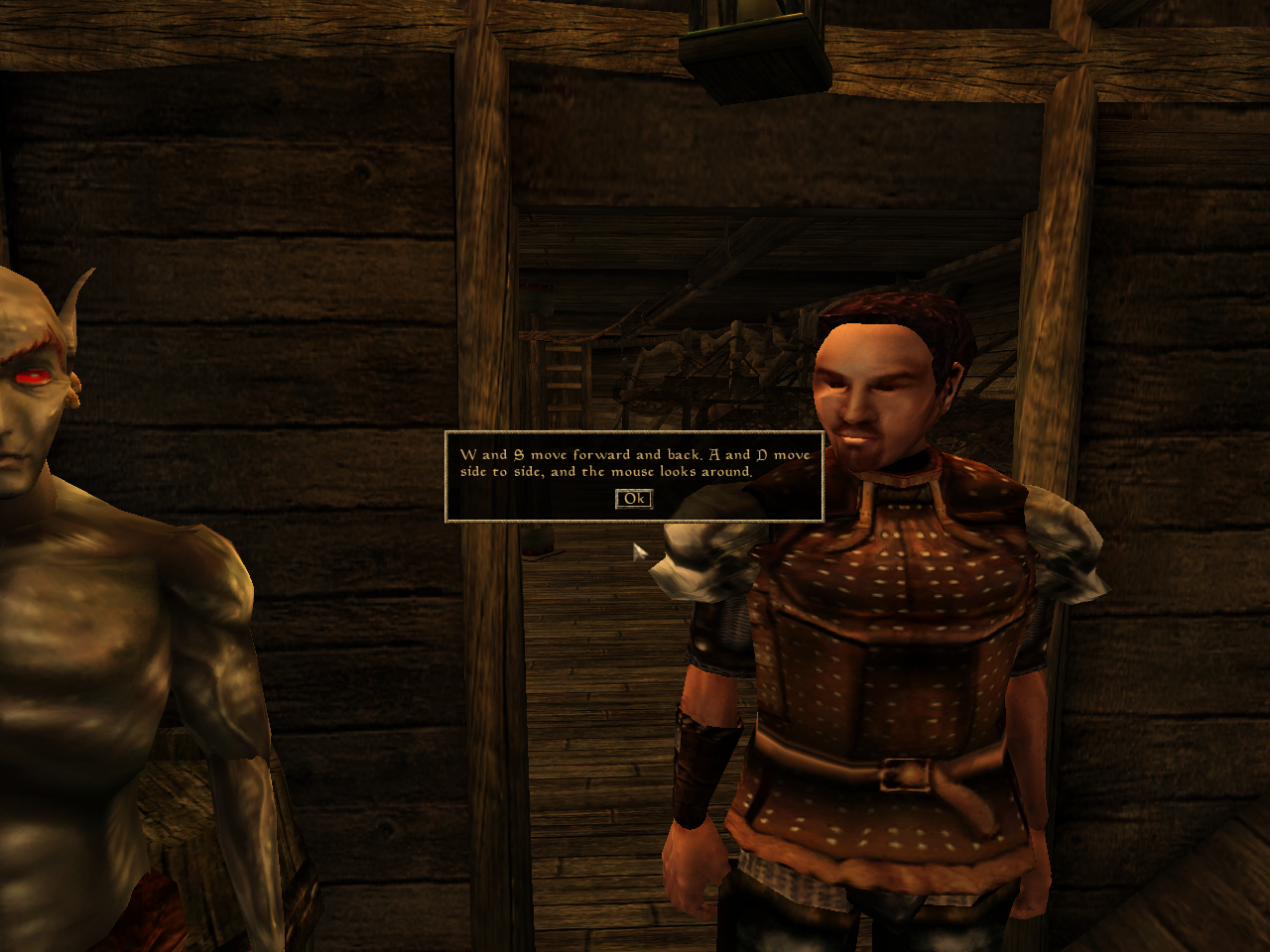
ship and interact with your jailor. As you leave the ship you are asked to tell the first clerk where you are from. This being the game’s way of making the player choose their race diegetically.
The landing area is small, verdant with life, and completely closed off from the rest of the gameworld. The player is situated directly in front of the entrance to the survey office as they leave the ship. This gives the player a clear goal, while also giving them small glimpses of the world beyond the introduction area.
Getting registered
Entering the customs office you are met by an elder Imperial man, asking you to fill in your paperworks. He dryly explains that there are a number of ways that this can be achieved, and that the choice is up to the player. Here the player can make their own class, pick one from the list of premade classes, or answer a few questions to let the game pick a class for you.
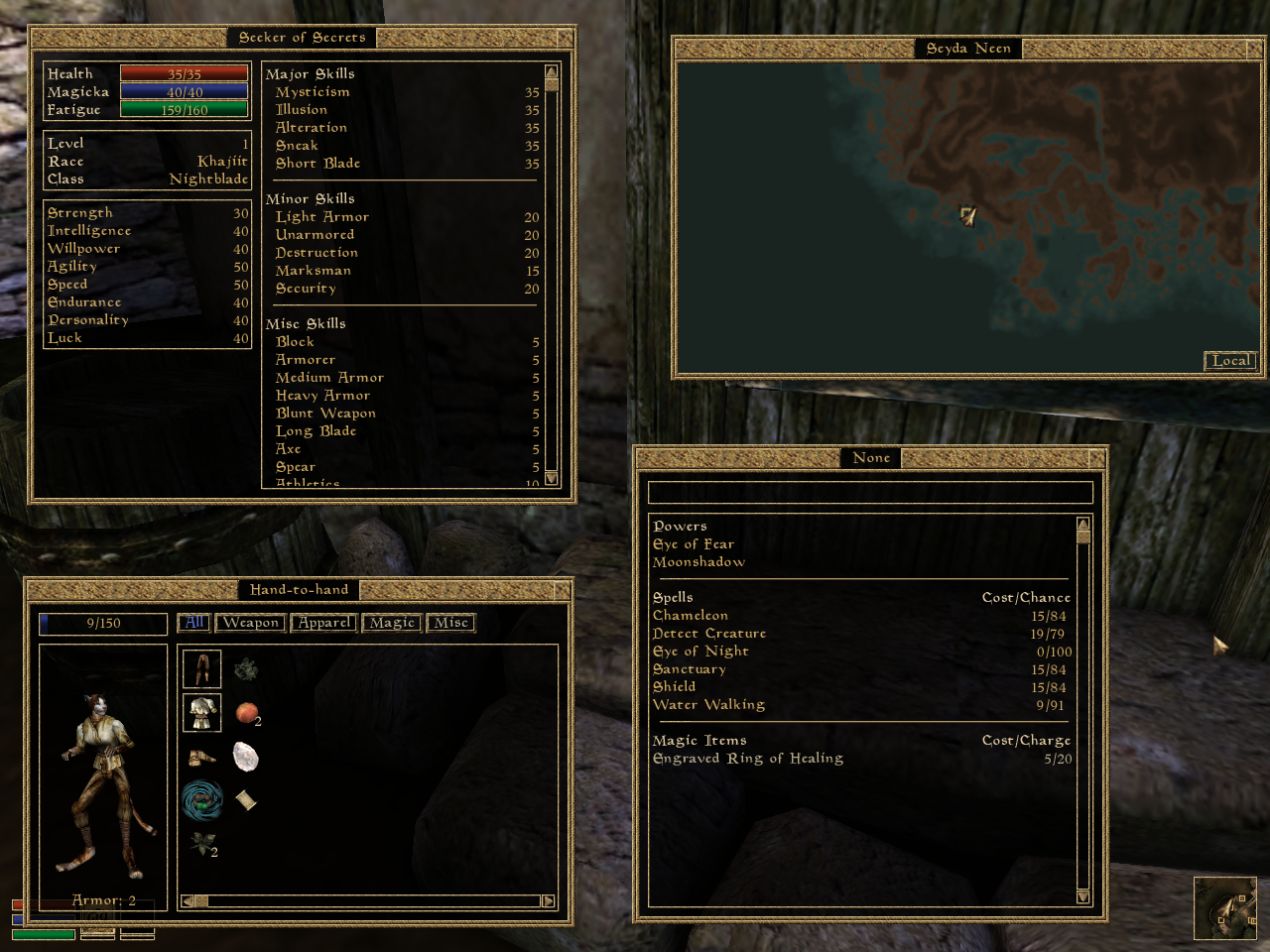
While these questions are rather strange and surreal in the context of the registration for entry, the game has done enough groundwork for it not to be too immersion breaking. As you fill in your race, class and birth sign, is your character menu likewise filled in with the relevant information, making the UI feel like a natural extension of your characters paperwork. You get one last chanse to correct anything you are not happy with before leaving the character creation process. At this you are ordered to grab your papers of registration and show them to the guard at the end of the room.
Exploring the halls
Leaving the costumes office you are briefly left to your own devices in a series of small rooms. Here you can find a few interesting objects that I will explain later in more detail, as well as plenty of trinkets books. Right ahead of the player is a small set of stairs, leading to a number of barrels and boxes, containing clutter items as well as alchemical ingredients,as weöö as gemeral nicknacks.
Directly to the right is a room that is far more inviting in its decor and overall layout. Here the player will find a book case, a locked chest, a dagger and a lockpick. Picking up the dagger or the lockpick gives the player a small tutorial window relating to combat and lock picking, the game suggests that the player tries to pick the lock of the small coin chest in the same room. The drinks and the bread can be picked up, leading to the same short tutorial on alchemy described earlier. Leaving the dining room leads the player to a small outdoors area.
The ring, the knife and the lockpick

It is in this walled off outdoors area that the player finds their last tutorial item in a barrel, a magic ring. The barrel is located in such a way that it is almost impossible for the player not to have it directly in their line of sight as they enter the area. The knife and the lockpick is similarly located in the player’s direct line of sight, with the dagger being called out in a corresponding note.
Picking up any of these items gives the player a small explanation on how they work, and how they are equipped, slowly introducing the players to the game mechanics as and when they become relevant. While not the most interactive tutorial mechanics available, are they effective at the goals that they aim to achieve. At the end of the tutorial area, most players will be informed about the game systems of magic fighting and lick picking. Leaving the open area leads you to the last room of the tutorial area.
Release, getting your orders
The player enters the last small office, populated by a single guard that instructs the player to take a packet of contact in Balmora. The player is given a package as well as some instructions on how to carry out this task. This being the only guidance the player gets besides their cryptic dream from the introduction cutscene for quite some time. This approach teaches the player that Morrowind’s secrets are many, and that they need to find them out for themselves.
The player can ask the guard a series of questions regarding a number of topics, as well as trying their hands on the persuasion system. The player learns through the dialogue tree that asking certain things can lead to new topics being discovered. When the player is ready to leave there is a door at the opposite end of the room.
Epilogue, choices and consequences
Leaving the costumes office, the player is faced with the last mechanic that the game will teach them for a while. A Bosmer man wanders outside of the costumes office, apparently he has had his prized magic ring confiscated recently. The same ring the player just picked up. Here the player learns about unavoidable text options in the form of red text snippets.

Here the player is forced to make a choice, to give the ring up, or to keep it. Keeping the ring allows the player to cast a spell they would otherwise not be able to for some time, while handing the ring over raises the disposition of the Bosmer man. The man also hints that mentioning this to the local shop keeper will give you better prices. If the player were to help the man, and mention it to the shopkeep, they will indeed be rewarded with better prices at the store.
From here the player is free to explore at their leisure, with a stern but gentle suggestion that they should travel to Balmora first, to get that entire prisoner business dealt with. So begins all games of Morrowind, heading out from the confined tutorial area of the Seada Neen customs office.
Do you like my writing and want to help me write more? Please take a look at my patreon, it has several essays, and would help me create a lot more: https://www.patreon.com/cw/SamRandom13

 An Unused Frequency