Warhammer 40k an in depth analysis: Part 1, IoM, part 6, The Emperors chosen.

Introduction

Last time we briefly discussed how the most numerous and expendable rank and file troopers of the Imperium of Man are presented and represented. We also previously discussed possible real life inspirations for these armies. This chapter we will take a look at the opposite, the elite and superhuman Space marine, or Adeptus Astartes. As with earlier chapters will this one serve as a simple introduction, a starting point on which we can later discuss more deep and complex subjects. This text will be focusing on describing the Space Marine, as well as their place in a long line of fictional, genetically engineered superhumans.

To begin with, we will start with some fast simple comparisons. A marine is a type of soldier, being trained to fight primarily at sea, and is in Science Fiction often a shorthand for specialist soldier. Adeptus, as we know from earlier chapters, roughly translates to servant of, or belonging to something. I have on the other hand not been able to find a direct translation to the word Astartes, though the simplest explanation would be that it is a simple pun on the term Star, so in other words, servant of the stars or belonging to the stars.

The Marine

The Space Marine is a hulking monstrosity of a human, breed from early age to fight. Later augmented with a series of artificial organs, they are turned from a normal human into a several feet tall monster of pure muscle and devotion. Clad in their signature power armour, and wielding their famed Bolter, they strike instantly recognizable image, often being used as the primary mascot of the franchise as a whole.
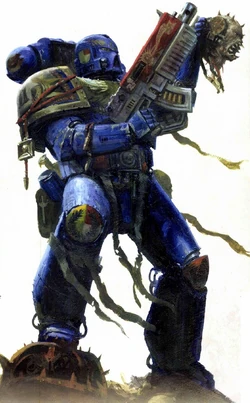
Ultramarines Artificer Armour

Source: http://warhammer40k.wikia.com/wiki/Ultramarines

A Space Marine is raised from the age of fourteen to become a loyal servant and instrument of the will of the Immortal Emperor of mankind. In order to reach this goal the individual is systematically broken down and built up from the ground up, both mentally and physically. This is done by inhumane mental and physical training, as well as with the implementation of powerful artificial organs. This procedure is extremely dehumanizing and dangerous, many die or get irreversibly disfigured during the process.

Standing several heads over the tallest mortal human, with the body proportions more akin to an early 90s superhero comic, then any form of real life anatomy, the Adeptus Astartes makes for an imposing figure. This grander than life size and stature is further enhanced by their armour, a fully sealed suit of armour powered by several motors and other assist systems. The Space Marine seem almost mythical, inhuman next to their unaugmented kin.

The Astartes, or Space Marine is raised by, and indoctrinated into a brotherhood of warriors, a cult of fully devoted soldiers, with a singular purpose, to serve the Emperor of mankind. The Astartes live a Spartan life, away from temptation and vice, their days being filled with prayer, drills and combat training. Everything to keep their mind and bodies occupied, and to stop them from turning against their creators. This fear is not without precedent, as their genetic ancestors rebelled against the Emperor himself at the order of Primarch Horus, a story we will cover at length in later chapters.

The Astartes has in essence, shredded himself, and become something non-human, in order to protect the very thing he has sworn off forever. For an Astartes there is no retirement, no leave of absence, no end to the struggle, for only in death does his service end. They know no other joys than battle, have no other goals than the safeguarding of all of Imperial space.

The superhuman

The myth of the superhuman is not a new one in science fiction, or in literature and storytelling in general for that matter. From the Greek myths to the modern super hero classics, can we find examples of individuals that through birth or other means become more than human.

The first allegory we will look to is that of the Jewish myth of the Golem. The Golem has become a standard stable of much of contemporary fantasy as well. The Golem being a sentient magical being, often made out of clay. This Golem is animated by holy texts and is said to follow the owners commands unquestioningly, until it is told to stop. The Marine is also a large loyal servant, created in much, with the use of holy scriptures and religious dogma.

The theme of super human soldiers is, as mentioned before, a long lasting staple of science fiction narratives. From Captain America and Bane to Solid Snake and Agent 47, only to mention a few, are contemporary fiction filled with genetically modified humans, breed to fight in humanities wars or other conflicts.

An imperfect system

As you will see in this series, the Imperium of man’s narrative is full of imperfect, broken or seemingly arbitrary laws, ideas or organisations. This imperfect state helps to further the feeling of dread, hopelessness and frustration that we have discussed earlier. Much of these emotions are created via the use of dramatic irony. Dramatic irony is a narrative tool, where the audience knows more than the actors in the story. The most well known example being, a couple sits at a restaurant, and there is a bomb under the table, the audience knows, but the couple do not. Alfred Hitchcock famously used this example to illustrate how he liked to build suspense in his stories.

Much of the drama and tension that the Astartes creates comes from a similar notion, for despite rigorous testing, and check-ups, are each Space Marine potentially flawed, unstable or disloyal. The creation of new Astartes is achieved using genetic materials of their predecessors, with the help of science beyond even the most skilled of the Imperium´s scholars. The Imperial scholars can not improve, nor reproduce the systems involved in the creation of new Astartes, only replicate it. This fact further helps create tension, and drama. To create a new Astartes, the organs and hormones needed for the process, must be extracted from an Astartes corpse. This means, if a Astartes corpse is lost, not only is he lost, but so is every possible successor that could be created using his genetic materials. These facts are well known to the readers, but not to the majority of the actors within the various narratives where the Astartis appears.

The inherent flaws of the Space Marine, and the Primarches, is the basis for one of the more popular and elaborate narratives within the Warhammer 40,00 franchise, the Horus heresy. We will tackle the setting, narratives and overall presentation of the Horus heresy in a later series.

The warrior cult

The last thing I like to discuss is how the Marine relates to the overall faith of the Imperium, more specifically The Imperial Creed, a subject which we will also discuss in a later chapter.

The Adeptus Astartes do not follow this general faith of the Imperial Creed, but rather have their own, unique cultures of devotion. The Astartis follow their own form of worship and traditions. All loyal Astartes, just like the rest of the Imperium, worship the God Emperor in one form or another. These traditions may vary from solemn prayer and contemplation, to worship through creation of art and weapons, or even severe self flagellation. These religions and cultures are a tightly guarded secret by the chapter, and are all but unknown to outsiders, something that further spreads paranoia and fear through the Imperium regarding the super human Astartis.

This dedication and secrecy further cements the Space Marines as more than just a fighting force, they are a devoted warrior cult, full of secrets and mysterious practises.

Conclusion

This chapter has been a short introduction to one of the major elements of the Warhammer narratives, the Space Marine. We will return to this topic many times in the future, but for now, this will be enough for us to be able to continue and explore the more complex parts of the Warhammer 40k narrative. Next time we will take a look at the Ecclesiarchy, the Imperiums official religious organisation, as well as the secretive polishing organ known as the Inquisition. 

Source

Games Workshop (2017). Codex Space Marines . Games Workshop.

Copyright Disclaimer

Under section 107 of the Copyright Act 1976, allowance is made for “fair use” for purposes such as criticism, comment, news reporting, teaching, scholarship, education and research. I do not claim to own an of the pictures in this post. Al copyrighted materials belongs to their respective owners.

This blog post was spell checked and edited for readability at 2021-06-14

Warhammer 40k an in depth analysis: Part 1, IoM, part 5, The Astra Militarum

Introduction

In this chapter we will be diving into the Imperiums most numerous military organisation the Astra Militarum. We will take a look at the standing forces of the IoM, and what their portrayal can tell us about how warfare is presented within the Warhammer 40k narrative. This text will be based on the seventh edition of the Warhammer narrative primarily. This chapter will be divided into two parts, each delving into the two seemingly opposing views of warfare presented in the Astra Militarum codex. These sides are a view of war as horror and one of war as heroics. (Hill. 2016)

The terror of logistics and dehumanisation

The wars of the Imperium are presented to be fought on a galactic scale, the size of their war machine too large for a single person to understand even less comprehend by any one member that is part of it. Each life is presented as a mere statistic, each death a decimal point in the eternal bureaucratic machine. Most die unnamed and unremembered. (Hill. 2016)

Each human soldier is described to be little to no match, to the other inhabitants of the universe. Individual people, nations, or even planets would easily be destroyed by humanity’s many foes. The Astra Militarum do not win their war through the strength of their soldiers, but rather the sheer volume of troops and war machines at their disposal. Populations of entire planets can easily be sacrificed with few lasting negative effects on the Imperium as a whole. The Astra Militarum is often described within fiction as “the Sledgehammer of the Emperor”. Regiments are raised and sacrificed in the millions, entire planetary populations are kept in brutal savage conditions simply to ensure a good “fighting stock” for the Imperium’s armies. (Hill. 2016)

The Manufactorum is a grand example of the massive scale, and incredibly dehumanising tactics that the Imperium of Mankind is described to employ. The bureaucratic and logistical branch of the Imperium`s armed forces, The Manufactorum is presented as an interplanetary organization of bureaucrats and scribes numbering the billions. Each carrying out jobs that they barely understand to reach goals they understand even less. Sending reports and orders back and forth, each typo leading to catastrophic errors such as a regiment being sent into combat without any ammunition, or a fleet being sent several light years of course, delaying arrival by months. (Hill. 2016)

The lone hero

Despite these themes of mindless sacrifice and dehumanisation, there is a parallel narrative. The narrative of a lone hero, or a small group of heroes saving the day at a critical moment. The codex describes a series of heroic men (for all the named major characters in the codex are male), that in one way or another through their cheer, bravery or genius saves the day. This trope is not something unique to this narrative, but is indeed a common vehicle for many war narratives. Saving private Ryan, apocalypse now, bad company etc, all follows small groups of soldiers facing great odds to finish their mission. (Hill. 2016)

The theatre of war

The aesthetics of warfare of the Astra Militarum is interesting to deconstruct. Most of the illustrations in the codex are depicting the regiments known as the Cadian shock troopers.

File:Img008.jpg
Source: http://wh40k.lexicanum.com/wiki/Cadian_Shock_Troopers

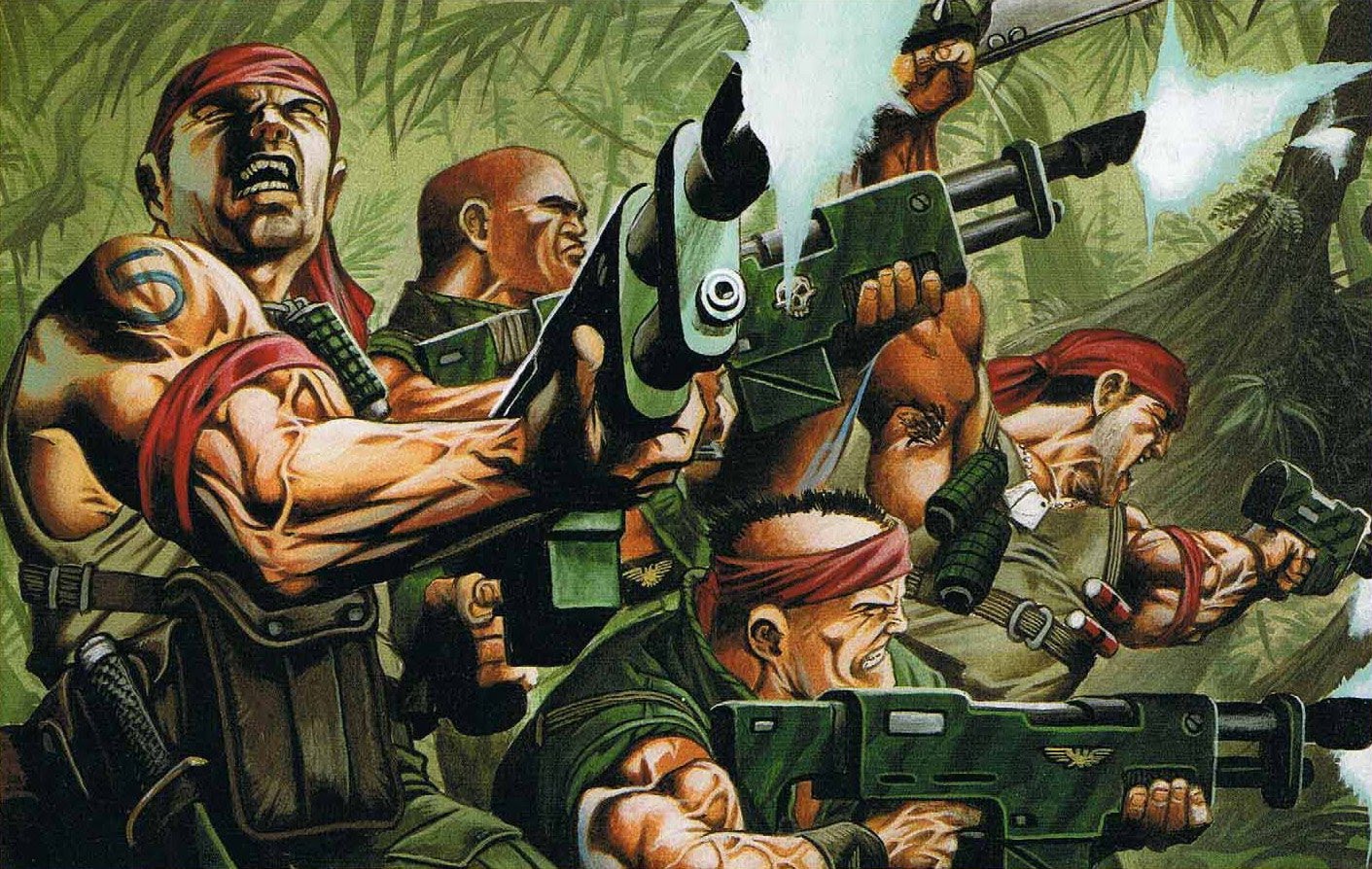
The most iconic visual of the Astra Militarum is the Cadian Shock troopers, reminiscent of the aesthetics of late world war 2 warfare. But these are far from the only representation of popular war narratives presented in the codex. These different historical war zones are represented by different regiments from different planets. For example are the Catachan jungle fighters an overt reference to the Vietnam war. As well as Vietnam inspired media such as the movie Predator.

Astra Militarum Regiment Tactics & List: Catachan | Frontline Gaming
Source: https://www.frontlinegaming.org/2017/10/31/astra-militarum-regiment-tactics-list-catachan/

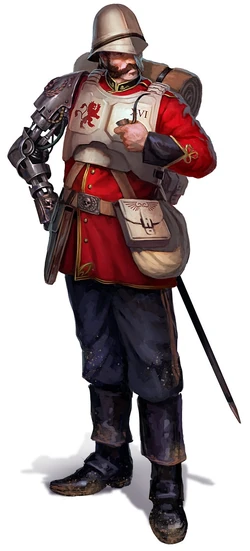
The praetorian guard are modelled on British colonial forces. A visual that is especially interesting in light of our earlier discussion on Colonialism. (Hill. 2016)

https://vignette.wikia.nocookie.net/warhammer40k/images/d/d0/Praetorian_sgt_by_diegogisbertllorens.jpg/revision/latest/scale-to-width-down/250?cb=20140619031051

We have the Death Korps of Krieg, which both in name and appearance and name appearance are referencing the German war machine during WW1. (Hill. 2016)

File:Krieg Guardsman.jpg

Source: http://wh40k.lexicanum.com/wiki/Death_Korps_of_Krieg

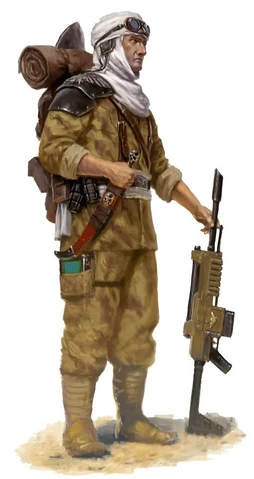
Lastly we have the Tallarn Desert Raiders with their desert war curved swords might be attributed to the Ottomans, with the rest of their wargear remenicant the desert battles of WW2. (Hill. 2016)

File:TallarnDesertRaiderMal'harof.PNG

Source: http://warhammer40k.wikia.com/wiki/Tallarn_Desert_Raiders

The armies presented in the codex are much more numerous then these, I simply aim to present a small example of some of the more clear references to real life theatres of war. As you can see, the war narratives presented within the codex are highly varied and draw from several different real life influencers. This lets Games Workshop a great deal of flexibility in the stories they tell. (Hill. 2016)

Conclusions

As we can see from this chapter alone, is the Astra Militarum a large and complex subject, both narratively and within the fiction itself. We will return to these soldiers several times throughout the series, but this has served as a quick introduction into how the Imperium of Mankind fights most of its wars.

Hill, J.D. (2016). Astra militarum. Games Workshop. Lenton, Nothingham.

Copyright Disclaimer

Under section 107 of the Copyright Act 1976, allowance is made for “fair use” for purposes such as criticism, comment, news reporting, teaching, scholarship, education and research. I do not claim to own an of the pictures in this post. Al copyrighted materials belongs to their respective owners.

This blog post was spell checked and edited for readability at 2021-06-14
Warhammer 40k an in depth analysis: Part 1, IoM, part 4, in service to the machine.

Introduction

This chapter will be our first in depth look at one of the numerous sub-factions of the Warhammer 40k franchise. With subfaction I am referring to a specific organization, culture or species that has a meaningful impact on the narrative, but is part of a greater faction, such as the IoM. This chapter will, as  mentioned in previous chapter, be focused on the religious order/scientific institution by the name of Adeptus Mechanicus. In this, as well as similar future chapters, we will discuss the factions codex (see part 1) as well as some supplementary materials. We will do this to get a base understanding of how this faction is presented, and what part they play in the narrative as a whole. We will later contrast and complicate this image by comparing them with real life ideologies, historical events and organisations and institutions. In doing so we will be creating a more complex and intriguing view of the franchise as a whole.

First and foremost, this will not be an exhaustive explanation of all the lore surrounding each faction. as This would be too much of a time and space consuming process. I will simply present enough context to make my arguments in a precise and understandable manner, even for newcomers to the franchise. Links to further reading will be provided at the end of the text.

Aesthetics

Arguably one of the most iconic images of the Adeptus Mechanicus is that of the “tech priests” and “magus”. The hooded individuals in long red robes, enveloped in machinery and religious artefacts.

Source: http://warhammer40k.wikia.com/wiki/Tech-priest?file=Techpriest2.jpg

Here we can clearly see a mix of the technological and the arcane that we discussed last chapter. This individual is completely engulfed in machines, wires and cybernetics, yet wears a robe and incense that makes us think of a catholic monk. We can also clearly see Games Workshop’s love for including skulls in their designs This is a theme that continues in the emblems of the Adeptus Mechanicus.

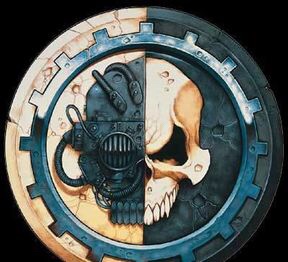
Source: http://warhammer40k.wikia.com/wiki/Adeptus_Mechanicus?file=Adeptus_mecanics.jpg

Here we see a heavily stylised human skull next to a mechanically reconstructed version of the same skull. Note that this skull is a recurring design within Games workshops visual aesthetics.

In universe history

The history of the Adeptus Mechanicus arches back to the colonisation of present day Mars. These colonies, with time, developed completely differently than the nations of Earth. Science and technology was highest regard, and with time became the basis for their art, culture and religion. Binary code and technical instructions was made in to poetry and prayers. Vital mechanical functions were fashioned to be provocative art, and simple activation routines were styled into rituals and prayers. (Sanders, R. 2016)

With time, and a series of crises, (which I will go into later) these texts and rituals eventually lose their context and meaning, but not their function. What was once written as a celebration of science, ingenuity and art becomes strict dogma and scripture, to be followed without questions. These arcane rituals are the only things that stand between humanity and complete and utter loss of their advanced technologies. (Sanders, R. 2016)

Structure and beliefs

The structure of the Adeptus Mechanicus is one of traditions and strict hierarchies. With the initiates at the bottom and the Mages at the top. The Magus have sole access to the most sacred and arcane knowledge.

The official religion of the Adeptus Mechanicus is named Cult Mechanicus. This religion is based on the previously mentioned rites and prayers, as well as a set of tenets and warnings displayed below:

The Mysteries

  • 01. Life is directed motion.
  • 02. The spirit is the spark of life.
  •  03. Sentience is the ability to learn the value of knowledge.
  •  04. Intellect is the understanding of knowledge.
  •  05. Sentience is the basest form of Intellect.
  •  06. Understanding is the True Path to Comprehension.
  •  07. Comprehension is the key to all things.
  • •08. The Omnissiah knows all, comprehends all.

The Warnings

  • 09. The alien mechanism is a perversion of the True Path.
  • 10. The soul is the conscience of sentience.
  • 11. A soul can be bestowed only by the Omnissiah.
  • 12. The Soulless sentience (i.e. the Necrons) is the enemy of all life.
  • 13. The knowledge of the ancients stands beyond question.
  • 14. The Machine Spirit guards the knowledge of the Ancients.
  • 15. Flesh is fallible, but ritual honours the Machine Spirit.
  • 16. To break with ritual is to break with faith.

Omnissiah

The being of Omnissiah, or the Machine spirit, is said by the Mechanicus to be the primary motivating force in the universe, especially within mechanical constructs. Each machine is said to have a will and spirit of its own. When a machine breaks down or fails to function it can be attributed to an angry or otherwise upset machine spirit. To appease the machine spirit, certain rites of repair, maintenance and prayer must be conducted. Rites must also be conducted to properly start, control and shut down any machine. The more ancient or complex the machine, the more complex and time consuming the rites needed to properly operate and maintain a certain machine. A simple rifle might just need a prayer of thanks and some sacred oils to function, while the great war machines called Titans, might need days or weeks to properly prepare. The supposed existence of the machine spirit is also why Artificial Intelligence (known as Abominable Intelligence by the Mechanicus), is seen as such a crime against the machine spirit, as this intelligence removes agency and freedom from said machine spirit.

At first glance it is easy to interpret these rites simply as misunderstood maintenance and repair routines, and that is defensibly a valid read. Here I will introduce one of the more interesting concepts of the 40k narrative. There exist two interlinked dimensions in the universe of Warhammer 40k. First of all there is the physical plain of the Materium, or the world of matter. Secondly is the Immaterium or the Warp, this dimension is a world of raw and pure emotions, reflecting the wishes, fears and feelings of every living creature in the Materium. If a group of individuals believes in something enough, it will manifest within the Immaterium and become real. For example, the citizens of the Imperium believe their Emperor to be a god, so he becomes one in the Immaterium. As a result it is possible to argue that even though these rites started as purely practical, the Mechanicus has enough faith to conjure their Machine god into existence. (Sanders, R. 2016)

The individual

These tenets outlines a faith of furthering the individuals personal growth of understanding, but also outlines a strict guidelines and paths to thread in order to learn this knowledge. Many avenues of research is completely outlawed, particularly alien machines, and as mentioned in earlier chapter, any form of artificial intelligent. The name Cult Mechanicus further paints the Mechanicus in the realm of mysticism. The status of cult is further cemented by the comparison to the Ecclesiarchy, that is presented as the official faith of the Imperium of mankind. The Ecclesiarchy will be the subject of a future text, but for now al we need to know that its a quite heavily exaggerated version of the catholic church.The Mysteries and the Warnings outline a doctrine designed to furthering the individual’s personal growth of understanding, but also outlines strict guidelines and paths to thread in order to learn this knowledge. Many avenues of research are completely outlawed, particularly alien machines, and as mentioned in earlier chapters, any form of artificial intelligence. The name Cult Mechanicus further paints the Mechanicus in the realm of mysticism. The status of cult is further cemented by the comparison to the Ecclesiarchy, which is presented as the official faith of the Imperium of mankind. The Ecclesiarchy will be the subject of a future text, but for now all we need to know is that it’s a quite heavily exaggerated version of the catholic church.

Progress vs history

The Mechanicus are guardians, distributors and producers of all of humanities more advanced technologies. These technological wonders are scarcely understood are exclusivity from humanities glorious past. Any and al innovation is me. The Mechanicus are guardians, distributors and producers of all of humanity’s more advanced technologies. These technological wonders are scarcely understood, and present relics from humanity’s glorious past. Any and all innovation is met with extreme suspicion, both from the Adeptus Mechanicus, and the general Imperium. To innovate is to question the masters and the Mechanicus itself, as a result any form of innovation is strictly forbidden. The goal of the Mechanicus is in other words, not to lead humanity into a new age of prosperity, but rather to fight to preserve what can be saved from humanity’s golden past. (Sanders, R. 2016) 

Here it is interesting to mention two terms used universally within the 40k narrative. These terms being miasma and alchemy. Both of these terms were at one point seen as the height of science, but have later been replaced by other terms and concepts as science evolved. In the place of miasma (the theory that illness was caused by “bad air”) was replaced with germ theory, and in place of alchemy we have the study of chemistry.

As we can see from the mysteries and warnings, knowledge and understanding are set in highest regards. Yet to go against previous knowledge is the highest form of taboo. The focus lay on traditions and honouring the old ways, rituals and old truths are beyond question. (Sanders, R. 2016)

Traditions vs innovation

The Mechanicus, like any cult, follows a strict series of rules and traditions to the point that they lose their original meaning. Everything from production of new tanks to the maintenance of a simple rifle is seen as a sacred duty that must be done following proper rites and rituals. These rites have taken the place of any meaningful scientific research and discovery in the IoM.

The Mechanicus might seem extremely conservative and needlessly complicated, but as is with most things in the IThe Mechanicus might seem extremely conservative and needlessly complicated, but as is with most things in the Imperium of mankind, this is for a reason. The universe is full of old alien or human technological wonders that are unimaginably dangerous. Not to mention the numerous agents of the mirror dimension known as the warp, and the dark gods that rule there (see chapter “the Immaterium”). Many reckless adventures have been undone when they stumbled upon a secret of the universe that would have been best left undiscovered. Considering the fragmented and often contradictory knowledge the Mechanicus has about the things they study, it’s understandable that a more caucus and calculated approach was adopted.

Data vs knowledge

Other than technology, the Mechanicus collects data, about anything, big or small. Any reading is important, and they are all fed into a great central computer, that will one say reveal the Truth. Data is in other words not a means to an end, but the end itself. The members of the Mechanicus use data as a currency amongst themselves. One interesting definition of knowledge to keep in mind is the following. 

Data is to be seen as raw numbers, figures, readings etc, a description of the real world but void of any context or further meaning. Information is data organized, and put in a further context to be able to constructively use said data. The last part that I will use is the term knowledge. Knowledge is the same information internalised within a person, and absorbed with other pieces of information previously internalised by the individual to make up what an individual knows. Not for the Mechanicus, who see data as the purest form of knowledge and tirelessly strive to collect as much as possible.

The Dark Mechanicus

The Dark Mechanicus is the first example of the “dark and corrupted” version of a IoM faction we encounter. This corruption occurs when the individual in question willingly or unwillingly gets in contact with the mirror world known as The Warp. In the case of the Dark Mechanicus does this corruption manifest in innovation, creativity and mixing of sciences. These heretics dares to go against many of the warnings, chiefly exploring alien technology as well as improving on or even disregarding the knowledge of the ancient masters of Mars. (Sanders, R. 2016)

Conclusion

The Adeptus Mechanicus is a good example of what happens when rituals and traditions lose context and meaning. The traditions themselves become deified and become beyond question. We can also see how these misunderstandings and dogmatism are made true, through the power and influence of the Immaterium.

Here we also see the first dynamic of loyalist vs heretics and how Warhammer 40k toys with what ideals are assigned to protagonists and antagonists. Here the loyalist and “good” Mechanicus is dedicated to dogmatically following traditions and rituals, at the expense of innovation and the self, while the corrupted renegades seek new and innovative discoveries, at the cost of morals, traditions and themselves.

References

Sanders, R. (2016). Adeptus Mechanicus. Games Workshop.

Copyright Disclaimer

Under section 107 of the Copyright Act 1976, allowance is made for “fair use” for purposes such as criticism, comment, news reporting, teaching, scholarship, education and research. I do not claim to own an of the pictures in this post. Al copyrighted materials belongs to their respective owners.

This blog post was spell checked and edited for readability at 2021-06-08

Warhammer 40k an in depth analysis: Part 1, IoM, part 3, Dark age of techonology

Introduction

The Warhammer 40k franchise is at its core based in the tradition of science fiction, as a result, technology and science are essential themes to the narrative. Technology and discussions of scientific discoveries being a cornerstone in much of modern as well as classic science-fiction.

As with earlier parts, we are going to discuss these phenomenons through the lens of the Imperium of Mankind, the representation for humanity within the Warhammer universe.

We will later discuss how science and technology is presented in the franchise as a whole. For now what you need to know is that within the universe there exists a source sometimes referred to as magic and sometimes referred to as psychic powers. The line between these powers and technology is often highly blurred, as well as the line between magic and psychic powers. It is with this setting in mind that we will discuss the technology of the IoM. (Hill 2016)

Analysis

The imperium of mankind is described as stagnant at, or rapid regression at worse. Much of their technological advancement is lost to time, and what small slivers of technology that remains are seen with fear and suspicion. Especially any form of artificial intelligence is strictly forbidden. In the core Codex for the faction Astra Militarium (Hill 2016) this ban is described to be a result of superstitious and conservative ways of the Adeptus Mechanicus. This religious order is tasked with taking care of, and researching what technological wonders humanity still has left. Were one to read closer though, further texts discuss a war between man and armies of man and  an army of artificially intelligent robots. This war is the true reason for the outlawing of many technologies. (Hill 2016) This is just one example of how the Warhammer 40k franchises uses unreliable narrators and conflicting narratives are used to create a fuller universe as well as a sense of mystery and intrigue. With unreliable narrators I am referring to that can be implicit or explicit, who present a wholly or partly false picture of the events in the narrative. This narrator often presents a third person narrative, but at some points, such as with letters and other metafictional texts, presents their text in a second person narrative.

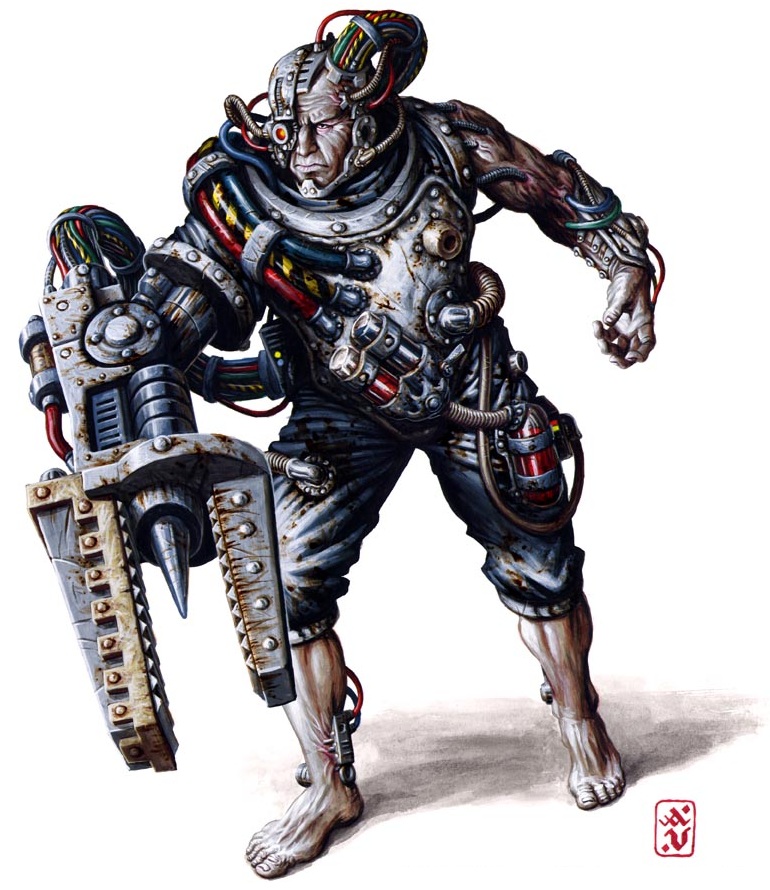
In the Imperium of Mankind is a human component used to compensate for many advanced mechanics components that have been lost to time. One example of these human and machine hybrids in the service of humanity are droids known as “servitors”.

Servitor_by_andreauderzo

Source: http://warhammer40k.wikia.com/wiki/Servitor

The picture above is an example of a mindless servitor used universally within the IoM. They do everything from help navigate star ships to harvest crops. Some of the more advanced servitors are wired directly into larger machines. These lobotomized humans are used as a loophole to keep using the technology that originally used artificial intelligence without breaking the taboo set by the Adeptus Mechanicus.

https://1d4chan.org/images/5/55/Servitors.jpg

Source: https://1d4chan.org/wiki/Servitor

As you can tell from these two pictures these Servitors are as varied in use, as they are in design. The Imperium also uses so-called “servo skulls”. Human skulls adorned with technological components capable of carrying out simple tasks. (Hill 2016).

These machine/human creations help further the atmosphere of stagnation and backwardness to the IoM. These creations also add an element of body horror to the setting. Humans are quite literally being made into the machinery that they work and die for.

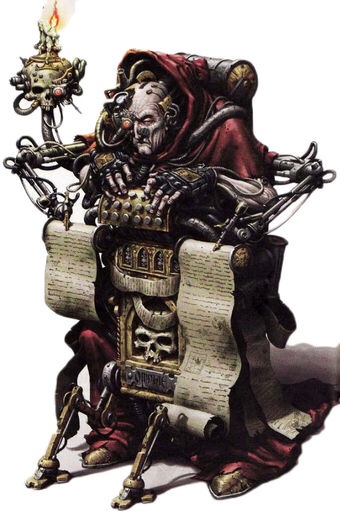
Scrolls, quills and papyrus are common visual elements of the Imperium of Mankind, as well as candles and other primitive forms of lighting. These elements are often paired with highly technologically advanced elements such as robots, lasers, advanced prosthetics or huge spaceships. This apparent disparity is what we are going to discuss in the remainder of this chapter.

Source: http://warhammer40k.wikia.com/wiki/Adeptus_Administratum

Many of the visual cues, such as skulls and scrolls can also be prevalently seen in Games Workshops other tabletop series Warhammer Fantasy (Cruddace 2011). Skulls and scrolls are a particularly common theme in this setting. As both franchises are owned and produced by the same company, it’s understandable that some visual elements carry over. In fact the trend of mixing sci-fi tropes with elements from their Fantasy series is something that we will see more and more of as this series continues. Candles and parchments make us think of the medieval dark ages, of monks and scribes of old. This leads us to how knowledge creators and preservers are depicted in the setting. By this I mean, individuals that is responsible for creating, distribution and curating knowledge. There are the above mentioned adeptus mechanicus, but also what Hills (2016) text call scribes and clerics of the adeptus administratum. Both departments take their names from Latin, or “high gothic”. Adeptus being able to be translated to overtaken or belonging to something, and mechanicus and administratum being engineer and administrator respectively. These titles would suggest that the individuals have been overtaken by their profession. Above we see a member of the Administrarium, as you can see he is dressed in a robe much like a western medieval monk.

All these elements bring together  to create a very archaic feeling of stagnation. If we tie these elements with what we discussed in the earlier chapter, will we start to get a notion of what kind of place the Imperium of mankind truly is.

Next time to follow up on the same theme, we will take a closer look at the Adeptus Mechanicus and discuss more deeply how the 40k franchise uses dramatic irony to produce a sense of dread and horror.

References:

Cruddace.R (2011). The Empire. Games Workshop. Lenton, Nothingham.

Hill, J.D. (2016). Astra militarum. Games Workshop. Lenton, Nothingham.

Adeptus. (2017, June 27). In Wikipedia. Retrieved June 3, 2015, from

https://en.wiktionary.org/wiki/adeptus

Copyright Disclaimer

Under section 107 of the Copyright Act 1976, allowance is made for “fair use” for purposes such as criticism, comment, news reporting, teaching, scholarship, education and research. I do not claim to own an of the pictures in this post. Al copyrighted materials belongs to their respective owners.

This blog post was spell checked and edited for readability at 2021-06-08

Warhammer 40k an in depth analysis: Part 1, IoM, part 2, A Gothic future

To be able to talk about the aesthetics of the Imperium of Mankind, we must first discuss how the narrative of the Warhammer 40.000 franchise is presented. We will divide the various narrative parts in to different levels. I will break down these narratives in the following structure:

1, rulebooks and expansions

2 Codexes

3 Novels

4 “Out of house” productions such as movies, card games, promotional materials etc.

The largest reason for this division is that it gives a much more flexible approach to analysing the different texts, as well as helping with the problem that some layers are considered more canonical than others.  Canonical is here used to mean “what is real or true within the limitations of a fictional universe”.

In this part we will focus on the second level of the narrative structure. More specifically the way that the Imperium of mankind is presented visually both in writing and illustrations within their Codexes.

The decision to base this analysis solely on only the second level is partly because  because I believe most readers comes in comes in contact with the Codexes first, as well as being the most consistent when it comes to tone and theme. This level is also under the tightest control of Games Workshop.

As the title suggests, I will in this text compare the visual aspects of the Imperium of Mankind to that of the Gothic aesthetic movement. Now, a disclaimer before continuing, my knowledge in this field is limited, so I apologize in advance for any errors that may occur.

In this chapter we will primary discuss the architecture of buildings, starships as well as war machines, and how they help to set a certain tone within the narrative, but first of all I would like to draw a parallel between the term Gothic, and the term for the two common human languages of the IoM, this being high and low Gothic. High Gothic being represented by a tongue and cheek take on Latin is presented as the language of the rich and learned. Low Gothic on the other hand is represented as English, and is the tongue of the commoner and uneducated (Hill, J.D 2016). Here we can see a clear nod to the Gothic movement.

Before we begin to discuss the visual aspect of the IoM, I will define what I mean with the term Gothic architecture. I will base my definition of the book Gothic architecture  (Banner, R. 1961) In this text he outlines the history of the style, as well as a series of defining features. These features include spires, prominent buttresses and a focus on verticality and scale in the design. The architecture in many parts mimics that of medieval fortresses. High Gothic architecture in particular was meant to make the onlooker feel small and insignificant. Branner ends his book by describing the Gothic architectural movement in the following manner:

“Gothic was the final expression of the medieval world, of the concepts of a mystical cosmos and a transcendental universal religion” (Banner 1961)

Keep this description in mind as you continue to read this series. This definition will become quite striking when we have a more complete picture of how the Imperium of Man is being described. First we will take a quick look at some buildings of the Imperium of man.

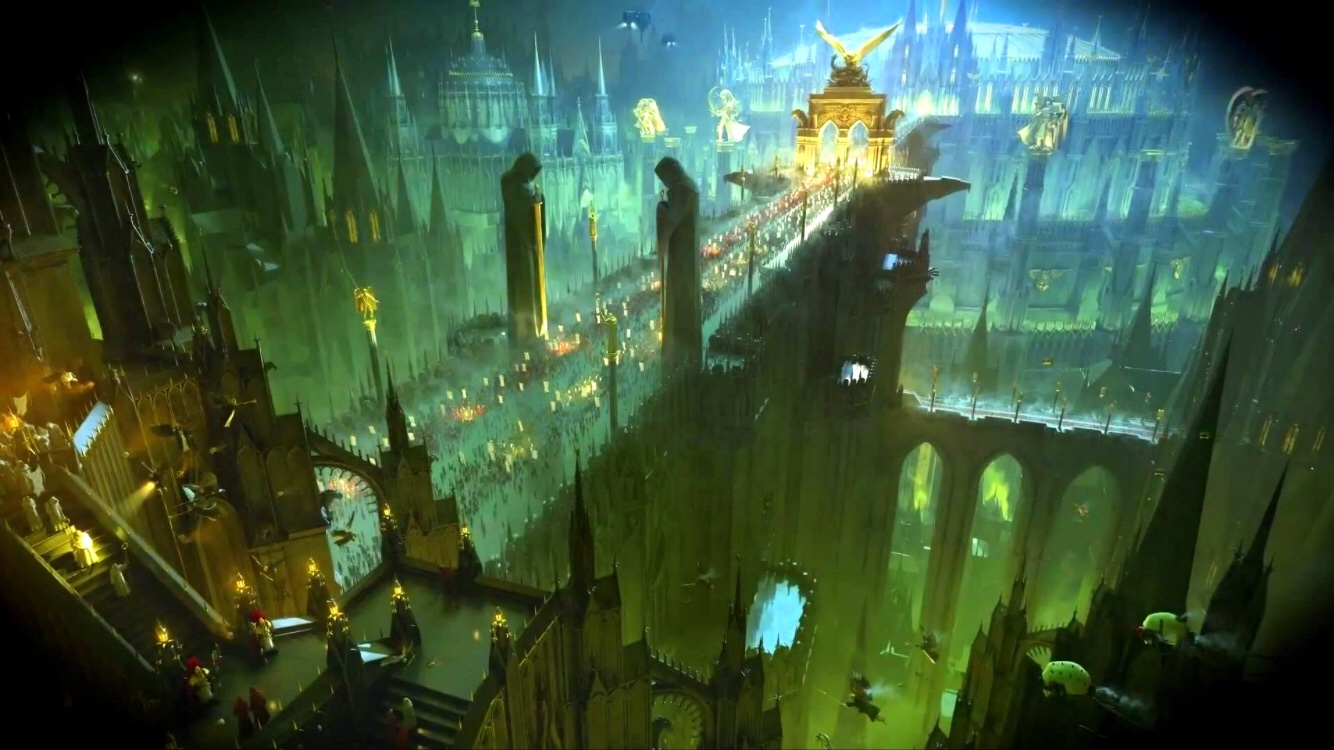
Source: http://warhammer40k.wikia.com/wiki/Imperial_Palace?file=Imperial_Palace_Terra2.jpg

As you can see from the picture above, there are many of the aforementioned details such as large spires,  prominent buttresses as well as an overall fortress-like design. Furthermore does the sensation of size and impression of grandeur permeate the works, making the humans next to buildings look miniscule and insignificant.

Imperial_vs._Chaos_duel.jpg

Source: warhammer40k.wikia.com/wiki/Battlefleet_Scarus

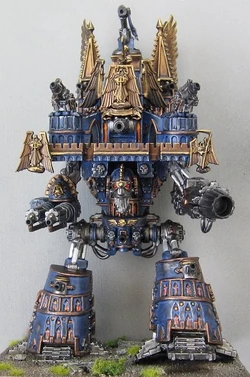
These design elements can also be seen on many of the Imperium s larger space ships. These designs can also be seen on many of the Imperiums larger space ships. These ships do not only include spires and buttresses, but also a notion of scale and a sense of a “larger than life” impression. These aesthetic elements can also be seen on many of the Imperium`s war machines such as the Imperial Titan, (a terrifyingly large walking gun platform used by some powerful Imperial officials), as well as the Imperiums more extravagant tanks.

Imperial Imperator Titan

Source: http://warhammer40k.wikia.com/wiki/Titan

http://wh40k.lexicanum.com/wiki/Fortress_of_Arrogance

At this point most readers will have noticed the prevalent use of religious iconography, more specifically to the Christian catholic faith. The connection between Warhammer 40k and the catholic faith, can partly be explained by the fact that the company responsible for it series is based in Great Britain, a land with a history of Catholic faith, as well as grand Gothic architecture. I will discuss faith and religion in the Warhammer 40k franchise in a later chapter. Lastly I would like to draw the attention to how dark and imposing this architecture appears, with dark colours and imposing size. I believe that the use of Gothic architecture is meant to enhance the tone of oppression and horror in the narrative.

Next chapter we will continue to discuss this topic by taking a  look at the Imperium use of technology.

References:

Branner, R. (1961). Gothic architecture. New York: George Braziller.

Hill, J.D. (2016). Astra militarum. Games Workshop. Lenton, Nottingham.

Copyright Disclaimer

Under section 107 of the Copyright Act 1976, allowance is made for “fair use” for purposes such as criticism, comment, news reporting, teaching, scholarship, education and research. I do not claim to own an of the pictures in this post. Al copyrighted materials belongs to their respective owners.

This blog post was spell checked and edited for readability at 2021-06-08

Warhammer 40k an in depth analysis: Part 1, Imperium of Mankind: part 1, Manifest destiny.

This begins a series of looks into the large and complex narrative of the Warhammer 40k franchise. We will begin this series by taking a look at the Imperium of mankind (IoM). We start with the IoM for a number of reasons, firstly does the IoM represent humanity within the narrative, and is as a result easiest to explain without further context. Secondly do IoM take part in, or work as a point of reference in the other factions narratives. Lastly, does IoM by far have the most material written about it. In the first part of this series we will discuss how one can find similarities between the IoM and Colonial Great Britain, more specifically how both cultures exhibit traits of colonialism and nationalism. The Imperium of Mankind can be seen as a glorification as well as a stark criticism of these concepts (1).

The Imperium describes itself as the “universe’s sole and rightful ruler” (.J.D. 2016) The Imperium is ruled in theory by The Emperor, a glorified corpse of a man, kept in semi-life by the sacrifice of millions of human lives. In reality an unimaginable large governmental body of scribes, bureaucrats, rule makers and statesmen rules in his stead. This organisation, just like Colonial Britain, is centrally controlled. In the case of the IoM this central entity is known as the High Lords of Terra (Hill 2016). The rule of both Empires was in fact quite decentralized due to the distance between the seat of power and her colonies. Greater decisions, and of course the collection of taxes is left to the central rulers. The biggest difference between the two empires being the mind bogglingly large scale of the IoM. Despite these long distances and independent rule, do the planets and space stations under mankind’s Control have an obligation to pay large amounts of taxes to Terra. These civilisations and communities are also expected to stay true to the “true Imperial values and customs”. This again, can be linked to how Great Britain ruled their colonies (Pennycook 1998). It is said that amongst all of the colonial powers, Britain was most eager to spread their culture to their colonies (Pennycook 1998). For example, did the British start cricket leagues in several of their colonies for this purpose, and it’s said that while Germans built railroads, Brits made horse racing tracks. Likewise does the IoM bring their creed, customs and religion to each planet they colonize or recapture. Like with the real life colonial counterparts, some cultures and people encountered became what was called “sanctioned aliens”, many others were destroyed (Hill 2016). To further cement the allegory to the British colonies are the rulers of Imperial planets named “planetary governors”, not unlike the title colonial governor given to the rulers of British colonies.

Next we will get into the most controversial and difficult topic of this comparison, how the IoM see “the other” and how this compares to their real life contemporaries.

The British Empire as well as the other contemporary colonial powers has a well documented and bloody history with what they saw as “the local savages”.These natives were never met on equal terms, always seen as the “lesser”. To further understand how the British colonial power saw the other, we must first discuss how it saw itself. The British empire is always described as cultivated, intelligent, mature and masculine. In comparison the “other” is seen as lesser, savage, childish and feminine (Pennycook, A. 1998). As you can see, does the British empire need others to define itself as superior.

The Imperium of Mankind follows a similar ideology, only expanded on a galactic scale, and against not just humans, but different sentient species as well. The IoM has several “others” to prove itself more superior than, alien species, heretical human societies and mutants can always be used to prove its superiority against. The virtuous do differ slightly between the two empires, but some, such as strength, civilisation, and purity, seems to exist within both cultures. (Hill 2016. Pennycook 1998).

Lastly will I discuss how these two colonial powers justify their conquests and exterminations. Part of the strategy of colonial Britain was to paint the colonization effort as a great adventure, where great men went on journeys of grand discoveries, slaying monsters, and (hopefully for the rulers), die som heroic death somewhere in the great wilderness. The actual reasons can more concisely be narrowed down to economical and political reasons, as well as a need to “educate and help” the local population (Pennycook, A. 1998). In the Warhammer universe there is a similar comparison to the wanderlust in the Rogue Traders faction, which will be explored in a later chapter. The Imperium of Mankind is on the other hand described as to follow a sort of Divine plan. It was their will of their Immortal God Emperor that humanity would rule the stars. And as their god commands, so shall it be. In other words, a literal form of divine destiny (Hill. 2016 Pennycook 1998).

In conclusion, we can see several ties between the fictional Imperium of Mankind and the real colonial powers, and colonial Britain in particular. This chapter has been but a small taste of our further discussion in order to familiarize the reader with my arguments and the topics we will discuss. Next chapter will dive into how the Imperiums aesthetics is presented and what that can say about the faction and the narrative at large.

(1) My choice to compare the IoM with just the great Britain is because the franchise creators Games Workshop is based in Great Britain, they use a lot of inspiration from their homeland in their work. Something that will only become more apparent as we move forward.

Referensers:

Hill, J.D. (2016). Astra militarum. Games Workshop. Lenton, Nottingham.

Pennycook, A. (1998) English and the Discourses of Colonialism. London: Routledge, 133-144.

Copyright Disclaimer

Under section 107 of the Copyright Act 1976, allowance is made for “fair use” for purposes such as criticism, comment, news reporting, teaching, scholarship, education and research. Al copyrighted materials belongs to their respective owners.

This blog post was spell checked and edited for readability at 2021-06-08

Warhammer 40k an in depth analysis: Introduction

This series will consist of an in-depth analysis of the major concepts, factions and themes that can be found within the Warhammer 40k franchise, created by Games Workshop UK. We will start with analysing each faction, theme and narrative individually. Later we will compare and contrast these different parts against each other, as well as contrasting them against some real world concepts.
The goal of this series of texts is to try and legitimize the analysis and discussion of this series of texts, as well as similar pop culture series. I also wish to help to spread a deeper intellectual discussion about the media you are passionate about.
Next time we will start our deep dive into The Imperium of Mankind, the totalitarian and Gothic description of humanity within the Warhammer 40k franchise.

This blog post was spell checked and edited for readability at 2021-06-07

Canon: an introduction

This article will serve as an introductory look into the term canon, and how we will use it in the rest of this blog. The term canon is most commonly used to group a series of works together. Usually you discuss  one or two connections. The first is a real world, or para-textual connection such as the canon of an author (Culler, 2011). The second is a fictional, or intertextual connection, like the Star Wars canon, or canon or non canon episodes of Fresh prince of Bel Air.

In this series we will mostly focus on the second definition. This is not to say that the other definition is any way less of a form of analysis, but this will be what we mostly focus on. More specifically, we will focus on what is considered “true” within the framework of certain pieces of media. It’s equally important for any canonical study to look at what isn’t included in a collection, as what is.

Culler, Jonathan D., Literary theory: a very short introduction, 2. ed., Oxford University Press, Oxford, 2011

This blog post was spell checked and edited for readability at 2021-06-07

The game: a definition

Several definitions of games exist within and without the academic world. With this text I will make the case for one of them. This definition goes as follows, “each game must have an implicit or explicit player” Furthermore we will define the player as “Someone with implicit or explicit control over the actions in a game”.

An observant reader might have noticed that the two definitions are intertwined, there is a point that we will come to later. But first let’s break down these two definitions into smaller parts. Let’s begin with the definition of a game, this is a modification of a literary definition. “A text is a text if it has an explicit or implicit reader”. The distinction between explicit and implicit reader is important. This way a text is not only a text if it would be to read, but also if it had the potential to be read. The same logic applies to or definition of a game. A game is still a game, even if no one ever plays it, as long as there is a possibility that someone could play it.

The next step is to define the player that is mentioned in our games definition. It’s important to define the term player for two reasons. First of all, the term is not as directly obvious as that of a reader. Secondly, the term player is used in several different scenarios, which leads to a need for further clarity to avoid confusion.

These definitions clear up two things, a game must not have been played, in order to be discussed or analysed as a game. Finally these definitions together means one very important thing. In order for a game to be considered a game in our discussion, it must have one thing. It must be possible for a player to take control over, in other words change something in the game. Note that this control does not need to have any meaningful result on the game itself. There must exist a deliberate interaction between the game and the player.

When we in the future discuss games of any kind, from board games to video games to slot machines, this is the definition I will use.

This blog post was spell checked and edited for readability at 2021-06-07