
Gwylim notes on Morrowind: Seyda Neen, the anatomy of a tutorial area

Introduction

All players of Morrowind start their adventure by leaving their prison ship, and entering through Vaardenfell costumes office. They enter the game as a prisoner, brought to Vadeenfell under unclear circumstances, with only a cryptic dream of Azura to guide you. The Sedya Neen port is a customs office, giving the game a perfect excuse to ask the players questions about their race, name and profession. The office effectively presents the player with the workings of the Empire and your role within it.

This is a goal that Skyrim also achieved by having you give your information to the executioner. Morrowind shows the bureaucratic rigour of the Empire, while Skyrim shows the cold and careless part of the same bureaucracy. Both approaches are useful, and have their positives as well as negatives. While Morrowind’s approach is more diegetic, is Skyrim’s approach doubtlessly more action oriented..

The ship and the dock

The game slowly introduces you to the controls of the game, moving, talking and interacting, as you travel through the
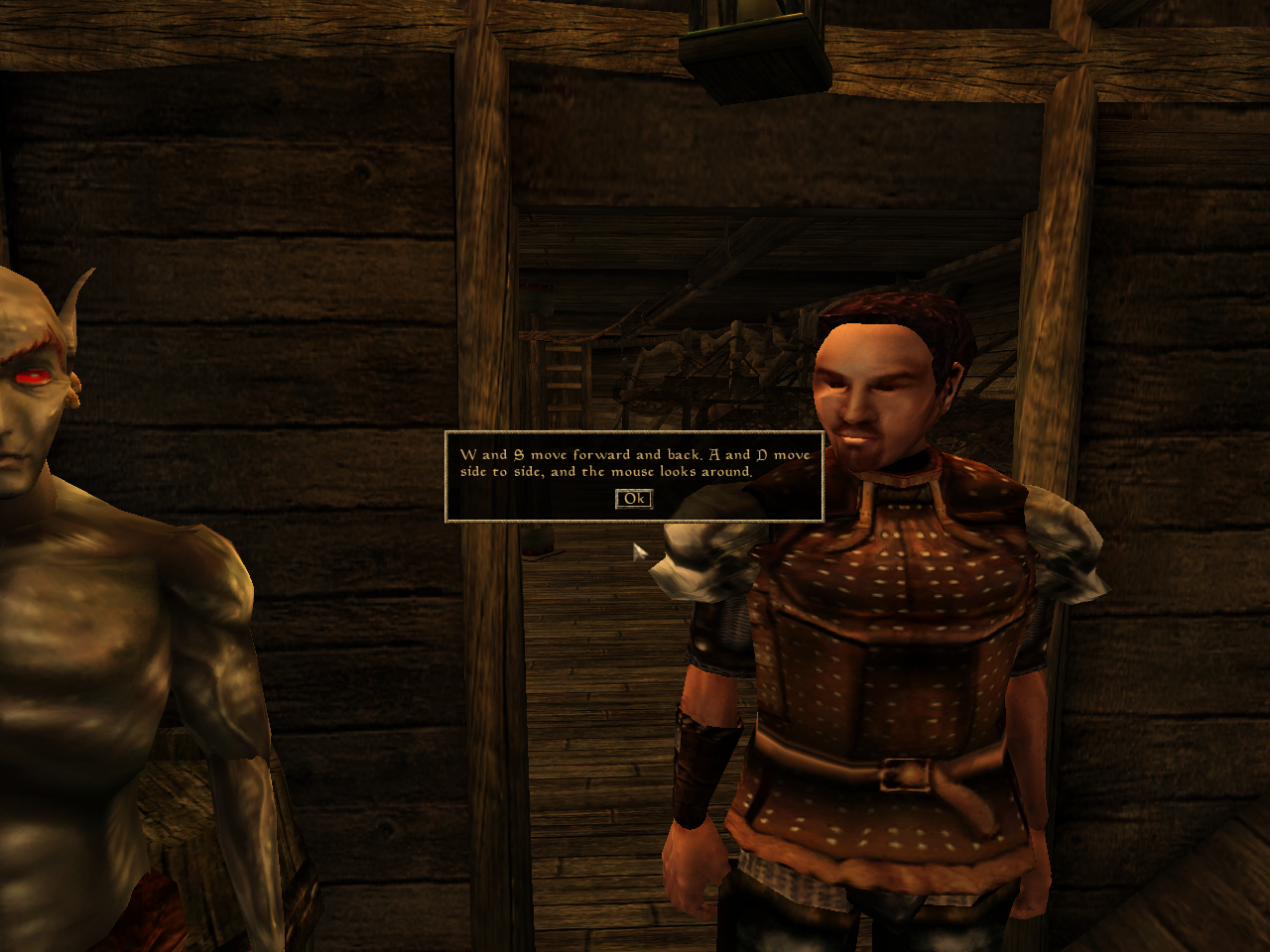
ship and interact with your jailor. As you leave the ship you are asked to tell the first clerk where you are from. This being the game’s way of making the player choose their race diegetically.

The landing area is small, verdant with life, and completely closed off from the rest of the gameworld. The player is situated directly in front of the entrance to the survey office as they leave the ship. This gives the player a clear goal, while also giving them small glimpses of the world beyond the introduction area.

Getting registered

Entering the customs office you are met by an elder Imperial man, asking you to fill in your paperworks. He dryly explains that there are a number of ways that this can be achieved, and that the choice is up to the player. Here the player can make their own class, pick one from the list of premade classes, or answer a few questions to let the game pick a class for you.
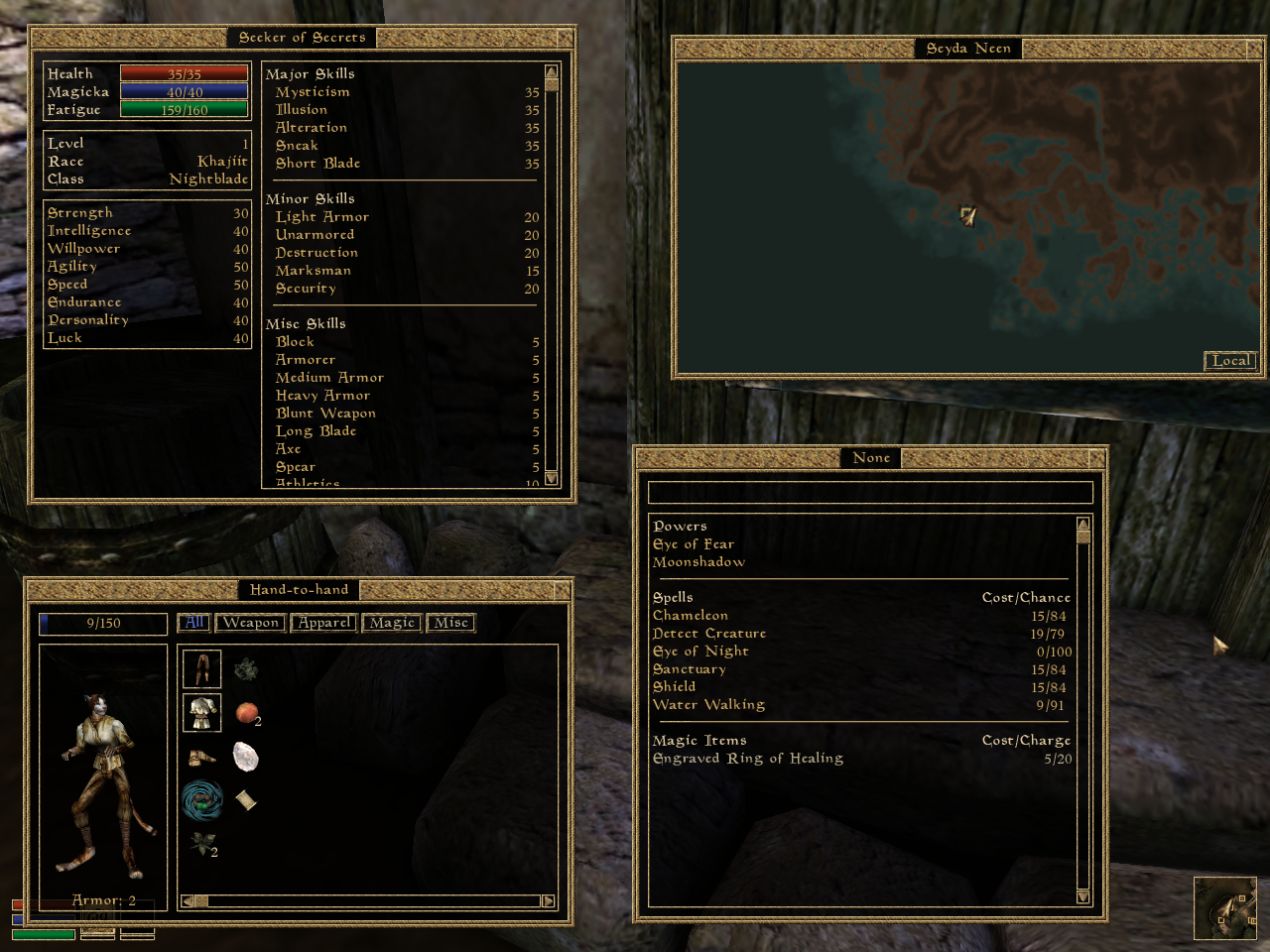
While these questions are rather strange and surreal in the context of the registration for entry, the game has done enough groundwork for it not to be too immersion breaking. As you fill in your race, class and birth sign, is your character menu likewise filled in with the relevant information, making the UI feel like a natural extension of your characters paperwork. You get one last chanse to correct anything you are not happy with before leaving the character creation process. At this you are ordered to grab your papers of registration and show them to the guard at the end of the room.

Exploring the halls

Leaving the costumes office you are briefly left to your own devices in a series of small rooms. Here you can find a few interesting objects that I will explain later in more detail, as well as plenty of trinkets books. Right ahead of the player is a small set of stairs, leading to a number of barrels and boxes, containing clutter items as well as alchemical ingredients,as weöö as gemeral nicknacks.

Directly to the right is a room that is far more inviting in its decor and overall layout. Here the player will find a book case, a locked chest, a dagger and a lockpick. Picking up the dagger or the lockpick gives the player a small tutorial window relating to combat and lock picking, the game suggests that the player tries to pick the lock of the small coin chest in the same room. The drinks and the bread can be picked up, leading to the same short tutorial on alchemy described earlier. Leaving the dining room leads the player to a small outdoors area.

The ring, the knife and the lockpick

It is in this walled off outdoors area that the player finds their last tutorial item in a barrel, a magic ring. The barrel is located in such a way that it is almost impossible for the player not to have it directly in their line of sight as they enter the area. The knife and the lockpick is similarly located in the player’s direct line of sight, with the dagger being called out in a corresponding note.

Picking up any of these items gives the player a small explanation on how they work, and how they are equipped, slowly introducing the players to the game mechanics as and when they become relevant. While not the most interactive tutorial mechanics available, are they effective at the goals that they aim to achieve. At the end of the tutorial area, most players will be informed about the game systems of magic fighting and lick picking. Leaving the open area leads you to the last room of the tutorial area.

Release, getting your orders

The player enters the last small office, populated by a single guard that instructs the player to take a packet of contact in Balmora. The player is given a package as well as some instructions on how to carry out this task. This being the only guidance the player gets besides their cryptic dream from the introduction cutscene for quite some time. This approach teaches the player that Morrowind’s secrets are many, and that they need to find them out for themselves.

The player can ask the guard a series of questions regarding a number of topics, as well as trying their hands on the persuasion system. The player learns through the dialogue tree that asking certain things can lead to new topics being discovered. When the player is ready to leave there is a door at the opposite end of the room.

Epilogue, choices and consequences

Leaving the costumes office, the player is faced with the last mechanic that the game will teach them for a while. A Bosmer man wanders outside of the costumes office, apparently he has had his prized magic ring confiscated recently. The same ring the player just picked up. Here the player learns about unavoidable text options in the form of red text snippets.

Here the player is forced to make a choice, to give the ring up, or to keep it. Keeping the ring allows the player to cast a spell they would otherwise not be able to for some time, while handing the ring over raises the disposition of the Bosmer man. The man also hints that mentioning this to the local shop keeper will give you better prices. If the player were to help the man, and mention it to the shopkeep, they will indeed be rewarded with better prices at the store.

From here the player is free to explore at their leisure, with a stern but gentle suggestion that they should travel to Balmora first, to get that entire prisoner business dealt with. So begins all games of Morrowind, heading out from the confined tutorial area of the Seada Neen customs office.

Do you like my writing and want to help me write more? Please take a look at my patreon, it has several essays, and would help me create a lot more: https://www.patreon.com/cw/SamRandom13

Gwylim notes on Morrowind: Guild quests, the value of mundanity

Mundanity is a powerful tool of storytelling, it helps anchor and expand the narrative, it gives the reader a chanse to recover from a particularly intense chapter. This last part is especially important for games where the players take a more active role than in for example film watching or reading. Morrowind has several organically formed downtimes, primarily traversal from one area and another, while this is a fascinating form of mundanity, and one that I will undoubtedly come back to, is there another mundanity I wish to discuss in this essay, the mundanity of faction questions.

Specifically the mundanity of the quests found in the joinable guilds. Unlike the later games in the series, these factions do not have a big Crisis to solve, no real villain, and no truly complete unbroken narrative. What you get from the quests is that of which you puzzle together on the way, vague hints and implications of grander plots. What makes these quests so engaging is that they often intersect with plots and narratives of both the main quest and other grander narratives of the game.

While you may only go to Vivec city to acquire a rare book for a colleagues research paper, you will inevitably find many more quests on the way, many more areas to explore, as well as some interesting hints and implication of the mystery of the Neravarine. The quests writing and design works rather effectively for giving you a reason not only to explore, but to place the player characters in regions and situations they may have otherwise missed.

The mundanity of the guild quests also helps with how Morrowind is designed to be interacted with. For the longest time, the player is not The hero of the tale, but a simple agent of the imperial crown, pardoned from an unspecific crime in return for providing a vague service to the crown. You are a person in the world, rather than a hero that happens to it. The game pretty early on heavily suggests that the player should join a guild or another organization, with the logic that the player will need some form of cover. Again enforcing that you are not necessarily the big hero, yet. So far you are a mere civilian and agent of the imperium’s spy network.

The mundane and pedestrian tasks of the guilds helps to drive this point home without making the process tedious and boring. The quests are often streamlined and located either near to the starting location or near one or several fast travel locations. The quests are often very simple from a purely mechanical standpoint, entailing going to a place, talking to or killing a person, or getting a thing. What sells the fantasy of the guilds is the consistent theming and narrative, giving everything you do a flavor unique to that faction.

The guilds have their own internal struggles and politics, and you get glimpses of, and partake in some of the politics as a player. There is bad blood between the thieves guild and the fighters guild, power struggles within the fighters guild, as well as discontent with the current mage guild leadership. As you carry out your orders, train your skills to raise in rank will the player inevitably find other quests and stories. The lack of a central narrative of a crisis makes it a lot easier for the writers to weave these quest tales in the wider tapestry of the world’s narratives.

Lastly, does this approach to quest design allow the player to more effectively play out the narrative of their character. Your role as a Mage guild member does not end when you leave the Balmora Mage guild in the same way that your role within the Mage guild in Oblivion disappears as soon as you leave the arcane collage. While the strategy of creating walled gardens for your faction quests may be more practical and easy to manage (I will return to this topic later), I would argue that the depth and life the Morrowind approach to faction quests entails, is well worth the extra work.

Do you like my writing and want to help me write more? Please take a look at my patreon, it has several essays, and would help me create a lot more: https://www.patreon.com/cw/SamRandom13

Essay: The immersive world of Morrowind

This text will be my first in a series of essays, more informal texts that are more opinion oriented then my normal research oriented texts. The topic of today’s text is brought to you by Daipanda, a loyal viewer of my twitch stream. If you like to have your own topic suggestion featured on the blog, please visit Twitch.tv/samrandom13 for more information.

Introduction

This text will discuss the many aspects of world-building found in the video game Elder Scrolls: Morrowind, and how they in tern leads to a number of role-playing possibilities for the players. I have recently been playing trough the game at my twitch channel, and have as a result spent a lot of time analysing its story and world building aspects. I will today discuss three aspects that I have found of special note, the faction system, the in game dialogue, as well as the in game books and other texts of Morrowind.

Factions

Elder Scrolls: Morrowind uses a series of reputation systems, one being a personal disposition system for non playable character, that ranges between zero and hundred, that gauges how friendly each character is towards the player character. A second system, and the one I am the most interested in today is the faction reputation system. This system similarly scales between zero and a hundred, and dictates the player characters options while dealing with said faction, as well as dictating the base level for NPCs personal base disposition with the players. Bring in good standing with a faction will allow the player to use certain traders, get better prices, as well as to get specific quests from them. Being in bad standing will lock the players out of many of these features, and in some cases, will turn the entire faction hostile towards the player. Al factions starts with varying degrees of like or dislike toward the player, and some will always despise the player cahracter, regardless of what they do.

The most interesting aspect of this faction disposition system is that, besides affection the relationships between the player character and the faction, do also play a role between the factions themselves. Each faction has a set disposition ration to every other faction. For example will the two major magical factions, the mages guild, and House Telvanni, have a negative disposition towards the others members, due to them competing for the same markets, namely magical services.

When a player joins a faction, these negative modifies will be calculated in to the disposition of every other faction. <in some cases, like with the great houses, it is impossible to join more then one, and joining one of them will permanently stop the players from joining the others with said player character. Due to the immense powers struggles being a major theme of the setting of Morrowind, will it be made clear to the player right a way that joining one of these great houses will swear them in to said house, and bar them from joining any other. The actions of the player will, as they progress trough their chosen house storyline put them in direct conflict with the other houses, and as a result will their personal and faction wide disposition go down with each of the NPCs pertain to said faction.

Other factions conflicts are more obscure and easy to miss, and several are deliberately obtuse, one well known example comes to mind early in he game, where he player is first introduced to the staple factions of the Elder scrolls series, the mages, thieves and fighters guilds respectively. The players are initially able to join both the thieves and fighters guild at their leisure, but are at one point tasked with retrieving a certain item, a book containing sensitive information, for both factions. both factions will have vested interest in this book, and the players will be forced to chose a side, with some outcomes leading to the players being unable to join one of the factions in the future.

By forcing the players to take sides in these and many other conflicts does the game enforces the idea that the character the players is in fact, part of is a part of a greater narrative and world, and by forcing the player to make these decision is the player incentivised to crystallize an identity with said world. The player is not a omnipresent being that exits outside the narrative, or indeed the ultimate hero for al inhabitants of the world. They are a part of a wilder narrative, if a very crucial part of it.

Dialogue

As is the case with many role-playing games, is the interactions with player cahracter one of the bigger parts of Elder scrolls Morrowind. This is primarily doe by approaching an npc and engaging in a dialogue, here the players will be presented with a series of topics that they can ask this specific npc about. These topics vary greatly from npc to npc. The players are normally allowed to ask about as many of these topics as they like, and as many times as they like.

In some rare cases are the players forced in to a decision, here the dialogue box is frozen, and the player is presented with to or more red dialogue options, that they must pick one off, before they can continue. With this mechanic will the player be forced to conciser the context in where they ask certain questions, and take up specific topics.

One last note on the dialogue options of Morrowind, is that many of the characters will give fully, or partially incorrect information to the players, rather due to ignorance, or wilful malice. In no area is this as obvious as with the case of directions, that is often obtuse by the original quest givers, forcing the player to wander around the countryside, or look for alternate directions form other npc`s in the area.

Books

The last facet I want to touch on is the large number of books, scrolls and booklets that the player can find and read trough the game. These range from travel guides, and instructional manuals on proper trade conduct, to theological discussions and series spanning high fantasy novel series.

These books gives an incredible depth and nuance to the setting as as a whole, by giving examples of fiction and no fiction alike. Books like “The true nature of the Orks” and “The wild Elves” presents thoughts and biases of the various nations of the world, and tales and poetry describing the war of the red mountain gives grand examples on how the various cultures and nations of the Elder Scrolls series perceives the same historical event.

One of the more interesting facets of the books and scrolls in the Elder Scrolls series has always been the numerous contradictions and arguments that can be found within many of the non fictional texts. These contradictions do not come form sloppiness or oversight in the writing, rather the opposite in fact. The world of Elder scrolls is full of various cultures, and al with their own varying groups of philosophers, researchers, magicians and academics. The differences and arguments that the player will most often find is of a theological nature, more specifically on the nature of the divinity, or lack there off, of the living gods of the Tribunal, a topic that I promise I will return to in a more academic text later on!

The way that a lot of the information and lore of the elder scrolls series, and especially Morrowind, is presented in the way of books and scrolls. As with much of real life information and texts, is there always a sender with a message and a goal. By presenting the world via these complex and sometimes contradictory explanations on everything form the nature of the gods to how to best cast a fireball, will the players be incentivised to think critically about every text and piece of information they come across, and slowly puzzle together the truth, just like a scholar living in Morrowind would.

Final thoughts

Elder Scrolls: Morrowind uses a number of strategies to draw the player in to its world, chief amongst them obfuscation, and forcing the players to take sides. By obfuscating some of the information that is presented by the player, and presenting conflicting narratives, does the game force the player to conciser each new piece of information from various sides and angles. Furthermore, by presenting some of the information from the npcs in a similar contradictory way, are the players forced to think of them less as objective directions given by a story, and more like subjective interpretation of various real life people.

By forcing the player to choose between various factions are the player encouraged to form a more uniform image of their character, one that is slowly formed from a blank slate in to an individual by the choses they make along the way. The player character is formed as much by the factions they join, and friends they make, as by the once they choose, or are forced not to join. The lack of ability by the player to join every faction, to see every side of each debate, at least in one playtrough, further drives home the subjective and splintered nature of the narrative in Elder Scrolls: Morrowind.

I would argue that these two facets of Morrowinds storytelling greatly helps the immersion and ability for the player to fully play the role of their chosen character, and is a contributing factor to why the game is still played, and talked about to this day. I will return at a later stage with a more in depth analysis of many of the subjects touched upon in this text, especially the concept of ambiguity in the presentation of the texts of the Tribunal and other faiths.