Introduction
We will in this post take a look at the consent of the Bootleg. Specificity will we look at the bootleg products created after the image of pop culture. The definition of bootleg we will use is the following: any material or content created for consumption by the public, without the knowlage and/or approval of the copyright owners involved. In other words using the visuals or themes of an already established trademark in order to make profit. Note that fan works do not fall within this genera, even if they are sold. This is solely confided to companies making unlicensed product relating to another companies intellectual product.
we will start this chapter by giving a few examples of influential fictional properties, before making a more overarching analysis of the overall similarities between the different franchisees of bootlegs. Note that in this text will we only be discussing bootlegged toys, as including things like bootlegged movies and games etc would make this chapter al to big to handle within a reasonable time frame.
Star Wars bootleg
Star Wars is a monolith of a franchise, that barely requires any introduction. The iconic star wars font, together with their highly marketable characters are seen on everything from billboards to happy meal boxes. It is difficult to overstate the importance of this franchise on contemporary pop culture. The visage of Darth Vader is recognizable to people not even familiar with the franchise.
These intellectual properties might be explicit like the example of this figure of “R2-CP30”. That both mention the franchise Star Wars and two character (R2-D2 and CP30) by name. It also clearly uses the trademarked type font, as well as two characters from the series of movies.

Source: https://m.imgur.com/CpuaB46
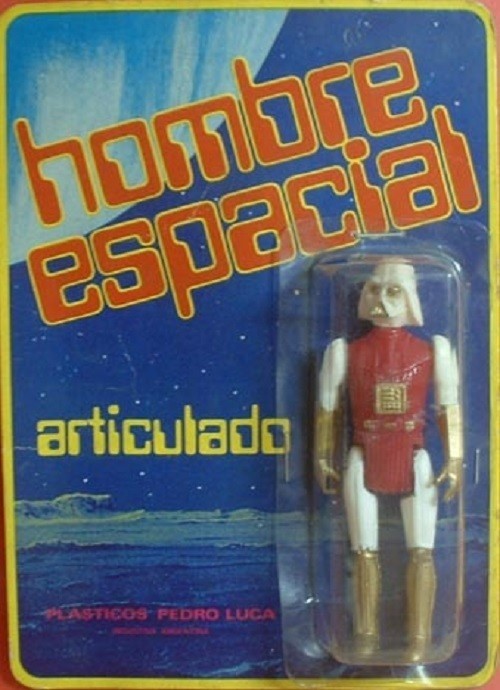
Or more subtly as with this toy of “space man” (my translation), that can be linked to star wars trough the helmet that looks early similar to the helmet and chest plate worn by the iconic character Darth Vader.


Lastly we have an interesting one, with very few if any visual ties to Star Wars in the toy itself. The only thing that clearly ties it to the larger Star Wars franchise is the title as well as the type font used on the name.
As we see from just these two examples does bootleggers take a number of strategies in order to sell on the iconographic value of the Star Wars franchise. Note that both of these were released before the Disney buyout.
Star Wars has a very recognizable aesthetic, from the characters to the world, to even the type font itself, as a result is it prime materials for bootlegging, as you need very few means to tie it to the series itself.
Harry Potter
Another franchise that has become almost universality known, but in a much shorter time frame. A lot of the bootlegs related to Harry Potter I was able to find in my searches was relatively straight forward.

We can see here a good example getting the inportant details right, yet staying completely out of legal territory. The boy shares traits with harry yes, like the glasses and short hair, but still has another hair colour. He comes with a broom and a staff, but not once that tie directly to the franchise visually. The font as well, hints at the famous Harry Potter font, but only vaguely.
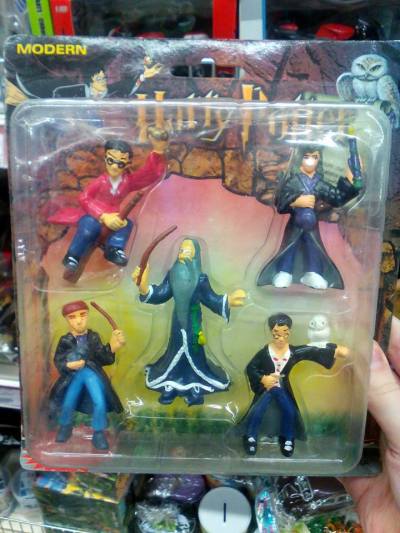
Yet again we here have a much more overt tie between the bootleg and the franchise it is copying. each character has clear ties to who they are supposed to be copying. The product also clearly uses the name of Harry Potter in the trademarked font.
We here see examples of the explicit as well as implicit ties to the franchise the bootleg is trying to copy.
Miscellaneous and mixed bootlegs.
Even more interesting are those bootlegs that wildly mixes and matches different franchises and intellectual properties. These products tries to tie itself to as many franchises as possible, amusedly to cater to as many fans as possible.

The So called Harry potter Obama backpack, is quite infamous, to the point of even having its own merchandise. Something we will dive deeper in to later in this esse. The backpack has a differently coloured version of Sonic the hedgehog on it, and the name Harry Potter, as well as, Obama, the name of the previous president of the united states of America.

This toy, seems to be a recolour of the Star wars character Bobba Fett (to which it also share its name), and the Pokemon Venusar. In the back is a Pikachu. Most interesting is the title of this series “Poké wars” which refers to both the franchise of Pokemon as well as Star Wars, with the wonderfully cryptic tag line “the power that is inside”. Here we can yet again see the use of a copy writen type font to more clearly tie the product together with the franchise it is copying.
Bootlegs and textuality
The bootleg raises interesting questions around paratextual connections, and what i and what isn’t considered Canon. I would like to preface this discussing by mentioning that we will not be discussing legality or the morality inherently tied to bootlegs. This text will solely by dedicated to discussing their visual and narrative implications.
Intertextuality
The concept of intertextuality refers to, as discussed in the chapter on Undertale, to the link between one text and another (see Undertale). More precisely are we going to discuss how these illegal toys ties to the legal representations of these franchises.
As discussed in the Undertale chapter, can you not point directly at an Intertextual connection within a work, unless of course directly tied to with a link or a reference.
With this logic would the ties between the the official and unofficial merchandise are equally as strong. At least from a purely Intertextual viewpoint. Does the connection of the bootlegged Star Wars toy being named Darth Vader, make it any less of a valid connection, that the on that the official toy with the same name makes?
Paratextuality
Paratextuality, as mentioned in the same chapter (see Undertale) refers to any connection point that is not found directly in the text itself. It is usually within this realm that ties between primary texts, such as books and movies, and secondary texts like toys and posters are found. A classic example is the use of a uniform type font and visual format.
The most easy reason that comes in mind is that canonical materials are al made by the same author. This of course falls apart, when we look at examples like Star Wars, where several authors. Th this point cant a single individual be called the source of the canon. The same thing can be said about a company, it is simple to try and tie al the canonical texts to a certain company. But what happens when several companies al produces texts individually and independently of each other. Should one of the companies texts be considered more canon then others, yet again the most simple solution would be to tie the canonical texts to those with the power over the copy-write. With this logic will the current copywrite-holders has the power to decide what is and what isn’t canon. This has some very strange implications for larger franchises and collections of texts, especially if the copywrite-holders change hands, like happened for example when Disney bought up Lucas-arts. This model of course falls apart, when we discuss things that no longer has an official copywrite-holder and has landed in the public domain.
Conclusions
The art of the bootleg is a fascinating one, and one that requires many revisits. At this juncture I mainly wished to introduce my readers to this wonderful world of wonky logic and near illegality. We have in this text managed to raise two interesting questions, as well as starting to answer them. These are questions of style and of authenticity.
Firstly have we managed to discern two schools of tough in the design of bootlegs, the direct and the abstract. The direct approach aims to get the likeness as close a possible while still being legally distinct. The abstract school goes in the other way, and tries to capture, an essence or vague concept of the original, and staying mostly visually distinct.
In the second part of this text did will endeavour to try and find or disprove canonical connections between the original and the bootleg. We failed to prove or disprove any ties intertextually, or within the texts themselves. We did manage to tie these bootlegs paratextualy to the original, but could not find any clear way of establishing if these ties were more or less valid then the ties between official materials, and other official materials. As mentioned before is this not a exhaustive analasys on the topic but rather meant to be an introduction to the topic, as well as an invitation to further discussions.








 An Unused Frequency