Gwylim notes on Skyrim: Books and magical excavations

Introduction

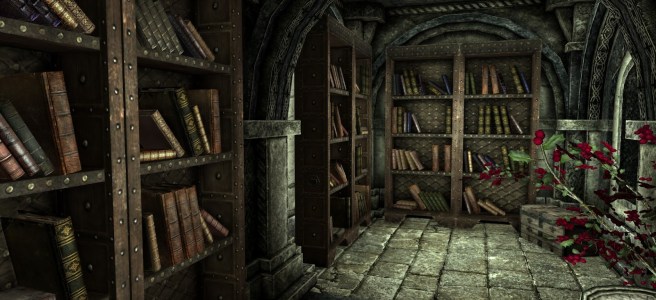
Image taken in Skyrim with Library mod

Books are a fundamental part of the narrative building of the Elder scrolls series, they can often bring context to the greater narratives as well as specific quests. In this essay I will discuss four different quests, two from Oblivion and two from Skyrim. The unifying themes for these quests is that, except for one, they get a lot of context from the lore books surrounding, or being part of the quest

In this way I will discuss the strengths and weaknesses of relying on a player to read a book, and when in the narrative the book becomes available to the player.

Excavations and exploration

The magic institutions of both games have large questlines tied to them, both that eventually will see the player become the leader of said organization. In Skyrim this is the college of Winterhold, while in Oblivion this is the mage guild. Both of these have quests that take place in an excavation of one form or another.

Oblivion’s quest takes place rather late in the quest chain, and is used as a simple way of showing the player a common task of the guild, as well as to give hints of the internal struggles and conflict within the guild. There are some lorebooks and journals tied to the excavation, but it does not drastically change the context or importance of the quest. The quest itself is mostly there to help the player feel more like a member of the guild.

In Skyrim the quest is the first real quest that the players are sent upon, and also ends up being the inciting incident for the entire quest chain. This is already a stark difference from the Oblivion quest, where the dog was shown to be important, but had nothing to do with the war against the worm cult that the questline later became to circle around.

The dig in Skyrim takes place in Saarthal and is presented as a rather mundane task, after all they are letting the first year students take part in this dig, and you are told you are there to “find novel uses of magic”. The player is given the task to find any form of arcane items, finding several rings, as well as a necklace that upon taking, traps the player in a corridor.

This all eventually leads the player to finding the Eye of magnus, an incredibly powerful item that seems to have been forgotten. Everyone in the college of winterhold is shocked by the discovery, and no one seems to be aware of where this item comes from. 

This is most likely how the player will react as well, as the player has been given no information about the digsite or its history at this point. This leads me to my second comparison, books, book hunting, and incentivising the player to read.

Hunting for knowledge

Both Skyrim and Oblivion have quests related to acquiring books. The two quests I like to discuss in this essay are the acquisition of the four texts of the Mythic Dawn cult, as well as the Winterhold college text to acquire some stolen books. Both collections of books are related and tied to the quests in mention, but the games take considerably different approaches to how the players acquire, and are incentivised  to interact with these books.

In Oblivion the player is tasked with acquiring all four commentaries created by the founder of the Mythic dawn. This leads the player to peruse book shops, talk to book collectors and finally meet with the cult itself to get the final book. The books are given slowly over several stages of the quest. The player needs to acquire these books in order to find the hidden base of the Mythic Dawn cult.

After the player has acquired all books they are tasked to discuss what they have found with a member of the mage guild. The woman will offer to solve the riddle of the books for the player, but will only do so after twentyfour in game hours, as she first encourages the player to try to solve the riddle by themselves. This gives the player some downtime with the books, and may peak their curiosity. While the books themselves are mostly superfluous, it does give the player some interesting insights into the philosophy and goals of the Mythic Dawn.

Compare this with the quests Hitting the books, a quest that sees the player fight a guild of differently minded mages to acquire a series of books regarding the newly found Eye of Magnus. The dungeon is in and of itself an interesting case study, and worth its own essay all on its own. What is relevant to this essay is the way that the players acquire the bespoke books. They are located at the end of the dungeon, in a strange barren room containing only three pedestals, as well as the dungeon’s boss.

The player can choose to leave a prisoner behind to acquire these books as a trade, or fight the final boss for the same reward. The books The Last King of the Ayleids, Fragment: On Artaeum and Night of Tears. The players are told at the offset of the quest that the book may contain some clues on The Eye of Magnus. The players are then directed to return these books to the library, upon which the librarian mentions that the Night of tears has some interesting implications.

The Night of Tears does indeed contain a very direct and obvious explanation that the place the Winterhold College were excavating was indeed holding some arcane item so powerful the Nord inhabitants gave their lives to keep it hidden. The other texts present the player with some more context on the Ayleids as well as the Psijic order. The player gets no further incentive on reading the texts, and as far as I am aware they are never brought up again.

What is notable about the quest Hitting the books, is that actually reading the books, drastically reframes the entire questline. The player is told in the quest dialogue that the dig at Saarthal is routine, safe and simple. Reading the Night of Tears makes it clear that this was never the case, and brings up some unintended implications of either the college’s incompetence, or duplicity. It seems like a stretch to imagine that neither the Arch mage, or one of the faculty in charge of this site did not know about the site they were excavating, especially since the book would be available to them.

Final thoughts

I have presented four quests in this text, two have involved excavations, and two have involved the procurement of books. All are related to acquiring information or performing research in one form or another. I hope to show different ways that lorebooks can be used to further a narrative, and how it can harm it. I would argue that it is vital that the player still gets the vital information they need, regardless of if they read supplementary texts or not.

The commentaries of the Mythic dawn are pushed on the player who is incentivised to carefully read and examine the texts. Even if they do not, the player still has plenty of options to acquire the same information they got from the book elsewhere. In contrast, the books in Hitting the books are never actively pointed out as important until after they are handed over to the quest giver. This is done despite the fact that the book contains vital context to the quest that the player will not find through playing through the questline.

I have also presented two ways that excavations can be used in RPGs, and what different goals their inclusion may have. While Oblivion used its excavation to present the player to mounting dissatisfaction in the Mage guild, Skyrim uses the excavation as a suspense tool to build up to the big inciting incident for the College of Winterhold questline. Both are valid approaches, but will lead to vastly different experiences, and leaves the player with different connections to what they have explored.

Gwylim notes on Skyrim: Fictional essays and their use in worldbuilding

I have previously written about the importance of in game stories and nonfiction books in world building and storytelling, especially when it comes to fantasy and sci fi. In this text I wish to go even more granular and discuss a genre that is close to my heart, the essay. Often more loose in form than a report or a paper, essays are great for presenting ideas and concepts in a condensed yet easy to understand format. 

Essays often exclude some of the contexts needed to understand the texts if it’s common knowledge. This allows the text to focus more on the topic at hand. This makes essays uniquely suited to give a player tidbits about the world a game is set in, without needing to present a lot of information all at once. Essays allow you to bring small packets of information in a condensed format. It allows the player to put together the information themselves over the length of the game’s narrative.

Essays have a further advantage of having a more personal voice in its writing. This allows you to not only tell stories with the essay itself, but also be able to create a writer of essays. A person that allows for a unique point of view. It is this point of view character that makes the essay such a vital tool of narratives.

The Elder scrolls series is no stranger to in-universe texts, some have gotten physical releases as well. Elder scrolls has several texts that not only discusses parts of the world, but argues for or against certain assumptions of the narrative. For example, the many schools of magic are hotly debated in a number of texts. Necromancy in particular is debated and arguments for and against.

Likewise many historical events of the narrative are discussed in great length. In this text  I would like to discuss two such texts in particular. The life of Barenziah and the mystery of the Dwemer. Both are excellent examples on how elder scrolls play with the idea of an objective reality in its narrative.

Dwemer, myths and misinformation

The disappearance of the Dwemer is described as one of the largest mysteries in the narrative of The Elder Scrolls. Their obsession with science, their alien philosophy and of course their sudden disappearance from Nirn all together have fueled discussions both in game and amongst fans. There are many texts discussing and arguing the minutiae of Dwemer, science and beliefs. Some texts like On Dwemer law and the Dwemer series are written as serious scholarly attempts to try and get to the bottom of Dwemer culture, and what impact they have had on Dunmer and Altmer culture.

There is also the series of Ancient Tales of the Dwemer. That presents the Dwemer in a very different light. The Dwemer described in these tables are considerably kinder, more peaceful and overall friendly than the Dwemer that can be found in other texts. 

This discrepancy is something the players will find for themselves when devling into the many Dwemer dungeons and facing the many sadistic traps and torture chambers of the old Dwemer holds.

This is a point that the scholar Hasphat Antabolis discusses in his text Dwemer History and Culture. He argues that the tales discussed in the Ancient Tales of the Dwemer are in fact re-packaged folk tales that have been rewritten to be given a certain exotic Dwemer flair.

That the kind and friendly Dwemer became a lot more palatable for the middle class reading rooms. These texts have as a result been spread and read by thousands, and are today still very prominent, despite the fact that they have been thoroughly debunked. The idea of a historical narrative remaining true even after decades of disproving is something that can be found in many places in real life.

The text brings up ideas of how dark and brutal histories and cultures can often be softened and simplified in order to make them more palatable to the general public. This is a wonderful example of how Skyrim uses real life phenomena within history and anthropological research to make its game world feel more complex.

The life of Barenziah and Biography of Barenziah

The controversial character of Barenziah has two texts written about her. One official series of biographies titled Biography of Barenziah paints her as the first and only Dunmer empress and describes the struggles of her life with a kind and borderline naive tone, breathlessly praising her numerous grand qualities. The second unofficial text written by an anonymous scribe titled The Real Barenziah is scandalous, provocative and deeply judgmental with poorly hidden sexism and racism contained through the text. The role of Straw the stable boy is one of the decisive differences.

What is interesting about these texts is the transparent intent of the authors behind both series. One series is describing in short and somewhat dry terms the life of the only Dunmer ruler of the empire. The other is a series of character assassinations and brutal accusations of promiscuity and debasement. Sadly this is a tactic that has, and still is used to discredit many women who have been in power. Furthermore, the first text is written as a simple document that retells major events in Barenziah life, while the second is written like a serialized romance novel, with rich descriptions of events and lengthy dialogues.

The stark difference in the texts presented narrative forces the player to look at this one historical figure from separate points of view. While the text of Skyrim makes it clear in the presentation of the texts which one is the more probable and reliable. It does nonetheless make a clear case that not every text that the player encounters can or should be trusted. Like in real life are all narratives created by a person, a person with a specific worldview, historical background and motivations. Both texts have clear biases, and both have clear goals with their narratives. It is up to the player what parts to believe.

Final thoughts

I like to conclude this essay by discussing another series, Rising threat, a series describing the rise of the Thalmer from an Altmer point of view. It is interesting for several reasons, one of them being the only purely Altmer narrative in the game, as well as for giving well needed context to the rise of the organization. This series explains how the Thalmer monopolized the sudden end to the Oblivion crisis, and claimed that they were the true heroes of the calamity.

Despite this falsehood eventually being disproven, has it nonetheless become a truism within the history of the Altmer. Furthermore, the texts are interesting for the disclaimer made by Praxis Erratuim that warns the reader not to take some of the more fanciful speculations of the texts all too seriously. Like with the Anecdotes of the Dwemer this text presents the idea that history is sometimes not created by the most reliable facts, but by the most prevailing of narratives.

My goal with this text is to present my reader with a  few examples in how ambiguity and contradictions can be used to deepen a narrative and make a fictional world feel more complex, more nuanced and more alive. I would also like to argue for the use of books and journals for the furtherance of narratives and lore that would be unwieldy to present in direct or ambient dialogues.With all this said, this kind of narrative presentation has some serious shortfalls. The chief being that the player needs to first find, and then read the text to get the information needed. I will discuss a few of these pitfalls in a future Skyrim essay: Books and magical excavations.

Gwylim notes on Skyrim: Stairs, gameplay and narrative guides

Introduction

Skyrim is the latest installment in the Elder scrolls series. The game series is an open world rpgs filled with magic, monsters and intrigue. Skyrim is set in the fringed northern land of the same name. This land is deeply inspired by a romanticized version of Viking and Nordic culture. The land is rugged and mostly barren, with a few scattered cities hidden behind grand walls. There are small farms scattered amongst the landscape, so are strange stone formations, caves, old temples and many many burial mounds. Skyrim is a mountainous land, and very few areas are completely flat. 

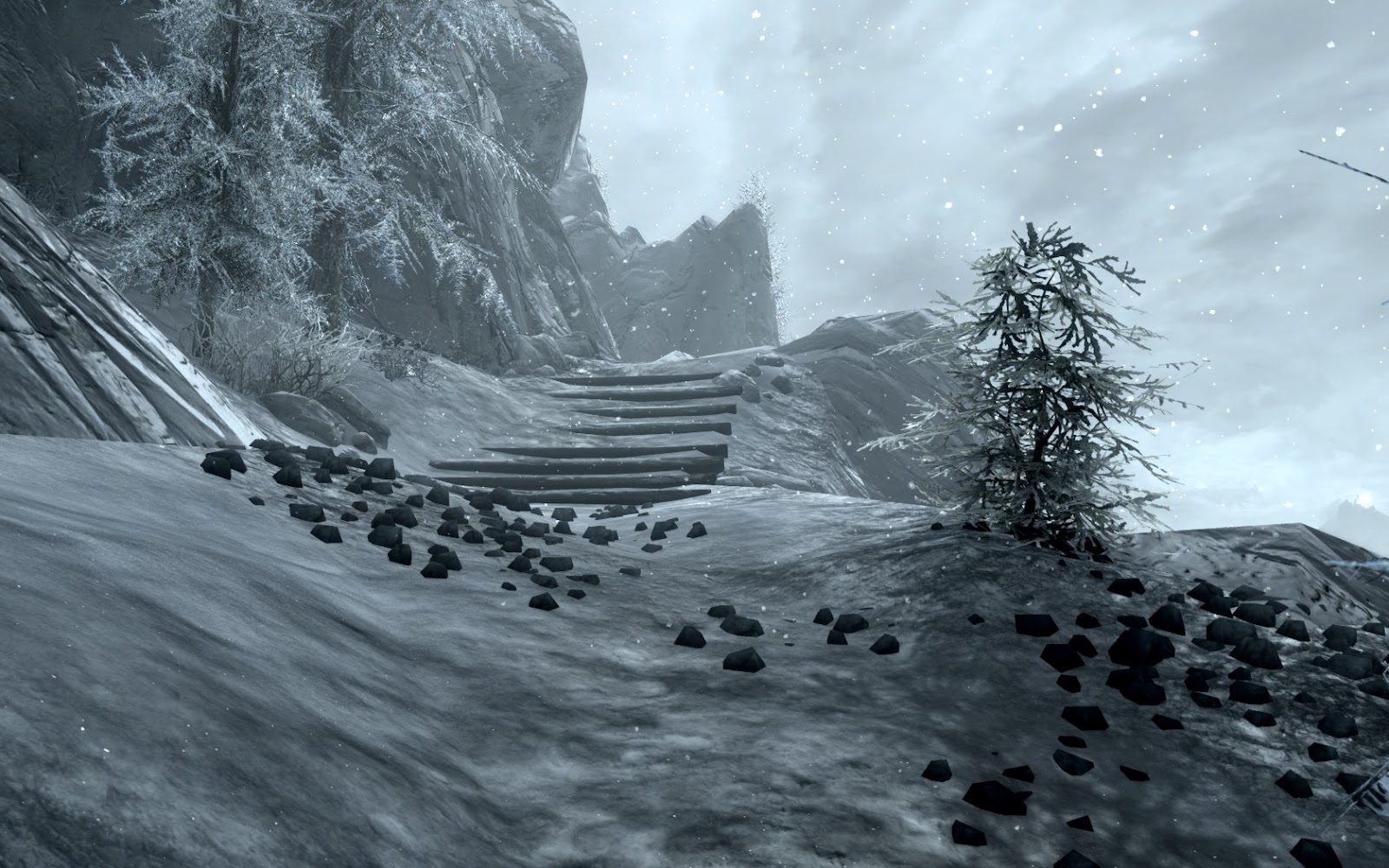
This makes the inclusion of stairs feel like a very natural part of the environment. One of the problems with open world games, especially those that are as large as Skyrim is the risk of players getting lost. Skyrim has many clever way of leading the player towards points of interests, from stone canines, small rocks statues, and dirt paths. One of the greatest way that the game leads the players is with stairs, low stone stairs that do not impede the players walking speed, but that subtly show that there is something important nearby. 


Height has also been used with great effect in Skyrims two latest predecessors. Cyrodiil in Oblivion is markedly bowl shaped, with the imperial city in the centre of the bowl. The effect is that if the player goes downhill they will eventually end up in the Imperial city. A logical design considering how vital the city is for the game both narrative and gameplay wise.

Vvardenfell in Morrowind is likewise built around a specific geographical feature, namely the red mountain. The cause of the red fever and home of Dagoth Ur. The presence of the red mountain in the centre of the map, in combination with the constant belching of smoke gives the game a constant sense of dread and urgency.

The player often simply needs to look up for a reminder of what they are fighting for, and trying to destroy.

Mountains and cliffs

The decision to make Skyrim a very mountainous area further helps to funnel the player in to areas of interest. Roads snaking along valleys and across vaistas is an easy way to lead the player towards points of interest. This strategy is very much enhanced by the combination of stairs leading up otherwise unscalable hills and cliffs. The world design takes great advantage of its mountainous areas to create breathtaking vistas from many of the games key locations.

The dragon priest ruins having several high points from where they practiced their Thu’um also makes for great vantage points to the players. Mountains also make for natural barriers, and while they do not often work like that in practice, mountains are great theoretical barriers to keep the players away from certain areas, or from taking unintended routes.

The introductory road to Riverwood being a great example of this, as the players snake along the road down the cliff they are faced with the vastness and emptiness of Skyrim’s wilderness.

Miraaks temple is placed on a hill, at one of the highest points of the island. The castles of the vampires and the Dawnstar are both located on an elevation, letting them loom over the players as they approach.

Cities and stairs

The main cities of Skyrim all use elevation in interesting, and often historically accurate ways. Windhelm is very clearly stratified around elevation, with the jarls kept at the top, leading down to great families, then the traders and last the common citizen. Morthal has a similar design with the temple of Diala and the jarls keep rather literally lording above the lower levels of the city. The poor are literally forced underground, while the rich live in cliffside residents. 

Winterhold is rather flat, with two exceptions, the docks and the grey quarters are both located at the bottom of steep stairs, putting them at a both spiritual and visual lower level then the ruling nord classes. It also increases the sense of isolation and destitution of these areas

Solitude has an interesting dip in the middle of the city, as well as a hill approaching it. This detail means that both the blue palace and the imperial fort are located uphill. The player will always approach these structures from below. Riften has the most obvious height dichotomy, with its most poor literally living underground, while the Jarl fort is also located at the top of a small hill.

The college of winterhold also is kept at a distinct elevation from the ruins of its former patron city. Finally at the greybeards located at the highterst top of the world, both in literal and spiritual sense.

Conclusions

Height and the traversal of height is a vital part of Skyrim, both from a narrative and gameplay point of view. The ways that Skyrim uses height can be mirrored in the way that Oblivion and Morrowind uses height. The concept of elevation can be used both as a gameplay tool, and as a narrative tool.

The volcano of the Red Mountain in Morrowind both works as a goal, but as a deterrent to the player. Doubly so with the addition of the ghost fence cutting the player off from the peak for most of the gameplay. It is a deterrent, but also a sign of the ultimate goal for the player.

Oblivion uses its bowl shape to give the player a constant reminder of the Imperial city, the seat of power for the empire, and the very thing that the player is working to save. From a gameplay perspective does Oblivion use the high tower of the Imperial city as well as its central location as a tool for the player to navigate, and find their way back to the central hub of the game.

Skyrim likewise uses elevation, and stairs both for narrative and gameplay use. The narrow valleys help guide the players towards points of interest, and the elevation of certain buildings relative to its surrounding can tell the player a lot about a place without saying it expressly. 

Gwylim notes on Skyrim: The joys and frustrations of in game book hunting

I am sure that many of my readers have had the joy of finding a specific book in an obscure bookshop or lurking in a digital archive somewhere. The frustration when you are missing but one text in your collection, the unwillingness to start a project before you know that you are all the texts you need to start. I admit that this is not a problem that many people have, but I am sure that at least some of my readers can empathise with my plight!

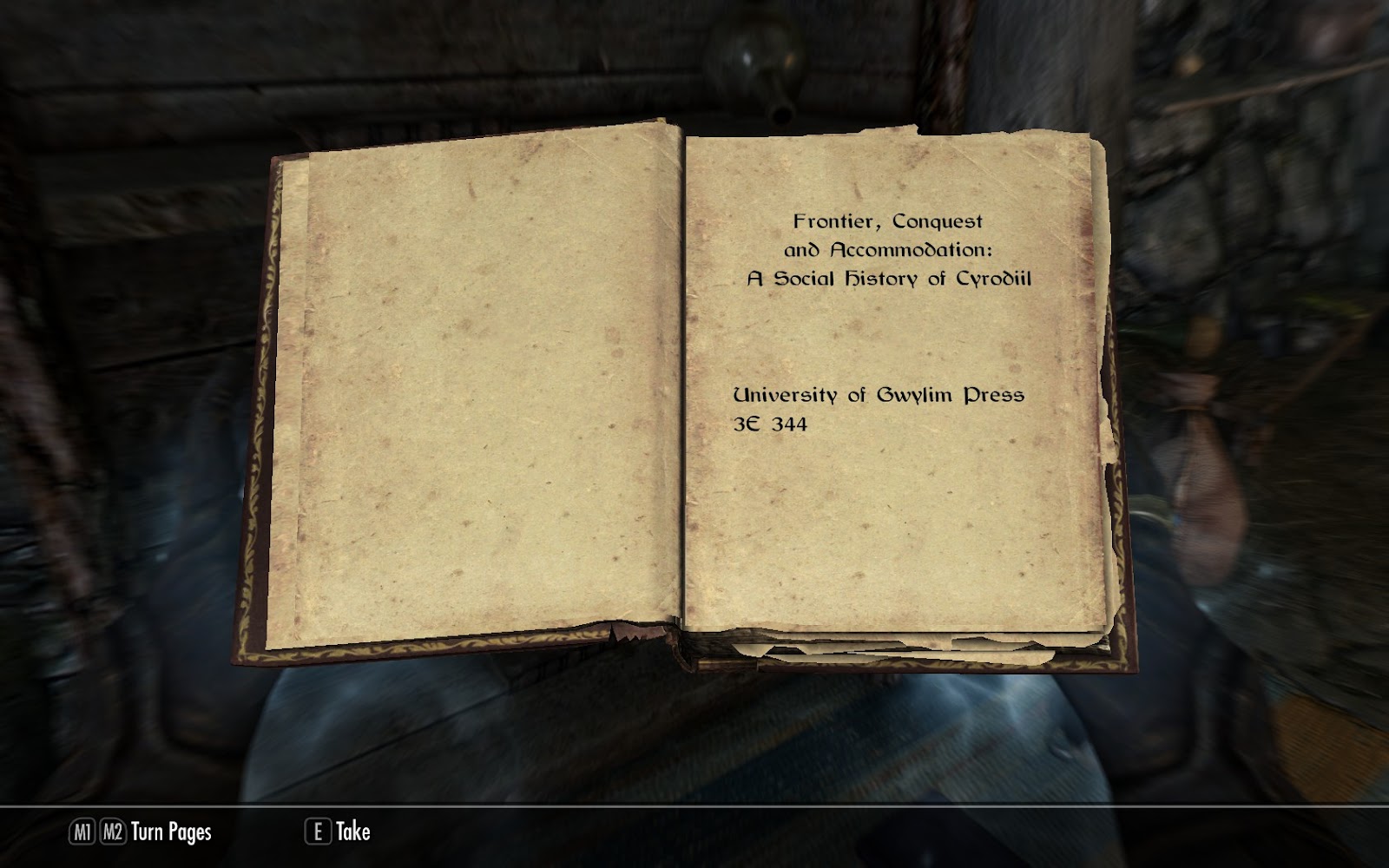
A book from Skyrim in the reading view of the game.

I have had a similar experience in skyrim recently. I have discussed the wealth of reading that can be found in the elder scrolls series many times. There are novels, poems, essays and unhinged ramblings to be found in all of the main games. In many of these games there also exist book sellers in where to easily and effectively acquire this reading materials, as well as libraries aplenty.

Skyrim is different in this regard, as it is the general store sellers that sells but a paltry few books. The only libraries available to the players are also located at either the seats of power, or at Skyrims two seats of learning, the bards college and the College of Winterhold, the primary location to learn the arcane arts.

The second of the two colleges have an especially stringent and suspicious librarian. Due to his dour nature, or due to a lack in coding, can you in fact Not borrow books from this library, though he does sell some of the texts he stores there. Due to a quirk in the book shelves in the Winterhold library can you only read the majority of the books if you steal them from the shelves, as they are not located in the regulair open style bookcases.

There are on the other hand other ways to acquire reading material in Skyrim. First and foremost does the otherwise uninterested populus of Skyrim own a fair few books themselves, as at least two or three can be found in each household. Likewise does it seem that everyone from blood crazed necromancers to cut throat bandits have a bend for reading. As a result the dungeons are populated by sentient races often surprisingly full of books, journals, scrolls and other reading material.

Many of these seemingly brutal and bullheaded robbers seem to have an interest in obscure history and advanced magical theories. As it is more common to find a thesis on Mysticism next to a bandit bed, then it is to find something salacious like The Lusty Argonian Maid.

This means that the best way to expand your library is to either delve into a dungeon, or go thieving in the neighborhood. I want to make the argument Skyrim has moved away from the cities being as much of a hub as they were in Oblivion and Morrowind. The wilderness and the quests and adventures that take place in the wilderness between the cities, has taken over much of the time spent in the cities, especially Oblivion. In the earlier games most quest givers lived in the cities, as well as large part of the quests themselves taking place in, or near cities.

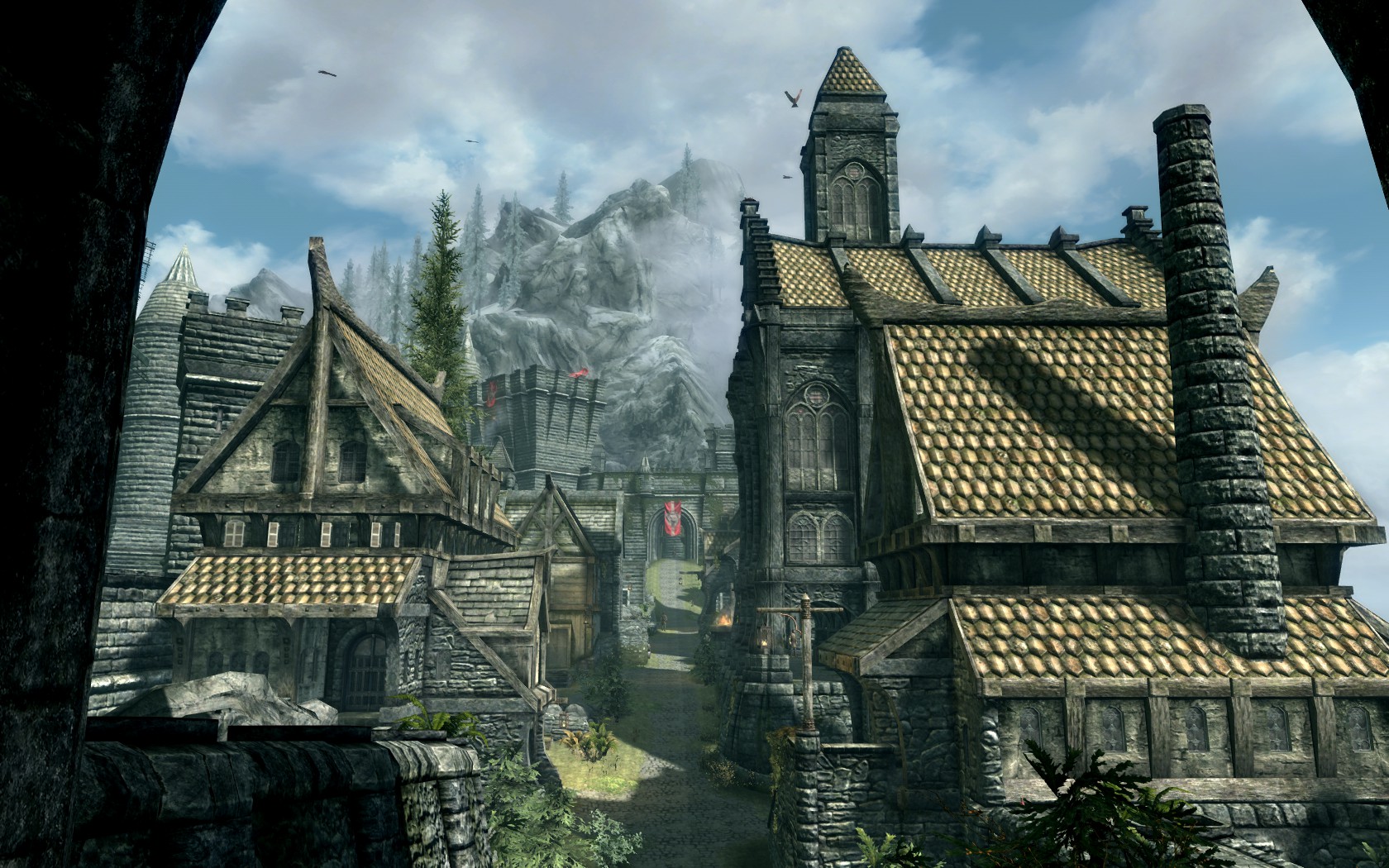
An in game view of the city of Solitude from the game Elder Scrills: Skyrim

As a result would it make sense that much of the amenities that the player needed, weapons, potions, books and other gear would be available to them in the cities. Likewise does the specialized stores help create a sense of urban life in both Morrowind and Oblivion that I believe is deliberately absent from Skyrim.

It makes sense for the seat of the mage guild to have a dedicated staff shop for example. Likewise would it make sense for Vvardenfell capital with its many educational and administrative centres to have a well stocked bookstore available. These shape the narrative of the world itself.

Skyrim is a much more rugged place, but also a different game. Many quest givers meet the player on the road, or in small villages, and when they are located in the cities do they more often than not direct the player to a cave in the wilderness. The courier is another mechanic that delivers quests to the players with the constant letters and requests. Specialized stores that only accepts certain kinds of loot would slow down the game loop of:

Visit town, get quest.
Visit wildernets, finish quest and get loot.
Visit town, sell loot, repeat.

A book from Skyrim in the reading view of the game.

All of this gives the gameplay a much more mobile feeling to its gameplay. I would argue that the lack of specialist stores have also had an effect on this. You are less likely to spend time in a town when every single town offers the same, smithy, general store and alchemist as the next.

All these design choices make Skyrim feel differently from their predecessors. You explore and interact with it in different time scales and relate to space in different ways. The way you interact with the hour to hour gameplay is subtly different in many small ways. For example how the player interacts and considers the loot from dungeons and quests.

As a result is it only natural that you would need to interact with the lore book in different ways. While I do miss The First Edition from Oblivion very much, I must admit that a bookstore in Skyrim would not fit into the differently phased and organized gameplay that the game works around.