
Warning: This text do contain several major spoilers for the game Undertale. We will in this examine the games narrative in its entirety. As a result we ask you to only read this paper if you have already consumed the medium in question, or don’t mind being spoiled on key parts of its narrative.
Introduction
Undertale is an indie game created in 2015 by Toby Fox. Undertale is s classic turn based role-playing games in the vein of Earthbound and the early Final fantasy games. The unique mechanic of Undertale is that every single foe can either be killed or befriended, as well as, the game saving everything you do contiguously, regardless of the players own saving and loading.
This is not going to be the focus of this paper tough, rather this text will focus on how Undertale plays with different narrative and textual levels. This text will begin with a small introduction to the terms and general theories this analasys will be based on, followed by an in depth analysis of the text concluded with a concluding discussion on the analasys as well as tips on further reading materials on the subject.
Terminology
Before we start with the analysis of Undertale itself, will I present a series of terms that we will use in this, and future texts like this. It is inportant when writing any kind of academic text to always clarify how You the author will use the terms used. A term like text or contextulity will have different meanings, and it is vital to specify which meaning you will use.
Text
Firstly the term Text will refer to everything that is traditionally considers to be part of a video game, graphics, music, game mechanics, dialogue etcetera. In other words is the term text not limited to the written word. In this chapter will text mean the game Undertale.
Textuality
This is a breakdown of the different textualists we will examine in this chapter. We will also analyse how these levels interact with each other.
Text– Everything that is explicitly part of the narrative or story itself. Characters, plot, game mechanics, items, rooms etc, game assets. The text encompass everything that can be part of the text itself, this is different between genera and media forms.
Subtext– Everything that is implied or offered by the author in the text. Themes, morals lessons etc. These themes are not directly mentioned openly in text, but inferred using allegory or hints left for the reader to find for themselves.
Intertextuality– Anything connecting this text with another text, for example Toby Foxes other games or games in similar genera. The most common example of intertextuality is between the texts within the same series. In the terms of literary theory is there no connection between, for example, part 1 and part 2 of the Harry Potter series. These ties are instead left for the reader to create, just as the subtextual connections. Intertextuality more difficultly means the narrative ties between books. Titles, the text on the back and the numbering of series, falls within the category of paratextuality.
Paratextuality– Surrounding texts not part of the text, including the code, the title screen and border etc. These are part of what is sometimes reoffered to as the “artefact” or the object of study. Code, the box, the background blurb.
Analysis
The text we are to analyse today is a video game titled Undertale, its tag line being “a friendly game where no on needs to die”.
Undertale is constructed as a traditional turn based RPG where you traverse several game maps or “rooms” and fight enemies on a “battle screen”. By battling you gain either experience or money. You get money by choosing to ”spare” an enemy, and you get XP for killing an enemy.

The picture above represents the battle screen in Undertale. Here you have a series of options presented to you, you can do one of the following things on your turn, fight, act, use an item or try to spare your opponent. Here you also see your level and your current hit points.
The large black screen is representing the enemy attacks, and here you will dodge, their attacks in the vein of bullet hell shooters1. This area is, as described earlier very much a physical plane within he game world. Other characters can very much influence this seemingly purely mechanical plane. This fact become even more apparent within the games so called ”dating hub”.


The paratextual connections, are used very often as a narrative device. This can most most easily be seen in the border window of Undertale, this border is not what we would consider part of the normal text. The border is often used as a narrative device, this is done by either changing the title of the game or moving the program around the desktop in various ways.

A second layer of paratextuality is a lot more closely tied to the text. This layer consists of the gameplay vs story. The battle screen is most often considered a semi real plane, existing only to drive the story forward. The most obvious moment being, the fight with Papyrus being interrupted by the annoying dog physically stealing his ultimate attack. A more obscure example is that the different areas within the world is know as ”rooms”. Rooms are usually what these areas are called within game terms. These rooms are then tied together, with ”doors” or ”portals”. The character Sans ability to teleport can be, the ability to freely enter these rooms out of order. These doors can at different points also lead to different areas, something we will discuss later.
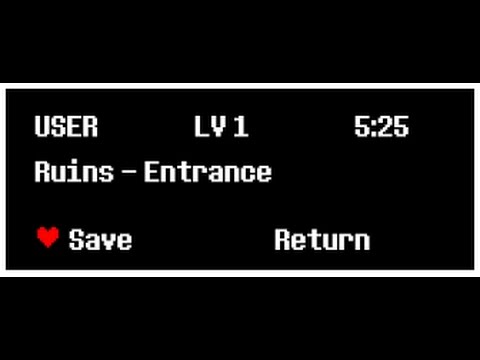
Lastly we need to discuss the concept of Loading and Saving. I here refer to the ability to create a ”save state”, this save state can later be returned to by loading a save state. The power of loading and saving is something that some characters have this ability to ”save” and ”load” at will. More specificity do you the player, and the main antagonist share this mechanics laden ability. This ability in game lets you return to a previous ”save state”, and fix potential problems and or misses you may have done. From a gameplay perspective does saving not actually create a save state per say, but rather moves you along a different narrative path, the game instead autosaves whenever the game is closed. This fact become apparent rather quickly as your player character has reactions to characters they meet for ”the first time”. Certain characters like Sans, and the shop keeper Temmie also seems to be able to keep track on whenever you load and save.
Subtext and the mystery of Gaster in the code.
In this last segment will indulge ourselves in some theorising on some materials not directly tied to a first hand source. In this area we will partly discuss things found within some second hand sources, mostly in the form of Wiki pages and other peoples analysis of Undertale. The character known as Gaster can only be encountered if some very specific criteria are met in the games algorithms. These algorithms are known in the games files as “fun values”, and are used to calculate a series of random events occurring.
One of the more interesting random events bring that of the character Gaster. Hem as well as any character related to him, can only be met if certain fun levels are met. One of these individual explains that Gaster was “lost in his own creation”. This could either relate to the grand power plant known as the Core, witch he supposedly created, or that he got lost in the very code itself.
Conclusion
The narrative style of Undertale takes up on a rich tradition of fourth wall breaking. This tradition was common in certain schools of theatre and film. These breaks go further then the simple acknowledgement of the audience, and makes both the game and the player itself, part of the narrative.
Different characters, such as Flowey, Sans and Asgore al have some sort of power to influence the game mechanics or objects on a Paratextual level. These are but a few examples of the various ways Undertale plays with differencing levels of textuality. I will leave it to the readers if the wish, to discover the rest for themselves.
Footnotes
1The genre of games where you play as a ship or other small object, dodging a series of bullets or other fast moving objects.
References and further reading
Click to access Narrative%20in%20Games.pdf
https://www.jesperjuul.net/text/clash_between_game_and_narrative.html
Analyzing the Game Narrative Structure and teqnice – Huaxin Wei
Undertale – Full Pacifist Play-through – No Commentary: Havoc teh Raven
Undertale Save File Nasıl Yüklenir
 An Unused Frequency