
Introduction
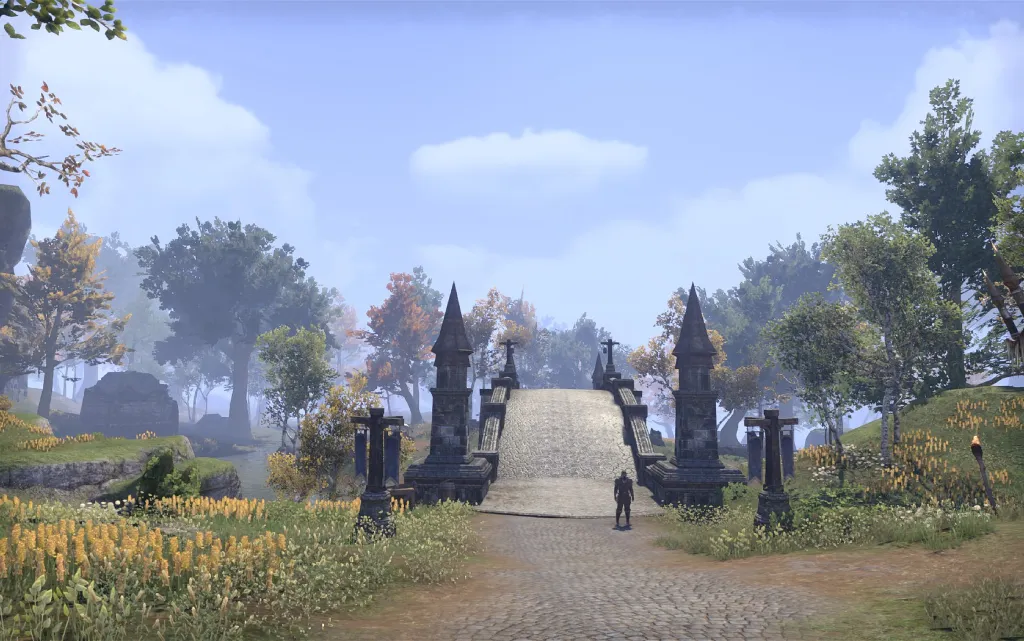
MMOs have to make several discreet and measured implementations of both story and landscape to make the world feel believable both as a solo player in an empty area, and as a group player in a bustling hub. In this text I will focus on how ESO works to keep their cities feeling lived in, regardless of player density. Specifically how the developers have used the language of urban city planning to create a living world that does not feel too crowded.
I lack the knowledge to discuss instancing and server load allocation, so I will leave that to others. I will note that this is also a large part of helping both performance and enjoyment for players in larger cities and settlements. Certain quests also require some cities and towns to exist within several instances, changing how the city is traversed as a hub of player activity and a setting for quests.
Trade, guilds and services
Stables tend to remain close to the city gates. Mage guilds and fighters guild halls located close to, but not at the centre of many large settlements. Crafters and crafting stores often take a central location forming a natural hub of activity. The Thieves guild hideout often has one entrance at the outskirts of town, and one in its center, easing entrance for players that have acquired bounty and stolen loot they do not wish to lose.
The challenge is to make cities that follow these utilitarian rules without making it too obvious to the player. Later zones often sprinkle in festival squares, specialty stores and other event spaces that makes the city or town feel more alive and unique.
Roads, harbors and wayshrines
Like real life cities and towns are their ESO counterparts focal points for several kinds of travel. Most small towns have a wayshrine either in or nearby. Wayshrines allow the player to travel to and from any discovered wayshrine, making for a natural reward for exploration. The wayshrines in the major cities are often available by default.
Each of the game’s zones have one central focus point, where the always available wayshrine is located. From here it is often relatively easy to find ways to get into the zone and its story. Many of these locations also contain a harbor, allowing players to traverse the world in a more diegetic way. Hopping from harbor to harbor until the desired destination is reached.
Both ways of travel are vital to the game experience, and the game would be lesser if one of them were omitted or neglected. I will discuss the importance of roadside traders and wilderness crafting stations to alleviate the sense of crowding in cities in a later essay.
Quest locations and drop off points
Many towns and all zone centers function as hubs and settings for all manner of quests. Here I must distinguish towns and quest locations. I will dive deeper into quest locations and their utility in a later essay. For now I distinguish towns as areas that contain quests, but are not defined by them, and quest locations that are fully defined by a quest chain. Many quest locations are environmentally, towns, and some become what I call towns after the quest chain is completed.
The primary location of a zone is often where the zone quest starts and ends, with several visits during the quest chain. It is as a result vital that the town can evolve as the player progresses through the main quest. Orsinium being the most extreme example of this, having the city be built as the player progresses through the story.
Most other zones simply move npcs around, or change a few things around town. The largest change being the celebration at the end of each zone, where the player gets a prologue to what happened to the people they met during the zone.
Final thoughts
Cities and towns are vital in most MMOs, as well as in ESO, they have great utility, and work as great start and ending points for many quests, especially prolog quests. They have many convenient crafting stations and work as a natural meeting point for other players. With this said, there are several ways that ESO naturally disperses players throughout the world in a way I have not seen in other MMOs. Traveling merchants, wilderness crafting and the absence of class trainers makes it easier for the player to stay in the wilderness for much longer than in other MMOs. I will discuss these design points in more detail in later essays.


