Ratchet and Clank 1 shares a lot of the same quirks as the first Crash Bandicoot game, created by the teams contemporaries, that of being the first. There is a sense of being on uncertain grounds and throwing everything at the wall. The player is thrown between rail grinding, shooting and puzzles within the first hour. A lot of the early game quests feels like after thoughts, you often travel to a planet solely to get a tool to solve a puzzle on another map. On several places the way to advance is to ignore the obvious path and go exploring. What makes the game so fascinating, is that it all works.
The game throws you from planet to planet, from play-style to play-style at a truly breakneck phase, yet never feel rushed. No one mechanic never truly comes to overstay its welcome. Like with the companies other start title Spyro, are these segments not nearly as jarring as one would expect.
The narrative of the game is primarily moved forward by the acquisition of data-bots. Small floating robots with screens for mouths, that sometimes, but not always runs away from you. These robots gives the player a cut scene tangentially related to the next plot beat, as well as the coordinates needed for the player to reach the next planet. More then once is the acquisition of these robots not tied at all to the main objective of the game.
A striking example of this narrative stricture is at the x research star base, where Ratchet suggest they should got to find a scientists to interrogate, in order to find the big bad, the owner of said space ship.
The player does indeed find a scientists on the station, and talk to him, but instead of getting any form of information out of him, the player is forced to buy a pair of grind boots to progress. These frequent hurdles exits throughout the game, and often requires the player to find more bolts, the games currency, or save up the bolts they find naturally. The problem being that these same bolts are also used to buy weapons, and ammunition, some being prohibitively expense. Teaching the player to early on be fiscally conservative with their bolts.
The data bot needed to progress is placed in a seeming side path, a quest to find rare tech. Thankfully the map design is made in such a way that the players vision first lands on the shuttle used to travel to the seemingly optional side quest. The game early on presents the player with these side paths, but only some are in fact optional.
The game is understood drastically differently if its either seen as a single game, or as the first game in a series. The first game in isolation has a strange sensation of trial and error, and unfinished ideas, but also of novelty and strangeness. When put in the context of the sequels does the vision become more clear, and the strange choices become more apparent and put in a larger context, just as with Crash Bandicoot and Spyro.
This era is full of games that never got the chance to leave this stage of novelty and strange experimentation. Glover and Rosco McQueen likewise falls in this genre of experimental third person platforms, all tying their creation to lesser or greater extent to the innovation that was the dual-shock controller. A revolution halfway trough the lifespan of the PlayStation one, it drastically changed how the players could navigate and look around a virtual space. No longer limited to workarounds like Z targeting that plagued so many Nintendo 64 games.
Many of these experimental games never got the squeal they needed to fulfill its promise, Ratchet and Clank was one of the exceptions, it got not only a sequel, but an entire series. It is trough this lens that I will return to Ratchet and Clank next.
Poes law stats that there is no way to know if a radical standpoint is an expression of a genuine belie, or irony in the absence of clear signifiers. Likewise would I argue that it today is impossible to determine if a volatile or radical editorial or article is written in good faith, or for the express purpose of being spread. I want to argue in this texts that there are discussions that are worth not having, opinions best not shared. In other words, in this strange game, its best not to play.
In this text I wish to discuss two forms of editorial texts, and why neither is worth engaging with. Both of these reneges has serious overlap, and the difficult in differentiating one from the other is part of the overall problem of engaging with this kind of material. My goal with this text is to argue for the old internet adage of not feeding the trolls, and instead focusing on boosting narratives you agree with.
The first kind of text is the one that holds a genuinely held belief, or expressly held beliefs. The second are written to profit of the first kind of text, written to be spread and so make money in the attention economy of the modern internet.
Foul beliefs, carelessly spread
These are assumedly written either to reach those that already agrees, or are open to be persuaded into such beliefs. These texts I aim to discuss often holds radically conservative, racist or bigoted views. Liberal and leftist writers and commentaries has traditionally tried to counter these arguments by commenting on, and arguing against them. If this is not done carefully will any spreading of this kind of material inevitably lead to it being shown to more people, and in the metric driven internet, this means even more preference in the algorithms.
I instead argue for an proactive rather then reactive approach, instead of commenting or “dunking” on radical conservatives, must we present our own narratives. Instead of sharing posts from racists uncles, share posts from creators and activists that work to further the causes you belie in. It is a fact of life that the mainstream internet is run by oligarchs, most if not all holding conservative beliefs and goals. It is therefore of utmost import hat we do not accidentally help the spread of radical conservative beliefs via the algorithms by pushing more views their way.
Rage bait slop, easy money, but not for you
The second form of text holds the same content most of the time, tough most likely more exaggerated. This form of content is solely meant to feed in division, anger and fear. Often using eye catching titles, images etc to draw your attention, if you click the link, the article has done its job, if you share it, even more so. The insincere tone is often easy to recognize once you learn how to spot it. And when you do, your job is done, and you can move on to something else, preferably after blocking and or reporting if that is an option.
These texts often contain logical fallacies, factual errors and deliberately aggressive and hateful rhetoric. The skill of recognizing rage bait is similar to the skill of recognizing scam messages. Scam messages are often written poorly, and sounds impossible to target those that have the largest risk of falling for the scam. In this way are the errors a deliberate part of the scam. In similar terms are these awful and clearly false facts part of the overall strategy to goat you into sharing their advertised slop even further.
What do we do?
The modern internet can often seem as a hateful, bitter and dangerous place, but it does not need to be. Trough education and sharing of resources can we help to educate the general public in internet media literacy. This starts with you dear reader, if you ever ask yourself “how can anyone belie this?” or “how can anyone be this stupid?” its most likely either deliberately written to make you angry, or written by someone you would not want to give more money to. This counts especially for large media companies and other corporations Remember that Bud light got thousands of dollars of free advertising from transphobies filming themselves shooting beers with machine guns.
It is difficult, and it will take time and work, but instead of sharing that link or post that comment, pause and consider the desired outcome for the poster. Just like a troll aims to make you angry, so does slop and rage material. Block, report and move on, focus on sharing what you live, and do your best to minimize the spread of what makes you angry.
Don’t feed the trolls, share joy, that’s the first step.
Specificity is vital in all forms of science, that includes the humanities. One part of specificity is the specification and standardisation of terms. Models can be made first when the parameter for that model has been created. These terms can often seen strange or alien for those outside of a specific field. These terms are often used differently from how they are used in everyday speech. I will over the course of a few essays present a series of terms that I have found invaluable in my work as a media analyst, starting with the term Text.
What is a text
The term text, in its simplest more basic form denotes the object that will be analysed or deconstructed. This text is any set of symbols that carry meaning, and can as a result be analysed. The text varies from street signs, to novels, movies and music. The form of the text takes is not important, the fact that it carries meaning is. The term text is a clear denoter of meaning, and can be applied to a large number of items, objects and concepts.
Why use text
There are several reasons to use the term text, chief amongst them is to create a unifying term of discussion forms of material. By crating and using a unifying term will the author not need to reiterate what kind of media that is being discussed. While any analysis of course needs to discuss what kind of media form that is being presented, will the term text make it easier to call back to the specific object.
A clear tie is created between the analysis the analysed and the rest of the world, a clear object with boundaries and properties. This is another use of the term text, as it can be used to specify cut off objects in otherwise loose and sometimes arbitrary collections of symbols. A text can be an entire website, or it can be a single blog post. A text can denote a single episode of a series, or the entire series.
Finally does the term text allow the researcher to make judgements and carry out tests between different forms of expression. For example can books and movies from the same series be presented in the same discussion without the need to specify that each object is a form of media at every part of the analysis. Instead can text 1 and text 2 be used for comparison purposes.
How to use text
The term text is a flexible tool, but as any tool does it have its limits. For example is it still vital to explain what form of text you are discussing. The text itself must first be fully and clearly be presented and defined. The term text should only be used to specify what artifact, or series of artifacts that are going to be discussed in the analysis. Due to the fact that all form of expression and information has their own language, can the term not be unclarity used to make blanket statements regarding for example, all romance novels. The text, in this case, romance novels, must be clearly defined beforehand. Just like with the term canon and author is it vital to present the context that the term text is used within. This specificity is especially important with the term text, as it can be used on everything from bulletin boards and street signs to novels and long form TV series.
Final thoughts
I have hopefully been able to show a number of uses and functions of the term text, as well as limits in this essay. This is a short introduction to the term and does not come close to covering everything that the term can be used for. I point towards my essays on pop culture for more practical example of its use. It is my hope that my media literacy essays can be used to gain a fuller understanding and appreciation of not only media analysis, but of media and its discussion in general.
All players of Morrowind start their adventure by leaving their prison ship, and entering through Vaardenfell costumes office. They enter the game as a prisoner, brought to Vadeenfell under unclear circumstances, with only a cryptic dream of Azura to guide you. The Sedya Neen port is a customs office, giving the game a perfect excuse to ask the players questions about their race, name and profession. The office effectively presents the player with the workings of the Empire and your role within it.
This is a goal that Skyrim also achieved by having you give your information to the executioner. Morrowind shows the bureaucratic rigour of the Empire, while Skyrim shows the cold and careless part of the same bureaucracy. Both approaches are useful, and have their positives as well as negatives. While Morrowind’s approach is more diegetic, is Skyrim’s approach doubtlessly more action oriented..
The ship and the dock
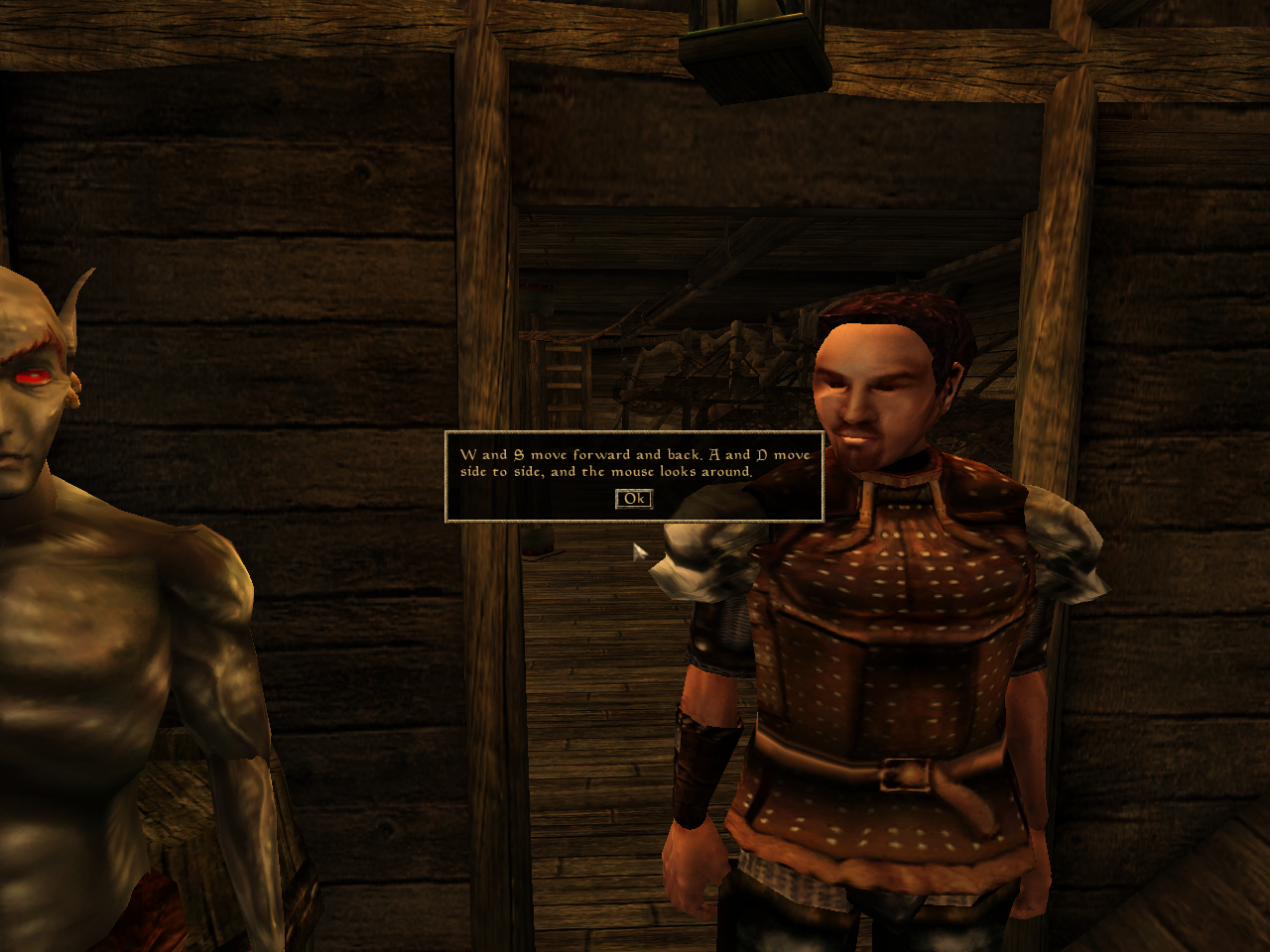
The game slowly introduces you to the controls of the game, moving, talking and interacting, as you travel through the
ship and interact with your jailor. As you leave the ship you are asked to tell the first clerk where you are from. This being the game’s way of making the player choose their race diegetically.
The landing area is small, verdant with life, and completely closed off from the rest of the gameworld. The player is situated directly in front of the entrance to the survey office as they leave the ship. This gives the player a clear goal, while also giving them small glimpses of the world beyond the introduction area.
Getting registered
Entering the customs office you are met by an elder Imperial man, asking you to fill in your paperworks. He dryly explains that there are a number of ways that this can be achieved, and that the choice is up to the player. Here the player can make their own class, pick one from the list of premade classes, or answer a few questions to let the game pick a class for you.
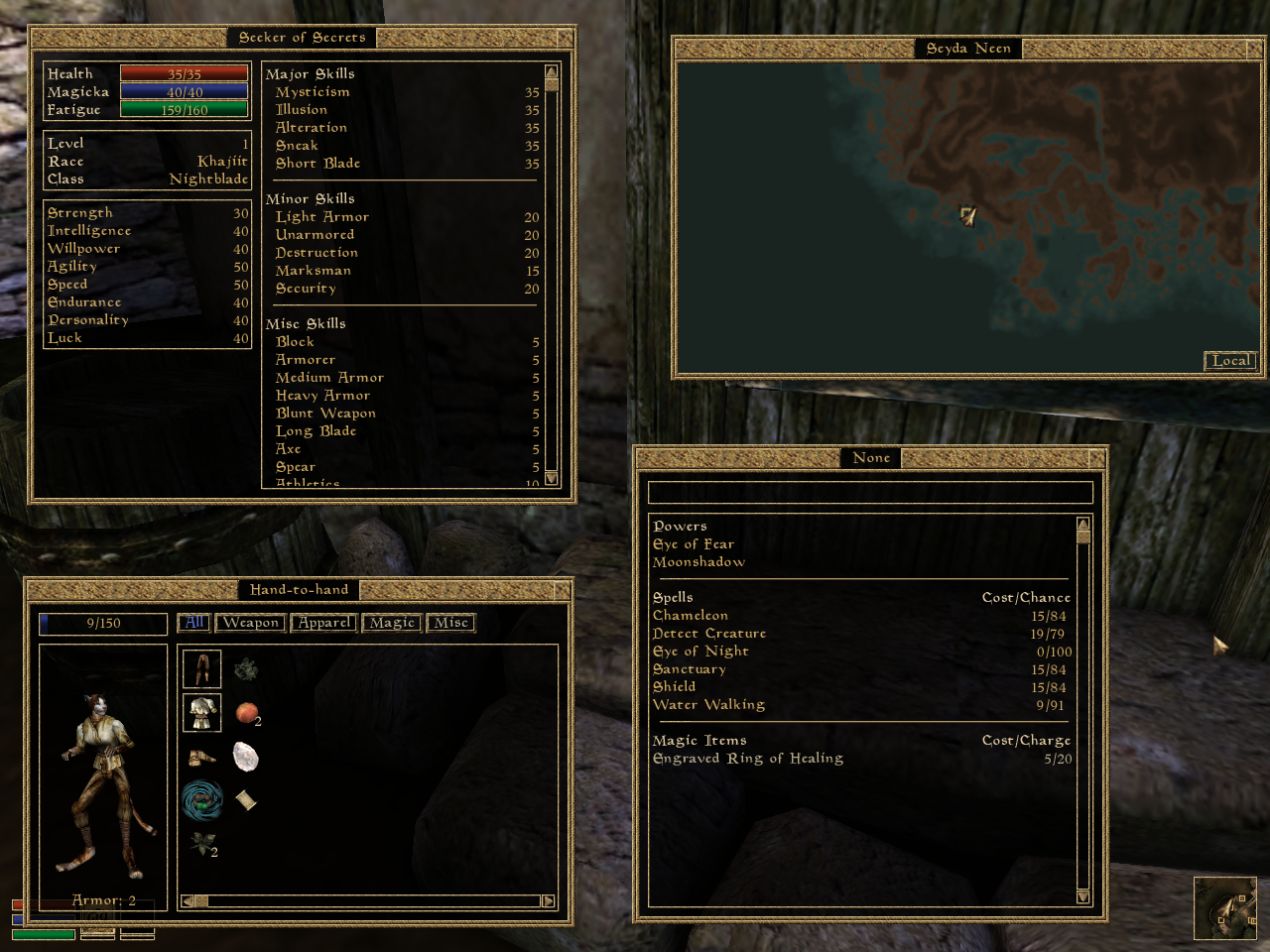
While these questions are rather strange and surreal in the context of the registration for entry, the game has done enough groundwork for it not to be too immersion breaking. As you fill in your race, class and birth sign, is your character menu likewise filled in with the relevant information, making the UI feel like a natural extension of your characters paperwork. You get one last chanse to correct anything you are not happy with before leaving the character creation process. At this you are ordered to grab your papers of registration and show them to the guard at the end of the room.
Exploring the halls
Leaving the costumes office you are briefly left to your own devices in a series of small rooms. Here you can find a few interesting objects that I will explain later in more detail, as well as plenty of trinkets books. Right ahead of the player is a small set of stairs, leading to a number of barrels and boxes, containing clutter items as well as alchemical ingredients,as weöö as gemeral nicknacks.
Directly to the right is a room that is far more inviting in its decor and overall layout. Here the player will find a book case, a locked chest, a dagger and a lockpick. Picking up the dagger or the lockpick gives the player a small tutorial window relating to combat and lock picking, the game suggests that the player tries to pick the lock of the small coin chest in the same room. The drinks and the bread can be picked up, leading to the same short tutorial on alchemy described earlier. Leaving the dining room leads the player to a small outdoors area.
The ring, the knife and the lockpick
It is in this walled off outdoors area that the player finds their last tutorial item in a barrel, a magic ring. The barrel is located in such a way that it is almost impossible for the player not to have it directly in their line of sight as they enter the area. The knife and the lockpick is similarly located in the player’s direct line of sight, with the dagger being called out in a corresponding note.
Picking up any of these items gives the player a small explanation on how they work, and how they are equipped, slowly introducing the players to the game mechanics as and when they become relevant. While not the most interactive tutorial mechanics available, are they effective at the goals that they aim to achieve. At the end of the tutorial area, most players will be informed about the game systems of magic fighting and lick picking. Leaving the open area leads you to the last room of the tutorial area.
Release, getting your orders
The player enters the last small office, populated by a single guard that instructs the player to take a packet of contact in Balmora. The player is given a package as well as some instructions on how to carry out this task. This being the only guidance the player gets besides their cryptic dream from the introduction cutscene for quite some time. This approach teaches the player that Morrowind’s secrets are many, and that they need to find them out for themselves.
The player can ask the guard a series of questions regarding a number of topics, as well as trying their hands on the persuasion system. The player learns through the dialogue tree that asking certain things can lead to new topics being discovered. When the player is ready to leave there is a door at the opposite end of the room.
Epilogue, choices and consequences
Leaving the costumes office, the player is faced with the last mechanic that the game will teach them for a while. A Bosmer man wanders outside of the costumes office, apparently he has had his prized magic ring confiscated recently. The same ring the player just picked up. Here the player learns about unavoidable text options in the form of red text snippets.
Here the player is forced to make a choice, to give the ring up, or to keep it. Keeping the ring allows the player to cast a spell they would otherwise not be able to for some time, while handing the ring over raises the disposition of the Bosmer man. The man also hints that mentioning this to the local shop keeper will give you better prices. If the player were to help the man, and mention it to the shopkeep, they will indeed be rewarded with better prices at the store.
From here the player is free to explore at their leisure, with a stern but gentle suggestion that they should travel to Balmora first, to get that entire prisoner business dealt with. So begins all games of Morrowind, heading out from the confined tutorial area of the Seada Neen customs office.
Do you like my writing and want to help me write more? Please take a look at my patreon, it has several essays, and would help me create a lot more: https://www.patreon.com/cw/SamRandom13
Mundanity is a powerful tool of storytelling, it helps anchor and expand the narrative, it gives the reader a chanse to recover from a particularly intense chapter. This last part is especially important for games where the players take a more active role than in for example film watching or reading. Morrowind has several organically formed downtimes, primarily traversal from one area and another, while this is a fascinating form of mundanity, and one that I will undoubtedly come back to, is there another mundanity I wish to discuss in this essay, the mundanity of faction questions.
Specifically the mundanity of the quests found in the joinable guilds. Unlike the later games in the series, these factions do not have a big Crisis to solve, no real villain, and no truly complete unbroken narrative. What you get from the quests is that of which you puzzle together on the way, vague hints and implications of grander plots. What makes these quests so engaging is that they often intersect with plots and narratives of both the main quest and other grander narratives of the game.
While you may only go to Vivec city to acquire a rare book for a colleagues research paper, you will inevitably find many more quests on the way, many more areas to explore, as well as some interesting hints and implication of the mystery of the Neravarine. The quests writing and design works rather effectively for giving you a reason not only to explore, but to place the player characters in regions and situations they may have otherwise missed.
The mundanity of the guild quests also helps with how Morrowind is designed to be interacted with. For the longest time, the player is not The hero of the tale, but a simple agent of the imperial crown, pardoned from an unspecific crime in return for providing a vague service to the crown. You are a person in the world, rather than a hero that happens to it. The game pretty early on heavily suggests that the player should join a guild or another organization, with the logic that the player will need some form of cover. Again enforcing that you are not necessarily the big hero, yet. So far you are a mere civilian and agent of the imperium’s spy network.
The mundane and pedestrian tasks of the guilds helps to drive this point home without making the process tedious and boring. The quests are often streamlined and located either near to the starting location or near one or several fast travel locations. The quests are often very simple from a purely mechanical standpoint, entailing going to a place, talking to or killing a person, or getting a thing. What sells the fantasy of the guilds is the consistent theming and narrative, giving everything you do a flavor unique to that faction.
The guilds have their own internal struggles and politics, and you get glimpses of, and partake in some of the politics as a player. There is bad blood between the thieves guild and the fighters guild, power struggles within the fighters guild, as well as discontent with the current mage guild leadership. As you carry out your orders, train your skills to raise in rank will the player inevitably find other quests and stories. The lack of a central narrative of a crisis makes it a lot easier for the writers to weave these quest tales in the wider tapestry of the world’s narratives.
Lastly, does this approach to quest design allow the player to more effectively play out the narrative of their character. Your role as a Mage guild member does not end when you leave the Balmora Mage guild in the same way that your role within the Mage guild in Oblivion disappears as soon as you leave the arcane collage. While the strategy of creating walled gardens for your faction quests may be more practical and easy to manage (I will return to this topic later), I would argue that the depth and life the Morrowind approach to faction quests entails, is well worth the extra work.
Do you like my writing and want to help me write more? Please take a look at my patreon, it has several essays, and would help me create a lot more: https://www.patreon.com/cw/SamRandom13
Simulator games are uniquely limited in scope and place where its narrative takes place. It is the only form of art where the players have the need to traverse the text’s narrative physically, where so much focus is put on the very action that the game aims to recreate. In the focus on the very executions of actions and interactions in a game world, do the text inevitably put focus on where these interactions end. Where the simulation stops, where the game, due to budget or usability or technological reasons, ends.
This essay aims to explore two instances where the simulation makes itself known, where gameplay necessity and immersiveness meet. Where technical limitations and real world expectations rub off on each other in interesting ways.
Highway meditations
Eurotruck simulator 2 is a game, where you drive a truck in primarily Europe. You are tasked with delivering cargo from one major city in Europe to another. These destinations are either large population centres, or well known destinations. The game limits tedium and creates a more enjoyable experience by drastically shortening the distance between these points. The game hides this shortening partly with the help of a severely sped up clock. One hour in the game is 3 minutes in real time. Twentyfour hours being roughly half an hour in real time.
The game further hides this space and time warping by having you drive on highways and other central connective roads. Not only does this make sense from a narrative perspective, you are after all trying to get from spot a to spot b as fast as possible. This decision to focus on larger arterial roads also lets the devs get away with fudging a lot of the granular details of long distance travel. Highways are often rather sterile and homogeneous, and the sensation of being on a highway is kept mostly intact even in their scaled down format.
This illusion is helped by the player now and then needing to take a sideroute or a smaller country road between highways or going in and out of towns. These diversions into the countryside are tightly designed and help to make the world you drive in feel more real, more alive.
Eurotruck Simulator uses glowing yellow X:es to denote when a road or lane is not in the game. These barriers are easy to hide behind off ramps and junctions in highways, but become all the more apparent on small roads and small towns, where streets and roads has a tendency to snake off into small areas, or lead off to service paths.Towns in particular made the screening of of parts of the game world highly apparent, even more so when the player can see cars drive from and through these barriers that are not available to them.
The endless warehouse district
Considering the choice of scaling, as well as the apparent and obtrusive cutting off of areas from the players, is it not difficult to understand why the devs have chosen to primarily set the game in industrial areas outside of cities. This again makes sense from a narrative perspective, as the player takes the role of a long distance trucker, and is as a result rarely involved in the “last mile” part of the delivery. From the vantage point of thoroughfares and warehouse districts is it easy to present the player with identifiable skylines and landmarks.
Intended or not, does this approach to world design lead to a separation between the world of the game and the player, a sensation of always being on the way towards something, but never truly arriving. The devs have alleviated this sensation in a small but rather effective way. Many of the warehouses where you pick up and drop off your cargo have a security guard or worker on break somewhere on the lot. They passively observe as the player comes and goes, but effectively anchor the game and stop it from becoming what could easily be a rather alienating and surreal experience.
The game similarly have work crews situated near new constructions, as well as police giving tickets of npc drives, as well as rescue personnel standing around car crashes and other accidents. It all comes together to create an experience that succeeds in feeling authentic, not because it tries to hide its limitations, but because the game shows them so clearly.
Do you like my writing and want to help me write more? Please take a look at my patreon, it has several essays, and would help me create a lot more: https://www.patreon.com/cw/SamRandom13
Drege is a fishing simulation and exploration game, where you are set to take over when the old fisherman disappeared
mysteriously. The game takes clear inspiration from Lovecraftian horror and tackles themes of loneliness, regret and isolation. There is something very wrong with the waters around your little peninsula, the fish turn strange, and murderous visions haunt you in the night.
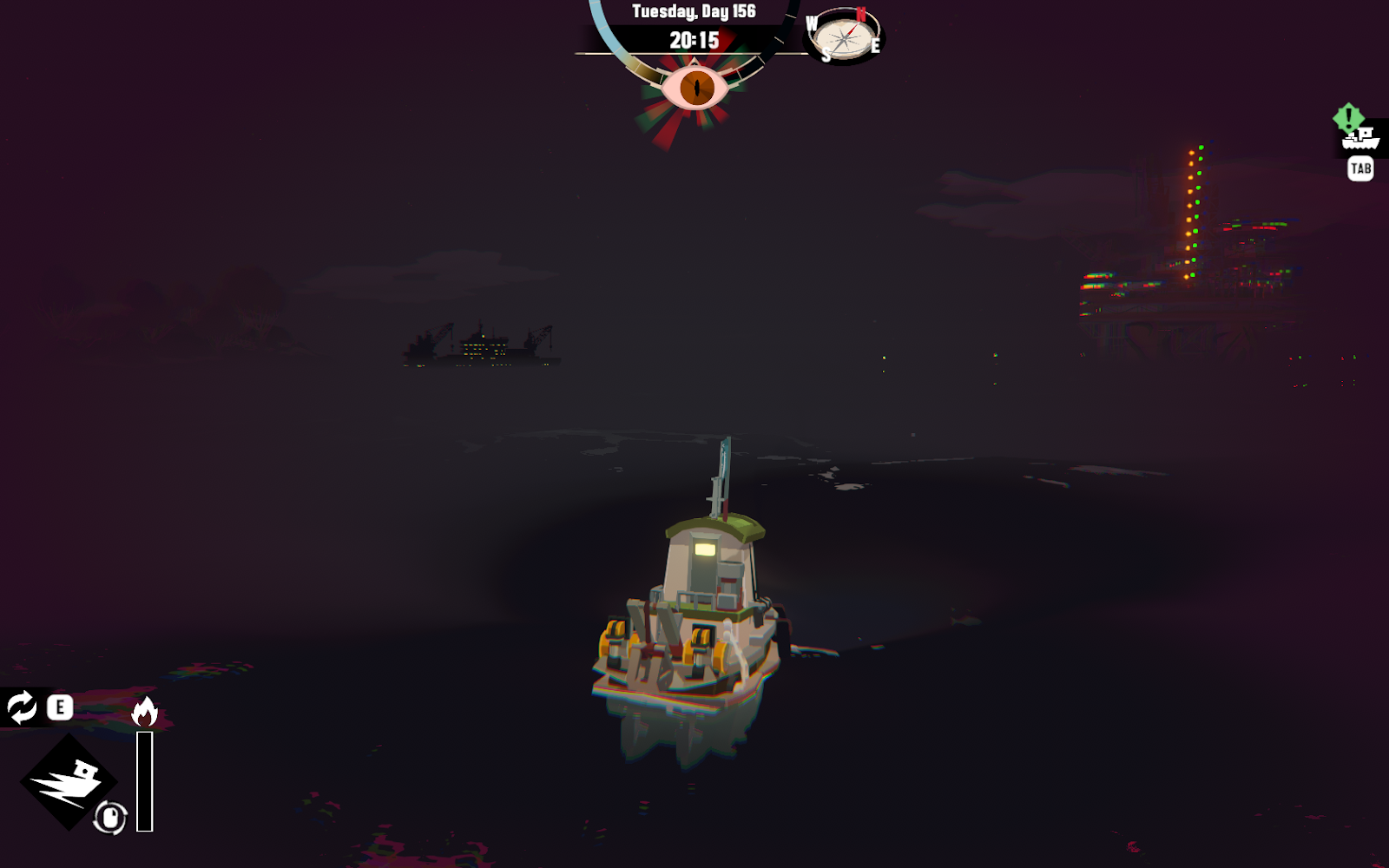
Dredge is a game about personal tragedies with the background of cosmic horrors beyond anyone’s understanding. The tragedies that take place in this strange island paradise are distinctly personal. This all changes with the introduction of an oil rig in the dlc The Iron Rig. The rig itself dominates all around it, at night it almost outshines the lighthouses that used to be your guiding light in the darkest of nights.
The player is tasked with helping to ferry cargo to the rig, as all the companies transport ships have run ashore or otherwise been lost to the depths of the sea. A fact that the foreman is not concerned or surprised by. As you build the rig, more and more upgrades and tactical items become available to the player. The rig’s chief scientist further tasks the player to investigate and take samples from a series of new fish that seemingly appeared after the start of the rigs operations.
The oil rig as the other
The image of the oil rig brings with it notions of exploitation and destruction, of pollution and depletion of the natural resources. Fishermen like that one you are playing are part of those that would have their livelihood threatened by the arrival of an oil rig. Even if there is no oil rig would the disturbance to the seabed as well as the transport ships make your work harder. The Ironhaven Corporation is depicted as a ruthless corporation that cares little for those they hurt in the process. The title of the corporation itself hints at their brutal and cold exterior.
The writing makes it clear that there are those that are with the company, and those that are not. You as the fishermen, are clearly not one of them. Your presence is only tolerated as long as you can be of use to the corporation, and not a second longer.
The rig invades your seas with oil spills and strange mutated fish, but it also invades your nightmares. The ghostly visions of fishing boats and safe harbors are slowly replaced by ghostly cargo ships and phantom oil rigs, tempting you to your death in the deep seas. Mentally and physically the oil rig dominates its surroundings.
They KNOW
The writing makes it clear from the very start that the company is not here to dig for oil. The chief operator casually notes that they have very little capacity to hold whatever it is they are supposed to be digging for, be that oil or minerals. The rig also has a surprisingly large staff of scientists and technicians, the chief scientist in particular seems to have no interest in the operation of oil mining, but a deep fascination with the area’s strange fish.
Your fears are justified with the arrival of the CEO of the company that seems hellbent on keep digging into the seabed, despite numerous attacks on the rig itself. He excitedly claims that “there is just one layer left”. He insists on digging despite the danger to his life and the lives of his crew. It is made clear by the text that the company, whatever they used to be before they went into oil mining, are fully aware of what they might find in your little archipelago.
While the rig is destroyed at the climactic end of the DLC, are the company still out there, the CEO being seen escaping on his helicopter at the final attack. The message is clear, you are no longer alone with the secrets of the deep sea. The outside knows to, and they will return one day.
Final thoughts
The Iron Rig effectively broadens the world of Dredge with a few well developed features and characters. Many of the activities of the rig have direct consequences for your friends in the surrounding fishing towns. The DLC opens the world by having it conveniently assert itself in your very backyard. It manages to hint at a much larger world without needing to make the game world itself much bigger at all. The DLC only has one new location, and it was previously an empty part of the map. The developers have managed to expand the world narratively without making the playable area much larger or complex. The dlc is a good lesson for other game devs, me included, you don’t need to make a new setting for your dlc to make your world feel bigger, you simply need to remind the player that there is a world outside the setting of the game.
Do you like my writing and want to help me write more? Please take a look at my patreon, it has several essays, and would help me create a lot more: https://www.patreon.com/cw/SamRandom13
Books are a fundamental part of the narrative building of the Elder scrolls series, they can often bring context to the greater narratives as well as specific quests. In this essay I will discuss four different quests, two from Oblivion and two from Skyrim. The unifying themes for these quests is that, except for one, they get a lot of context from the lore books surrounding, or being part of the quest
In this way I will discuss the strengths and weaknesses of relying on a player to read a book, and when in the narrative the book becomes available to the player.
Excavations and exploration
The magic institutions of both games have large questlines tied to them, both that eventually will see the player become the leader of said organization. In Skyrim this is the college of Winterhold, while in Oblivion this is the mage guild. Both of these have quests that take place in an excavation of one form or another.
Oblivion’s quest takes place rather late in the quest chain, and is used as a simple way of showing the player a common task of the guild, as well as to give hints of the internal struggles and conflict within the guild. There are some lorebooks and journals tied to the excavation, but it does not drastically change the context or importance of the quest. The quest itself is mostly there to help the player feel more like a member of the guild.
In Skyrim the quest is the first real quest that the players are sent upon, and also ends up being the inciting incident for the entire quest chain. This is already a stark difference from the Oblivion quest, where the dog was shown to be important, but had nothing to do with the war against the worm cult that the questline later became to circle around.
The dig in Skyrim takes place in Saarthal and is presented as a rather mundane task, after all they are letting the first year students take part in this dig, and you are told you are there to “find novel uses of magic”. The player is given the task to find any form of arcane items, finding several rings, as well as a necklace that upon taking, traps the player in a corridor.
This all eventually leads the player to finding the Eye of magnus, an incredibly powerful item that seems to have been forgotten. Everyone in the college of winterhold is shocked by the discovery, and no one seems to be aware of where this item comes from.
This is most likely how the player will react as well, as the player has been given no information about the digsite or its history at this point. This leads me to my second comparison, books, book hunting, and incentivising the player to read.
Hunting for knowledge
Both Skyrim and Oblivion have quests related to acquiring books. The two quests I like to discuss in this essay are the acquisition of the four texts of the Mythic Dawn cult, as well as the Winterhold college text to acquire some stolen books. Both collections of books are related and tied to the quests in mention, but the games take considerably different approaches to how the players acquire, and are incentivised to interact with these books.
In Oblivion the player is tasked with acquiring all four commentaries created by the founder of the Mythic dawn. This leads the player to peruse book shops, talk to book collectors and finally meet with the cult itself to get the final book. The books are given slowly over several stages of the quest. The player needs to acquire these books in order to find the hidden base of the Mythic Dawn cult.
After the player has acquired all books they are tasked to discuss what they have found with a member of the mage guild. The woman will offer to solve the riddle of the books for the player, but will only do so after twentyfour in game hours, as she first encourages the player to try to solve the riddle by themselves. This gives the player some downtime with the books, and may peak their curiosity. While the books themselves are mostly superfluous, it does give the player some interesting insights into the philosophy and goals of the Mythic Dawn.
Compare this with the quests Hitting the books, a quest that sees the player fight a guild of differently minded mages to acquire a series of books regarding the newly found Eye of Magnus. The dungeon is in and of itself an interesting case study, and worth its own essay all on its own. What is relevant to this essay is the way that the players acquire the bespoke books. They are located at the end of the dungeon, in a strange barren room containing only three pedestals, as well as the dungeon’s boss.
The player can choose to leave a prisoner behind to acquire these books as a trade, or fight the final boss for the same reward. The books The Last King of the Ayleids, Fragment: On Artaeum and Night of Tears. The players are told at the offset of the quest that the book may contain some clues on The Eye of Magnus. The players are then directed to return these books to the library, upon which the librarian mentions that the Night of tears has some interesting implications.
The Night of Tears does indeed contain a very direct and obvious explanation that the place the Winterhold College were excavating was indeed holding some arcane item so powerful the Nord inhabitants gave their lives to keep it hidden. The other texts present the player with some more context on the Ayleids as well as the Psijic order. The player gets no further incentive on reading the texts, and as far as I am aware they are never brought up again.
What is notable about the quest Hitting the books, is that actually reading the books, drastically reframes the entire questline. The player is told in the quest dialogue that the dig at Saarthal is routine, safe and simple. Reading the Night of Tears makes it clear that this was never the case, and brings up some unintended implications of either the college’s incompetence, or duplicity. It seems like a stretch to imagine that neither the Arch mage, or one of the faculty in charge of this site did not know about the site they were excavating, especially since the book would be available to them.
Final thoughts
I have presented four quests in this text, two have involved excavations, and two have involved the procurement of books. All are related to acquiring information or performing research in one form or another. I hope to show different ways that lorebooks can be used to further a narrative, and how it can harm it. I would argue that it is vital that the player still gets the vital information they need, regardless of if they read supplementary texts or not.
The commentaries of the Mythic dawn are pushed on the player who is incentivised to carefully read and examine the texts. Even if they do not, the player still has plenty of options to acquire the same information they got from the book elsewhere. In contrast, the books in Hitting the books are never actively pointed out as important until after they are handed over to the quest giver. This is done despite the fact that the book contains vital context to the quest that the player will not find through playing through the questline.
I have also presented two ways that excavations can be used in RPGs, and what different goals their inclusion may have. While Oblivion used its excavation to present the player to mounting dissatisfaction in the Mage guild, Skyrim uses the excavation as a suspense tool to build up to the big inciting incident for the College of Winterhold questline. Both are valid approaches, but will lead to vastly different experiences, and leaves the player with different connections to what they have explored.
I have previously written about the importance of in game stories and nonfiction books in world building and storytelling, especially when it comes to fantasy and sci fi. In this text I wish to go even more granular and discuss a genre that is close to my heart, the essay. Often more loose in form than a report or a paper, essays are great for presenting ideas and concepts in a condensed yet easy to understand format.
Essays often exclude some of the contexts needed to understand the texts if it’s common knowledge. This allows the text to focus more on the topic at hand. This makes essays uniquely suited to give a player tidbits about the world a game is set in, without needing to present a lot of information all at once. Essays allow you to bring small packets of information in a condensed format. It allows the player to put together the information themselves over the length of the game’s narrative.
Essays have a further advantage of having a more personal voice in its writing. This allows you to not only tell stories with the essay itself, but also be able to create a writer of essays. A person that allows for a unique point of view. It is this point of view character that makes the essay such a vital tool of narratives.
The Elder scrolls series is no stranger to in-universe texts, some have gotten physical releases as well. Elder scrolls has several texts that not only discusses parts of the world, but argues for or against certain assumptions of the narrative. For example, the many schools of magic are hotly debated in a number of texts. Necromancy in particular is debated and arguments for and against.
Likewise many historical events of the narrative are discussed in great length. In this text I would like to discuss two such texts in particular. The life of Barenziah and the mystery of the Dwemer. Both are excellent examples on how elder scrolls play with the idea of an objective reality in its narrative.
Dwemer, myths and misinformation
The disappearance of the Dwemer is described as one of the largest mysteries in the narrative of The Elder Scrolls. Their obsession with science, their alien philosophy and of course their sudden disappearance from Nirn all together have fueled discussions both in game and amongst fans. There are many texts discussing and arguing the minutiae of Dwemer, science and beliefs. Some texts like On Dwemer law and the Dwemer series are written as serious scholarly attempts to try and get to the bottom of Dwemer culture, and what impact they have had on Dunmer and Altmer culture.
There is also the series of Ancient Tales of the Dwemer. That presents the Dwemer in a very different light. The Dwemer described in these tables are considerably kinder, more peaceful and overall friendly than the Dwemer that can be found in other texts.
This discrepancy is something the players will find for themselves when devling into the many Dwemer dungeons and facing the many sadistic traps and torture chambers of the old Dwemer holds.
This is a point that the scholar Hasphat Antabolis discusses in his text Dwemer History and Culture. He argues that the tales discussed in the Ancient Tales of the Dwemer are in fact re-packaged folk tales that have been rewritten to be given a certain exotic Dwemer flair.
That the kind and friendly Dwemer became a lot more palatable for the middle class reading rooms. These texts have as a result been spread and read by thousands, and are today still very prominent, despite the fact that they have been thoroughly debunked. The idea of a historical narrative remaining true even after decades of disproving is something that can be found in many places in real life.
The text brings up ideas of how dark and brutal histories and cultures can often be softened and simplified in order to make them more palatable to the general public. This is a wonderful example of how Skyrim uses real life phenomena within history and anthropological research to make its game world feel more complex.
The life of Barenziah and Biography of Barenziah
The controversial character of Barenziah has two texts written about her. One official series of biographies titled Biography of Barenziah paints her as the first and only Dunmer empress and describes the struggles of her life with a kind and borderline naive tone, breathlessly praising her numerous grand qualities. The second unofficial text written by an anonymous scribe titled The Real Barenziah is scandalous, provocative and deeply judgmental with poorly hidden sexism and racism contained through the text. The role of Straw the stable boy is one of the decisive differences.
What is interesting about these texts is the transparent intent of the authors behind both series. One series is describing in short and somewhat dry terms the life of the only Dunmer ruler of the empire. The other is a series of character assassinations and brutal accusations of promiscuity and debasement. Sadly this is a tactic that has, and still is used to discredit many women who have been in power. Furthermore, the first text is written as a simple document that retells major events in Barenziah life, while the second is written like a serialized romance novel, with rich descriptions of events and lengthy dialogues.
The stark difference in the texts presented narrative forces the player to look at this one historical figure from separate points of view. While the text of Skyrim makes it clear in the presentation of the texts which one is the more probable and reliable. It does nonetheless make a clear case that not every text that the player encounters can or should be trusted. Like in real life are all narratives created by a person, a person with a specific worldview, historical background and motivations. Both texts have clear biases, and both have clear goals with their narratives. It is up to the player what parts to believe.
Final thoughts
I like to conclude this essay by discussing another series, Rising threat, a series describing the rise of the Thalmer from an Altmer point of view. It is interesting for several reasons, one of them being the only purely Altmer narrative in the game, as well as for giving well needed context to the rise of the organization. This series explains how the Thalmer monopolized the sudden end to the Oblivion crisis, and claimed that they were the true heroes of the calamity.
Despite this falsehood eventually being disproven, has it nonetheless become a truism within the history of the Altmer. Furthermore, the texts are interesting for the disclaimer made by Praxis Erratuim that warns the reader not to take some of the more fanciful speculations of the texts all too seriously. Like with the Anecdotes of the Dwemer this text presents the idea that history is sometimes not created by the most reliable facts, but by the most prevailing of narratives.
My goal with this text is to present my reader with a few examples in how ambiguity and contradictions can be used to deepen a narrative and make a fictional world feel more complex, more nuanced and more alive. I would also like to argue for the use of books and journals for the furtherance of narratives and lore that would be unwieldy to present in direct or ambient dialogues.With all this said, this kind of narrative presentation has some serious shortfalls. The chief being that the player needs to first find, and then read the text to get the information needed. I will discuss a few of these pitfalls in a future Skyrim essay: Books and magical excavations.





 An Unused Frequency