Writing update

So, funny story. I have several papers cooking, but none of them are finished for today! One, almost was. But would make no sense without the other. So here’s a little rundown of upcoming topics!

Gwylim notes on Skyrim: health potions and visual shorthand

This is the next part of my Skyrim series, it needs some more research done, and I need to take some reference photos before it’s ready but the base is there.

The potion bottle is a staple of the fantasy game genre, and can be found in most every game of the genre, from Dark souls to legend of Zelda. In Skyrim are the potions easily labeled and color coded to the stat that they refill, green for stamina, blue for mana and red for health. What I wish to discuss in this text is their prominence in the game world.

Health potions can be bought by vendors for sure, but can also be found in caverns, dungeons and most interestingly, inside people’s homes. While this makes sense from a gameplay sense, it does lead to some interesting narrative consequences. At some points are you able to hand these magical potions to an npc, that indeed does get better. Others you are forced to leave to their death. It is worth noting that Elder Scrolls Online is much more guilty of this crime than Skyrim.

Gwylim notes on Skyrim: Books and magical excavations

This will be a continuation of my exploration of books and their use in narrative building in Skyrim and Oblivion. I want to lay a fair bit of groundwork before I post this one. There is a fair bit of research to do for this, and the other essays in the series.
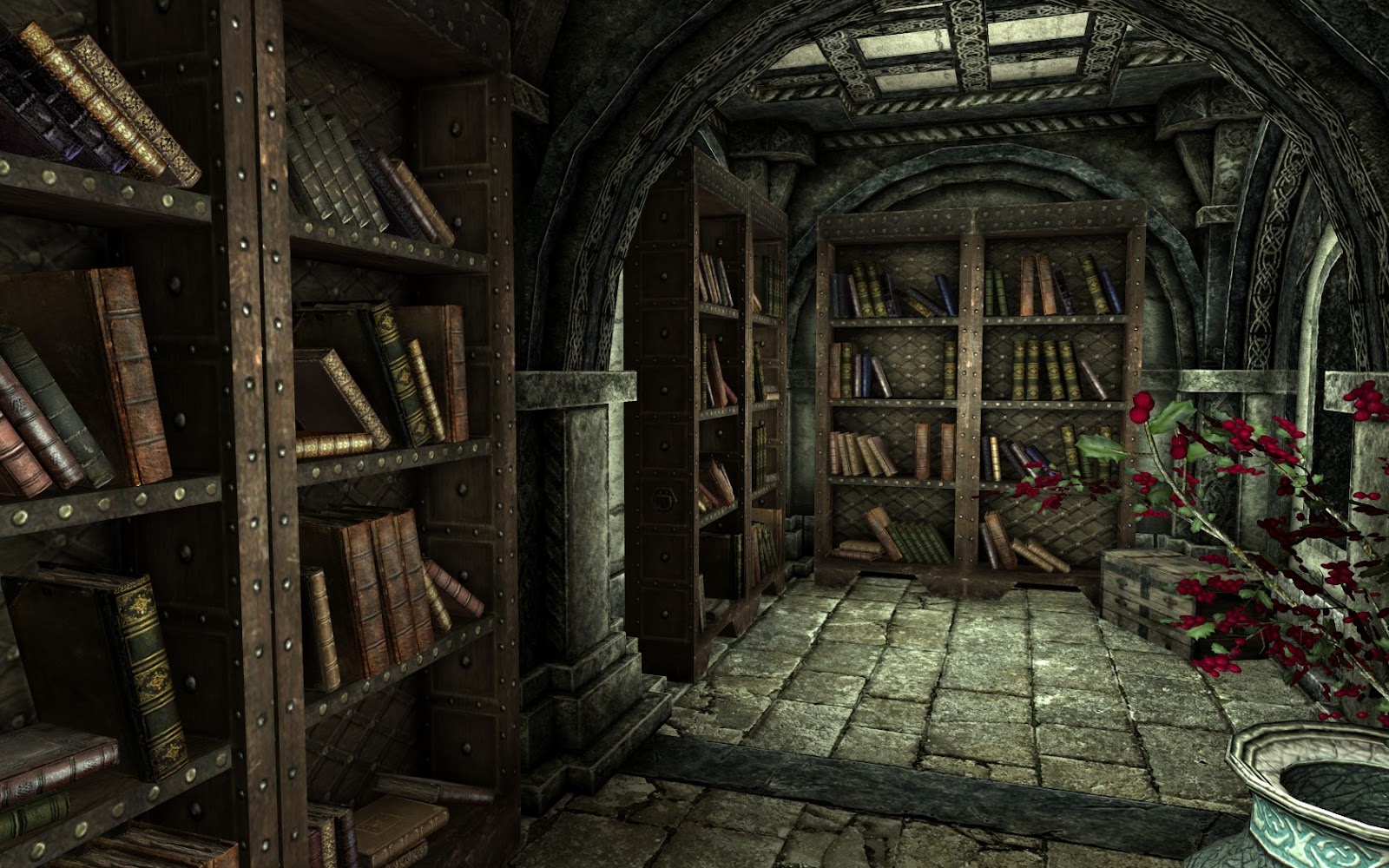
Books are a fundamental part of the narrative building of the Elder scrolls series, they can often bring context to the greater narratives as well as specific quests. In this essay I will discuss four different quests, two from Oblivion and two From Skyrim.  The unifying themes for these quests is that, except for one, they get a lot of context from the lore books surrounding, or being part of the quest.

In this way I will discuss the strengths and weaknesses of relying on a player to read a book, and when in the narrative the book becomes available to the player.

Warhammer essay: Wild creativity and measured preservation

I have slowly been working on more Warhammer essays, but currently are the Skyrim essays taking precedence. I need to get my hands on a few lore books first if I want to be able to discuss Warhammer properly again, as a lot of the texts I have are either too old, or too new for what I want to write about.

Warhammer fantasy as well as warhammer 40k has an interesting relationship to the concept of creativity, knowledge and the art of creation. There are two opposing forces that are present in much of the texts. These are of innovation and of tradition, as well as carelessness and caution.

Each faction lands somewhere between these parameters, and a lot of the faction’s philosophy, morals and history can be gleaned from these traditions. There are some ideas that returns again and again. Tradition often comes with stagnation and loss of generational knowledge. On the other side is carefree innovation leading to explosive results. I will present a few examples of these themes in this essay, but they are by my way exhaustive.

Umvelon: City of magic

I have been writing a lot on a lore supplement for my homebrew setting Landhurst. I have posted a bit of this project on my patreon, so if this sounds like something that is interesting to you, you can find more information there. I want to present the introductory text here, to give my readers an idea of what I have been working on.

Introduction

Umvelon is Landhurst’s third largest city, and the second largest centre for education in the entire nation.  It is most importantly the undisputed centre for arcane education, research and regulation. The seemingly ancient city is in fact one of the younger cities in the nation’s history.

After the Elven defeat did the nascent mage guilds take the arcana rich site to be their centre of learning and research. From the humble campus on top of a ruined Elven metropolis did the mighty city of today take shape. Spreading ever downwards towards the muddy waters of the surrounding swamplands that keeps the city isolated from the mainland.

Magic education and bureaucracy.

Umvelon is the seat for higher arcane learning, and the only place where one can learn the many trades that require a full time commitment, such as battle mage, alchemist or healer. While the rest of the nation have rudimentary research and safety training for proper arcane use is it only in Umvelon that one can become a full fledged member of the mage guilds.

Furthermore the city is the centre for the governing body of the mage guilds. It is from here that arcane disasts, corruption and other dangers are investigated and rooted out. The dreaded Mage hunters, the personal juridical wing of the mage guilds also have their headquarters in the city, brazenly displaying their clandestine operations in broad daylight.

Patrons of art and education

Besides the arcane colleges there are several smaller academic institutions present in the city, not least of them the Librarians and archival collage, as well as the academies for History and the liberal arts. These campuses can be found all across the city, but everyone boasts at least one lecture hall on the coveted Campus hill in the fourth ring of the city.

Beyond the official institutions is the city sprawling with museums, bookstores and coffee shops that hold unplanned lectures and readings for anyone interested. Most of these institutions are free for citizens and are paid for by the many rich trade families that have made the city their home. A grand payment to one or more of the educational institutions of the city not only garners good will with the citizens, but also gives them rather generous tax cuts from the city’s mayor and mayoral staff.

Arcane trade

Umvelon is the centre of all arcane trade in Landhurst, and all arcane items are either made here, or made by someone who has been educated here. The guilds keep a close eye on all wares of an arcane nature that moves through the nation’s many waterways. Close, but not so close that smuggling and bribery is not permitted, solely to make sure that research and production runs smoothly ofcourse.

Arcane artifact

While many of the bulk products such as magically enchanted ammunition, scrolls, crystals and potions are made in large warehouses elsewhere, the city is still full of production. It is unsurprisingly full with the kind of production that will not disturb a college professor’s mid day nap with its noise, or the kind of smell that makes a high society lady reach for her perfumed handkerchief.

Gwylim notes on Skyrim: The joys and frustrations of in game book hunting

I am sure that many of my readers have had the joy of finding a specific book in an obscure bookshop or lurking in a digital archive somewhere. The frustration when you are missing but one text in your collection, the unwillingness to start a project before you know that you are all the texts you need to start. I admit that this is not a problem that many people have, but I am sure that at least some of my readers can empathise with my plight!

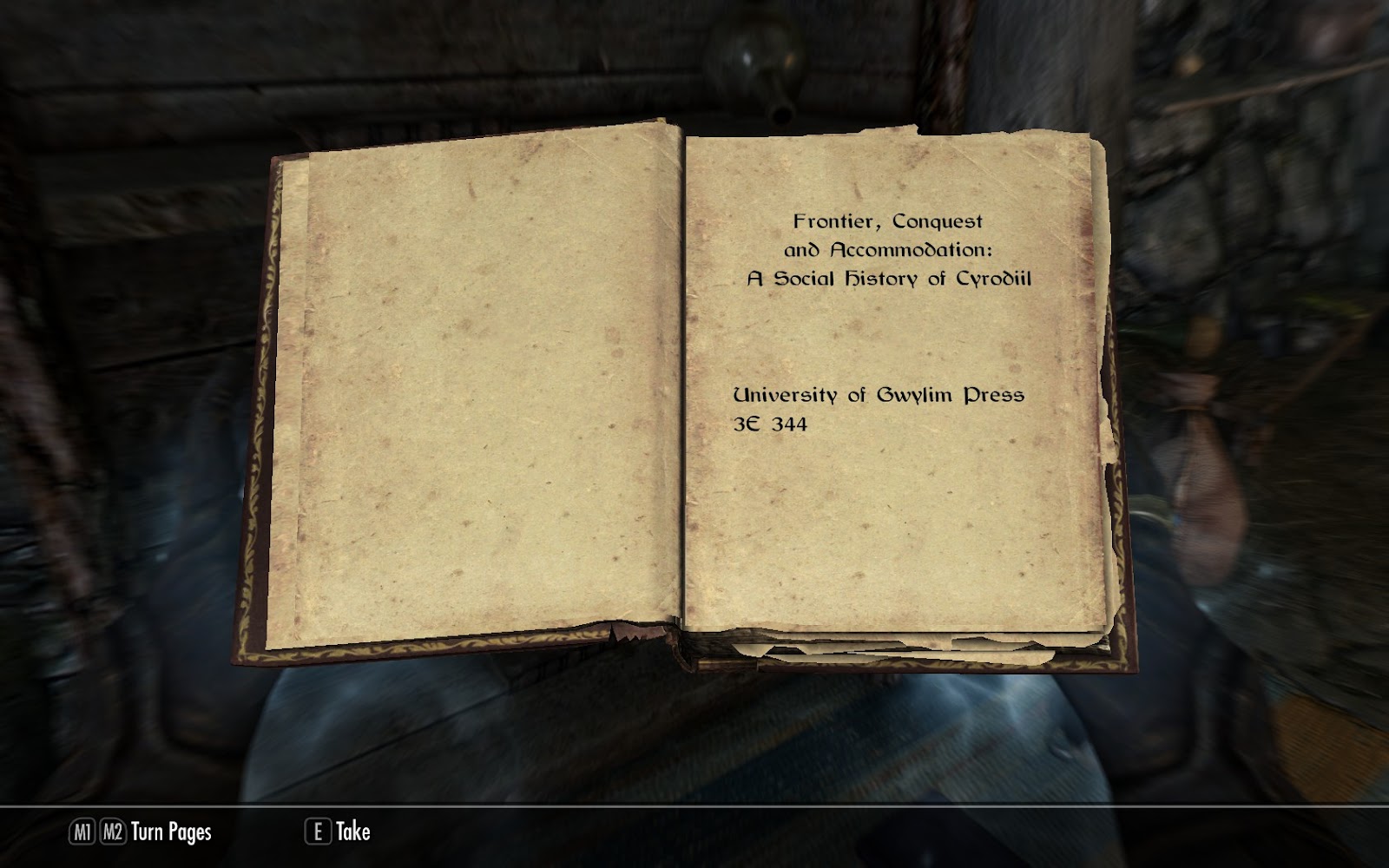
A book from Skyrim in the reading view of the game.

I have had a similar experience in skyrim recently. I have discussed the wealth of reading that can be found in the elder scrolls series many times. There are novels, poems, essays and unhinged ramblings to be found in all of the main games. In many of these games there also exist book sellers in where to easily and effectively acquire this reading materials, as well as libraries aplenty.

Skyrim is different in this regard, as it is the general store sellers that sells but a paltry few books. The only libraries available to the players are also located at either the seats of power, or at Skyrims two seats of learning, the bards college and the College of Winterhold, the primary location to learn the arcane arts.

The second of the two colleges have an especially stringent and suspicious librarian. Due to his dour nature, or due to a lack in coding, can you in fact Not borrow books from this library, though he does sell some of the texts he stores there. Due to a quirk in the book shelves in the Winterhold library can you only read the majority of the books if you steal them from the shelves, as they are not located in the regulair open style bookcases.

There are on the other hand other ways to acquire reading material in Skyrim. First and foremost does the otherwise uninterested populus of Skyrim own a fair few books themselves, as at least two or three can be found in each household. Likewise does it seem that everyone from blood crazed necromancers to cut throat bandits have a bend for reading. As a result the dungeons are populated by sentient races often surprisingly full of books, journals, scrolls and other reading material.

Many of these seemingly brutal and bullheaded robbers seem to have an interest in obscure history and advanced magical theories. As it is more common to find a thesis on Mysticism next to a bandit bed, then it is to find something salacious like The Lusty Argonian Maid.

This means that the best way to expand your library is to either delve into a dungeon, or go thieving in the neighborhood. I want to make the argument Skyrim has moved away from the cities being as much of a hub as they were in Oblivion and Morrowind. The wilderness and the quests and adventures that take place in the wilderness between the cities, has taken over much of the time spent in the cities, especially Oblivion. In the earlier games most quest givers lived in the cities, as well as large part of the quests themselves taking place in, or near cities.

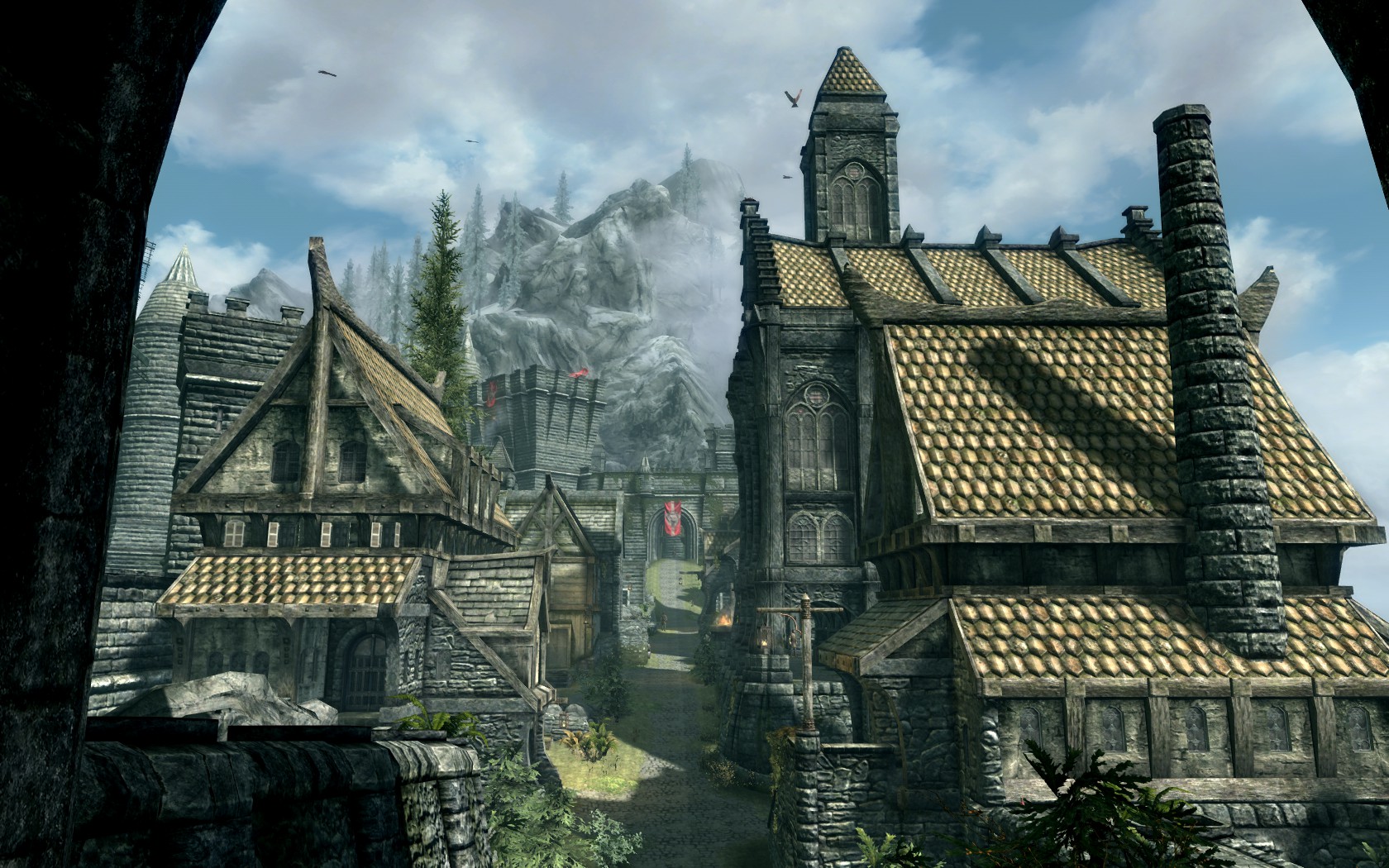
An in game view of the city of Solitude from the game Elder Scrills: Skyrim

As a result would it make sense that much of the amenities that the player needed, weapons, potions, books and other gear would be available to them in the cities. Likewise does the specialized stores help create a sense of urban life in both Morrowind and Oblivion that I believe is deliberately absent from Skyrim.

It makes sense for the seat of the mage guild to have a dedicated staff shop for example. Likewise would it make sense for Vvardenfell capital with its many educational and administrative centres to have a well stocked bookstore available. These shape the narrative of the world itself.

Skyrim is a much more rugged place, but also a different game. Many quest givers meet the player on the road, or in small villages, and when they are located in the cities do they more often than not direct the player to a cave in the wilderness. The courier is another mechanic that delivers quests to the players with the constant letters and requests. Specialized stores that only accepts certain kinds of loot would slow down the game loop of:

Visit town, get quest.
Visit wildernets, finish quest and get loot.
Visit town, sell loot, repeat.

A book from Skyrim in the reading view of the game.

All of this gives the gameplay a much more mobile feeling to its gameplay. I would argue that the lack of specialist stores have also had an effect on this. You are less likely to spend time in a town when every single town offers the same, smithy, general store and alchemist as the next.

All these design choices make Skyrim feel differently from their predecessors. You explore and interact with it in different time scales and relate to space in different ways. The way you interact with the hour to hour gameplay is subtly different in many small ways. For example how the player interacts and considers the loot from dungeons and quests.

As a result is it only natural that you would need to interact with the lore book in different ways. While I do miss The First Edition from Oblivion very much, I must admit that a bookstore in Skyrim would not fit into the differently phased and organized gameplay that the game works around.

Warhammer exploratory essay: Who gets to be human

Introduction

I have alluded to the idea of personhood in earlier chapters, but in this text I will discuss it in more clear terms. All the playable factions are humanoid in one way or another. The non-human factions are either adjacent to humans like Elves or dwarves, or they are more inhuman like Lizardmen, Skaven and Goblins. All of them have humanoid characteristics and keep some sort of human culture.

What became clear when I started researching this topic is just how human centric the Old World is. Humans as humans, exist in Europe, Africa and Asia, with clear, if often tokenized versions of their real life counterparts cultures. There are humans in fantasy Arabia, even the undead of the setting version of Egypt are still decidedly human, despite their undead appearance. It is this prevalence of humans and human adjacent races like Elves that makes the less than human races stand out so much more.

The humanized

The humanised creatures are those that are clearly based on a real human culture, and also has humanizing features. Here you can find the Dwarves, and the Elves, both are staple of the fantasy genre when the setting was made, as they still are today. THe dwarves are proud and the Elves are arrogant, both see themselves as better than the short lived humans. Wood Elves are likewise seen as more wild but yet arrogant and in many ways superior to humans in most ways.

The lizardmen live in the south of the Old Worlds version of Africa, as well as the southern version of South america. The aesthetic of the Lizard men are hard to miss, living in large stone cities with grand temples to golden serpent gods, gods that require living sacrifices in large numbers. While still a sympathetic depiction, there are still some connotations to certain conspiracy theories that makes them a bit uncomfortable to consider. As part of being reptilian are to varying degrees been described as unemotional and mechanical, going from almost pure automata at their inception, to the strange and otherworldly, but yet fully sentient creatures in the later editions.

The second example of the use of human cultures for nonhuman creatures is less easy to explain away. The Ogres, the hungry, dumb and brutal race of giant humans, are both located where real life Mongolia is, as well as sharing some physical features and stereotypes of Mongolian men.

With thick eyebrows and rather characteristic mustaches, their connection to gluttony, violence and stupidity is a rather unfortunate one to say the least. But with this said, are they still considered moral in one way or another, and are often seen as neutral, if not good. Vampires and undead, are likewise seen as monsters but are still human when it comes down to it. This is in rather starch contrast to some of the other humanoid factions in the setting.

The inhuman

There are two factions that I wish to discuss when it comes to dehumanised, or monstrous versions of humans in the Warhammer fantasy universe, first of them are the Orks and Goblins, playing much the same role that they do in dungeons and dragons and similar fictions of the time. They are violent and aggressive, and live only for combat. They are the stereotype of a villain. They soely exist to fight, destroy and eat, but unlike their ogre counterparts do they have very few humanizing features, or seen as capable of any good. THis pigheaded and absurd evil is often played as a sort of comic relief, playing off the improbability of their civilizations to begin with.

Orks are strong, resilitand and sprout out of the ground, being grown from fungi.They have absolute faith in all that they do and can never be persuaded to leave their path of destruction for one simple reason, they are finding it all too fun. Goblins are ted tibet as the menial cast of the faction, working, carrying, farming and building, though the quality of these efforts are often described as subpar at best. They also trade and barter, giving the faciton their only hire non violent connection with the other factions.

The second faction to discuss is the Skaven, a fascinating society of half ratmen, that lives under the cities of all the world’s major factions and civilizations. The Skaven are depicted as man’s worst qualities, selfish, greedy and ambitious, each Skaven lives only for themselves, and will not hesitate for a second to sacrifice another of their kind if it meant gaining an upper hand in their competitive and cut throat society.

While some are vaguely human in their organisation and culture, are they not as closely tied to a certain culture or nationality. Both the Orks and the Skaven are clearly meant to be parodies or exaggerated versions of some of humans’ worst sides, and vices. Even more so then the followers are chaos are these races often used as dark or warped mirrors of humanity. Orcs are aggressive and ambitious in the extreme, while Skaven are greedy and cowardly in the extreme.

Conclusions

The question of who gets to be human and who doesn’t is not a question that is unique to warhammer, but is one that tends to turn up in many high fantasy settings. For example does the Elder scrolls make a clear distinction between, elves, humans and “the bestial races” of orcs, argonians and khajiit. The concept of having other or near human races is not a problem in and of itself.

It is a great way to add some variety and texture to the world. Likewise is it not a problem in itself to base these races on specific human cultures, Elder Scrolls argonians for example shares their mesoamerican inspiration with the Lizardmen of Warhammer fantasy. Problems can arise when certain races are tied to both a specific culture and a specific negative trope tied to that culture. For example the brainded hunger of the Ogres, or the cold and alien Lizardmen.

Furthermore can a non human race become rather flat and simplistic if it is only allowed to have one cultural expression. This is especially apparent, if like in the elder scrolls series, there are several human cultures but only one Argonian culture. The Warhammer examples are very good at making a varied and complex set of cultures, even amongst the more comedic races. There is a large difference between the plague worshipers of Clan Pestilence and the quirky engineers of Clan Skryre. Despite this do the races as whole have a uniforming feel and cohesion that makes them easily recognized.

The tokenization and alienation of real cultures is not a problem unique to Warhammer, but can be seen across many series and settings. The Kajiit of the Elder scrolls used to talk, and to some degree do in a stereotypical Romani coded voice, and are also depicted as being semi nomadic, and known for thievery. To take another example, the goblins in Harry Potter are only seen working in banks- They are long nosed, greedy and untrustworthy, a sadly still all too common anti semitic trope in fantasy.

It is only through nothing but biases and assumptions in writing that we can become better writers. If we wish to aim to write a more true and inclusive fantasy world, must we first explore what inspiration we draw from real life and why. That is why it is vital to listen to voices different from your own. I am not innocent of this as well, there are many times I have had to step back from my writing and re-evaluate, when I am getting too close to tokenizing or orientalising a culture or race in my writing. Tokens and stereotypes are powerful because they are easy to recognize to a reader, and a useful shorthand as a writer. This makes it even more important that we use them with respect and caution.

Worldbuilding and context: the existential questions of Pixar films

Introduction

When creating a narrative, it is up to the author to make the world around the text itself. When it comes to real world stories is this a relatively straightforward task. The references exist to draw upon, and more importantly, there are already rules that the reader will understand. The more removed from this common ground, the more the text needs to explain how it works.

There is an interesting problem in writing, and movie making, where you have a set a specific time to explain how a narrative works, and how the fictional setting works. The more time spent on making a setting work, the less time you can spend on the narrative itself, but without explaining the narrative the story might not work as well. 

The less you explain the more holes are allowed to be filled in the text. There is less of a narrative background, and it is more difficult to explain and understand the text when thought about outside of the premise. The more the text is set in a world that is dissimilar to our own, the more things need to be explained, and the more space must be given for the audience to get used to how the world and narrative works.

Pixar movies

Pixar, the branch of Disney has made a large number of amazing 3D animations and narratives over the years, and are very much pioneers in the field. Their stories are heartfelt, complex and often focus on family, friendship and loyalty. Very much following the stories of older Disney filmed. The pixar films are often very good at putting effective visuals to the narrative they are presenting. often is the fact that most, if not all their main characters in the early movies are not human. This allows them to discuss hard questions via proxy- By using humanised robots, toys or cars can you tell stories of death, growing up and loss without having explicitly tying them to humans. THere also let’s be honest, it’s a lot easier to monetize.

 With that said, does many of their earlier films have things and settings that are very abstract, and can be downright strange if they are set under too much consideration. This is not a fault of these films, and not a criticism of the art, but rather an interesting analysis of how different stories are told,and what consequences the choices as well as restrictions are set on to a film.

A bug’s life: gender and sex in the insect world

A bug’s life is an interesting little film, and a grand example of early 3d. It is a classic pop cultural exploration of the time. One fascinating thing that seems to plague every animated film about swarming insects, is the concept of gender. In both bugs life, ants and in the bee movie are the main character, the downtrodden worker, a man, while all colones in reality are made out of almost exclusively women.

Cars: classism and racism

Cars is one of the most abstract films that the studio has made, while being the most straightforward on the surface. On a narrative level it is a simple tale of a popup superstar learning the joy of the little things, and the slow life. It is also a love letter to a certain american small town that may or may not have ever existed. It is nostalgic and feels like a good lesson in a simple but enjoyable tale.

The largest consist and the gimmick of the tale is the fact that every character is some sort of car or other kind of vehicle. There seems to be no humans in the setting, and they are never mentioned. With that said, do we later learn that cars are constructed, and it seems that most are made for a specific role in mind. Lighting Mcqueen is a race car so he races, his semi truck driver is made to transport cars, so he transports Lighting Mqueen.

There are some cars shown to not have a clear role to serve, and one school bus is working as a wrestler, or the car related version of wrestling. The general public seems to be made out of personal cars with no job related to them. In the later movies it is introduced that there are new models of cars being made and built explicitly. Before it was implicit since there are older and newer models of cars, especially in the racing circuit where old models are being retired for the newer faster cars to take their place.

Toy story: Rules with no consequences, eternal servitude

There is a rule in the toy story universe where the toys must never be seen to be alive by humans. This is clearly a reference to the raggedy ann movies where the toys die if the humans see a toy moving, that toy dies. This is initially set up as somewhat of a rule in the first movie, until the climactic finale where the toy tortures a struggling depressed from a poor family for the crime of taking out his aggression on inanimate objects. There can be argued that the scare helped ZId, as his behavior could be seen as early 

Later it is proven that the toys are not aware originally that they are toys and indeed believe that they are the person they are emptying. Making the rules about not being seen even more strange. In the third movie the implications of being a toe is being seen as a toy, ergo the craft comes to life. A concept that deepens the rabbit hole even further.

The rules are expanded and changed between the movies and does not entirely keep to the same internal logic. Something that is understandable since the goal is not to make a deep deconstruction on how toys work in the universe, but rather themes of growing up and family and aging.

Conclusions

Note that none of these critiques are meant to be critical of the texts, but rather how texts can be formed and presented when the goal is not to make a cohesive world but rather to present morals and a sense of a narrative. The early pixar movies are not meant to be deconstructed in this way. They are meant to present tales and lessons to kids, and in this way they are highly effective.

I write this text as a fun way to discuss and think about narratives, and the implications of what sections in storytelling can lead to. A way of peeling back the curtains and looking behind the walls of narrative writing. There are always limits for what you can tell in a story, there are boundaries for when a story starts and where it ends. You must choose what to tell and what to be left implied. The more fantastical a tale, the more things need to either be explained or left unsaid. For every sentence you lay on explaining a world or a narrative, is a sentence you can not use to drive the narrative forward.

This is why some fantasies can often either feel like they are giving you a lecture, or leaving you in the dark on how the world works. It is a delicate balance to tread, one that I myself struggle with a lot. 

The wonder with analysing texts is that it will inevitably tell you something about yourself in the process. Just like telling a story, is there a limit for how much you can say in one analysis before it gets too long, too complex and granular. In this text I have focused on the holes in the canvas of a tale, the places where the set stops. I have done this because it inevitably opens a lot of room for imagination and contemplation. 

I can not tell why these decisions were made, only that they were, and that me and many others have noticed them in one way or another.  everything we write and not write into a text will have a reaction from the  reader. the reader will understand it in one way or another. That is the joy of storytelling, you never have the entire picture, a story is always created in collaboration with the reader.

Warhammer exploratory essay: Old Worlds and new

Introduction

Warhammer fantasy has existed for decades in one form or another. What started as a roleplaying game with models and rather simple and generic fantasy settings has transformed and morphed with time into something very unique indeed. In a series this old, and with so many creative voices is it inevitable that changes happen. It is these changes that I am interested in, what changed and what have stayed the same.  

The Warhammer fantasy franchise has recently taken the stance of having it both ways. Keeping the old and making the new. This is a rather strong contrast to how the company looked at Warhammer Fantasy when Age of Sigmar was first released, where more of a scorched earth approach was implemented. This was true both in the product line, where many options disappeared, as well as in the universe where the old world was literally and metaphorically destroyed.

This has had several explanations, ranging from a need to unify the narrative and to make sure that Games Workshop owns the copyright to all their model lines. This has historically been a problem as the warhammer franchise has involved a lot of generic fantasy terms like Orcs and Elves.

Similar changes have been done by several other franchises, for example did DC comics wildly simplify their extended universe in their series Crisis on Infinite Earths. Disney after acquiring the rights to Star Wars also drastically changed what texts were considered to be in the official canon, and what texts were considered to be in the Legends canon. In the narrative are the legends texts supposedly tall tales. In a meta sense is this a clear delineation of what is considered to be part of the marketable and saleable part of the franchises, and what will continue to be supported.

In this series I will return to my roots and analyse a series of texts given out by games workshop. Rather than making another breakdown will I this time focus on themes and settings as well as to try and set the series in a wider concept of fantasy and mythology. There are two distinct iterations of warhammer fantasy, and I aim to explore both of them in my series going forward. 

Age of Sigmar

First is the Age of Sigmar series, the largest departure from the classic elves and dwarfs fantasy of the past, with a clear cut from the past and making something that is wholly unique to the franchise. The magic is more abstract and the factions more extreme, the world is sundered and reality is warped. The setting is now made explicitly with the idea of marketability and copyright in mind. Creatures like Orks are now called Oruks, and a lot more care and time has taken in making sure that the races, nations and species present in Age of Sigmar are nor solely copies of other fantasy tropes, or asd was often the case in WF, a blatant copy or simplification of a real life culture.

The world if AoS is made out of realms, all that have their own rules and are governed by special kinds of magic. In order to travel between the realms one must use special gateways or risk the perils of the warp. This is as a result of the catastrophic disaster that sundered the old world into pieces. It is interesting to note that there once was a grand scale campaign played through hundreds of official matches of warhammer fantasy to decide the fate of the word world. IN that game the good side won and the world stayed intact.

The setting has indeed done a lot to reinvent the setting, and a lot of genre bending writing has come from the setting. To understand the genre defining changes and their implications must the reader first understand where the genre comes from.

The Old World

In order to give this context I will also analyse and discuss the Old World franchise. The Old World series is a return to the old and more traditional setting of the franchise. WHere humans lived in either an exaggerated version of France or an even more exaggerated version of the Holy Roman empire. The empire is a land of olympus humans and poor and desperate peasants. It is a land of innovation and superstition. A place where you are just as likely to meet a town witch or seer as you are to meet a powerful steampowered tank. Bretonnia is likewise a land of grand contrasts, being primarily a parody of the glorification of the noble times of swords and dragons  described in myths like the war of the roses and the Arthurian myths. In fact despite the fact that Beroettonia is clearly set in France, or brettony is the setting itself heavily inspired by the arthurian myth, down to the lady of the lake and the grand templars of the round table.

Dwarves and Elves are both present in the OW and share a lot of appearance with their Tolkien counterparts. Two things are distinctly different, the first is that they both have a distinct satirical side to them. The Dwarves are petty, long sighted and rather boring, the ELves are apathetic, selfish and condescending to everyone else. 

The OW is inhabited by many strange and magical creatures, primary of them are the Ogres, Orcs, goblins and lizardmen. The Orcs and goblins primarily keep their role as general antagonists and destroyers that can be found both in classic mythology and in contemporary fantasy, their big twist being that they are part fungi, and grow out of fungal patches. 

The Ogres are located geographically in what would be real life Mongolia, and are described as dumb, greedy and gluttonous. A description that is not made with the fact that the earlier Ogres was often described as having thick eyebrows and distinct pointy mustache.

The Old World title is a reference both to the fact that the series is set in the old Warhammer setting that was destroyed in the Age of Sigman franchise, as well as the fact that Europe in the old Warhammer setting was called The Old world. This old world is a clear and apparent translation of Europe, and much of the warhammer world is set in an allegory to the real world, with mixed results. 

Final thoughts

I will discuss both these series in the light of what was once called Warhammer Fantasy. In order to make it easier to differentiate will I dub Age of Sigmar AoS the old world OW and the original warhammer fantasy WF. Warhammer fantasy has in and of itself gone through a large number of iterations, one of the more interesting changes being a distinction from its Tolkien inspired roots, as well as a larger focus on humor and satire.

There is a clear theme of political and social commentary and comedy in the many factions of WF, especially the humans are more often than not painted in a comedically pathetic and backwards way, strongly contrasting the actual often uncultured and simple ways of even the highest of nobles with the grand and culture image that the nations like to present themselves as. There are these differences and similarities that I aim to analyze in this series. I will begin with analyzing and discussing how humanity is described in ToW followed by AoS, finishing with a  discussion on who gets to be human, and who gets to be a monster.